Energy in Chemical Reactions — Practice · Grade 11 Science
Chapter: Chemical Energy & ThermodynamicsWhat this practice covers
By the end of Energy in Chemical Reactions you should be able to:
- I can classify a reaction as endothermic or exothermic from its energy flow, temperature change, and the sign of ΔH.
- I can read a potential-energy diagram to identify the reactants, products, activation energy, and enthalpy change.
- I can use q = mcΔT to calculate the heat absorbed or released when a substance changes temperature.
10 questions, multiple choice, numeric and written answer, each with a worked explanation.
Vocabulary used: enthalpy change (ΔH), exothermic reaction, endothermic reaction, bond energy, activation energy (Ea), specific heat (c).
Problem 1
- negative
- positive
- always zero
- impossible to determine
Answer and explanation
positive
An endothermic reaction absorbs energy into the system, so ΔH is positive.
Problem 2
Answer and explanation
4180 J
ΔT = 35.0 − 15.0 = 20.0°C, so q = mcΔT = 50 × 4.18 × 20 = 4180 J.
Problem 3
- the two dashed helper lines
- the reactants and the products
- the reactants and the peak (the activated complex)
- the products and the x-axis
Answer and explanation
the reactants and the peak (the activated complex)
Activation energy is the height of the peak above the reactant energy level — the energy barrier the reaction must climb.
Problem 4
Answer and explanation
Under the stated assumptions, the reaction absorbs heat from the solution, so it is endothermic and ΔH is positive. A temperature fall without these conditions would not uniquely prove reaction enthalpy; other energy transfers or processes could contribute.
Problem 5
Answer and explanation
15 °C
Rearranging q = mcΔT gives ΔT = q ÷ (m × c) = 6270 ÷ (100 × 4.18) = 6270 ÷ 418 = 15°C.
Problem 6
Hints
Do not omit the reaction-amount basis when scaling.
Answer and explanation
−100 kJ under identical conditions.
Problem 7
Hints
State what the supplied observations or conditions establish, and separate that from any assumption.
Answer and explanation
Net reaction energy balances input to break bonds against release from forming new bonds; breaking alone is not the energy source.
Problem 8
Answer and explanation
It reverses the physical energy change without reversing the account’s sign; the corresponding B→A enthalpy is +40 kJ for the displayed basis.
Enthalpy is a state function, and a thermochemical reaction change is associated with a defined transformation and amount basis. Multiplying every coefficient scales the enthalpy change by the same factor; reversing the reaction reverses its sign. A number labeled kJ/mol must specify mol of what—product, reactant or reaction extent. Phase labels also matter because liquid and vapor have different enthalpy states. Keep these details when using a reference value in stoichiometry.
It reverses the physical energy change without reversing the account’s sign; the corresponding B→A enthalpy is +40 kJ for the displayed basis.
Response criteria
- Interpret labels, structures, axes, units and directions correctly.
- Explain the chemistry relationship or mechanism.
- Respect stated assumptions and distinguish observation from inference.
Problem 9
Answer and explanation
ΔH≈720−880=−160 kJ for the selected equation amount. Doubling all coefficients gives approximately −320 kJ. Average bond energies are an approximate full-reaction estimate, not proof about spontaneity or rate.
ΔH≈720−880=−160 kJ for the selected equation amount. Doubling all coefficients gives approximately −320 kJ. Average bond energies are an approximate full-reaction estimate, not proof about spontaneity or rate.
Response criteria
- Use the stated measurements or conditions, with correct units.
- Connect the result to the chemical mechanism or evidence relationship.
- Identify the assumption, model limit or further evidence requested.
Problem 10
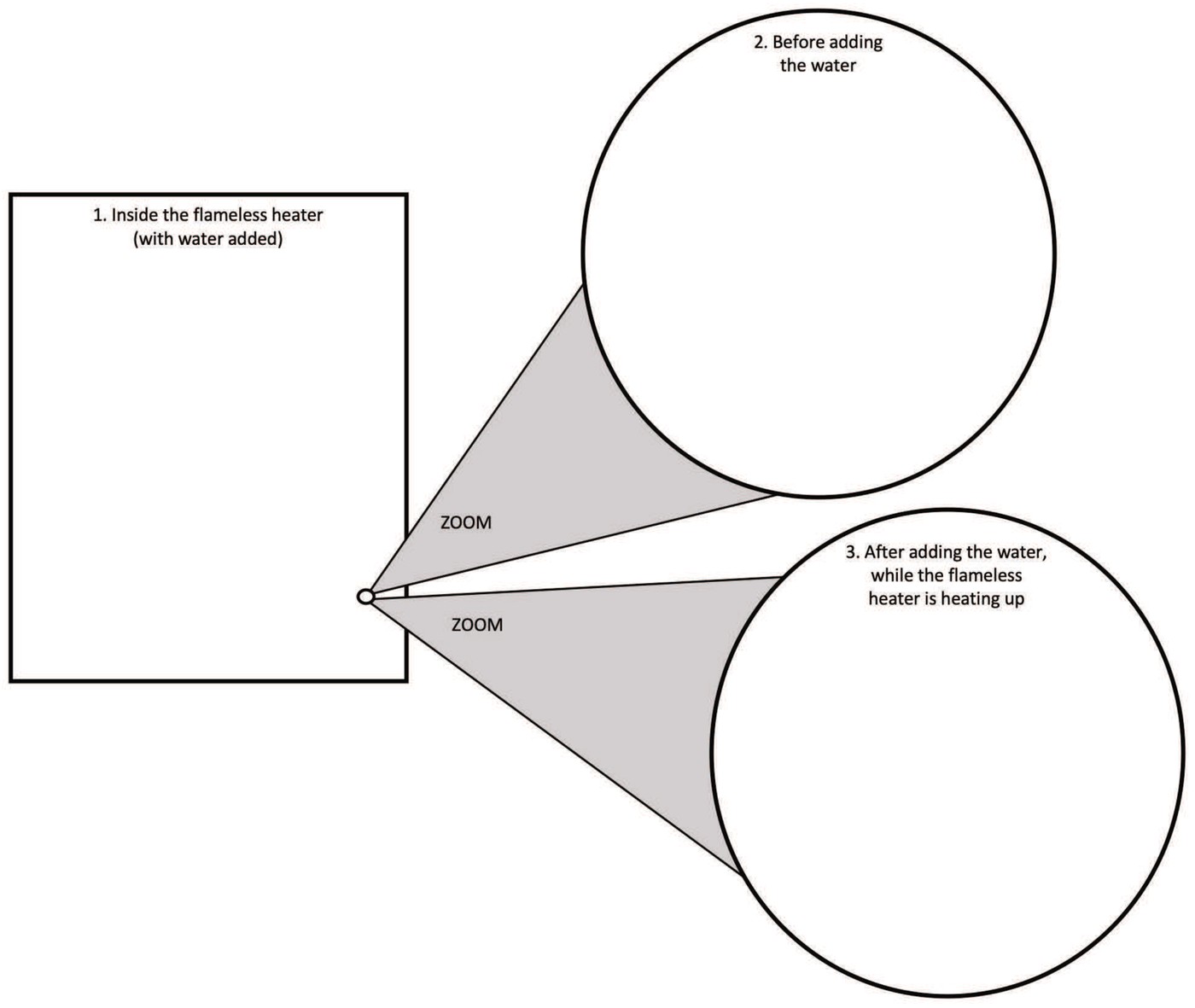
Answer and explanation
Define the selected reaction system and surroundings, identify species from appropriate evidence, conserve material and account for bond breaking plus formation. Connect transferred energy with heat capacity and measured temperature under stated conditions. The empty template alone cannot identify the reaction, quantify enthalpy or prove a construction method.
Identify the source’s visible labels, scales and unfinished or omitted information.
Use the local complete explanations to connect the observation with an explicit mechanism.
State assumptions and a limit before extending the model.
Response criteria
- Interpret the source symbols and boundary correctly.
- Explain the relevant mechanism using quantities/species consistently.
- State a meaningful omission, assumption or evidence limitation.