Types of Reactions — Practice · Grade 11 Science
Chapter: Reactions, Moles & CompositionWhat this practice covers
By the end of Types of Reactions you should be able to:
- I can classify a reaction as synthesis, decomposition, single replacement, double replacement, or combustion by looking at the pattern of its reactants and products.
- I can predict the products of a simple reaction once I know its type and the way the atoms recombine.
11 questions, multiple choice, numeric and written answer, each with a worked explanation.
Vocabulary used: synthesis reaction, decomposition reaction, single-replacement reaction, double-replacement reaction, combustion reaction, activity series.
Problem 1
- synthesis
- decomposition
- single replacement
- combustion
Answer and explanation
synthesis
Several substances combining into one product is the defining pattern of a synthesis (combination) reaction.
Problem 2
- CaCO₃ → CaO + CO₂
- CH₄ + 2O₂ → CO₂ + 2H₂O
- AgNO₃ + NaCl → AgCl + NaNO₃
- 2Na + Cl₂ → 2NaCl
Answer and explanation
CH₄ + 2O₂ → CO₂ + 2H₂O
A fuel (methane) reacting with oxygen to give carbon dioxide and water is complete combustion.
Problem 3
- synthesis
- decomposition
- single replacement
- double replacement
Answer and explanation
decomposition
A single compound breaking apart into simpler substances is decomposition (AB → A + B).
Problem 4
Answer and explanation
1 molecules
The coefficient in front of H₂ is 1, so one zinc atom releases one H₂ molecule.
Problem 5
Answer and explanation
It is a synthesis reaction. Magnesium combines with oxygen to form magnesium oxide, MgO. The balanced equation is 2Mg + O₂ → 2MgO.
Problem 6
- CaCO₃ → CaO + CO₂
- 2H₂ + O₂ → 2H₂O
- Fe + CuSO₄ → FeSO₄ + Cu
- HCl + NaOH → NaCl + H₂O
Answer and explanation
Fe + CuSO₄ → FeSO₄ + Cu
Iron (a lone element) replaces copper in copper sulfate, matching A + BC → AC + B. Because iron is more reactive than copper, the displacement actually occurs.
Problem 7
Hints
Use supplied products and states to justify the category.
Answer and explanation
Complete combustion under the given products; it is also a redox process.
Problem 8
Hints
State what the supplied observations or conditions establish, and separate that from any assumption.
Answer and explanation
Reactant identities and proton-transfer/stoichiometric evidence; warming alone occurs in other processes too.
Problem 9
Answer and explanation
It identifies a separate solid phase, distinguishing precipitation from ions simply remaining in the aqueous phase.
The state symbol (aq) means a species is dissolved in water, not that a solid formula unit is moving unchanged through solution. Precipitation forms a separate solid phase when conditions favor it. A supplied solubility rule can support an introductory prediction, while concentrations and equilibrium determine the more detailed outcome. Gas formation and acid–base reactions can also change aqueous species. A visible change suggests something to investigate but does not by itself establish the exact product identity or amount.
It identifies a separate solid phase, distinguishing precipitation from ions simply remaining in the aqueous phase.
Response criteria
- Interpret labels, structures, axes, units and directions correctly.
- Explain the chemistry relationship or mechanism.
- Respect stated assumptions and distinguish observation from inference.
Problem 10
Answer and explanation
Balance atoms of each element and total charge. A precipitate prediction also needs appropriate solubility/concentration evidence under the conditions; balanced pattern matching alone does not establish a separate solid phase.
Balance atoms of each element and total charge. A precipitate prediction also needs appropriate solubility/concentration evidence under the conditions; balanced pattern matching alone does not establish a separate solid phase.
Response criteria
- Use the stated measurements or conditions, with correct units.
- Connect the result to the chemical mechanism or evidence relationship.
- Identify the assumption, model limit or further evidence requested.
Problem 11
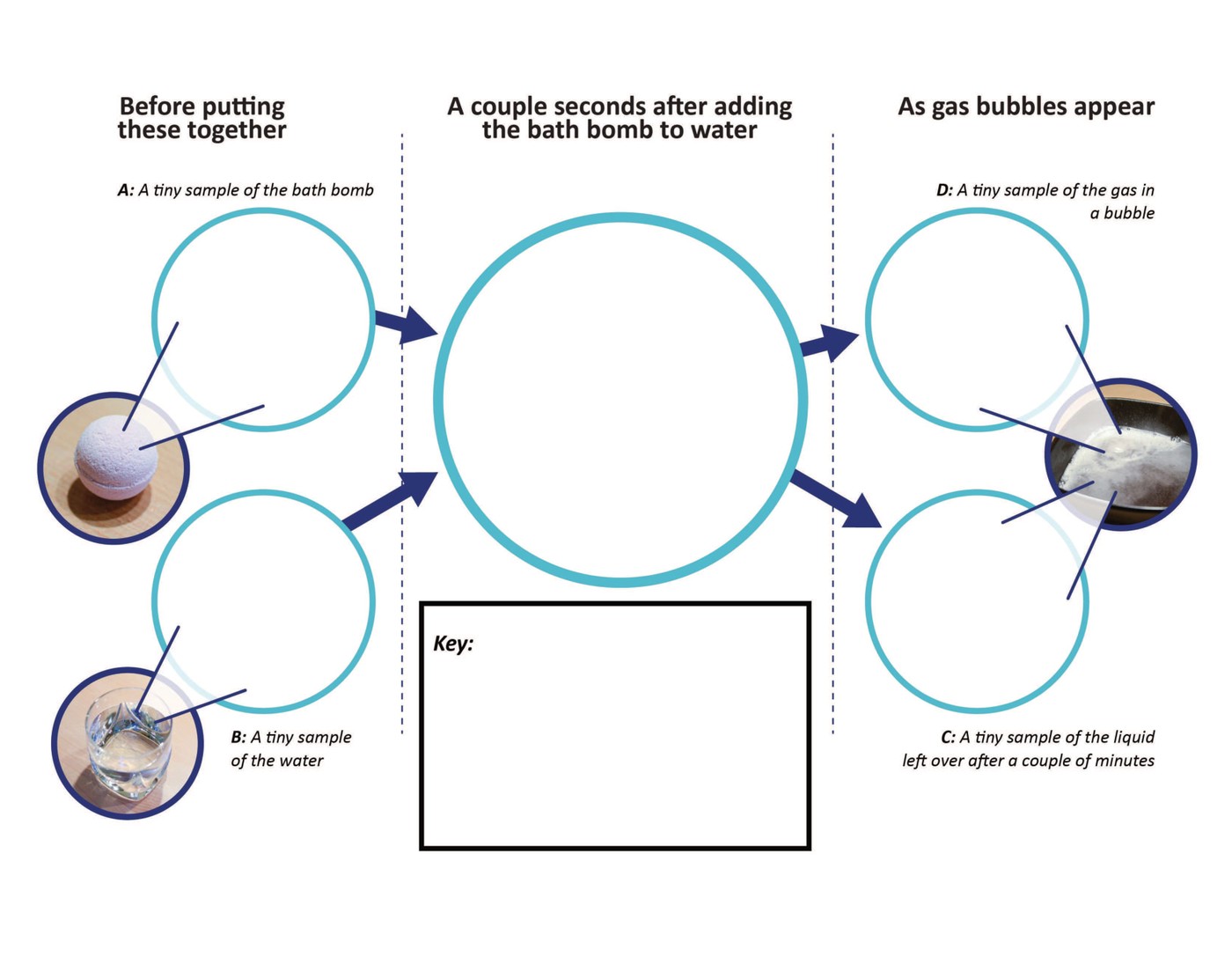
Answer and explanation
Record the visible solid/water and later bubbles or liquid. A completed model must define its species symbols and conserve atoms/material across the boundary, including dissolved and gas species. Bubbles can arise through reaction, vaporization or released dissolved gas; temperature and product evidence are needed to distinguish them.
Identify the source’s visible labels, scales and unfinished or omitted information.
Use the local complete explanations to connect the observation with an explicit mechanism.
State assumptions and a limit before extending the model.
Response criteria
- Interpret the source symbols and boundary correctly.
- Explain the relevant mechanism using quantities/species consistently.
- State a meaningful omission, assumption or evidence limitation.