Springs, Torque & Static Equilibrium — Practice · Grade 12 Science
Chapter: Forces, Rotation & EquilibriumWhat this practice covers
By the end of Springs, Torque & Static Equilibrium you should be able to:
- I can calculate spring force and energy within an elastic model.
- I can apply both force and torque balance about a stated pivot.
9 questions, numeric and written answer, each with a worked explanation.
Vocabulary used: spring constant, torque, lever arm.
Problem 1
Hints
Write the relationship first; substitute with consistent units.
Answer and explanation
3 N
100×.03=3.
Problem 2
Answer and explanation
The force lines can produce a nonzero net torque about the object.
Response criteria
- State a scientifically accurate conclusion.
- Show the calculation or mechanism that supports it.
- Include units, conditions, or limits where relevant.
Problem 3
Hints
List the given quantities, select a relationship, and check units before substituting.
Answer and explanation
1 J
½×200×.10²=1.
Problem 4
Answer and explanation
Force varies with extension; integrate or use the triangular graph area.
Response criteria
- State a scientifically accurate conclusion.
- Show the calculation or mechanism that supports it.
- Include units, conditions, or limits where relevant.
Problem 5
Hints
Use perpendicular lever arm and rotational sign.
Answer and explanation
F=kx=10 N, directed toward restoring equilibrium.
Problem 6
Hints
State what the supplied observations or conditions establish, and separate that from any assumption.
Answer and explanation
Zero net force prevents translational acceleration; zero net torque prevents angular acceleration.
Problem 7
Answer and explanation
No. The vector force sum must also vanish, and the starting state must be at rest.
Static equilibrium means the body remains at rest without translational or rotational acceleration. It needs ΣF=0 and Στ=0 about a selected pivot in the rigid-body model. Equal opposing torques alone can coexist with nonzero net force, while balanced forces can still form a turning couple. For this weightless-bar example equal downward loads at equal opposite arms balance torque, and the upward support must balance their combined 60 N force.
No. The vector force sum must also vanish, and the starting state must be at rest.
Response criteria
- Interpret labels, structures, axes, units and directions correctly.
- Explain the physical or environmental relationship or mechanism.
- Respect stated assumptions and distinguish observation from inference.
Problem 8
Answer and explanation
Torque balance: F×2=60×0.50, so F=15 N upward. Vertical balance gives pivot reaction=60−15=45 N upward. Both balances are necessary.
Torque balance: F×2=60×0.50, so F=15 N upward.
Vertical balance gives pivot reaction=60−15=45 N upward.
Both balances are necessary.
Response criteria
- Use the stated measurements or conditions, with correct units.
- Connect the result to the physical or environmental mechanism or evidence relationship.
- Identify the assumption, model limit or further evidence requested.
Problem 9
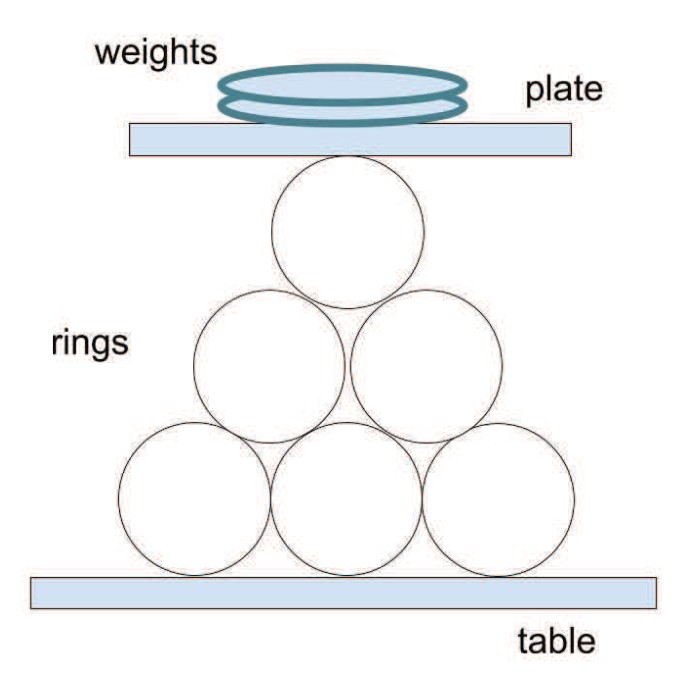
Answer and explanation
The rings push the loaded plate upward and Earth attracts that selected plate/load downward. Their magnitudes balance at rest but they are not a third-law pair. The plate pushes the rings downward as the support force’s partner on a different body. Impact peak force requires a time-resolved interaction and motion record, not a static layout.
Read source labels, scope, axes and intentional omissions.
Use the complete local explanation to draw a justified mechanism or calculate a supported quantity.
State what is observed, what is assumed and what evidence remains needed.
Response criteria
- Interpret the source labels, units and scope accurately.
- Explain the relevant mechanism with a labeled model or supported calculation.
- Identify a meaningful assumption, uncertainty or missing comparison.