Reflection, Refraction & Optics — Practice · Grade 12 Science
Chapter: Waves, Sound & OpticsWhat this practice covers
By the end of Reflection, Refraction & Optics you should be able to:
- I can apply the law of reflection and use the index of refraction (n = c/v) and Snell's law to describe how light bends.
- I can predict image formation by lenses and mirrors using the thin-lens equation and magnification.
11 questions, multiple choice, numeric and written answer, each with a worked explanation.
Vocabulary used: reflection, normal, refraction, index of refraction (n), total internal reflection, focal length (f), real vs. virtual image.
Problem 1
- the horizon
- the edge of the mirror
- the surface itself
- the normal (the perpendicular to the surface)
Answer and explanation
the normal (the perpendicular to the surface)
All angles in optics are measured from the normal, the line perpendicular to the surface at the point of contact.
Problem 2
Answer and explanation
1.5
n = c ÷ v = (3 × 10⁸) ÷ (2 × 10⁸) = 1.5.
Problem 3
- bends toward the normal and slows down
- bends toward the normal and speeds up
- bends away from the normal and speeds up
- passes straight through with no change
Answer and explanation
bends toward the normal and slows down
Entering a denser, higher-index medium, light slows down and bends toward the normal.
Problem 4
Answer and explanation
30 cm
1 ÷ dᵢ = 1 ÷ f − 1 ÷ dₒ = 1 ÷ 15 − 1 ÷ 30 = 2 ÷ 30 − 1 ÷ 30 = 1 ÷ 30, so dᵢ = 30 cm.
Problem 5
Answer and explanation
A real image forms where light rays actually converge, so it can be projected onto a screen (like the image on a camera sensor or a movie screen); it is usually inverted. A virtual image forms where rays only appear to come from — they never actually meet there — so it cannot be projected; it is upright, like the enlarged image seen through a magnifying glass or your reflection in a flat mirror.
Problem 6
Answer and explanation
6 cm
Magnification magnitude = dᵢ ÷ dₒ = 30 ÷ 10 = 3, so the image height = 3 × 2 cm = 6 cm.
Problem 7
Hints
State the sign convention; a negative image distance has a different interpretation.
Answer and explanation
1/d_i=1/10−1/20=1/20; d_i=20 cm.
Problem 8
Hints
State what the supplied observations or conditions establish, and separate that from any assumption.
Answer and explanation
Refraction changes propagation speed and wavelength while frequency is continuous across a stationary boundary.
Problem 9
Answer and explanation
di=−10 cm and m=+2: an upright enlarged virtual image on the object side.
In the stated thin-lens convention, 1/f=1/do+1/di, with f positive for a converging lens, do positive for a real object and di positive for a real image on the far side. Magnification m=−di/do gives image height divided by object height. For f=10 cm and do=20 cm, di=20 cm and m=−1: the real image is inverted and equal in height. State the convention rather than interpreting every negative sign as an error.
di=−10 cm and m=+2: an upright enlarged virtual image on the object side.
Response criteria
- Interpret labels, structures, axes, units and directions correctly.
- Explain the physical or environmental relationship or mechanism.
- Respect stated assumptions and distinguish observation from inference.
Problem 10
Answer and explanation
1/di=1/12−1/36=1/18, so di=18 cm and m=−18/36=−0.50. It is real, inverted and half the object height in this paraxial model.
1/di=1/12−1/36=1/18, so di=18 cm and m=−18/36=−0.50.
It is real, inverted and half the object height in this paraxial model.
Response criteria
- Use the stated measurements or conditions, with correct units.
- Connect the result to the physical or environmental mechanism or evidence relationship.
- Identify the assumption, model limit or further evidence requested.
Problem 11
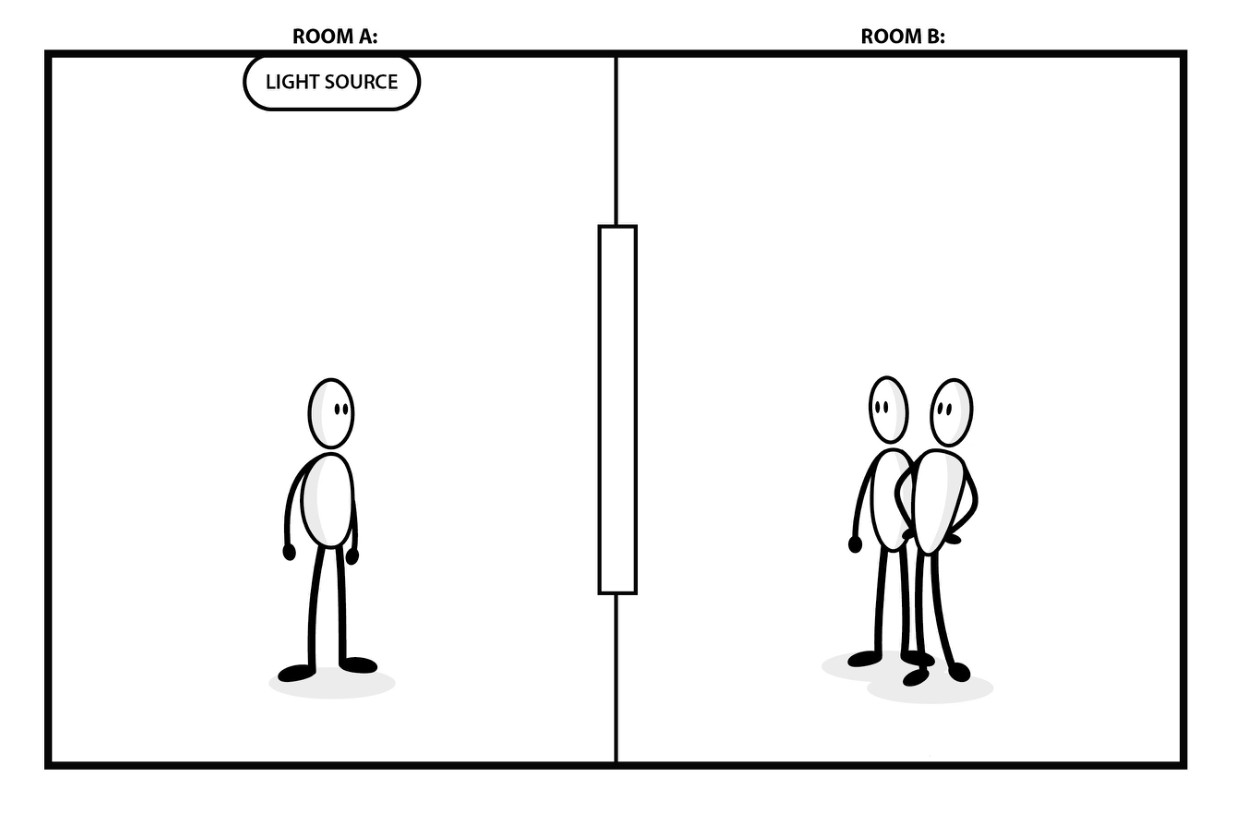
Answer and explanation
Draw source-to-surface rays, then reflected or transmitted paths that actually reach the observer. Light enters the eye from the path; the eye does not emit rays that create sight. Angles are measured from the boundary normal, reflection uses equal angles and transmitted direction requires the indices and geometry.
Read source labels, scope, axes and intentional omissions.
Use the complete local explanation to draw a justified mechanism or calculate a supported quantity.
State what is observed, what is assumed and what evidence remains needed.
Response criteria
- Interpret the source labels, units and scope accurately.
- Explain the relevant mechanism with a labeled model or supported calculation.
- Identify a meaningful assumption, uncertainty or missing comparison.