Wave Properties — Practice · Grade 12 Science
Chapter: Waves, Sound & OpticsWhat this practice covers
By the end of Wave Properties you should be able to:
- I can distinguish transverse from longitudinal waves and identify amplitude, wavelength, frequency, and period.
- I can relate frequency, wavelength, and speed using v = f λ, and predict the result of two waves interfering.
11 questions, numeric, multiple choice and written answer, each with a worked explanation.
Vocabulary used: wave, transverse wave, longitudinal wave, amplitude, wavelength (λ), frequency (f), interference.
Problem 1
Answer and explanation
30 m/s
v = f × λ = 10 × 3 = 30 m/s.
Problem 2
Answer and explanation
250 Hz
f = 1 ÷ T = 1 ÷ 0.004 = 250 Hz.
Problem 3
Answer and explanation
3 m
λ = v ÷ f = 12 ÷ 4 = 3 m.
Problem 4
- parallel to the wave's motion
- perpendicular to the wave's motion
- in the exact direction the wave travels
- only when the wave stops
Answer and explanation
perpendicular to the wave's motion
Transverse means the vibration is perpendicular (at right angles) to the direction the wave travels.
Problem 5
- the frequency doubles
- the wavelength doubles
- they cancel to zero amplitude
- their amplitudes double
Answer and explanation
they cancel to zero amplitude
Equal waves exactly out of phase interfere destructively and cancel — this is destructive interference.
Problem 6
Answer and explanation
5 m
λ = v ÷ f = 1500 ÷ 300 = 5 m.
Problem 7
Hints
Check v=fλ independently.
Answer and explanation
v=30 m/s.
Problem 8
Hints
State what the supplied observations or conditions establish, and separate that from any assumption.
Answer and explanation
Particles oscillate locally while interactions pass the disturbance and energy onward.
Problem 9
Answer and explanation
λ=v/f=0.50 m under the stated medium conditions.
Wave speed satisfies v=fλ for a steady periodic traveling wave. Frequency is cycles per second and wavelength is meters per cycle, so their product gives meters per second. In a nondispersive medium, changing source frequency changes wavelength while speed stays approximately fixed. In a dispersive medium, speed can depend on frequency, so “speed is always fixed” is too broad. Identify the medium, wave type and relevant approximation.
λ=v/f=0.50 m under the stated medium conditions.
Response criteria
- Interpret labels, structures, axes, units and directions correctly.
- Explain the physical or environmental relationship or mechanism.
- Respect stated assumptions and distinguish observation from inference.
Problem 10
Answer and explanation
f=50 Hz and v=40 m/s. At100 Hz with the same 40 m/s speed, λ=0.40 m.
f=50 Hz and v=40 m/s.
At100 Hz with the same 40 m/s speed, λ=0.40 m.
Response criteria
- Use the stated measurements or conditions, with correct units.
- Connect the result to the physical or environmental mechanism or evidence relationship.
- Identify the assumption, model limit or further evidence requested.
Problem 11
Answer and explanation
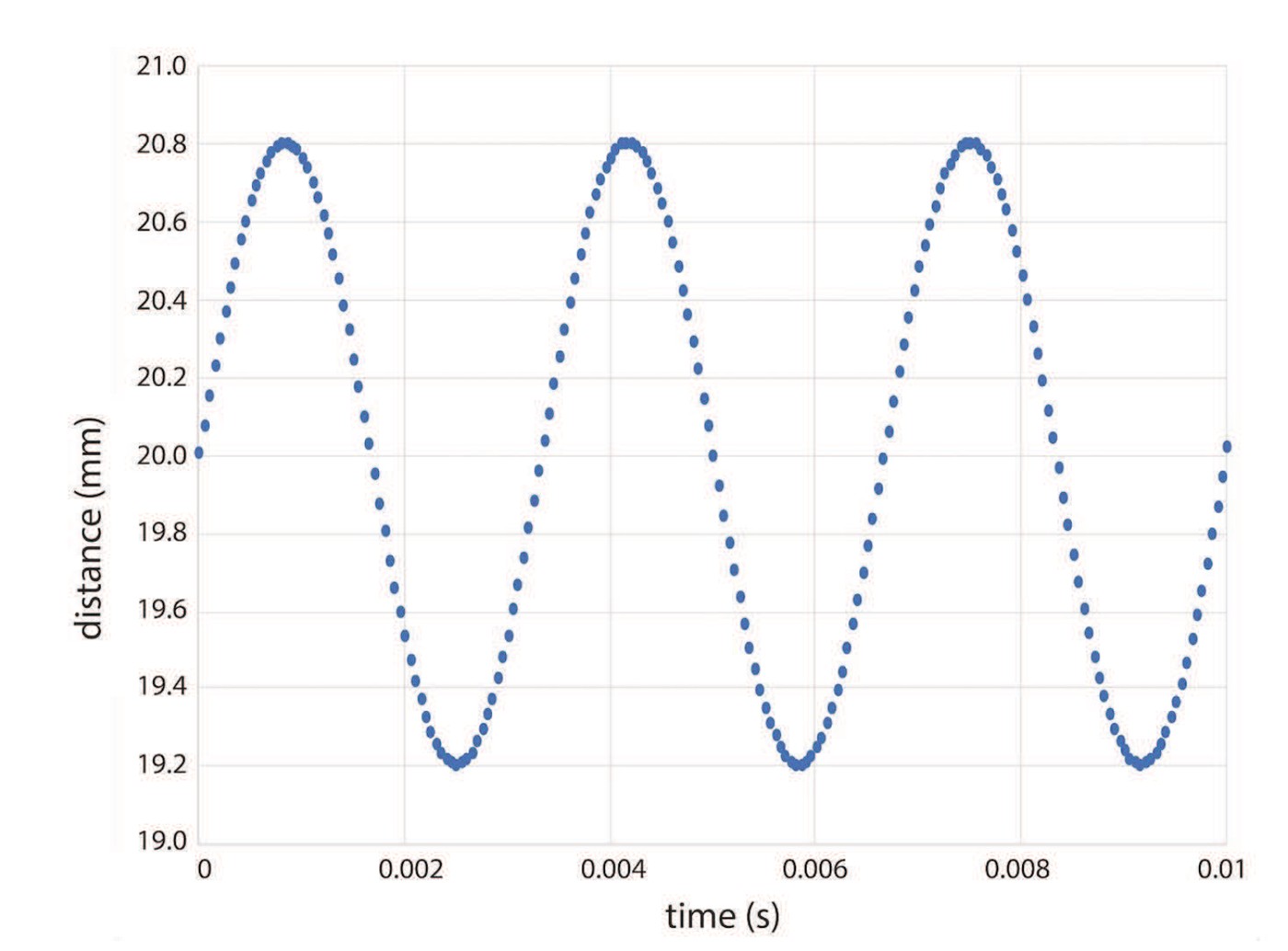
The equilibrium is about 20 mm and amplitude about 0.8 mm, measured from that mean rather than from zero. Roughly three cycles occupy 0.01 s, givingT≈0.0033 s andf≈300 Hz. These are approximate visual readings. Time at one source does not provide spatial wavelength or wave speed without additional information.
Read source labels, scope, axes and intentional omissions.
Use the complete local explanation to draw a justified mechanism or calculate a supported quantity.
State what is observed, what is assumed and what evidence remains needed.
Response criteria
- Interpret the source labels, units and scope accurately.
- Explain the relevant mechanism with a labeled model or supported calculation.
- Identify a meaningful assumption, uncertainty or missing comparison.