DNA, Genes & Chromosomes — Print · Grade 7 Science
Chapter: Genes, Cell Division & HeredityDNA, Genes & Chromosomes
Learning goals
- I can explain dna, genes & chromosomes.
- I can use evidence, a model, and stated assumptions to support a biological explanation.
Before this unit
Use the supplied vocabulary, distinguish an observation from an explanation, and identify any units or model assumptions. Revisit a connected earlier unit if needed; new terms are explained here.
Use three flexible 40–45-minute sessions: core background and Parts 1–2 with their checks; Parts 3–4 and the worked application; then remaining practice, a labeled model, revision, and the exit check. Checks completed during reading can count toward the practice set. Read one short part at a time. Investigations and chapter review/quiz have separate sessions, and flexible weeks allow more time.
Every cell in your body — a nerve cell in your spine, a cell lining your gut, a muscle cell in your calf — carries the same DNA, and they behave nothing alike. That is the fact to keep hold of through this unit, because it rules out the obvious wrong answer. Cells are not different because they were given different instructions. They are different because they use different parts of the same instructions, and understanding that requires knowing how the instructions are organised.
The organisation is nested, and the nesting runs one way. DNA is a long molecule whose sequence carries information. A gene is a section of that molecule — a stretch of sequence that specifies a product, usually a protein. A chromosome is a very long DNA molecule packaged with proteins into a structure compact enough to be handled during cell division, and it carries hundreds or thousands of genes along its length. So: chromosomes contain genes, genes are made of DNA, and DNA is the molecule throughout. Human cells carry 46 chromosomes, arranged as 23 pairs, with roughly 20,000 genes distributed among them.
Two further terms matter. A gene can exist in different versions, and a version is an allele — one allele of a flower-colour gene may specify a product that makes purple pigment and another a product that does not. An organism with paired chromosomes carries two alleles of most genes, one on each member of the pair. What you observe — the colour, the height, the shape — is the phenotype, and the relationship between alleles and phenotype is rarely one to one. Most observable characteristics depend on many genes together and on the environment, which is why a single gene for a complex trait is almost always a misleading way to talk.
Build your understanding
Where this fits
Sexual reproduction produces offspring that differ from their parents and from each other. That raises the question this chapter answers: what is actually inherited, and how does it get divided between gametes and recombined? This unit starts with the material itself and how it is organised.
Use three flexible 40–45-minute sessions: core background and Parts 1–2 with their checks; Parts 3–4 and the worked application; then remaining practice, a labeled model, revision, and the exit check. Checks completed during reading can count toward the practice set. Read one short part at a time. Investigations and chapter review/quiz have separate sessions, and flexible weeks allow more time.
Part 1 · Getting the nesting the right way round
The order is DNA, gene, chromosome, from smallest scale to largest. DNA is the molecule; a gene is a section of it; a chromosome is a single very long DNA molecule packaged with protein. A common drafting error puts a chromosome inside a gene, which inverts the whole relationship — it is like saying a chapter contains the book.
The packaging is not incidental. Stretched out, the DNA in one human cell would run about two metres, and it has to fit in a nucleus about six micrometres across and then be separated reliably every time the cell divides. Winding it around proteins and condensing it into chromosomes is what makes that handling possible, which is why chromosomes become visible as distinct bodies only when a cell is dividing.
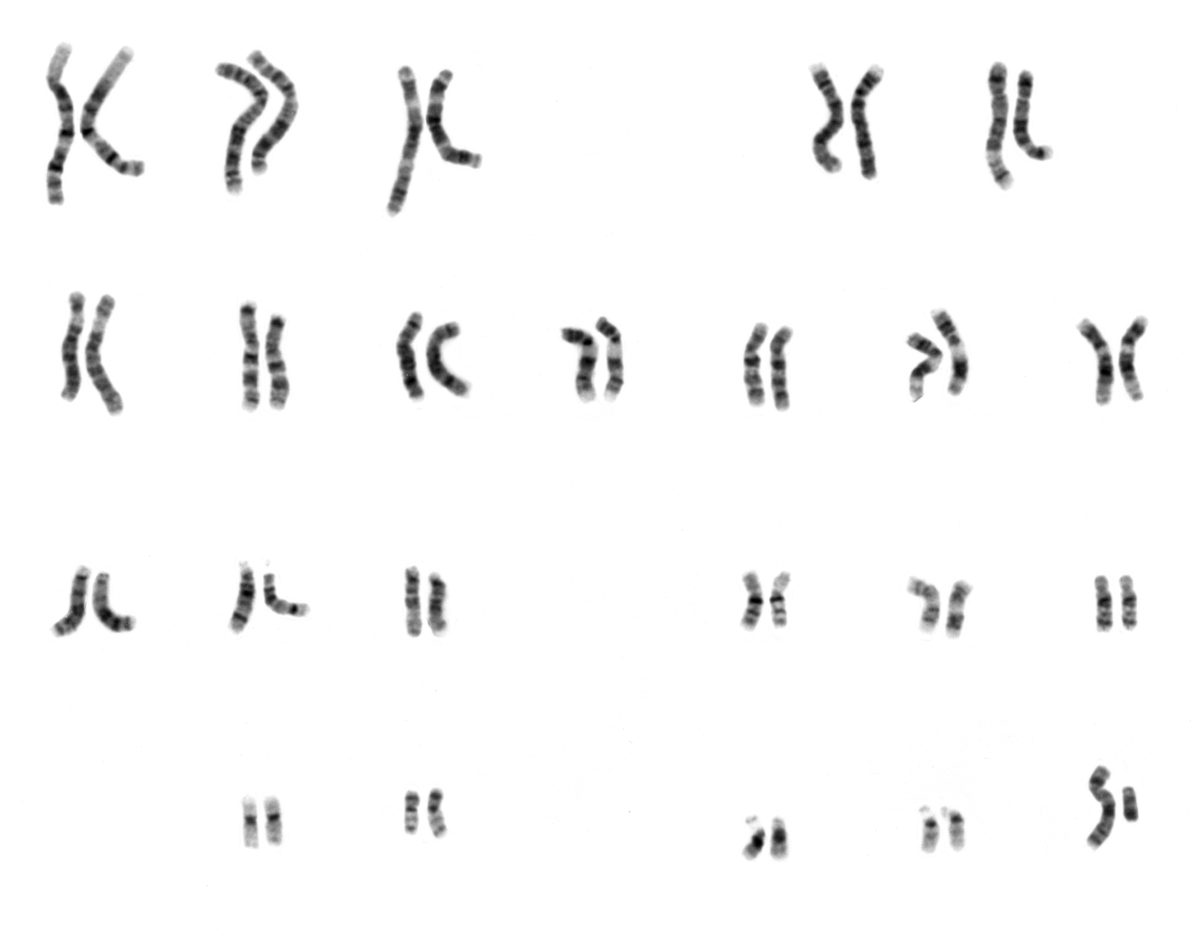
Pairing matters for everything later in this chapter. Your 46 chromosomes are 23 pairs, one member of each pair originally from each parent, and the two members of a pair carry the same genes in the same order — though not necessarily the same alleles. Holding that picture makes meiosis and Punnett squares straightforward instead of mysterious.
Pause and explain
Put DNA, gene and chromosome in order from smallest to largest and say how each relates to the next.
Check your reasoning after answering
DNA is the molecule carrying the information in its sequence. A gene is a section of DNA specifying a product, usually a protein. A chromosome is one very long DNA molecule packaged with proteins, carrying hundreds or thousands of genes along its length. So chromosomes contain genes, and genes are made of DNA — never the other way round.
Part 2 · From sequence to product to characteristic
A gene's sequence specifies the order of amino acids in a protein, and that order determines the shape the protein folds into, and the shape determines what it can do. Enzymes, structural fibres, membrane channels, antibodies, hormones — all proteins, all built by ribosomes from instructions copied out of genes, as Chapter 2 described.
That is the route from information to characteristic, and it runs through chemistry rather than jumping straight to what you can see. A gene does not specify brown eyes; it specifies a protein, and that protein takes part in a process, and the process contributes to a colour. Every intermediate step is a place where other genes and the environment can also have an effect.
This is why single-gene stories are usually wrong for the things people care about. Height, weight, skin colour and most aspects of behaviour depend on many genes each making a small contribution, plus nutrition, activity and circumstance. A few characteristics really do follow a single gene — and those are the ones textbooks use for Punnett squares, because they are the simple cases, not the typical ones.
Pause and explain
Why is "there is a gene for height" misleading?
Check your reasoning after answering
Because height depends on many genes each contributing a small amount, together with nutrition, health and other environmental factors during growth. A gene specifies a protein, and the route from protein to an observable characteristic passes through processes that other genes and the environment also affect. Single-gene characteristics exist, but they are the simple exceptions, not the pattern.
Part 3 · Allele and trait are different things
An allele is a version of a gene — a particular sequence. A trait is an observable characteristic. The two are related but they sit at different levels, and keeping them apart prevents most of the confusion in the rest of the chapter. An organism with paired chromosomes carries two alleles of a gene, and those two may be the same version or different versions.
Having two alleles does not mean displaying two characteristics. How the pair is expressed depends on what the products do: sometimes one allele's product is sufficient to produce the characteristic whatever the other allele specifies, which is what dominance describes. The Punnett square unit later in this chapter is entirely about turning allele pairs into expected phenotypes under a stated rule.
The language also needs care because it travels. Describing an allele as better is almost always wrong — an allele's effect depends on which other alleles, which environment and which demands are in play, and the same version can be advantageous in one setting and costly in another. The evolution chapter returns to exactly this.
Pause and explain
An organism carries two different alleles of a gene. Does it display two different traits?
Check your reasoning after answering
No. It carries two versions of the gene, and what is displayed depends on what their products do together. One allele's product may be sufficient to produce the characteristic regardless of the other, which is dominance. The pair is at the level of sequence; the trait is what you observe, and the relationship between them needs a stated rule.
Part 4 · Same DNA, different cells
Return to the opening fact. A muscle cell and a gut lining cell in the same body carry the same chromosomes and the same genes. What differs is which genes are being used — switched on and read, or kept silent. A muscle cell is making large amounts of contractile proteins and none of the digestive enzymes its neighbour is producing from the very same instructions.
That mechanism is what makes specialisation possible with one genome. During development, cells take different paths in response to signals and position, and each settles into using a particular subset of the available genes. It also makes the alternative explanation unnecessary: nobody needs to suppose that cells inherit separate sets of instructions, and in fact they do not.
The exceptions prove useful rather than awkward. Gametes carry half a set, as the meiosis unit will show, and mature mammalian red blood cells have discarded their nucleus altogether. Both are specialisations arrived at during development, not separate inheritances, which is exactly the point.
Pause and explain
If every body cell has the same DNA, why is a muscle cell different from a gut lining cell?
Check your reasoning after answering
Because they use different parts of the same instructions. Each cell type has particular genes switched on and others kept silent, so a muscle cell builds contractile proteins while a gut cell builds digestive enzymes and absorbing structures from the same genome. Specialisation comes from differences in which genes are read, not from different inherited instructions.
Apply the whole unit · Repair a genetic-information diagram
Illustrative draft, not a real text: a student's diagram places a chromosome inside a gene, and the accompanying sentence says that because every body cell has the same DNA, every body cell must perform the same task.
Your task
Repair the nested relationship and explain cell specialisation without inventing a separate set of inherited instructions for each cell type.
What your response should show
- Explain the relevant biological process accurately.
- Use the supplied evidence and show calculation steps with units where needed.
- Connect a labeled model or mechanism with the claim.
- State an assumption, evidence limitation, or useful next observation.
Response guidance — after your attempt
Correct the nesting: DNA is the molecule, a gene is a section of it, and a chromosome is one very long DNA molecule carrying many genes — so a gene sits inside a chromosome, not the reverse.
Accept the premise that is right: every body cell does carry the same DNA, and that part of the draft is correct.
Reject the conclusion: cells differ because different genes are switched on in each type, so the same instructions produce different products.
Give an example: a muscle cell builds contractile proteins while a gut lining cell builds digestive enzymes and absorbing structures, from the same genome.
The nesting in the draft is inverted. DNA is the molecule whose sequence carries information; a gene is a section of that sequence specifying a product, usually a protein; and a chromosome is one very long DNA molecule packaged with proteins, carrying hundreds or thousands of genes along its length. So a chromosome contains genes, not the other way about. Human cells carry 46 chromosomes in 23 pairs, with roughly 20,000 genes distributed among them. The draft's premise is actually correct — body cells do carry the same DNA — and the conclusion drawn from it is not. Cells differ because they use different parts of the same instructions: in each cell type particular genes are switched on and read while others are kept silent, so a muscle cell produces large amounts of contractile protein and a gut lining cell produces digestive enzymes and absorbing structures, from an identical genome. During development, cells take different paths in response to signals and position, and settle into using a particular subset of what is available. No separate inheritance is needed, and none occurs. Two apparent exceptions confirm rather than undermine this: gametes carry half a set because of meiosis, and mature mammalian red blood cells have discarded their nucleus as they specialised. Both are things that happen to cells during development, not evidence of different instructions being inherited.
Scientific references for this unit
Parent / teacher teaching notes
Ask for a because-statement and a labeled relationship, not just a memorized word. Work through one calculation step at a time, permit oral or diagram responses, and use flexible sessions for difficult reading. Compare the learner’s actual evidence with the supplied model; do not reward copying or agreement with a personal preference. No private family, genetic, or medical records are required.
The key idea
DNA is a molecule carrying genetic information in its sequence. A gene is a region of genetic material contributing to functional products and biological processes; a chromosome is a larger organized structure containing DNA. Genes are not separate tiny organisms, and one chromosome contains many regions. In a typical eukaryotic cell, most chromosomes are in the nucleus.
Worked examples
Example 1 · Repair an inverted hierarchy
- Identify the largest structure: a chromosome, a packaged DNA molecule carrying many genes.
- Identify what a gene is: a section of that DNA specifying a product.
- Place allele correctly: not a component of a gene but a version of one — a particular sequence that gene might have.
Allele is the word most often misplaced. It is a version, not a component.
Example 2 · Explain specialisation without separate genomes
- State what both cells have: the same chromosomes and the same genes, including the one specifying insulin.
- State what differs: which genes are switched on and read in each cell type.
- Say why the alternative fails: if skin cells had lost genes, the cells they later divide into would also lack them, and specialisation would be irreversible loss rather than regulated use.
Ask what is being used, not what is present. Presence is the same across body cells.
Avoid these mistakes
- Mistake: a gene contains chromosomes. The nesting runs the other way — a chromosome is a long DNA molecule carrying many genes, and a gene is a section of DNA.
- Mistake: an allele is part of a gene. It is a version of a gene — a particular sequence that gene might have — not a smaller component inside it.
- Mistake: different cell types inherit different genes. Every body cell has the same genome; they differ in which genes are switched on, which is how one set of instructions builds many kinds of cell.
- Mistake: there is a gene for height. Height depends on many genes plus nutrition and health; single-gene characteristics are the simple exceptions textbooks use, not the pattern.
Check your understanding
Is a gene normally a whole chromosome?
Discuss the answer
No. A gene is a region of genetic material; a chromosome contains many regions and other DNA.
Why is “DNA letters directly become an eye color” incomplete?
Discuss the answer
Genetic information affects cellular products and processes; traits emerge through those processes and often involve several influences.
Words to know
- DNA
- The long molecule whose sequence carries genetic information; about two metres of it is packed into a nucleus six micrometres across.
- gene
- A section of DNA specifying a product, usually a protein, whose shape determines what it can do.
- allele
- A version of a gene; an organism with paired chromosomes carries two alleles of most genes, which may be the same or different.
- chromosome
- One very long DNA molecule packaged with proteins so it can be handled during division; humans have 46, in 23 pairs.
- phenotype
- The observable characteristic, which usually depends on many genes together with the environment rather than on one allele.
Extend your scientific explanation
Compare a second supplied example or the linked educational reference. Identify a connection, a model limit, and an additional observation that would test the explanation.
In the real world
Use a clear question, reliable observations, and a biological mechanism to evaluate a claim. State what remains uncertain before applying a classroom model to a different setting.
Exit check
Why are complex traits poorly represented by one letter pair?
Check your explanation after answering
Several genetic and environmental contributions can interact; the one-pair model omits them.
Explain your reasoning without notes. If a key idea is missing, revisit the lesson and try again.
Problem 1
Answer and explanation
No. A gene is a region of genetic material; a chromosome contains many regions and other DNA.
Problem 2
Answer and explanation
Genetic information affects cellular products and processes; traits emerge through those processes and often involve several influences.
Problem 3
Answer and explanation
No. Dominance describes an observed relationship between allele effects in a specified model, not a property of typography.
Problem 4
Answer and explanation
Several genetic and environmental contributions can interact; the one-pair model omits them.
Problem 5
Answer and explanation
Gene regions are parts of chromosome DNA, not containers for whole chromosomes. Cells with broadly similar genetic information can use different portions and develop different structures and roles. The model does not show every gene, product, or interaction, so a shared genome does not imply identical activity in all cells.
Place gene regions along chromosome DNA.
Connect information use with functional products.
Distinguish shared information from identical activity.
Response criteria
- Explain the relevant biological process accurately.
- Use the supplied evidence and show calculation steps with units where needed.
- Connect a labeled model or mechanism with the claim.
- State an assumption, evidence limitation, or useful next observation.
Problem 6
Answer and explanation
No. The genotype letters identify versions under the model, but the genotype-phenotype relationship must be specified or supported by evidence.
Response criteria
- Explain the relevant biological process accurately.
- Use the supplied evidence and show calculation steps with units where needed.
- Connect a labeled model or mechanism with the claim.
- State an assumption, evidence limitation, or useful next observation.
Problem 7
- A gene contains every chromosome
- A chromosome contains DNA with many gene regions
- DNA is an organ
- Alleles are whole species
Answer and explanation
A chromosome contains DNA with many gene regions
Gene regions occur within genetic material organized into chromosomes.
Problem 8
Answer and explanation
They can use different parts of the information and develop different structures and cellular activities.