Genes, Cell Division & Heredity — Print · Life Science & Scientific Inquiry, Grade 7
Five focused units, a three-session investigation, chapter review, and chapter quiz.
Printable chapter lessons and review.
DNA, Genes & Chromosomes
Learning goals
- I can explain dna, genes & chromosomes.
- I can use evidence, a model, and stated assumptions to support a biological explanation.
Before this unit
Use the supplied vocabulary, distinguish an observation from an explanation, and identify any units or model assumptions. Revisit a connected earlier unit if needed; new terms are explained here.
Use three flexible 40–45-minute sessions: core background and Parts 1–2 with their checks; Parts 3–4 and the worked application; then remaining practice, a labeled model, revision, and the exit check. Checks completed during reading can count toward the practice set. Read one short part at a time. Investigations and chapter review/quiz have separate sessions, and flexible weeks allow more time.
Every cell in your body — a nerve cell in your spine, a cell lining your gut, a muscle cell in your calf — carries the same DNA, and they behave nothing alike. That is the fact to keep hold of through this unit, because it rules out the obvious wrong answer. Cells are not different because they were given different instructions. They are different because they use different parts of the same instructions, and understanding that requires knowing how the instructions are organised.
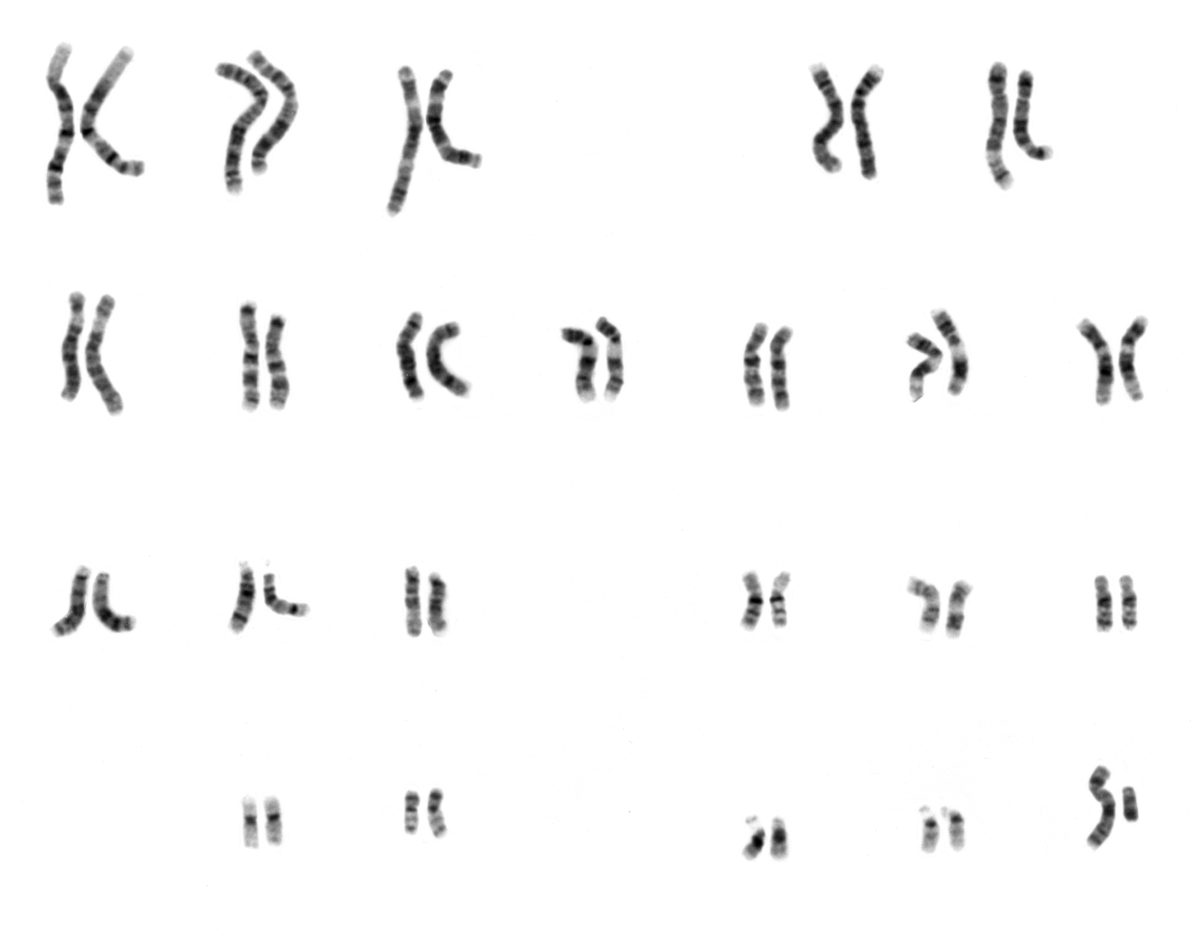
The organisation is nested, and the nesting runs one way. DNA is a long molecule whose sequence carries information. A gene is a section of that molecule — a stretch of sequence that specifies a product, usually a protein. A chromosome is a very long DNA molecule packaged with proteins into a structure compact enough to be handled during cell division, and it carries hundreds or thousands of genes along its length. So: chromosomes contain genes, genes are made of DNA, and DNA is the molecule throughout. Human cells carry 46 chromosomes, arranged as 23 pairs, with roughly 20,000 genes distributed among them.
Two further terms matter. A gene can exist in different versions, and a version is an allele — one allele of a flower-colour gene may specify a product that makes purple pigment and another a product that does not. An organism with paired chromosomes carries two alleles of most genes, one on each member of the pair. What you observe — the colour, the height, the shape — is the phenotype, and the relationship between alleles and phenotype is rarely one to one. Most observable characteristics depend on many genes together and on the environment, which is why a single gene for a complex trait is almost always a misleading way to talk.
Build your understanding
Where this fits
Sexual reproduction produces offspring that differ from their parents and from each other. That raises the question this chapter answers: what is actually inherited, and how does it get divided between gametes and recombined? This unit starts with the material itself and how it is organised.
Use three flexible 40–45-minute sessions: core background and Parts 1–2 with their checks; Parts 3–4 and the worked application; then remaining practice, a labeled model, revision, and the exit check. Checks completed during reading can count toward the practice set. Read one short part at a time. Investigations and chapter review/quiz have separate sessions, and flexible weeks allow more time.
Part 1 · Getting the nesting the right way round
The order is DNA, gene, chromosome, from smallest scale to largest. DNA is the molecule; a gene is a section of it; a chromosome is a single very long DNA molecule packaged with protein. A common drafting error puts a chromosome inside a gene, which inverts the whole relationship — it is like saying a chapter contains the book.
The packaging is not incidental. Stretched out, the DNA in one human cell would run about two metres, and it has to fit in a nucleus about six micrometres across and then be separated reliably every time the cell divides. Winding it around proteins and condensing it into chromosomes is what makes that handling possible, which is why chromosomes become visible as distinct bodies only when a cell is dividing.
Pairing matters for everything later in this chapter. Your 46 chromosomes are 23 pairs, one member of each pair originally from each parent, and the two members of a pair carry the same genes in the same order — though not necessarily the same alleles. Holding that picture makes meiosis and Punnett squares straightforward instead of mysterious.
Pause and explain
Put DNA, gene and chromosome in order from smallest to largest and say how each relates to the next.
Check your reasoning after answering
DNA is the molecule carrying the information in its sequence. A gene is a section of DNA specifying a product, usually a protein. A chromosome is one very long DNA molecule packaged with proteins, carrying hundreds or thousands of genes along its length. So chromosomes contain genes, and genes are made of DNA — never the other way round.
Part 2 · From sequence to product to characteristic
A gene's sequence specifies the order of amino acids in a protein, and that order determines the shape the protein folds into, and the shape determines what it can do. Enzymes, structural fibres, membrane channels, antibodies, hormones — all proteins, all built by ribosomes from instructions copied out of genes, as Chapter 2 described.
That is the route from information to characteristic, and it runs through chemistry rather than jumping straight to what you can see. A gene does not specify brown eyes; it specifies a protein, and that protein takes part in a process, and the process contributes to a colour. Every intermediate step is a place where other genes and the environment can also have an effect.
This is why single-gene stories are usually wrong for the things people care about. Height, weight, skin colour and most aspects of behaviour depend on many genes each making a small contribution, plus nutrition, activity and circumstance. A few characteristics really do follow a single gene — and those are the ones textbooks use for Punnett squares, because they are the simple cases, not the typical ones.
Pause and explain
Why is "there is a gene for height" misleading?
Check your reasoning after answering
Because height depends on many genes each contributing a small amount, together with nutrition, health and other environmental factors during growth. A gene specifies a protein, and the route from protein to an observable characteristic passes through processes that other genes and the environment also affect. Single-gene characteristics exist, but they are the simple exceptions, not the pattern.
Part 3 · Allele and trait are different things
An allele is a version of a gene — a particular sequence. A trait is an observable characteristic. The two are related but they sit at different levels, and keeping them apart prevents most of the confusion in the rest of the chapter. An organism with paired chromosomes carries two alleles of a gene, and those two may be the same version or different versions.
Having two alleles does not mean displaying two characteristics. How the pair is expressed depends on what the products do: sometimes one allele's product is sufficient to produce the characteristic whatever the other allele specifies, which is what dominance describes. The Punnett square unit later in this chapter is entirely about turning allele pairs into expected phenotypes under a stated rule.
The language also needs care because it travels. Describing an allele as better is almost always wrong — an allele's effect depends on which other alleles, which environment and which demands are in play, and the same version can be advantageous in one setting and costly in another. The evolution chapter returns to exactly this.
Pause and explain
An organism carries two different alleles of a gene. Does it display two different traits?
Check your reasoning after answering
No. It carries two versions of the gene, and what is displayed depends on what their products do together. One allele's product may be sufficient to produce the characteristic regardless of the other, which is dominance. The pair is at the level of sequence; the trait is what you observe, and the relationship between them needs a stated rule.
Part 4 · Same DNA, different cells
Return to the opening fact. A muscle cell and a gut lining cell in the same body carry the same chromosomes and the same genes. What differs is which genes are being used — switched on and read, or kept silent. A muscle cell is making large amounts of contractile proteins and none of the digestive enzymes its neighbour is producing from the very same instructions.
That mechanism is what makes specialisation possible with one genome. During development, cells take different paths in response to signals and position, and each settles into using a particular subset of the available genes. It also makes the alternative explanation unnecessary: nobody needs to suppose that cells inherit separate sets of instructions, and in fact they do not.
The exceptions prove useful rather than awkward. Gametes carry half a set, as the meiosis unit will show, and mature mammalian red blood cells have discarded their nucleus altogether. Both are specialisations arrived at during development, not separate inheritances, which is exactly the point.
Pause and explain
If every body cell has the same DNA, why is a muscle cell different from a gut lining cell?
Check your reasoning after answering
Because they use different parts of the same instructions. Each cell type has particular genes switched on and others kept silent, so a muscle cell builds contractile proteins while a gut cell builds digestive enzymes and absorbing structures from the same genome. Specialisation comes from differences in which genes are read, not from different inherited instructions.
Apply the whole unit · Repair a genetic-information diagram
Illustrative draft, not a real text: a student's diagram places a chromosome inside a gene, and the accompanying sentence says that because every body cell has the same DNA, every body cell must perform the same task.
Your task
Repair the nested relationship and explain cell specialisation without inventing a separate set of inherited instructions for each cell type.
What your response should show
- Explain the relevant biological process accurately.
- Use the supplied evidence and show calculation steps with units where needed.
- Connect a labeled model or mechanism with the claim.
- State an assumption, evidence limitation, or useful next observation.
Response guidance — after your attempt
Correct the nesting: DNA is the molecule, a gene is a section of it, and a chromosome is one very long DNA molecule carrying many genes — so a gene sits inside a chromosome, not the reverse.
Accept the premise that is right: every body cell does carry the same DNA, and that part of the draft is correct.
Reject the conclusion: cells differ because different genes are switched on in each type, so the same instructions produce different products.
Give an example: a muscle cell builds contractile proteins while a gut lining cell builds digestive enzymes and absorbing structures, from the same genome.
The nesting in the draft is inverted. DNA is the molecule whose sequence carries information; a gene is a section of that sequence specifying a product, usually a protein; and a chromosome is one very long DNA molecule packaged with proteins, carrying hundreds or thousands of genes along its length. So a chromosome contains genes, not the other way about. Human cells carry 46 chromosomes in 23 pairs, with roughly 20,000 genes distributed among them. The draft's premise is actually correct — body cells do carry the same DNA — and the conclusion drawn from it is not. Cells differ because they use different parts of the same instructions: in each cell type particular genes are switched on and read while others are kept silent, so a muscle cell produces large amounts of contractile protein and a gut lining cell produces digestive enzymes and absorbing structures, from an identical genome. During development, cells take different paths in response to signals and position, and settle into using a particular subset of what is available. No separate inheritance is needed, and none occurs. Two apparent exceptions confirm rather than undermine this: gametes carry half a set because of meiosis, and mature mammalian red blood cells have discarded their nucleus as they specialised. Both are things that happen to cells during development, not evidence of different instructions being inherited.
Scientific references for this unit
Parent / teacher teaching notes
Ask for a because-statement and a labeled relationship, not just a memorized word. Work through one calculation step at a time, permit oral or diagram responses, and use flexible sessions for difficult reading. Compare the learner’s actual evidence with the supplied model; do not reward copying or agreement with a personal preference. No private family, genetic, or medical records are required.
The key idea
DNA is a molecule carrying genetic information in its sequence. A gene is a region of genetic material contributing to functional products and biological processes; a chromosome is a larger organized structure containing DNA. Genes are not separate tiny organisms, and one chromosome contains many regions. In a typical eukaryotic cell, most chromosomes are in the nucleus.
Worked examples
Example 1 · Repair an inverted hierarchy
- Identify the largest structure: a chromosome, a packaged DNA molecule carrying many genes.
- Identify what a gene is: a section of that DNA specifying a product.
- Place allele correctly: not a component of a gene but a version of one — a particular sequence that gene might have.
Allele is the word most often misplaced. It is a version, not a component.
Example 2 · Explain specialisation without separate genomes
- State what both cells have: the same chromosomes and the same genes, including the one specifying insulin.
- State what differs: which genes are switched on and read in each cell type.
- Say why the alternative fails: if skin cells had lost genes, the cells they later divide into would also lack them, and specialisation would be irreversible loss rather than regulated use.
Ask what is being used, not what is present. Presence is the same across body cells.
Avoid these mistakes
- Mistake: a gene contains chromosomes. The nesting runs the other way — a chromosome is a long DNA molecule carrying many genes, and a gene is a section of DNA.
- Mistake: an allele is part of a gene. It is a version of a gene — a particular sequence that gene might have — not a smaller component inside it.
- Mistake: different cell types inherit different genes. Every body cell has the same genome; they differ in which genes are switched on, which is how one set of instructions builds many kinds of cell.
- Mistake: there is a gene for height. Height depends on many genes plus nutrition and health; single-gene characteristics are the simple exceptions textbooks use, not the pattern.
Check your understanding
Is a gene normally a whole chromosome?
Discuss the answer
No. A gene is a region of genetic material; a chromosome contains many regions and other DNA.
Why is “DNA letters directly become an eye color” incomplete?
Discuss the answer
Genetic information affects cellular products and processes; traits emerge through those processes and often involve several influences.
Words to know
- DNA
- The long molecule whose sequence carries genetic information; about two metres of it is packed into a nucleus six micrometres across.
- gene
- A section of DNA specifying a product, usually a protein, whose shape determines what it can do.
- allele
- A version of a gene; an organism with paired chromosomes carries two alleles of most genes, which may be the same or different.
- chromosome
- One very long DNA molecule packaged with proteins so it can be handled during division; humans have 46, in 23 pairs.
- phenotype
- The observable characteristic, which usually depends on many genes together with the environment rather than on one allele.
Extend your scientific explanation
Compare a second supplied example or the linked educational reference. Identify a connection, a model limit, and an additional observation that would test the explanation.
In the real world
Use a clear question, reliable observations, and a biological mechanism to evaluate a claim. State what remains uncertain before applying a classroom model to a different setting.
Exit check
Why are complex traits poorly represented by one letter pair?
Check your explanation after answering
Several genetic and environmental contributions can interact; the one-pair model omits them.
Explain your reasoning without notes. If a key idea is missing, revisit the lesson and try again.
The Cell Cycle & Mitosis
Learning goals
- I can explain the cell cycle & mitosis.
- I can use evidence, a model, and stated assumptions to support a biological explanation.
Before this unit
Use the supplied vocabulary, distinguish an observation from an explanation, and identify any units or model assumptions. Revisit a connected earlier unit if needed; new terms are explained here.
Use three flexible 40–45-minute sessions: core background and Parts 1–2 with their checks; Parts 3–4 and the worked application; then remaining practice, a labeled model, revision, and the exit check. Checks completed during reading can count toward the practice set. Read one short part at a time. Investigations and chapter review/quiz have separate sessions, and flexible weeks allow more time.
You replace the lining of your gut roughly every few days and produce something like two million red blood cells every second. Every one of those new cells needs a complete and accurate copy of 46 chromosomes. Getting two metres of DNA copied and then divided evenly between two cells, millions of times a second, without losing or duplicating anything, is a serious engineering problem — and the cell cycle is the solution.
The cycle has two parts and the order is the whole trick. First a long growth phase, during which the cell builds up materials, carries out its normal work, and at one point copies all of its DNA. That copying is replication, and it produces for each chromosome two identical copies joined together, called sister chromatids. The cell now holds twice the DNA it started with, still organised as the same number of chromosomes — each one simply consists of two joined copies rather than one.
Then mitosis separates them. The joined copies line up, the pairs are pulled apart, and one copy of every chromosome goes to each end of the cell. The cell then divides, and each daughter cell receives a complete set identical to the original. Copy first, then separate: that is why both daughters end up with the full number rather than half of it, and why the chromosome number stays constant generation after generation of cells. The temporary doubling during replication is not a permanent doubling of the set.
Build your understanding
Where this fits
You now know what is inherited and how it is organised into chromosomes. Before inheritance between generations, there is a more immediate problem: every time a cell divides, both daughters need a complete set. This unit is how that is achieved, and it is the groundwork for meiosis in the next unit.
Use three flexible 40–45-minute sessions: core background and Parts 1–2 with their checks; Parts 3–4 and the worked application; then remaining practice, a labeled model, revision, and the exit check. Checks completed during reading can count toward the practice set. Read one short part at a time. Investigations and chapter review/quiz have separate sessions, and flexible weeks allow more time.
Part 1 · Copy first, then separate
The sequence is not arbitrary. If a cell divided its chromosomes without copying them first, each daughter would get half a set and neither could function. By replicating first, the cell creates a situation where separating the copies leaves each side with everything.
During replication the two strands of the DNA molecule come apart and each acts as a template for building its partner, so the two resulting molecules are each half old and half new. That mechanism is what makes accurate copying possible, and it also means errors can be detected by comparison against the template — which is why replication is far more accurate than simple copying would be.
Afterwards each chromosome exists as two identical sister chromatids joined at a point. This is the stage that causes most confusion when chromosomes are counted, because a chromosome made of two chromatids is still one chromosome. The count has not changed; the amount of DNA has.
Pause and explain
Why must DNA be copied before the chromosomes are separated, rather than after?
Check your reasoning after answering
Because separating first would give each daughter cell half a set, and neither could function or divide again. Copying first means every chromosome exists as two identical joined copies, so pulling the copies apart leaves a complete set on each side. Copy then separate is what keeps the chromosome number constant through generations of cells.
Part 2 · Counting chromosomes with a stated convention
Chromosome counting trips people because the thing being counted changes shape. The convention is this: count the number of separate structures attached at their own centromere. Two sister chromatids joined together count as one chromosome; once they separate, they are two.
Work a case. A cell starts with six chromosomes. Replication copies the DNA, so there are now six chromosomes each made of two chromatids — still six, with twice the DNA. Mitosis separates the chromatids, sending one of each pair to opposite ends, so each end receives six. The cell divides and each daughter has six chromosomes, the same as the original.
Saying the convention out loud is part of a correct answer, because the number depends on it. "Six chromosomes, each consisting of two sister chromatids after replication" is unambiguous; "twelve" is wrong under the standard convention and would need explaining even if someone intended it to mean twelve chromatids.
Pause and explain
A cell with six chromosomes replicates its DNA and then divides by mitosis. How many chromosomes does each daughter cell have?
Check your reasoning after answering
Six. Replication doubles the amount of DNA, giving six chromosomes each made of two joined sister chromatids — still six under the standard convention. Mitosis separates those chromatids and sends one of each to each end, so each daughter cell receives a full set of six, identical to the original cell's.
Part 3 · What mitosis is for
Mitosis produces genetically identical cells, which is exactly what growth and repair require. A growing organism needs more cells of the same kinds; a healing wound needs replacements for the cells that were damaged; and tissues that wear out, like your gut lining and your skin, need continuous replacement. In each case a faithful copy is what is wanted.
It is also how many organisms reproduce. Asexual reproduction from the last chapter runs on mitosis: a strawberry runner, a budding hydra, a rooted cutting all produce offspring by the same copying division, which is why their offspring are genetic copies.
Notice what mitosis does not do. It generates no variation at all — that is its purpose. Variation in an asexual lineage comes only from mutation, and the reshuffling that sexual reproduction depends on happens in a different kind of division, which is the next unit.
Pause and explain
Why is it an advantage that mitosis produces identical cells?
Check your reasoning after answering
Because growth and repair need more cells of the same kind. A healing wound needs replacements that do the job the damaged cells did, and a growing organism needs more of the tissues it already has. Faithful copying is the requirement, and it is also why asexual reproduction, which runs on mitosis, produces genetic copies of the parent.
Part 4 · Regulation, and the limits of a diagram
The cycle is controlled. A cell does not divide whenever it can; it passes through checkpoints at which conditions are assessed — whether the DNA was copied completely, whether damage was detected, whether the cell is large enough and has the materials. If something is wrong, the cycle halts until it is resolved or the cell is destroyed.
That regulation is as important as the mechanism. Uncontrolled division is the common feature of cancers, which is why the control system is studied so intensively. This course explains the mechanism; anything concerning a real person's health belongs to a qualified professional, which is the same boundary the defence unit drew.
Finally, the diagrams are models and simplify heavily. They show a handful of large chromosomes rather than 46; they freeze a continuous process into discrete stages; they draw the cell as a tidy oval; and they give no sense of the timing, which varies enormously between cell types. The stages are a useful vocabulary for describing a process that does not actually stop.
Pause and explain
Name two ways a textbook mitosis diagram differs from what happens in a real cell.
Check your reasoning after answering
It shows a few large chromosomes rather than the real number — 46 in a human cell — and it freezes a continuous process into separate still stages that a real cell passes through without pausing. It also omits the checkpoints that regulate whether division proceeds at all, and gives no sense of timing, which varies widely between cell types.
Apply the whole unit · Count a normal division model
Illustrative cell, not a measured specimen: it starts with six chromosomes. Its DNA is copied, the corresponding copies separate normally, and the cell forms two daughter cells.
Your task
State the chromosome number in each daughter cell, and distinguish the copying of DNA from a permanent doubling of the chromosome set.
What your response should show
- Explain the relevant biological process accurately.
- Use the supplied evidence and show calculation steps with units where needed.
- Connect a labeled model or mechanism with the claim.
- State an assumption, evidence limitation, or useful next observation.
Response guidance — after your attempt
Start with the count: six chromosomes before replication.
Apply replication: the DNA is copied, so each chromosome now consists of two identical sister chromatids joined together — still six chromosomes, with twice the DNA.
Apply separation: mitosis pulls the sister chromatids apart, sending one copy of each chromosome to each end of the cell.
State the result: each daughter cell receives six chromosomes, the same number the original had.
Each daughter cell has six chromosomes, the same as the cell that produced them. The sequence explains why. The cell begins with six. Replication copies the DNA so that each chromosome consists of two identical sister chromatids joined at a centromere: under the standard convention, structures attached at their own centromere are counted, so there are still six chromosomes, now carrying twice the DNA. Mitosis then separates the sister chromatids and sends one copy of each chromosome to each end of the cell, so each end has six complete chromosomes, and the cell divides. The distinction the task asks for is between the amount of DNA and the number of chromosomes in a set. Replication doubles the DNA temporarily, and that doubling is undone by the separation — the whole point of copying first is that both daughters end up with a complete set rather than half of one. A permanent doubling of the chromosome set would mean the daughters had twelve, which would be a different event entirely and would change what the cells were. Stating the counting convention is part of a correct answer, because "twelve" would be the result of counting chromatids rather than chromosomes at the replicated stage. It is also worth noting that this account describes a normal division; the cycle has checkpoints that can halt it, and a diagram of the process freezes something continuous into stages.
Scientific references for this unit
Parent / teacher teaching notes
Ask for a because-statement and a labeled relationship, not just a memorized word. Work through one calculation step at a time, permit oral or diagram responses, and use flexible sessions for difficult reading. Compare the learner’s actual evidence with the supplied model; do not reward copying or agreement with a personal preference. No private family, genetic, or medical records are required.
The key idea
Cells grow, use resources, copy genetic material, and sometimes divide. In a typical eukaryotic cell cycle, DNA is copied before the nucleus divides through mitosis. Division of the cell contents produces daughter cells. Mitosis helps growth, repair, and some asexual processes; it is not the gamete-producing process called meiosis.
Worked examples
Example 1 · Track DNA and chromosome number separately
- Before replication: four chromosomes, each a single DNA molecule — call the DNA amount one unit.
- After replication: still four chromosomes, because each now consists of two joined sister chromatids counted as one — DNA amount two units.
- In each daughter: four chromosomes, each a single molecule again after separation — DNA amount one unit.
Chromosome number and DNA amount are two different quantities. Track them in separate columns.
Example 2 · Diagnose a division error
- Check the total: 5 + 7 = 12, which is the six replicated chromosomes' worth of material, so nothing was lost or gained overall.
- Identify the failure: the separation sent both copies of one chromosome to the same end instead of one to each.
- Name the consequence: both daughters have an incomplete or unbalanced set even though the total is correct.
A correct total does not mean a correct division. Check both daughters, not the sum.
Avoid these mistakes
- Mistake: replication permanently doubles the chromosome set. It doubles the DNA temporarily; separation then gives each daughter a complete single set, which is why the number stays constant.
- Mistake: a chromosome made of two chromatids counts as two. Under the standard convention it is one chromosome until the chromatids separate — six replicated chromosomes are six, not twelve.
- Mistake: mitosis produces variation. It produces identical cells by design, which is what growth and repair need; variation in an asexual lineage comes only from mutation.
- Mistake: the diagram is the process. Diagrams show a few large chromosomes instead of 46 and freeze a continuous process into still stages, omitting the checkpoints that control it.
Check your understanding
Why is copying needed before the modeled division?
Discuss the answer
It provides corresponding genetic information for the daughter nuclei rather than merely splitting the original information into incomplete portions.
Does DNA replication mean each daughter must have eight chromosomes in a four-chromosome model?
Discuss the answer
No. Proper separation gives each daughter the original four-chromosome set; copying DNA is not permanent doubling of each daughter’s set.
Words to know
- cell cycle
- The sequence a cell passes through between divisions: a long growth phase including DNA replication, then division, with checkpoints controlling progress.
- replication
- Copying the DNA, with each strand acting as a template for its partner, so that each chromosome becomes two identical joined copies.
- sister chromatids
- The two identical copies of a chromosome joined after replication; counted as one chromosome until they separate.
- mitosis
- The division that separates sister chromatids so each daughter cell receives a complete identical set; it produces no variation.
- daughter cell
- Either of the two cells produced, each with the same chromosome number as the original.
Extend your scientific explanation
Compare a second supplied example or the linked educational reference. Identify a connection, a model limit, and an additional observation that would test the explanation.
In the real world
Use a clear question, reliable observations, and a biological mechanism to evaluate a claim. State what remains uncertain before applying a classroom model to a different setting.
Exit check
Can a stable cell count coexist with division?
Check your explanation after answering
Yes. Division can replace cells that are lost, giving no net change in total count.
Explain your reasoning without notes. If a key idea is missing, revisit the lesson and try again.
Meiosis, Gametes & Genetic Variation
Learning goals
- I can explain meiosis, gametes & genetic variation.
- I can use evidence, a model, and stated assumptions to support a biological explanation.
Before this unit
Use the supplied vocabulary, distinguish an observation from an explanation, and identify any units or model assumptions. Revisit a connected earlier unit if needed; new terms are explained here.
Use three flexible 40–45-minute sessions: core background and Parts 1–2 with their checks; Parts 3–4 and the worked application; then remaining practice, a labeled model, revision, and the exit check. Checks completed during reading can count toward the practice set. Read one short part at a time. Investigations and chapter review/quiz have separate sessions, and flexible weeks allow more time.
Here is an arithmetic problem the last unit leaves behind. Your cells carry 46 chromosomes. If a sperm with 46 fused with an egg with 46, the result would have 92, and the next generation 184, and so on. That does not happen, so something must halve the number before fusion restores it. That something is meiosis, the division that produces gametes — sex cells carrying half a set.
The vocabulary for the two states is worth fixing. A body cell with chromosomes in pairs is diploid; a gamete with one chromosome from each pair is haploid. In humans, diploid is 46 in 23 pairs and haploid is 23. Meiosis takes a diploid cell and produces four haploid cells, and fertilisation puts two haploid gametes together to restore the diploid number in the zygote. Halve, then combine: the cycle is stable because the two steps are matched.
Meiosis does something beyond halving, and it is the more important half of the story. Which member of each pair ends up in a given gamete is a matter of chance, and the pairs assort independently, so with 23 pairs the number of possible combinations is enormous before anything else happens. On top of that, recombination occurs: paired chromosomes exchange corresponding segments with each other, producing chromosomes that are themselves mixtures of the two originals. Between them, independent assortment and recombination mean that every gamete a parent produces is very likely unique — which is why siblings differ, and why sexual reproduction generates variation reliably rather than occasionally.
Build your understanding
Where this fits
Mitosis keeps the chromosome number constant, which is what growth and repair need. Sexual reproduction has the opposite problem: if two cells with full sets fused, the number would double every generation. This unit is the division that solves it, and it is also where the variation the next two units depend on is actually produced.
Use three flexible 40–45-minute sessions: core background and Parts 1–2 with their checks; Parts 3–4 and the worked application; then remaining practice, a labeled model, revision, and the exit check. Checks completed during reading can count toward the practice set. Read one short part at a time. Investigations and chapter review/quiz have separate sessions, and flexible weeks allow more time.
Part 1 · Paired sets, and what halving means
Start by picturing the pairs rather than a list. A diploid cell with eight chromosomes has four pairs, and the two members of each pair carry the same genes in the same order, one having come originally from each parent. They may carry different alleles of those genes, which is what makes the choice between them consequential.
Halving means taking one member of each pair, not any four chromosomes at random. A gamete with four chromosomes that happened to include both members of one pair and neither of another would be missing genes entirely and carrying others twice — which would not work. The requirement is one complete set, and the machinery of meiosis is built to deliver exactly that.
So haploid is not simply half the number; it is one full set rather than two. That distinction is why the restored diploid number after fertilisation is a working genome rather than an arbitrary collection: each parent contributed one complete set, and the pairs reform.
Pause and explain
A species has eight chromosomes in a diploid body cell. How many are in a gamete, and why is it not just any four?
Check your reasoning after answering
Four — one from each of the four pairs. It cannot be any four, because a gamete containing both members of one pair and neither of another would carry some genes twice and others not at all. Haploid means one complete set, not merely half the number, which is why fertilisation can restore a working diploid genome.
Part 2 · Two divisions, doing two different jobs
Meiosis is two divisions in succession, and they are not repetitions of each other. DNA is replicated once, at the start, exactly as in mitosis. Then the first division separates the members of each pair, sending one of each pair to each side — this is the division that halves the number. The second division separates sister chromatids, as mitosis does, producing four cells in total.
Getting the jobs the right way round matters. The first division reduces the count from diploid to haploid by separating pairs. The second does not reduce it further; it simply separates the joined copies, so each of the four products has one complete haploid set.
Compare the outcomes side by side. Mitosis: one replication, one division, two diploid cells identical to the parent. Meiosis: one replication, two divisions, four haploid cells that differ from the parent and from one another. Same starting material, different machinery, different purposes — one for growth and repair, one for making gametes.
Pause and explain
What does the first division of meiosis do that the second does not?
Check your reasoning after answering
The first division separates the members of each chromosome pair, sending one of each to each side, which is what reduces the count from diploid to haploid. The second division separates sister chromatids, as mitosis does, and does not reduce the number further — it takes two haploid cells and makes four.
Part 3 · Where the variation actually comes from
Two mechanisms generate it, and both act during meiosis. The first is independent assortment. When pairs line up before the first division, which member of each pair goes to which side is independent of what the other pairs do. With four pairs that gives two to the power of four, which is sixteen possible combinations; with the human 23 pairs it is over eight million, before anything else is considered.
The second is recombination, and it adds far more. Before the first division the members of a pair come together and exchange corresponding segments, so a chromosome in a gamete can be part one parental chromosome and part the other. That means the combinations are not limited to the whole chromosomes a parent received; new mixtures are created within chromosomes as well.
Together these make it effectively certain that no two gametes from the same individual are identical, and that no two offspring of the same parents are either, barring identical twins who come from a single zygote. This is the source of the variation that natural selection acts on in the last chapter, and it is produced reliably every generation rather than waiting for a mutation.
Pause and explain
Why are two gametes from the same parent almost never identical?
Check your reasoning after answering
Because of independent assortment and recombination. Which member of each pair goes into a gamete is independent for each pair, giving over eight million combinations with 23 pairs. Recombination then exchanges segments between paired chromosomes, so the chromosomes themselves are new mixtures. Together these make identical gametes vanishingly unlikely.
Part 4 · Fertilisation restores the set
Fertilisation does the other half of the arithmetic. Two haploid gametes fuse, their chromosome sets combine, and the zygote is diploid again with the pairs reformed — one member of each pair from each parent. For a species with eight chromosomes in a body cell, gametes carry four and the zygote has eight. The number is restored exactly because halving and combining are matched operations.
The combination is also a second source of variation layered on the first. Not only is each gamete unique, but which two gametes meet is itself a matter of chance, so the number of possible zygotes from one pair of parents is the product of two already enormous numbers.
After fertilisation, every subsequent division in the developing organism is mitosis, which is why all its body cells carry the same genome — the fact the first unit of this chapter started from. Meiosis happens only in making gametes, and the cycle repeats in the next generation.
Pause and explain
For a species with eight chromosomes in a body cell, how many are in a gamete and in a zygote?
Check your reasoning after answering
A gamete has four, one from each of the four pairs, because meiosis halves the diploid number. A zygote has eight, because fertilisation combines two haploid gametes and the pairs reform with one member from each parent. Halving and combining are matched, which is why the number stays constant across generations.
Apply the whole unit · Trace a fictional chromosome cycle
Illustrative species, not a real organism: a diploid body cell contains eight chromosomes, arranged in four pairs. Normal gametes are formed by meiosis, and two of them fuse.
Your task
Give the chromosome number in a gamete and in the resulting zygote, and explain how different gametes from the same parent can carry different combinations.
What your response should show
- Explain the relevant biological process accurately.
- Use the supplied evidence and show calculation steps with units where needed.
- Connect a labeled model or mechanism with the claim.
- State an assumption, evidence limitation, or useful next observation.
Response guidance — after your attempt
Apply meiosis: four pairs means a gamete receives one chromosome from each pair, so a gamete has four chromosomes.
Apply fertilisation: two haploid gametes fuse, so the zygote has 4 + 4 = 8 chromosomes, with the pairs reformed.
Explain independent assortment: which member of each pair enters a given gamete is independent for each pair, giving 2 to the power of 4 = 16 possible combinations of whole chromosomes.
Add recombination: paired chromosomes exchange corresponding segments beforehand, so the chromosomes in a gamete can be mixtures rather than whole parental ones, raising the number of possibilities far beyond sixteen.
A gamete has four chromosomes and the zygote has eight. Meiosis takes the diploid cell with its four pairs and produces haploid gametes carrying one chromosome from each pair — four in total, which is one complete set rather than any four chromosomes. Fertilisation then fuses two gametes, so the zygote receives 4 + 4 = 8, with the pairs reformed and one member of each pair coming from each parent. Halving and combining are matched operations, which is why the number is stable from generation to generation instead of doubling. Different gametes carry different combinations for two reasons acting together. Independent assortment: when the pairs line up before the first division, which member of each pair goes to which side is decided independently for each pair, so with four pairs there are 2 × 2 × 2 × 2 = 16 possible combinations of whole chromosomes. Recombination: before that division, the members of a pair come together and exchange corresponding segments, so a chromosome entering a gamete may be part one parental chromosome and part the other. That makes the possibilities far greater than sixteen, because the combinations are no longer limited to the whole chromosomes the parent inherited. The model simplifies in ways worth naming: four pairs rather than a real species' number, no account of how often recombination occurs or where, and the assumption that every gamete is equally likely to take part in fertilisation.
Scientific references for this unit
Parent / teacher teaching notes
Ask for a because-statement and a labeled relationship, not just a memorized word. Work through one calculation step at a time, permit oral or diagram responses, and use flexible sessions for difficult reading. Compare the learner’s actual evidence with the supplied model; do not reward copying or agreement with a personal preference. No private family, genetic, or medical records are required.
The key idea
In the diploid sexual life cycle studied here, body cells have chromosome pairs and gametes carry one member of each pair. Meiosis follows DNA replication and includes two divisions that produce reduced chromosome sets. Fertilization combines two gamete sets, restoring the paired arrangement in the resulting zygote.
Worked examples
Example 1 · Count combinations from the number of pairs
- Identify the choice at each pair: one of two members goes into the gamete, independently of the other pairs.
- Count the independent choices: three pairs, each with two options.
- Multiply: 2 × 2 × 2 = 8 possible combinations.
Independent choices multiply. That is why the number grows so quickly with chromosome count.
Example 2 · Spot the consequence of the wrong division
- State what mitosis produces: cells with the same chromosome number as the parent, so diploid gametes.
- Apply fertilisation: two diploid gametes fusing would give a zygote with twice the diploid number.
- Follow it forward: the number would double every generation, and the variation from independent assortment and recombination would also be absent.
Halving and combining must be matched operations, or the arithmetic runs away.
Avoid these mistakes
- Mistake: haploid means any half of the chromosomes. It means one complete set, one from each pair; a gamete with both members of one pair and neither of another would not work.
- Mistake: both meiotic divisions halve the number. The first separates the pairs and halves it; the second separates sister chromatids and takes two cells to four.
- Mistake: variation comes from mutation alone. Independent assortment and recombination generate it reliably every generation, which is why siblings differ.
- Mistake: meiosis happens whenever cells divide. Every division in a developing organism is mitosis; meiosis occurs only in producing gametes.
Check your understanding
Why is “any random half of the chromosomes” inadequate?
Discuss the answer
A functional gamete in this simplified normal model needs one representative of each type, not an arbitrary subset missing some types.
Why is one mitotic division not a sufficient meiosis model?
Discuss the answer
It normally preserves the paired set rather than producing the reduced gamete set through the studied two-division process.
Words to know
- meiosis
- The division producing gametes: one replication followed by two divisions, giving four haploid cells that differ from the parent and from each other.
- gamete
- A sex cell carrying one complete set of chromosomes, so that fusion restores the diploid number rather than doubling it.
- diploid
- Having chromosomes in pairs — 46 in 23 pairs for humans — with one member of each pair originally from each parent.
- haploid
- Having one chromosome from each pair: one complete set, not merely half the number.
- recombination
- Exchange of corresponding segments between paired chromosomes during meiosis, so a gamete's chromosomes are mixtures rather than whole parental ones.
Extend your scientific explanation
Compare a second supplied example or the linked educational reference. Identify a connection, a model limit, and an additional observation that would test the explanation.
In the real world
Use a clear question, reliable observations, and a biological mechanism to evaluate a claim. State what remains uncertain before applying a classroom model to a different setting.
Exit check
Why is reduction relevant before gamete fusion?
Check your explanation after answering
It permits the paired set to be restored rather than repeatedly doubling the set across generations in this model.
Explain your reasoning without notes. If a key idea is missing, revisit the lesson and try again.
Inheritance, Probability & Punnett Squares
Learning goals
- I can explain inheritance, probability & punnett squares.
- I can use evidence, a model, and stated assumptions to support a biological explanation.
Before this unit
Use the supplied vocabulary, distinguish an observation from an explanation, and identify any units or model assumptions. Revisit a connected earlier unit if needed; new terms are explained here.
Use three flexible 40–45-minute sessions: core background and Parts 1–2 with their checks; Parts 3–4 and the worked application; then remaining practice, a labeled model, revision, and the exit check. Checks completed during reading can count toward the practice set. Read one short part at a time. Investigations and chapter review/quiz have separate sessions, and flexible weeks allow more time.
Gregor Mendel grew somewhere around 28,000 pea plants in a monastery garden in the 1850s and 1860s, and the reason his work mattered is that he counted. Others had crossed plants and described what came out; Mendel kept tallies, across thousands of offspring, and the ratios that emerged were consistent enough to point at a mechanism — that characteristics are carried by discrete factors, inherited one from each parent, which separate when gametes form. He had no idea what a chromosome was. The mechanism was inferred from the numbers alone, which is a good demonstration of what careful counting can do.
The method that follows from it is simple arithmetic. An organism's genotype is the pair of alleles it carries for a gene, written as two letters. Homozygous means the two are the same — AA or aa. Heterozygous means they differ — Aa. Meiosis separates the pair, so each gamete receives one allele, and for a heterozygous parent half the gametes carry each.
Turning genotypes into appearances needs a stated rule, and the usual one is complete dominance: an allele is dominant if one copy is enough to produce its effect, and recessive if its effect appears only when no dominant allele is present. So with A dominant over a, both AA and Aa show the dominant phenotype and only aa shows the recessive one. A Punnett square sets out the gametes from each parent along two edges and fills in every combination, giving the probability of each outcome. That word needs care: a probability describes the expected proportion over many offspring, not a guarantee about any four.
Build your understanding
Where this fits
Meiosis explains how alleles are separated into gametes and recombined at fertilisation. That makes the outcome of a cross predictable — not for any individual offspring, but as a probability. This unit is the method for working those probabilities out, and the care needed in reading what a probability does and does not promise.
Use three flexible 40–45-minute sessions: core background and Parts 1–2 with their checks; Parts 3–4 and the worked application; then remaining practice, a labeled model, revision, and the exit check. Checks completed during reading can count toward the practice set. Read one short part at a time. Investigations and chapter review/quiz have separate sessions, and flexible weeks allow more time.
Part 1 · Listing what each parent can contribute
Everything starts with the gametes, and that is where errors creep in. A parent with genotype Aa can produce two kinds of gamete — one carrying A, one carrying a — in equal proportions, because meiosis separates the pair and each member goes to half the gametes. A parent with genotype aa can produce only one kind, carrying a, because both members of its pair are the same.
Write the possibilities out before drawing anything. For the cross Aa × aa: parent one gives A or a; parent two gives a only. Doing this first prevents the common mistake of assuming every cross has four distinct gamete types or that both parents must offer two.
The equal proportions matter for the arithmetic. Saying that a heterozygous parent produces A and a gametes in equal numbers is a model assumption — a good one for most genes, and one worth stating, because the probabilities calculated afterwards depend on it entirely.
Pause and explain
What kinds of gamete can a parent with genotype Aa produce, and in what proportions? What about aa?
Check your reasoning after answering
An Aa parent produces two kinds, carrying A and carrying a, in equal proportions, because meiosis separates the pair and each allele goes to half the gametes. An aa parent produces only one kind, carrying a, since both members of its pair are the same. Listing the gametes first is what makes the square straightforward.
Part 2 · Combining one allele from each parent
A Punnett square is a table of every possible combination. Put one parent's gamete types along the top and the other's down the side, then fill each cell with the pair formed by combining the two. Every cell is equally likely if the gamete types are equally likely, which is why the proportion of cells showing an outcome is its probability.
Run Aa × aa. Along the top: A and a. Down the side: a and a. The four cells are Aa, aa, Aa, aa. So the genotypes are Aa and aa, each appearing in two of the four cells — a probability of one half, or 50%, for each.
Check the square by reading it back. Each cell should contain exactly two alleles, one from each parent, and the cells should account for every combination. If a cell has three letters, or a cell repeats an allele from the same parent twice, something has gone wrong in setting up the edges.
Pause and explain
For the cross Aa × aa, what genotypes appear and in what proportion?
Check your reasoning after answering
Two genotypes appear: Aa and aa. The Aa parent contributes A to half its gametes and a to the other half, while the aa parent contributes a to all of them. Combining gives Aa in two of the four cells and aa in the other two — each with a probability of one half, or 50%.
Part 3 · Applying the phenotype rule
Genotypes become appearances only once a rule is stated. Under complete dominance with A dominant over a, any genotype containing at least one A shows the dominant phenotype, and only aa shows the recessive one. The rule has to be given; it is not something you can read off the letters.
Apply it to the cross above. Of the four cells, two are Aa and show the dominant phenotype, and two are aa and show the recessive one. So the probability of the recessive phenotype is 2 in 4, which is one half or 50%, and the same for the dominant phenotype in this particular cross.
Not every gene follows complete dominance, which is why the rule must be stated rather than assumed. In some cases a heterozygote looks intermediate between the two homozygotes; in others both alleles' products appear together. The Punnett square method is unchanged — it gives you the genotype proportions — and only the translation into phenotypes differs.
Pause and explain
In the cross Aa × aa, with A completely dominant, what is the probability of the recessive phenotype?
Check your reasoning after answering
One half, or 50%. The four cells of the square are Aa, aa, Aa, aa. Under complete dominance only aa shows the recessive phenotype, and aa occupies two of the four cells. The dominant phenotype has the same probability here, since the two Aa cells make up the other half.
Part 4 · A probability is not a promise about four offspring
A 50% probability means that over many offspring, about half are expected to show the outcome. It does not mean that four offspring will divide two and two. Four offspring could easily be three and one, or four and none — in the same way that four coin tosses are often not two heads and two tails.
The reason is that each fertilisation is an independent event. Which gamete takes part is not influenced by what happened in the previous one, so there is no mechanism that would correct an imbalance. Expecting exactly half in a small sample is the same error as expecting a coin to alternate.
The resolution is sample size, which is why Mendel's thousands of plants mattered and a single pod would have told him nothing. Large numbers bring the observed proportion close to the expected one; small numbers scatter widely around it. That is the same point the data unit in Chapter 1 made about means and ranges, arriving here from a different direction.
Pause and explain
A cross predicts a 50% chance of the recessive phenotype. Four offspring are all dominant. Is the prediction wrong?
Check your reasoning after answering
Not necessarily. Each fertilisation is independent, so four offspring can easily fall all one way, just as four coin tosses can all be heads. A probability describes the expected proportion over many offspring, not a guarantee about four. Testing the prediction properly needs a large number of offspring, which is why Mendel counted thousands.
Apply the whole unit · Use a fictional inheritance model
Illustrative cross, not a real organism: Aa × aa, where A is completely dominant over a, and the two gamete types from the heterozygous parent are modelled as equally probable.
Your task
List the possible genotypes, calculate the probability of the recessive phenotype, and explain why four offspring need not divide exactly two and two.
What your response should show
- Explain the relevant biological process accurately.
- Use the supplied evidence and show calculation steps with units where needed.
- Connect a labeled model or mechanism with the claim.
- State an assumption, evidence limitation, or useful next observation.
Response guidance — after your attempt
List the gametes: the Aa parent gives A or a in equal proportions; the aa parent gives a only.
Fill the square: the four combinations are Aa, aa, Aa, aa.
Apply the dominance rule: with A completely dominant, Aa shows the dominant phenotype and aa the recessive one, so the recessive phenotype occupies two of four cells — a probability of 50%.
Explain small samples: each fertilisation is independent, so four offspring can fall three and one or four and none, exactly as four coin tosses often do.
The possible genotypes are Aa and aa. The heterozygous parent produces gametes carrying A and gametes carrying a in equal proportions, because meiosis separates the pair; the homozygous recessive parent produces only gametes carrying a. Combining one allele from each parent gives four equally likely cells: Aa, aa, Aa and aa. Applying the stated rule of complete dominance, any genotype containing an A shows the dominant phenotype, so the two Aa cells are dominant and the two aa cells are recessive. The probability of the recessive phenotype is therefore 2 in 4, which is one half or 50%, and the dominant phenotype has the same probability in this particular cross. Four offspring need not split two and two because each fertilisation is an independent event. Nothing records what the previous offspring was, and no mechanism corrects an imbalance, so four offspring can easily come out three and one or even four and none — in exactly the way four coin tosses frequently are not two heads and two tails. The 50% figure describes the proportion expected over many offspring, and the observed proportion approaches it as numbers grow, which is why Mendel's conclusions rested on tallies across thousands of plants rather than on a single pod. Two model assumptions are worth stating: that the two gamete types are equally likely, and that every combination is equally likely to survive to be counted.
Scientific references for this unit
Parent / teacher teaching notes
Ask for a because-statement and a labeled relationship, not just a memorized word. Work through one calculation step at a time, permit oral or diagram responses, and use flexible sessions for difficult reading. Compare the learner’s actual evidence with the supplied model; do not reward copying or agreement with a personal preference. No private family, genetic, or medical records are required.
The key idea
A Punnett square models possible allele combinations from parental gametes under stated assumptions. In the fictional one-region diploid model, each offspring receives one allele from each parent. The square lists possibilities and probabilities, not a schedule guaranteeing particular offspring in a particular order.
Worked examples
Example 1 · Work a cross where both parents are heterozygous
- List the gametes: both parents give A or a in equal proportions.
- Fill the four cells: AA, Aa, Aa, aa.
- Apply the rule: AA and both Aa cells show the dominant phenotype, and only aa shows the recessive one.
Genotype proportions and phenotype proportions are different answers. Give whichever was asked for.
Example 2 · Work backwards from offspring
- Use the recessive offspring: showing the recessive phenotype means its genotype is aa, so it received a recessive allele from each parent.
- Apply that to the parents: each parent must carry at least one a.
- Combine with their appearance: each also shows the dominant phenotype, so each must carry at least one A — making both Aa.
A recessive offspring is highly informative, because it pins down one allele in each parent.
Avoid these mistakes
- Mistake: every cross gives four different genotypes. Aa × aa gives only Aa and aa, because the homozygous parent produces one kind of gamete; list the gametes before drawing the square.
- Mistake: a Punnett square predicts the offspring. It gives probabilities — expected proportions over many offspring — and four offspring need not divide two and two, any more than four coin tosses do.
- Mistake: the dominance rule can be read off the letters. It has to be stated; not every gene shows complete dominance, and in some the heterozygote looks intermediate.
- Mistake: genotype proportions and phenotype proportions are the same. Aa × Aa gives genotypes one to two to one and phenotypes three to one under complete dominance.
Check your understanding
What can an Aa parent contribute at the studied region?
Discuss the answer
Either A or a, one version per gamete in the stipulated model.
Why are Aa and aA not separate phenotype categories by letter order?
Discuss the answer
They contain the same two allele versions; the written order does not create a different genotype category in this model.
Words to know
- genotype
- The pair of alleles an organism carries for a gene, written as two letters such as Aa.
- heterozygous
- Carrying two different alleles of a gene, such as Aa; such a parent produces two kinds of gamete in equal proportions.
- homozygous
- Carrying two identical alleles, such as AA or aa; such a parent produces only one kind of gamete.
- dominance
- The stated rule relating genotype to appearance; under complete dominance one copy of the dominant allele is enough to produce its effect.
- probability
- The proportion of an outcome expected over many offspring — not a guarantee about any small number of them.
Extend your scientific explanation
Compare a second supplied example or the linked educational reference. Identify a connection, a model limit, and an additional observation that would test the explanation.
In the real world
Use a clear question, reliable observations, and a biological mechanism to evaluate a claim. State what remains uncertain before applying a classroom model to a different setting.
Exit check
Must four offspring contain exactly one aa individual?
Check your explanation after answering
No. One quarter is a probability for each event, not a fixed allocation in every group of four.
Explain your reasoning without notes. If a key idea is missing, revisit the lesson and try again.
Inherited Traits, Environment & Mutation
Learning goals
- I can explain inherited traits, environment & mutation.
- I can use evidence, a model, and stated assumptions to support a biological explanation.
Before this unit
Use the supplied vocabulary, distinguish an observation from an explanation, and identify any units or model assumptions. Revisit a connected earlier unit if needed; new terms are explained here.
Use three flexible 40–45-minute sessions: core background and Parts 1–2 with their checks; Parts 3–4 and the worked application; then remaining practice, a labeled model, revision, and the exit check. Checks completed during reading can count toward the practice set. Read one short part at a time. Investigations and chapter review/quiz have separate sessions, and flexible weeks allow more time.
Two seedlings from the same packet, genetically as similar as you can arrange, grown side by side except that one gets good light and the other does not. One ends up 8 cm tall and the other 5 cm. Nothing about their genes changed. The difference came entirely from the conditions they grew in, and this is the ordinary case rather than a curiosity: most of what you can observe about an organism is the product of its genetic information and its circumstances acting together, which is why the question "is it genetic or environmental?" almost always has the answer "both, in proportions that depend on what you are measuring."
An inherited trait is one whose variation is influenced by genetic information passed from parents. An environmental influence is a factor in the surroundings affecting how that information is expressed — light, nutrition, temperature, injury, what an organism learns. A plant's maximum possible height is constrained by its genes and its actual height is set by water, light and soil. Neither factor alone determines the outcome, and a well-designed comparison, as Chapter 1 showed, is what lets you separate their contributions.
A mutation is different from both: a change in the genetic information itself — a change in the DNA sequence. Mutations arise from copying errors during replication and from damage by radiation and some chemicals. Three things about them are routinely got wrong. They are not purposeful: a mutation is not produced because an organism needs it, and most are neutral or harmful simply because a working system is easier to break than improve. They are not usually visible: most change nothing an observer could detect. And transmission to offspring depends entirely on which cell the mutation occurs in — a change in a skin cell affects that cell's descendants in that body and goes no further, while a change in a cell that produces gametes can be passed on. The distinction between an inherited change and an acquired characteristic turns on exactly that.
Build your understanding
Where this fits
Punnett squares predict inheritance for the simple cases, where one gene maps cleanly onto one characteristic. Most characteristics are not like that, and the last unit of this chapter deals with the two complications: the environment, which shapes what develops, and mutation, which changes the information itself. Both matter for the evolution chapter at the end of the course.
Use three flexible 40–45-minute sessions: core background and Parts 1–2 with their checks; Parts 3–4 and the worked application; then remaining practice, a labeled model, revision, and the exit check. Checks completed during reading can count toward the practice set. Read one short part at a time. Investigations and chapter review/quiz have separate sessions, and flexible weeks allow more time.
Part 1 · Separating a genetic contribution from an environmental one
The way to separate them is the method from Chapter 1: hold one constant and vary the other. Take organisms as genetically similar as possible and give them different conditions, and any difference that appears is environmental. Take organisms in matched conditions and compare different genotypes, and any difference is genetic. Doing both is how the contributions get sorted out.
The seedling comparison does the first of these. Same seed stock, matched soil, water and temperature, different light, and a difference in height appears. That supports an environmental explanation for this difference under these conditions — and notice how narrow that claim is. It does not say light is more important than genes in general, or that this is how much light matters for other species, or that the same gap would appear at a different time of year.
Both contributions are always present. A plant cannot grow taller than its genetic information permits however much light it gets, and it cannot reach that height in the dark. Asking which one caused the height is the wrong question; asking which one accounts for the difference between these two groups is answerable.
Pause and explain
Two groups of genetically similar seedlings differ in height after being grown under different light. What does that support?
Check your reasoning after answering
That the difference between these two groups, under these conditions, was produced by the difference in light. It does not establish that light matters more than genetic information in general, or that the same gap would appear for another species or season. Holding genetics constant and varying the environment is what makes the attribution possible.
Part 2 · Mutation happens without intention
A mutation is a change in the DNA sequence, and it arises from a physical process rather than from a need. Replication is extremely accurate but not perfect, and radiation and certain chemicals can damage DNA directly. Whatever the source, the change occurs first and its consequences follow — nothing in the mechanism is steered by what would be useful.
Most mutations have no detectable effect, because much of a genome does not specify protein, and because many sequence changes do not alter the protein's function. Of those that do have an effect, more are harmful than helpful, for the same reason that a random change to a working machine is more likely to break it than improve it. Occasionally one is advantageous in a particular environment, and that is the raw material natural selection works with in the last chapter.
Language is the trap here. Saying a population developed a mutation because it needed one reverses the order of events: the variation arises first, independently, and the environment then determines which variants leave more offspring. Keeping that order straight is the single most important preparation for the evolution chapter.
Pause and explain
Why is "the bacteria mutated because they needed to survive the antibiotic" the wrong way round?
Check your reasoning after answering
Because mutations arise from copying errors and damage, independently of what would be useful, and they occur before the environment is encountered. In a large population some cells will already carry a change that happens to help; the antibiotic then determines which survive and reproduce. The variation comes first and selection acts on it — need does not produce the change.
Part 3 · Which changes can reach the next generation
Transmission depends on the cell. A mutation in a cell that gives rise to gametes can be passed to offspring, because that genetic information is what a gamete carries. A mutation in any other body cell is passed only to that cell's descendants within the same body, and it disappears when the organism dies.
The same distinction settles the question of acquired characteristics. A weightlifter's developed muscles, a scar, a language learned, a plant trained along a wire — all are real changes to an organism, and none alters the DNA in the cells that make gametes, so none is inherited. The offspring receive the genetic information, not the history.
This is the point that took a long time to establish historically, because inheritance of acquired characteristics is an intuitive idea and was widely held. What settled it was the mechanism: once it was clear what gametes carry and where it comes from, the question of what could travel to the next generation had a definite answer.
Pause and explain
A person trains for years and develops strong muscles. Will their children inherit the strength?
Check your reasoning after answering
No. The training changed muscle cells in that body; it did not change the DNA in the cells that produce gametes, and gametes carry genetic information rather than an organism's history. The children may inherit genetic factors influencing how their muscles respond to training, which is a different thing from inheriting the training's results.
Part 4 · Resisting the single-factor conclusion
When a difference appears, the tempting move is to name one cause. The seedling that grew to 5 cm must have a mutation; the taller child must have taller genes; the plant that failed must have been a bad seed. Each of these reaches for a genetic explanation when an environmental one was available and, in the seedling case, was the one the experiment deliberately created.
The test is to ask what was actually varied and what was held constant. In the seedling comparison the genotypes were matched and the light was not, so the light is the supported explanation and no mutation needs to be invoked at all. Proposing one would be adding an unevidenced cause to explain something already accounted for.
What would be needed to support a mutation claim is evidence of a change in the sequence, not merely an unexpected measurement. That is the general shape of good reasoning here: name the factors that were varied, name those held constant, and do not introduce a new cause unless the evidence requires one.
Pause and explain
In the seedling comparison, why should you not conclude that the shorter plants carry a mutation?
Check your reasoning after answering
Because the experiment created an environmental difference deliberately — the light was varied while the genotypes were matched — so the difference is already explained. Proposing a mutation adds an unevidenced cause to account for something that has a cause. Supporting a mutation claim would need evidence of a change in the DNA sequence, not just an unexpected height.
Apply the whole unit · Evaluate a trait explanation
Illustrative comparison, not a measured experiment: two groups of seedlings with the same genotype are grown with everything matched except light. The group with adequate light averages 8 cm; the group with low light averages 5 cm. No change in DNA sequence is recorded for either group.
Your task
Explain what the comparison supports, and correct a claim that every shorter plant must have acquired a heritable mutation.
What your response should show
- Explain the relevant biological process accurately.
- Use the supplied evidence and show calculation steps with units where needed.
- Connect a labeled model or mechanism with the claim.
- State an assumption, evidence limitation, or useful next observation.
Response guidance — after your attempt
Identify what was varied and what was held constant: light differed, genotype and all other stated conditions did not.
State the supported conclusion: the 3 cm difference between group averages, from 8 cm to 5 cm, is attributable to the difference in light under these conditions.
Correct the mutation claim: no sequence change is recorded, and the difference is already explained by the factor the comparison deliberately varied.
Add the transmission point: even a mutation in a leaf or stem cell would not be heritable, since only changes in cells producing gametes can reach offspring.
The comparison supports an environmental explanation. Genotype and all other stated conditions were matched, and light was the one factor varied, so the 3 cm difference between the group averages — 8 cm with adequate light against 5 cm with low light — is attributable to the light under these conditions. That is a well-structured comparison, and the claim it supports is appropriately narrow: it does not establish how much light matters for other species, at other times, or over longer periods, and it says nothing about which factor matters more in general. The mutation claim should be rejected on two separate grounds. First, it is unnecessary: the difference already has a cause, created deliberately by the design, and no change in DNA sequence is recorded for either group. Adding an unevidenced cause to explain something already accounted for is the error. Second, even if some plants had acquired a mutation, it would not follow that it was heritable — transmission depends on the cell in which the change occurred, and a mutation in a leaf or stem cell is passed only to that cell's descendants within the same plant. Only a change in cells that give rise to gametes could reach offspring. What would be needed to support a mutation claim is direct evidence of a sequence change, and ideally evidence that offspring of the shorter plants were also shorter when grown in good light — which would test heritability rather than assume it.
Scientific references for this unit
Parent / teacher teaching notes
Ask for a because-statement and a labeled relationship, not just a memorized word. Work through one calculation step at a time, permit oral or diagram responses, and use flexible sessions for difficult reading. Compare the learner’s actual evidence with the supplied model; do not reward copying or agreement with a personal preference. No private family, genetic, or medical records are required.
The key idea
Observed traits can reflect inherited genetic information, environmental conditions, and interactions between them. A seedling’s height can depend on inherited growth patterns and also light, water, and other resources. “Inherited” and “environmentally influenced” are not always mutually exclusive labels for an entire complex trait.
Worked examples
Example 1 · Design a comparison to separate the contributions
- Test the environmental contribution: grow plants of the same genotype under the two different conditions and see whether a difference appears.
- Test the genetic contribution: grow plants of the two genotypes under identical matched conditions and see whether a difference appears.
- Combine: if both comparisons show differences, both contribute, and the sizes of the two differences indicate how much each accounts for under these conditions.
Separating two causes needs two comparisons, each holding one of them constant.
Example 2 · Decide whether a change can be inherited
- Apply the rule: only changes in cells that give rise to gametes can be transmitted.
- Check each case against it, asking which cells were affected and whether those cells produce gametes.
- Note that being real and being heritable are different: all three are genuine changes to an organism.
Ask which cell, not how dramatic the change is.
Avoid these mistakes
- Mistake: a characteristic is either genetic or environmental. Nearly all are both — a plant cannot exceed what its genes permit and cannot reach it in the dark; the answerable question is what accounts for the difference between two groups.
- Mistake: organisms mutate because they need to. Mutations arise from copying errors and damage before any need arises; the environment then determines which variants leave more offspring.
- Mistake: any mutation can be inherited. Only a change in cells that give rise to gametes can reach offspring; a skin or leaf cell mutation stays in that body.
- Mistake: an unexpected result implies a mutation. In the seedling comparison the light was deliberately varied, so the difference is already explained; a mutation claim needs evidence of a sequence change.
Check your understanding
Does a height difference prove a genetic difference?
Discuss the answer
No. Resources and other environmental conditions can also affect height.
Why is “a seedling mutated because it wanted more light” incorrect?
Discuss the answer
It gives intention to mutation. Changes arise through biological processes; their consequences depend on conditions.
Words to know
- mutation
- A change in the DNA sequence, arising from copying errors or damage; it occurs independently of whether it would be useful.
- inherited trait
- A characteristic whose variation is influenced by genetic information passed from parents.
- environmental influence
- A factor in the surroundings — light, nutrition, temperature, injury, learning — affecting how genetic information is expressed.
- acquired characteristic
- A change during an organism's life, such as developed muscles or a scar, which does not alter gamete DNA and is therefore not inherited.
- transmission
- Whether a change can reach offspring, which depends on the cell: only changes in cells producing gametes can be passed on.
Extend your scientific explanation
Compare a second supplied example or the linked educational reference. Identify a connection, a model limit, and an additional observation that would test the explanation.
In the real world
Use a clear question, reliable observations, and a biological mechanism to evaluate a claim. State what remains uncertain before applying a classroom model to a different setting.
Exit check
Is learning the same skill from a parent proof of a new inherited allele?
Check your explanation after answering
No. Teaching and experience can transmit a skill through learning; that is not evidence of a specific genetic change.
Explain your reasoning without notes. If a key idea is missing, revisit the lesson and try again.
Problem 1
Answer and explanation
Gene regions are parts of chromosome DNA, not containers for whole chromosomes. Cells with broadly similar genetic information can use different portions and develop different structures and roles. The model does not show every gene, product, or interaction, so a shared genome does not imply identical activity in all cells.
Place gene regions along chromosome DNA.
Connect information use with functional products.
Distinguish shared information from identical activity.
Response criteria
- Explain the relevant biological process accurately.
- Use the supplied evidence and show calculation steps with units where needed.
- Connect a labeled model or mechanism with the claim.
- State an assumption, evidence limitation, or useful next observation.
Problem 2
Answer and explanation
No. A gene is a region of genetic material; a chromosome contains many regions and other DNA.
Problem 3
Answer and explanation
Each daughter receives six chromosomes in the stipulated normal model. Replication supplied DNA copies so both receive the set; it does not leave each daughter with twelve chromosomes. The result depends on normal distribution and does not describe every real division error or specialized cell.
Begin with the six-chromosome set.
Represent each as copied before separation.
Distribute one corresponding copy to each daughter.
Response criteria
- Explain the relevant biological process accurately.
- Use the supplied evidence and show calculation steps with units where needed.
- Connect a labeled model or mechanism with the claim.
- State an assumption, evidence limitation, or useful next observation.
Problem 4
Answer and explanation
It provides corresponding genetic information for the daughter nuclei rather than merely splitting the original information into incomplete portions.
Problem 5
Answer and explanation
Each modeled gamete has four chromosomes; fusion yields a zygote with eight. Different pair distributions and exchanges can produce varied combinations despite equal counts. Equal chromosome count does not imply identical allele versions. The conclusion assumes the stipulated normal diploid life cycle, not every organism’s reproductive arrangement.
Divide the paired set into one per pair: four.
Combine two gamete sets: four plus four equals eight.
Connect distributions with varied inherited combinations.
Response criteria
- Explain the relevant biological process accurately.
- Use the supplied evidence and show calculation steps with units where needed.
- Connect a labeled model or mechanism with the claim.
- State an assumption, evidence limitation, or useful next observation.
Problem 6
Answer and explanation
A functional gamete in this simplified normal model needs one representative of each type, not an arbitrary subset missing some types.
Problem 7
Answer and explanation
The expected genotype probabilities are 50% Aa and 50% aa; the recessive phenotype probability is 50%. Four independent offspring need not contain exactly two of each. These predictions depend on the fictional single-region model and supplied dominance rule; they are not general predictions for complex human traits.
Aa contributes A or a; aa contributes a.
Combinations are Aa and aa with equal probabilities.
Apply the stipulated phenotype rule and separate probability from count.
Response criteria
- Explain the relevant biological process accurately.
- Use the supplied evidence and show calculation steps with units where needed.
- Connect a labeled model or mechanism with the claim.
- State an assumption, evidence limitation, or useful next observation.
Problem 8
Answer and explanation
Either A or a, one version per gamete in the stipulated model.
Problem 9
Answer and explanation
The supplied record supports an environmental growth comparison, with a 3 cm mean difference under the stated light conditions. It does not document a sequence change or heritable mutation. Actual causal interpretation still depends on the fairness of the comparison and variation. A trait difference alone cannot establish mutation or transmission to offspring.
Calculate the observed 3 cm mean difference.
Use the stated equal-genotype information.
Separate environmental response from undocumented mutation and transmission.
Response criteria
- Explain the relevant biological process accurately.
- Use the supplied evidence and show calculation steps with units where needed.
- Connect a labeled model or mechanism with the claim.
- State an assumption, evidence limitation, or useful next observation.
Problem 10
Answer and explanation
No. Resources and other environmental conditions can also affect height.