The Solar System · Grade 9 Science
Chapter: Earth, Moon & Solar SystemThe Solar System
Learning goals
- I can list the eight planets in order from the Sun and classify each as terrestrial, gas giant, or ice giant.
- I can use astronomical units (AU) to compare distances in the solar system.
- I can distinguish asteroids, comets, meteoroids, meteors, and meteorites.
Readings for this unit
Before this unit
Distinguish planets, moons, asteroids and comets.
Plan three teaching sessions: core explanation and Parts 1–2; Parts 3–4 with diagrams and reasoning checks; then the whole-unit application, worked examples, independent practice, and exit check. Read one part at a time, explain it without notes, and revisit any gap. Allow about 40–50 minutes per session; adjust after checking understanding. Trace and explain the labeled figures in each part. In the third session, complete the illustrated case and changed independent application; retain a corrected explanation rather than only an answer.
Start with something to explain
What can an image of a distant world tell us, and what does it leave unknown?
Illustrative evidence case. A selected distance chart gives AU scales, while instruments can return images, spectra or samples with different information.
Notice and wonder
Record two observations using the stated quantities or relationships. Keep observations separate from possible causes. Write one question that a new measurement could help answer.
What can an image of a distant world tell us, and what does it leave unknown?
Your first model
Separate object diameter, orbital distance and evidence types; state one testable inference and one unknown.
Build the language from the idea
- astronomical unit (AU)
- A distance unit equal to the average distance from Earth to the Sun, about 93 million miles (150 million km); used to keep solar system distances easy to compare.
- terrestrial planet
- One of the four small, dense, rocky inner planets — Mercury, Venus, Earth, or Mars.
- gas giant
- One of the two huge outer planets, Jupiter or Saturn, made mostly of hydrogen and helium gas.
- asteroid
- A small, rocky object orbiting the Sun, most commonly found in the asteroid belt between Mars and Jupiter.
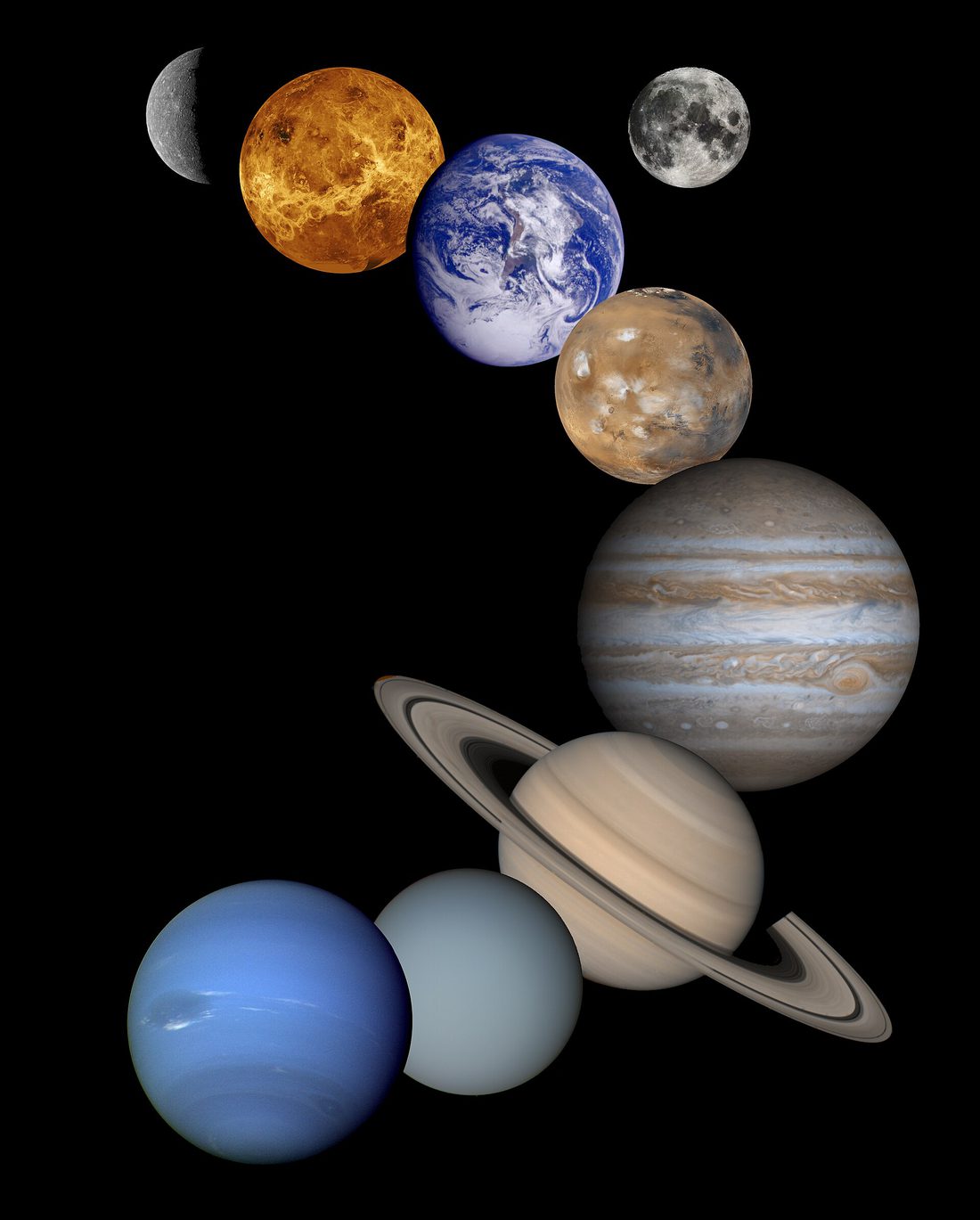
Our solar system is organized by two things at once — how far each planet orbits from the Sun, and what it's made of — and the two turn out to be neatly connected. The four planets closest in are the terrestrial planets — Mercury, Venus, Earth, and Mars — small, dense, rocky worlds with solid surfaces you could (in principle) stand on, and few or no moons. Then comes the asteroid belt, a ring of rocky debris, and just past it the planets change character completely.
Beyond the belt orbit the two gas giants, Jupiter and Saturn — colossal planets made mostly of hydrogen and helium, wrapped in rings and circled by dozens of moons each. Farther still are the two ice giants, Uranus and Neptune, built from icy materials like water, ammonia, and methane mixed with hydrogen and helium. Why the sharp split between little rocky worlds and giant gassy ones? Scientists think it's because the newborn Sun was so hot that close in, only rock and metal could survive to clump into planets while gases boiled away — but far from the Sun, in the deep cold, planets could gather and hold onto enormous envelopes of gas and ice, so they grew huge.
Distances out here are so staggering that ordinary miles and kilometers become almost useless — the numbers are just too big to picture. So astronomers use a shortcut called the astronomical unit (AU): 1 AU is simply the average distance from Earth to the Sun, about 93 million miles (150 million km). Now the whole solar system fits into tidy, comparable numbers — Mars orbits at about 1.5 AU, while distant Neptune crawls around at about 30 AU, that is, thirty times farther from the Sun than we are. It's a bit like measuring a road trip in 'days of driving' instead of writing out every single mile.
For all the attention the planets get, they are almost a rounding error next to the Sun, which holds about 99.8% of all the mass in the solar system — every planet, moon, and speck of rock combined makes up the leftover sliver. Beyond the eight planets orbit dwarf planets like Pluto and Ceres, plus countless smaller bodies. Asteroids are small, rocky objects, most of them circling in the asteroid belt between Mars and Jupiter, left over from the solar system's construction. Comets are icy bodies from the frigid outer solar system; when one swings close to the Sun, some of its ice vaporizes and streams out into the long, glowing tail we can sometimes see from Earth.
Finally, there's a handy little vocabulary chain that trips people up, all describing the same object at different moments. A meteoroid is a small chunk of rock drifting through space. If it plunges into Earth's atmosphere, it heats up until it's glowing white-hot and blazes across the sky as a meteor — the streak we call a 'shooting star.' And if any piece of it survives that fiery plunge and thuds onto the ground, that surviving rock is a meteorite. Knowing how these pieces fit together — the scale of the AU, the makeup of each planet, the debris drifting between them — is what lets scientists plan missions across those enormous distances and understand our own place in the neighborhood.
The solar system formed from a disk of material around the young Sun. Temperature and the available materials contributed to differences between inner rocky planets and outer giant planets. This is a model supported by observations, not a claim that every planetary system must be identical.
A planet's surface and atmosphere reflect interacting factors including gravity, temperature, composition and history. Size alone does not determine habitability. Compare measurements such as atmospheric pressure and liquid-water conditions rather than relying on one label.
Model scale carefully: a diagram that makes planet sizes visible usually compresses their separations. Read whether size and distance use the same scale. Distinguish astronomical units for solar-system distances from light-years used for much larger distances.
Build your understanding
Plan three teaching sessions: core explanation and Parts 1–2; Parts 3–4 with diagrams and reasoning checks; then the whole-unit application, worked examples, independent practice, and exit check. Read one part at a time, explain it without notes, and revisit any gap. Allow about 40–50 minutes per session; adjust after checking understanding.
Part 1 · Use distance and size as different scales
An astronomical unit, or AU, is a distance unit based on Earth’s mean Sun-distance scale, approximately 150 million kilometres. Orbital distance can be represented by a semimajor axis or by instantaneous Sun separation; state which is being used. Planets are very small compared with their separations, so a readable page usually exaggerates their dots. Jupiter’s large diameter and its distance from the Sun are different measurements. A diagram that fits planets tightly together with visible surfaces is often a montage, not a common physical size-and-distance scale.
Read the visual model
Read the selected labeled mean distances against the same linear AU scale. Earth’s label is offset below its near-Sun dot rather than implying a large radius.
Why could a scale showing realistic planet diameters make the distances impossible to fit on a normal page?
Visual reasoning — after your attempt
Diameters are tiny relative to orbital separations. Separate scales preserve readability while clearly stating which quantity each view represents.
Solar-system objects differ greatly in size and separation. A diagram fitting both to one page often distorts one or both. Astronomical units describe orbital distances relative to Earth’s mean Sun distance; they are not object sizes. State whether distances use orbital radius, semimajor axis or instantaneous separation.
A bead model can show relative sizes while a separate long-distance model shows separations. Label the two scales instead of drawing planets apparently touching adjacent orbits.
Pause and explain
Why are separate size and distance scales often useful?
Check your reasoning after answering
The actual proportions are too large to show both clearly on a small diagram.
Part 2 · Explain composition and structure through formation
In a forming solar system, gas and dust occupy a rotating disk. Condensation here means formation of solid material from gases under suitable conditions, not only water droplets. Temperature differences influence which materials can remain as solids, contributing to rocky and volatile-rich building materials. Accretion gathers those materials into bodies. Large planets can retain and accumulate substantial gas, while migration, collisions and changing disk conditions alter later histories. Present distance alone therefore cannot uniquely determine composition, atmosphere or a planet’s full formation story.
Read the visual model
The disk is a process model rather than an actual observed image of the early Solar System. Read each condition/history link separately.
Why should “farther from the Sun” alone not be used as a complete explanation of every planetary property?
Visual reasoning — after your attempt
Materials, growth history, gas retention, migration, impacts and later evolution also matter. Distance helps describe conditions but is not the only cause.
A disk of early gas and dust supported accretion. Temperature and material availability differed with location, influencing what could condense and accumulate. Terrestrial and giant planets reflect different histories, while migration and later impacts complicate a simple distance-only explanation of every property.
Compare rocky surfaces with giant-planet envelopes using actual properties. Being farther away alone does not prove a particular atmosphere or present temperature without composition and energy evidence.
Pause and explain
Why should planetary properties not be inferred from distance alone?
Check your reasoning after answering
Composition, atmosphere, mass, formation and later history also affect them.
Part 3 · Distinguish planets, moons and small bodies
A moon orbits a larger body, while planets and many smaller bodies orbit the Sun under different classification criteria. Asteroids and comets preserve diverse histories and compositions. When a comet approaches the Sun, heating can release gas and dust. Solar radiation and the solar wind influence tail directions; an ion tail tends to point away from the Sun, while a dust tail can curve along a different geometry. A tail need not trail directly behind the comet’s velocity. Activity is an observation to explain, not a criterion that every distant icy body must always show a tail.
Read the visual model
The blue motion arrow and green away-from-Sun tail arrow point in different directions. The tail is one selected ion-tail direction, not a universal dust-tail shape.
Why can a comet tail fail to point behind its direction of travel?
Visual reasoning — after your attempt
Solar wind/radiation affect released material, so tail direction depends on the Sun and material type as well as the orbit. An ion tail points broadly away from the Sun.
Classification depends on orbital and physical criteria, not importance or attractiveness. Moons orbit larger bodies; asteroids, comets and other small bodies preserve different materials and histories. A tail depends on comet activity and solar effects, not simply the direction the object travels.
A comet’s material response near the Sun can produce different tails. Avoid drawing every tail as a trail behind a car; identify sunlight and solar-wind influences in the model.
Pause and explain
Why can a comet tail fail to point behind its direction of travel?
Check your reasoning after answering
Solar radiation and solar-wind effects influence tail orientation rather than travel direction alone.
Part 4 · Use missions as evidence with limits
An image records appearance in specified wavelengths, a spectrum records light–matter interactions and a returned sample permits direct material tests. These observations can complement one another but are not interchangeable. Habitability concerns conditions potentially compatible with life as considered in the model; evidence of water can support one such condition without proving organisms existed. Internal composition, age and biological origin require appropriate evidence and tests of alternatives. State the measurement, its uncertainties and the inference scope before interpreting a dramatic image as a complete history.
Read the visual model
The panels identify measurement types rather than rank them by scientific importance. Connect each to the property it can constrain.
Would a surface image interpreted as an ancient water channel directly prove living organisms were there?
Visual reasoning — after your attempt
No. It can support a geological water-related interpretation with qualifications. Evidence of biological activity needs additional tests and alternative explanations.
Images, spectra, gravitational measurements and samples provide different kinds of evidence. Surface appearance alone does not establish internal composition, exact age or habitability. Compare observations with models and distinguish the conditions needed for a phenomenon from proof that it actually occurs there.
Evidence of past water-related minerals can support a past interaction without establishing present life. Name the observation and the narrower conclusion before extending an interpretation.
Pause and explain
Does evidence of past water automatically demonstrate living organisms?
Check your reasoning after answering
No. It supports water-related conditions; life requires additional evidence.
Apply the whole unit · A two-scale solar-system model
Illustrative model scale: Earth’s mean orbital distance is 1 AU and represented by 10 cm. Three bodies have distances 0.5, 2 and 5 AU.
Your task
Place the bodies at scaled distances, explain why bead diameter needs a separate stated scale, and identify two limitations of the linear display.
What your response should show
- Use the supplied evidence accurately and label units or locations.
- Explain a physical mechanism or evidence-to-claim relationship.
- Show calculations or a clearly labeled model when the task calls for one.
- Identify a meaningful assumption, uncertainty, or competing explanation.
Response guidance — after your attempt
Distances are 5, 20 and 50 cm from the Sun under the stated mean-distance scale. Bead sizes require another scale; a line omits orbital geometry, changing positions and many size/separation ratios. Do not confuse AU with a body’s diameter.
Scientific references and adapted source material
Parent / teacher teaching notes
Ask the learner to state what each measurement represents. Retain the assigned reference table for actual planetary data and use clear source dates rather than memorize every measurement. Ask the learner to explain each visual label and causal step before calculating. Preserve a first model, attempt the changed independent case, then use feedback to revise. Diagrams state whether values are illustrative or observed. Selected OpenSciEd excerpts are middle-school source material used for supported foundations; the independent high-school explanations and supplements are not the complete OpenSciEd teacher editions or an endorsement.
Animation of the Sun at the center with the eight planets — Mercury, Venus, Earth, Mars, Jupiter, Saturn, Uranus, and Neptune — orbiting at increasing distances.
The key idea
The solar system is organized by distance and composition — rocky terrestrial planets close in, gas and ice giants farther out — and astronomical units (AU) keep its huge distances easy to compare.
Astronomical Unit (AU) Conversion
distance (miles) = distance (AU) × 93,000,000
1 AU ≈ 93 million miles (150 million km), the average Earth–Sun distance; multiply to convert AU to miles, divide to convert miles back to AU.
Worked examples
Example 1
- To compare the two distances, divide Mars's distance by Earth's distance.
- 1.5 AU ÷ 1 AU = 1.5.
Example 2 · Worked application
- Rocky planets have substantial solid surfaces and high-density materials.
- Gas giants contain large gaseous/fluid envelopes and differ in structure.
- Use actual data for mass, radius and atmosphere instead of size alone.
Larger radius alone does not determine greater mean density.
Example 3
- Multiply Neptune's distance in AU by the number of miles in 1 AU.
- 30 × 93 million miles = 2,790 million miles.
Example 4
- One AU corresponds to 1 m in this model.
- Multiply 5 AU by 1 m/AU.
Example 5 · Find and fix the mistake
- Test the claim against the stated conditions: Larger radius alone does not determine greater mean density.
- Planets orbit the Sun; moons orbit their primary bodies while also traveling with them around the Sun.
Larger radius alone does not determine greater mean density.
Example 6 · Reason from the visual evidence
- The blue motion arrow and green away-from-Sun tail arrow point in different directions. The tail is one selected ion-tail direction, not a universal dust-tail shape.
- Solar wind/radiation affect released material, so tail direction depends on the Sun and material type as well as the orbit. An ion tail points broadly away from the Sun.
Original qualitative comet/planet/moon scene with exaggerated body sizes and one selected ion-tail direction. It is not a real encounter image or simultaneous orbital-position map. The caption distinguishes the ion-tail example from possible curved dust-tail geometry.
Avoid these mistakes
- A classroom solar-system drawing is rarely to scale in both sizes and separations.
Check your understanding
A model places Earth 1 m from the Sun. At the same distance scale, a planet at 5 AU is how far away?
Discuss the answer
5 m from the model Sun; planet-size scale may still differ.
Why does planetary habitability require more evidence than distance from the Sun alone?
Discuss the answer
Distance influences conditions but does not uniquely determine atmosphere, composition, energy sources, geological history or biology. Evidence for one suitable condition, such as water, does not prove life.
Return to the phenomenon
Return to the initial case. What can an image of a distant world tell us, and what does it leave unknown? Revise your drawing or explanation using two named ideas and one stated limitation.
Compare explanations after your attempt
Solar-system diagrams often use different size/distance scales. Formation and later history influence properties, and mission measurements constrain selected questions. Water-related conditions alone are not proof of life.
What should we investigate next?
Which comparison would test a remaining uncertainty? State what you would change, keep comparable and measure.
Investigate, explain and revise
Complete the tasks after studying the visual parts. Keep the first model and explain a revision before consulting the guidance.
Activity 1 · Explain the opening case
Use this unit’s opening record, Parts 1–4 and your notebook model. No external equipment or text is required for this supplied-data route.
Your task
Return to the initial case. What can an image of a distant world tell us, and what does it leave unknown? Revise your drawing or explanation using two named ideas and one stated limitation.
Success criteria
- Use two stated observations or conditions.
- Connect the mechanism to a labeled diagram or calculation.
- Identify what your original model missed.
- State a useful further test and a limitation.
Hint
Name the quantities and interactions before assigning a cause.
Response guidance — discuss after your attempt
Solar-system diagrams often use different size/distance scales. Formation and later history influence properties, and mission measurements constrain selected questions. Water-related conditions alone are not proof of life.
Activity 2 · Transfer to a changed case
Use the figures, captions and vocabulary in this unit; cover the worked answer.
Your task
A Solar System distance model places a body at a = 10 AU. Convert that scale to kilometres using 1 AU ≈ 150 million km. Explain why the distance and an image of a water-related feature do not alone establish its size or life.
Success criteria
- Use the stated measurements or conditions, with correct units.
- Connect the result to the physical mechanism or evidence relationship.
- Identify the assumption, model limit or further evidence requested.
Hint
Separate measured values, calculated results and model assumptions.
Response guidance — discuss after your attempt
The scale is about 1.5 billion km. It is an orbital distance, not a diameter. A water-related surface interpretation concerns geological conditions and does not alone prove organisms or all habitability requirements.
Words to know
- astronomical unit (AU)
- A distance unit equal to the average distance from Earth to the Sun, about 93 million miles (150 million km); used to keep solar system distances easy to compare.
- terrestrial planet
- One of the four small, dense, rocky inner planets — Mercury, Venus, Earth, or Mars.
- gas giant
- One of the two huge outer planets, Jupiter or Saturn, made mostly of hydrogen and helium gas.
- asteroid
- A small, rocky object orbiting the Sun, most commonly found in the asteroid belt between Mars and Jupiter.
Kepler's laws: orbits aren't just circles at constant speed
In the early 1600s, German astronomer Johannes Kepler analyzed decades of precise observations and discovered that planetary orbits are actually slight ellipses, not perfect circles, with the Sun sitting off-center at one focus. He also found that a planet sweeps out equal areas of its orbit in equal times — meaning every planet moves faster when it's closer to the Sun and slower when it's farther away. His third law revealed a precise mathematical relationship between a planet's orbital period and its distance from the Sun (period squared is proportional to distance cubed), a relationship still used today to calculate the orbits of newly discovered objects.
Born from a spinning cloud: the solar nebula theory
About 4.6 billion years ago, the entire solar system began as a single enormous, slowly rotating cloud of gas and dust that collapsed under its own gravity, forming the Sun at the dense center while the leftover material flattened into a spinning disk — explaining why every planet still orbits in roughly the same plane, in the same direction. Beyond an invisible boundary called the frost line, temperatures were cold enough for ices to solidify, letting the outer planets accumulate huge amounts of material and grow into gas and ice giants, while the inner planets, too close and warm for ice to survive, stayed small and rocky.
The vote that cost Pluto its planet status
Pluto was considered the solar system's ninth planet from its discovery in 1930 until 2006, when astronomers started finding other icy, Pluto-sized worlds even farther out in the Kuiper Belt — including Eris, which is nearly as large as Pluto. Rather than declare dozens of new 'planets,' the International Astronomical Union voted in 2006 on a formal definition requiring a true planet to have gravitationally 'cleared its neighborhood' of other debris — a test Pluto fails, since it shares its orbital region with countless other Kuiper Belt objects. That reclassified Pluto as a dwarf planet, a decision still debated by some astronomers today.
If the Sun were a basketball
The distances described by astronomical units are so vast they're hard to picture, so try this scale model: shrink the Sun down to the size of a basketball. On that scale, Earth would be a peppercorn sitting about 30 yards away, Jupiter would be a golf ball roughly 150 yards out, and Neptune — at 30 AU — would sit almost half a mile from the basketball Sun. And the next-nearest star beyond our solar system, at that same scale, would be roughly 4,000 miles away — a vivid reminder of just how empty and enormous space really is.
In the real world
Mission planners at NASA use AU-scale distances and orbital timing to launch spacecraft toward Mars only during the few-week launch windows that occur roughly every 26 months, when Earth and Mars line up for the shortest possible trip.
Exit check
Compare terrestrial planets with giant planets using composition and location.
Check your explanation after answering
The inner terrestrial planets have rocky surfaces and relatively small sizes. Jupiter and Saturn are gas giants; Uranus and Neptune are ice giants with different compositions. All four giant planets orbit farther from the Sun than the terrestrial planets.
Explain your reasoning without notes. If a key idea is missing, revisit the lesson and try again.