Calculus I · A Toolkit for Slopes
The exponential, and the derivatives of inverse functions
The exponential cameo. One function deserves a special mention here and a full chapter (Chapter 5) of its own: , the function that is its own derivative,
(From the definition, the difference quotient is , and the fact that is precisely what singles out the number — the loan you flagged in Chapter 3’s Looking-ahead, repaid in Chapter 5.) Combined with the chain rule, this differentiates every exponential you’ll meet: , .
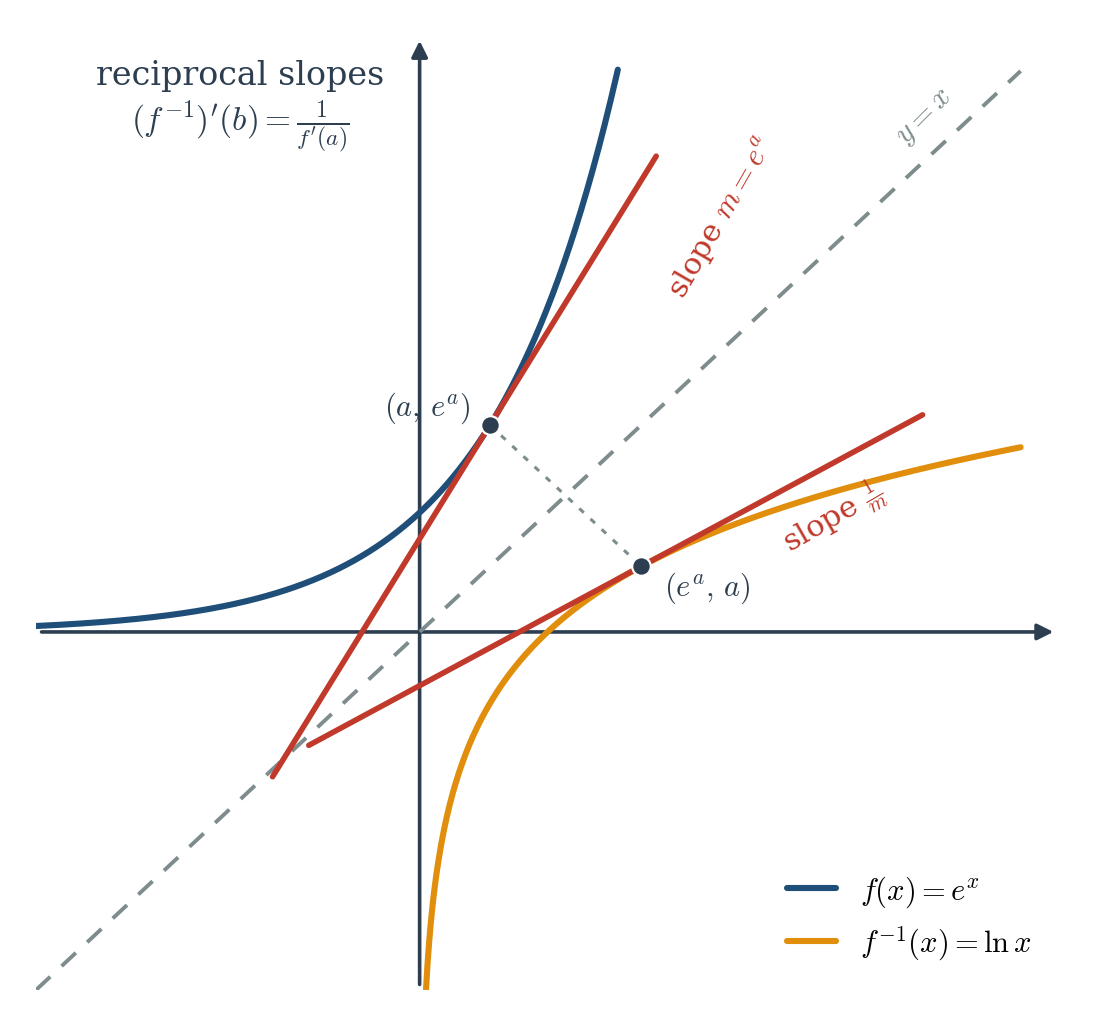
Inverse functions. The last tool in the kit, and the one Chapter 5 needs to differentiate the logarithm. Suppose is the inverse of — meaning for all . Differentiate both sides with the chain rule: the left side gives , the right side gives . Solve:
Inverse-Function Rule. If , then
The picture is clean: an inverse reflects a graph across the line , which swaps “rise” and “run” — so the slope of the inverse at a point is the reciprocal of the slope of the original at the matching point. And it passes an honesty check against Chapter 3: is the inverse of (for ), and since , the rule gives — the same answer you rationalized by hand, now obtained without a single difference quotient. This is exactly the machinery Chapter 5 will turn on (the inverse of ) to discover that its derivative is .
Toolkit: The rules of differentiation
Rule Formula Power Sum Constant multiple Product Quotient Chain Sine / Cosine Exponential Inverse With these, you can differentiate essentially every function in this book — no difference quotients required. The art is recognizing which rule (or combination) a given function calls for.