Calculus I · Building a Function From Its Derivatives
The honest part: how wrong is the approximation?
A Taylor polynomial is an approximation, and an approximation you can’t bound is a guess. So we account for the gap exactly. Write
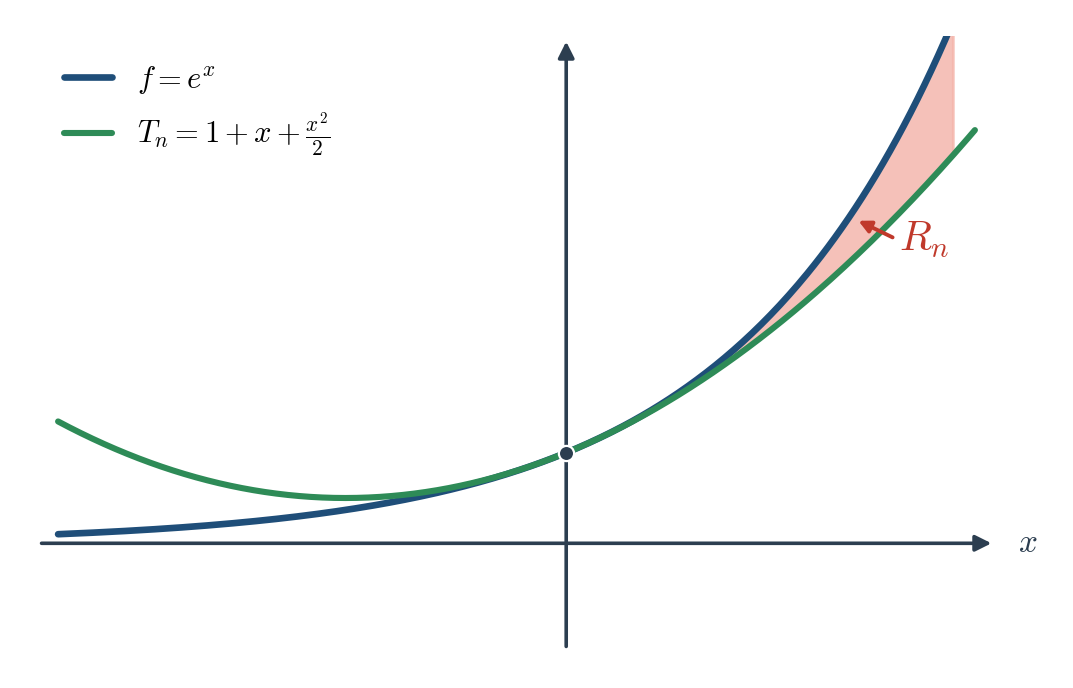
where is the remainder — everything the polynomial missed. Taylor’s theorem gives it a stunningly clean form:
Taylor’s Theorem (Lagrange remainder). For some point between and ,
Stare at that. It is exactly the next term of the series — the -th — except the derivative is evaluated not at the center but at some unknown point in between. And now look at the smallest case, :
That is the Mean Value Theorem. The case is — the “second-order MVT” we previewed in Chapter 6. Taylor’s remainder is the Mean Value Theorem, escalated one derivative at a time. This is precisely why we proved the MVT — and its Cauchy cousin — before we got here: they are the engine that produces this error term.
The unknown might look like it ruins everything — how can a formula with a mystery point be useful? Because you don’t need to find ; you only need to bound over the interval. If between and , then
Worked example — with a guarantee. Take , , , so . The remainder needs , and on we have . So
We have proven, without a calculator, that is within of the true . (It is: the true value is , off by .) That is the difference between Taylor as a suggestion and Taylor as mathematics: the remainder turns “approximately” into a number you can stand behind.
◆ Layer 2 — Proof of Taylor’s theorem with Lagrange remainder
Fix the target . Choose the number that makes the equation exact: . We’ll show for some . Define, as a function of a moving center , Two endpoint checks: (only the term of the sum survives at , giving ), and by our choice of . So , and Rolle’s theorem (Chapter 6) gives a with . Now differentiate . The sum telescopes — each term’s product-rule pieces cancel against the next term’s — leaving only So . Setting and canceling : One auxiliary function, one application of Rolle — the same tilt-and-flatten move that gave us the MVT itself, run at higher order.
◆ Layer 2 — Why actually equals its series everywhere
Having a series isn’t the same as the series being true. For it is, for every , and the remainder proves it. With , for some between and , so . Fix and let : the factorial in the denominator overwhelms the power in the numerator (you saw in Chapter 1 how violently outgrows any fixed base raised to ), so . The polynomials converge to itself. That is what licenses writing “” instead of “.”