Calculus I · Maxima, Minima, and the Shape of a Function
Finding the global extremum on a closed interval
Often the domain is a closed interval — a quantity that can’t go below or above . Here the Extreme Value Theorem from Chapter 2 makes a flat guarantee: a continuous function on a closed interval does attain a global maximum and a global minimum somewhere on it. They exist; we just have to find them. And the candidate list is finite:
Closed-interval method. To find the global max and min of a continuous on : 1. Find all critical points inside . 2. Evaluate at each critical point and at both endpoints and . 3. The largest value is the global max; the smallest is the global min.
The endpoints earn their place because Fermat’s theorem only governs interior extrema — on a closed interval, the highest point can sit at an edge where the slope never had to be zero. (Figure 8.5: a curve on whose global maximum is at an interior critical point but whose global minimum is at an endpoint, showing why both must be checked.)
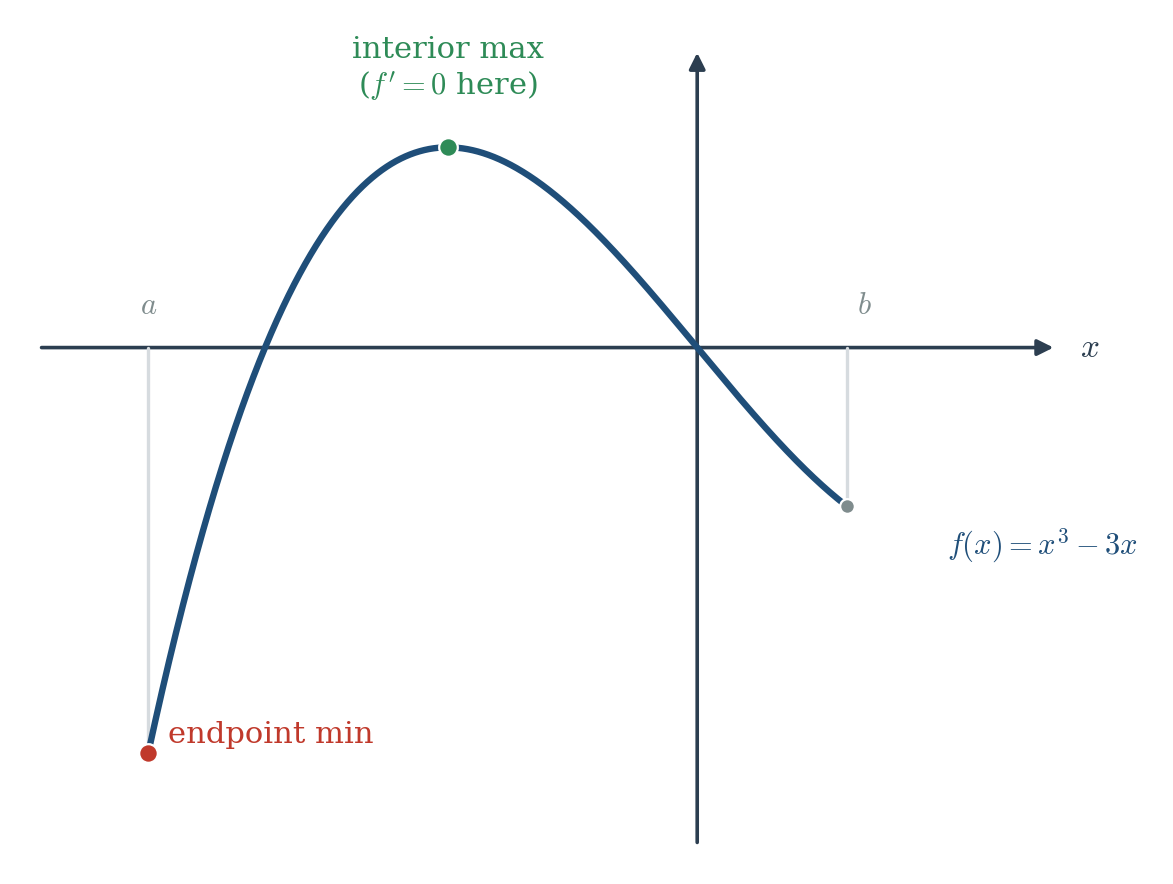
Worked example. Find the global extremes of on . Critical points: , of which only is in . Evaluate at the candidates : , , . So the global minimum is at , and the global maximum is at the endpoint . (Notice the max hid at an endpoint — exactly the case the method is built to catch.)
Optimization in the wild: a worked design problem
The real payoff is turning a word problem into a function and minimizing it. Here is the genre’s classic, an honest engineering question.
Problem. A cylindrical can must hold a fixed volume . What dimensions use the least metal (least surface area)?
Set it up. A cylinder of radius and height has surface area (two circular ends plus the wall) and volume . We want to minimize , but it has two variables — so use the volume constraint to eliminate one. From , , and substituting:
Optimize. Set : . Confirm it’s a minimum (not a max): for all — so is convex, and by our theorem this lone critical point is the global minimum. No further checking needed; convexity guarantees it.
Read the answer. With , the height works out to . The most efficient can is exactly as tall as it is wide (, height equals diameter). That’s a clean, memorable design law — and the reason real cans aren’t shaped that way is that they optimize for shelf appearance and grip, not metal, which is its own lesson about what “optimal” means once you choose the right thing to minimize.