Calculus I · Maxima, Minima, and the Shape of a Function
The second derivative: how a function curves
The derivative of the derivative, , is the rate of change of the slope — and that measures curving. Watch what its sign means:
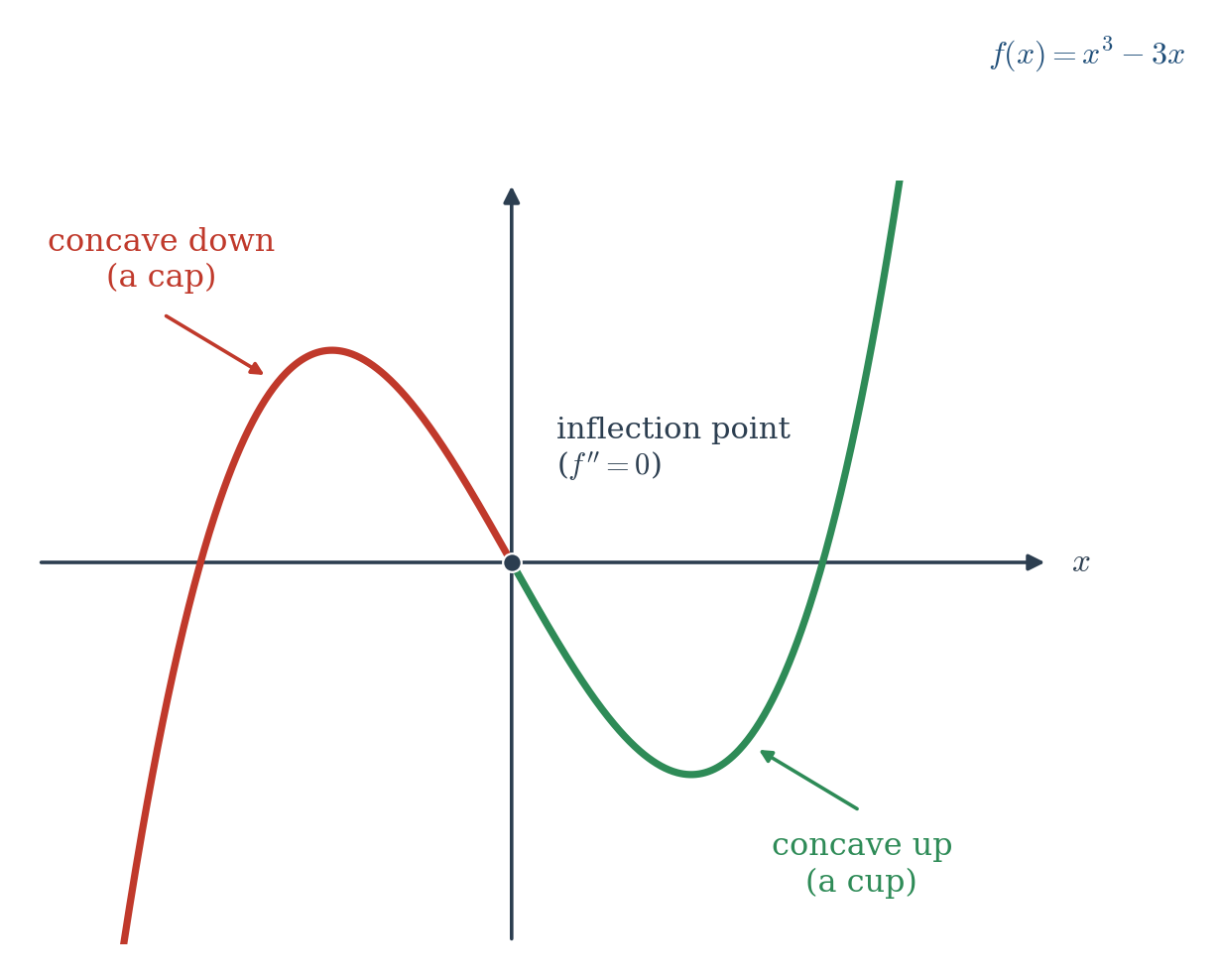
- : the slope is increasing (getting more positive or less negative as you move right), so the curve bends upward — like a cup, or a valley. We say is concave up.
- : the slope is decreasing, so the curve bends downward — like a cap, or a hilltop. We say is concave down.
A point where the concavity switches — where changes sign — is an inflection point, the spot where a curve stops bending one way and starts bending the other (the steepest point of an S-shaped growth curve, for instance). (Figure 8.3: a single curve colored by the sign of — concave-up stretches as cups, concave-down as caps, with the inflection point where they meet.)
This gives a second, often faster, way to classify critical points.
The second-derivative test (and where it came from)
At a critical point — where — the concavity settles the question immediately:
Second-Derivative Test. Suppose . - If , then is a local minimum (the curve cups upward there). - If , then is a local maximum (it caps downward). - If , the test is inconclusive — could be a max, a min, or neither.
Where does this come from? Straight from Chapter 7. Near a critical point, the Taylor quadratic loses its linear term (because ) and becomes
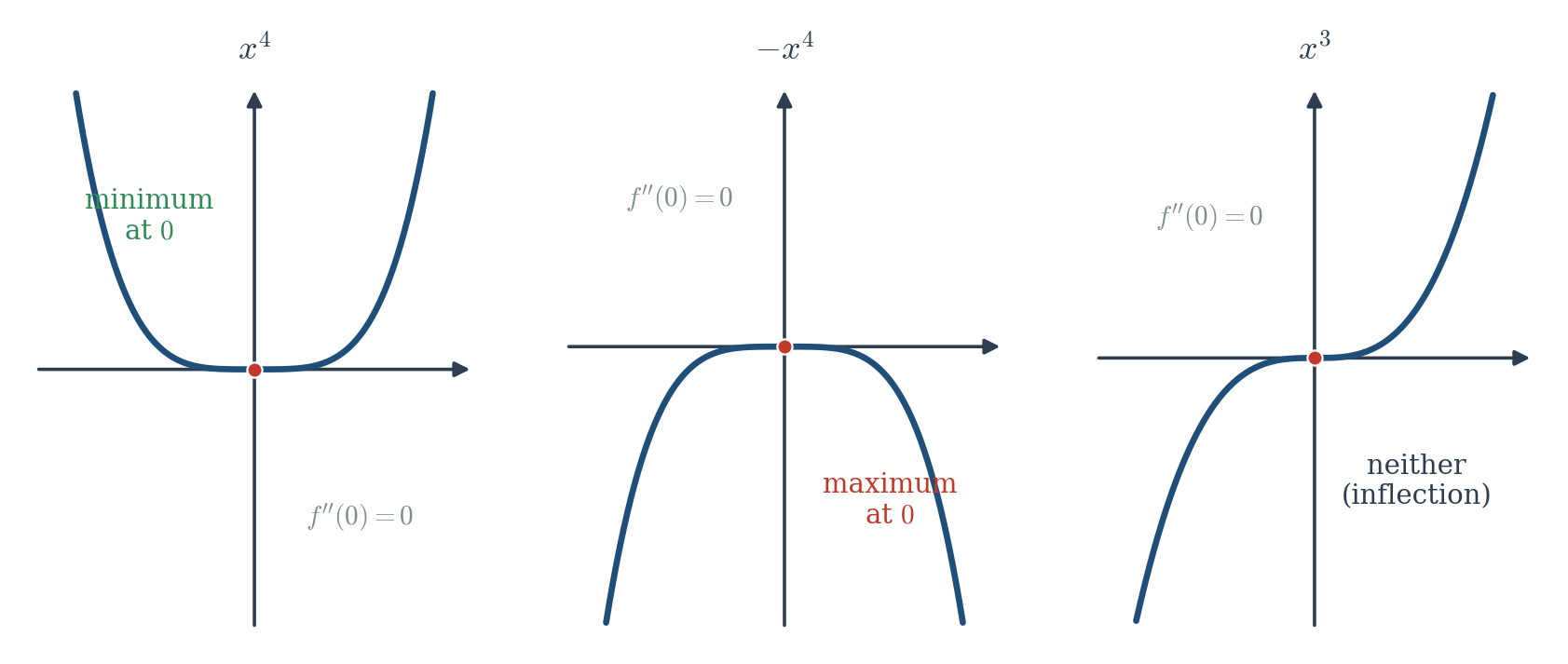
That is a parabola sitting at . If the parabola opens upward — a minimum; if it opens downward — a maximum. The second-derivative test is nothing more than reading the leading Taylor term at a critical point. And the inconclusive case is honest: when , the parabola is flat and the next Taylor term takes over — for (a min), (a max), and (neither), all have , and only the higher terms tell them apart. (Figure 8.4: the three functions , , near , all flat to second order, showing why can’t decide.)
Toolkit: Classifying a critical point (where )
- Second-derivative test (fastest): compute . Positive → min, negative → max, zero → fall back to step 2.
- First-derivative test (always works): check the sign of just left and just right of . → max, → min, no change → neither.