Calculus I · Patterns That Go Somewhere
Limits that fight back
Everything so far has been gentle: substitute, simplify, read off the answer. The limits that teach you something are the ones where that fails. Look at these three:
Try the naive move on the first. As , the factor runs off to infinity while the parenthesis collapses to . So the answer is… infinity times zero? That is not a number. It is a fight between a part pulling the product up and a part pulling it down, and “” is just our shorthand for “the winner is not yet decided — look closer.”
These deadlocks have a name: indeterminate forms. The usual suspects are
When substitution lands you on one of these, you have learned exactly one thing: you cannot stop here. The limit might be , might be , might be any finite number in between — it depends on how fast each part moves, and finding out is the whole skill. Our three sequences are, in order, an , an , and a . Let’s win all three. First we need one new tool.
Toolkit: The Squeeze Theorem
If a sequence is trapped between two others heading to the same place, it has no choice but to go there too.
Squeeze Theorem. If for all large , and both and , then .
Use it when itself is hard but you can bound it above and below by things you understand. The art is choosing good walls.
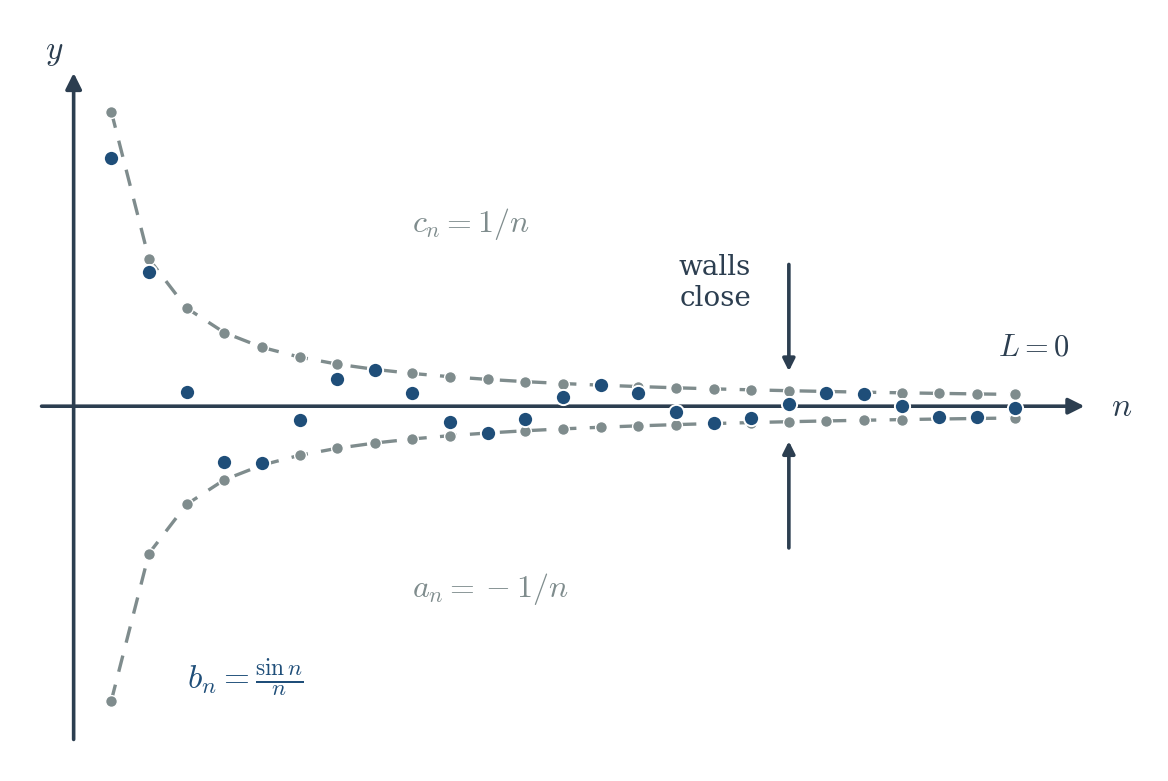
A quick win, to watch it move: what is ? The numerator lurches around forever and has no limit of its own — but it never escapes the corridor . Divide through by :
Both walls, , go to . Squeezed between them, — and we never had to tame the wild numerator. We just fenced it in.
◆ Proof: the Squeeze Theorem
Play the game. Given : since there’s a cutoff past which ; since there’s a cutoff past which . Let be the larger of the two. Then for every , the sandwich gives so . Beaten for every , so .
Fight one: (an )
The move with an indeterminate form is almost always to rewrite it until a shape you can finish. Here the troublemaker is the difference of a square root and , and the standard cure is to rationalize — multiply by the conjugate over itself, which turns the difference of roots into a clean difference of the things under them:
The canceled the — the two combatants annihilated, leaving something tame. As , , so the bottom heads to , and
Not , not , but exactly : the growing and the shrinking parenthesis were perfectly matched, and they balance at one-half. (Tuck this away: in Chapter 3 you’ll recognize as the slope of at . You are computing a derivative right now without knowing it — and we’ll meet the same -after-rationalizing move again the moment we reach functions in Chapter 2.)
Fight two: (an , and a genuine surprise)
This one should bother you. Take the -th root of : , , , , . The thing under the root is racing to infinity, yet the root is settling toward . The form is — a huge base, a vanishing exponent — and the vanishing exponent wins. (Intuition: roots are ferocious levelers; a giant number rooted hard enough is tamed almost to .) The proof is a small gem.
◆ Proof:
Since , write with ; we must show . Raise to the -th power: . Expand by the binomial theorem and throw away every term but one — keep only the term, legal because all terms are nonnegative: Divide by : , so . The right wall is built from , so it ; the left wall is . Squeeze: , hence . The trick worth stealing: when a binomial expansion is all-positive, keeping a single well-chosen term is a valid lower bound — and one term is often all you need.
Making the theorem earn its living: a sequence that defines itself
The monotone-convergence principle feels abstract until you meet a sequence with no formula at all, built by feeding each term back into itself:
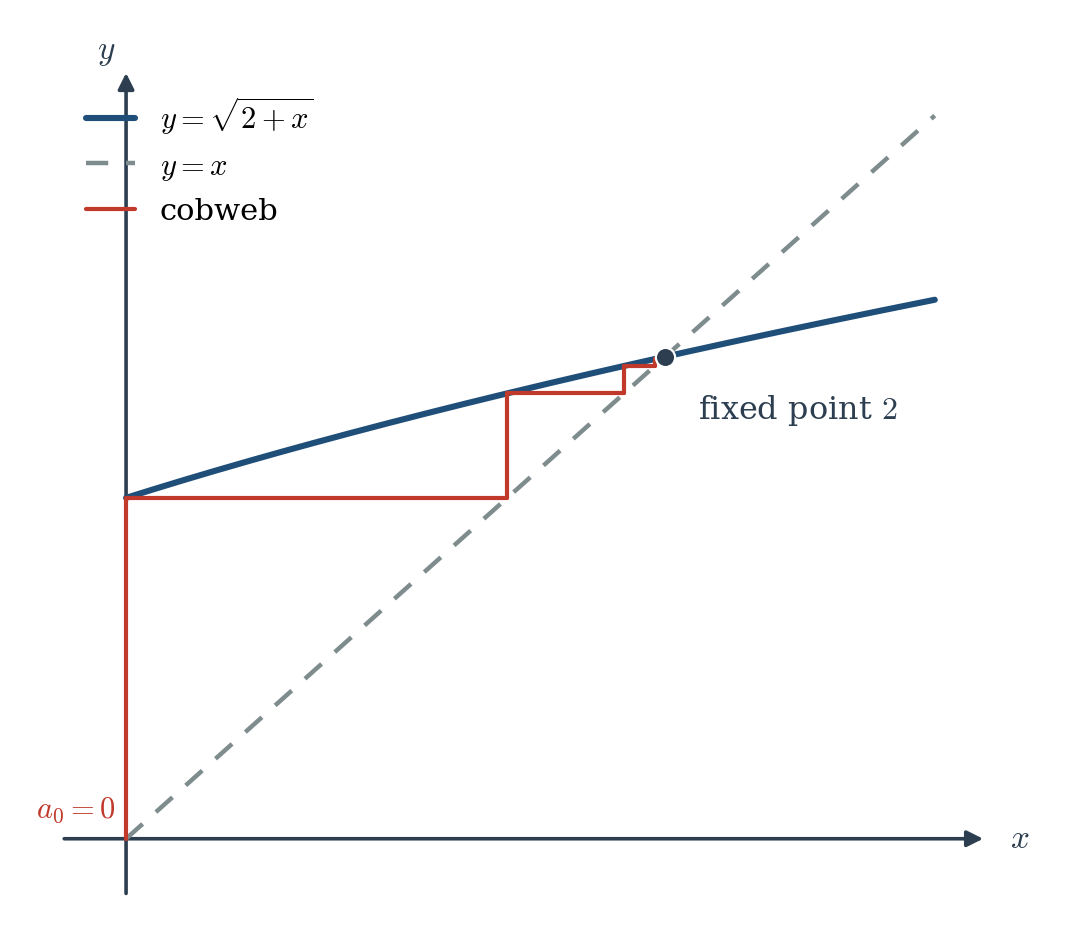
So , , , climbing toward… something. We can’t write in closed form — but we can still find the limit exactly, and this is the principle’s finest hour.
◆ Layer 2 — Solving a self-defined sequence
Step 1 — bounded above by (induction): ; and if , then . So every term stays under . Step 2 — increasing: means , i.e. (square, both sides positive) , i.e. , i.e. — true for every with , which Step 1 guarantees. Step 3 — therefore it converges (increasing and bounded above) to some limit . Step 4 — pin down . Take the limit of both sides of the rule . The left side ; the right side . So must obey its own equation: Hence (reject : the terms are positive). The sequence we couldn’t even write down converges to exactly . That move — let the limit satisfy the rule — is your first fixed point: a value a process leaves unchanged. It returns whenever you study how an iteration settles, including, in spirit, the iterations of Chapter 8.