Calculus I · The Function That Is Its Own Slope
Hunting for the base that leaves the axis at slope 1
We want the base where the curve crosses the -axis at slope exactly — where . Let us just measure for a few bases by taking very small in . (This is the kind of thing a calculator, or the notebook for this chapter, does in a heartbeat. Try .)
| base | slope at the axis, |
|---|---|
For the curve leaves the axis too gently — slope only . For it leaves a little too steeply — slope . So somewhere between and there is a base where the slope is exactly . (If you want this argument made airtight: slides smoothly upward as grows, it is below at and above at , so it must hit somewhere in between. We will sharpen “slides smoothly” later, but the picture is honest.)
That special base gets its own letter. We call it :
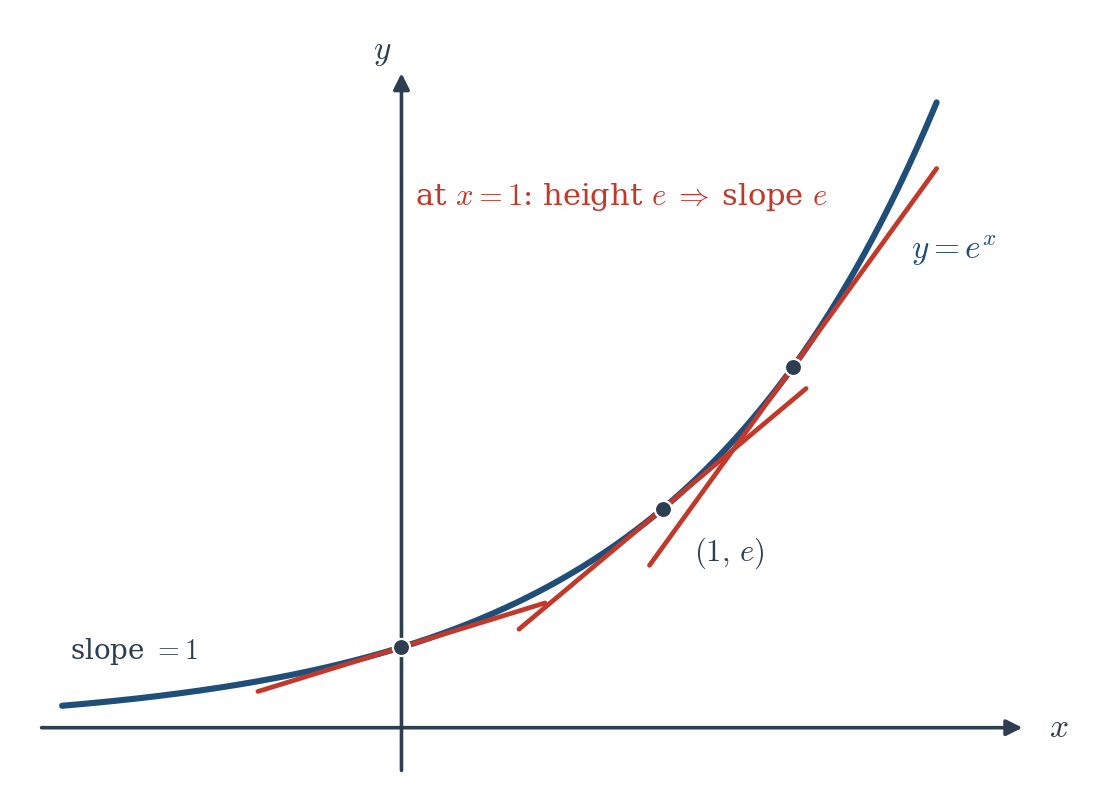
and it is defined to be the base for which . The instant we say that, the boxed rule gives us our prize:
This is the function that is its own slope. We did not pull it out of a hat. We went looking for a function equal to its own derivative, discovered that every exponential is almost one (off only by a constant ), and then picked the one base that makes the constant vanish. The number is exactly the price of that wish.
(Figure 5.2: with tangent lines drawn at several points. At every point, the steepness of the tangent equals the height of the curve. Where the curve is at height , the slope is . That is what “its own derivative” looks like.)
A promise about , to be kept in Chapter 1’s other form
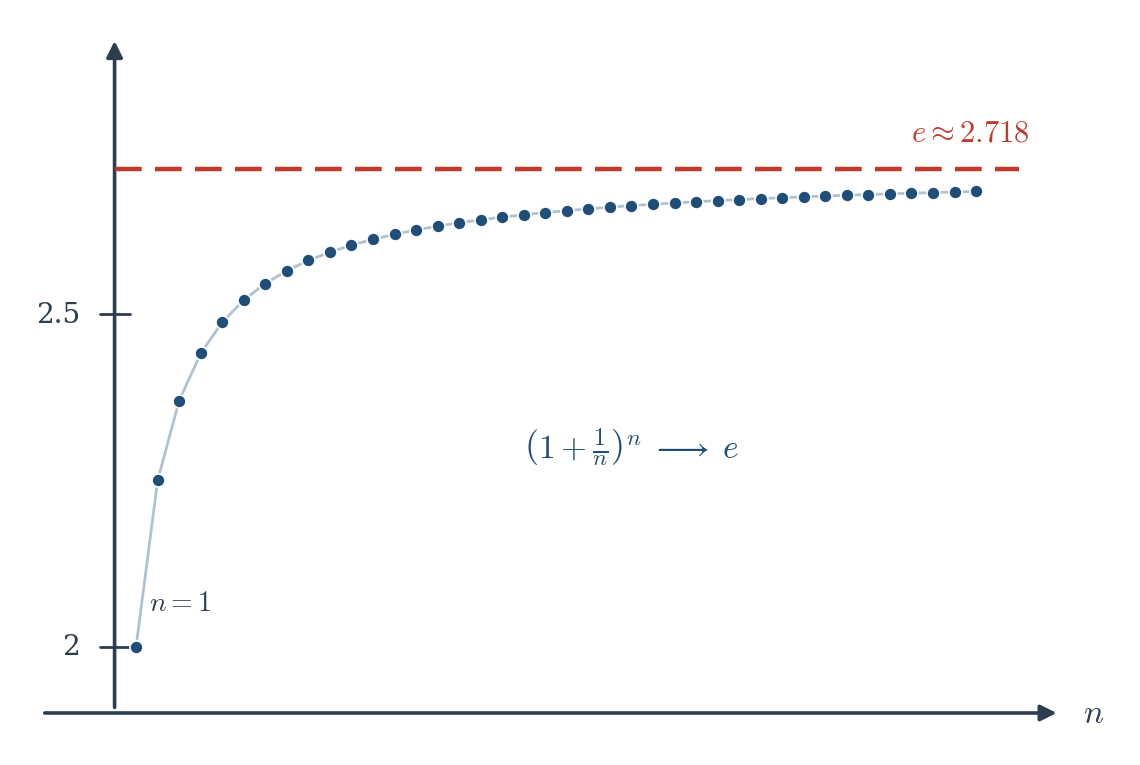
Back in Chapter 1, when we played with sequences, we watched the quantity creep upward as grew — , then , then , settling toward . That was the same number . It is not obvious that “the base whose curve leaves the axis at slope ” and “the number that sneaks up on” are the same number. They are. This is the loan I warned you about. For now, take it as a promise backed by the matching decimals; in Chapter 10, with integrals in hand, we will prove the two descriptions of are genuinely one number.
Toolkit: Differentiating exponentials
- — the headline. The function is its own derivative.
- — by the chain rule from Chapter 4 (outer function , inner function , inner derivative ).
- — the mystery constant turns out to be . We prove this two pages from now.
The middle line is the one you will use most. The constant being positive means growth; negative means decay. That single sign is the difference between rabbits and radioactivity.