Calculus I · The Fundamental Theorem of Calculus
The capstone: defining the logarithm, and settling every debt
We end by paying our debts. All through this book we borrowed: in Chapter 1 we asserted the number exists; in Chapter 5 we used and the laws of logarithms; each time we flagged it as a loan against a later, rigorous account. This is that account. And the instrument that settles everything is the one antiderivative the power rule could never produce — the missing case, .
So we turn it around and make it a definition:
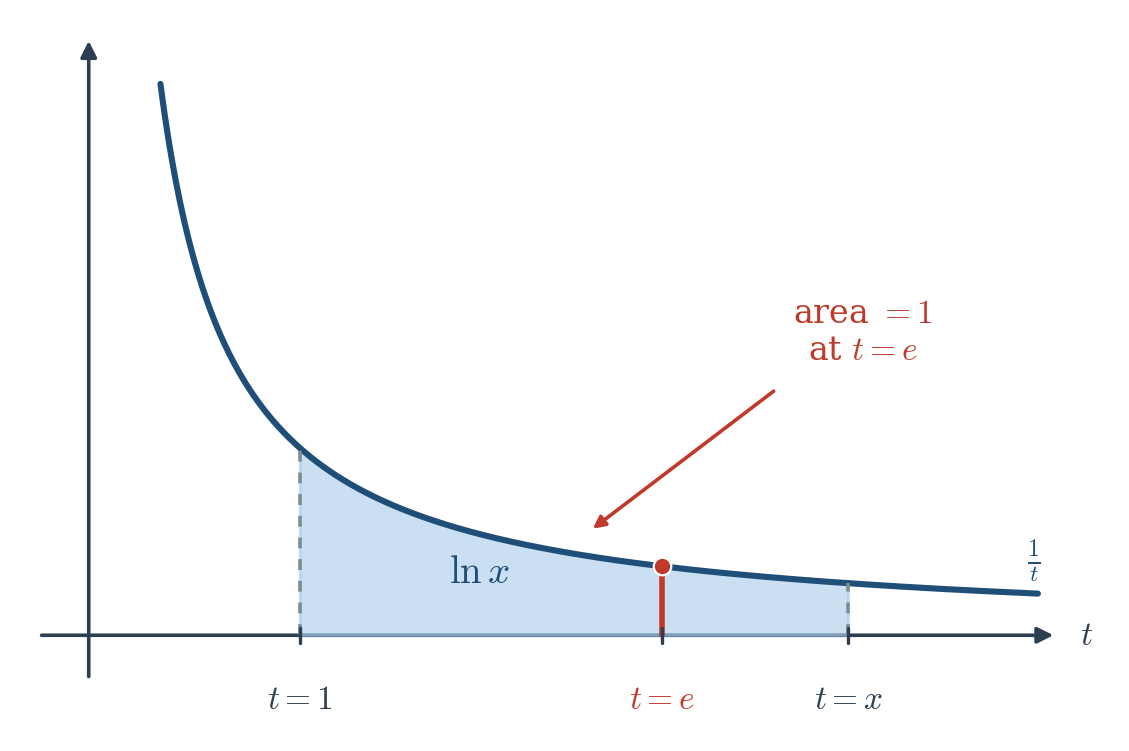
We define the natural logarithm to be the area under from to . From this one line, with nothing assumed, every property of we ever used falls out as a theorem:
- : it’s , an integral over no width. ✓ (The loan that — repaid by definition.)
- : immediate from the Fundamental Theorem, Part 1 — the derivative of is the integrand . The fact we assumed in Chapter 5 is now a one-line consequence. ✓
- is increasing for : its derivative is positive. And it grows without bound as (the area under never stops accumulating). ✓
- The product law : split the defining integral and substitute. We have . In the second piece let (so , and becomes ): it turns into . Hence — the signature property of logarithms, emerging from integral additivity and a substitution. ✓
- The number exists: define as the unique number with — i.e. the right edge at which the area under first equals . It exists because is continuous with and grows past , so by the Intermediate Value Theorem (Chapter 2) it hits somewhere. This is the very loan from Chapter 1 — that exists at all — now discharged completely. ✓
- and its derivative: the exponential is simply the inverse function of , and follows from the inverse-function rule (Chapter 4). ✓
Every promissory note the book ever wrote is now paid. The whole edifice — , , , their derivatives and laws — which we used freely and honestly flagged as borrowed, rests in the end on a single integral and the Fundamental Theorem. The account balances. (Figure 11.2: the curve with the area from to shaded and labeled ; a second marker at where the accumulated area first reaches exactly .)