Calculus I · The Fundamental Theorem of Calculus
The payoff: areas become subtractions
Part 1 says the area function is an antiderivative of . But antiderivatives are easy to find — just reverse the Chapter 4 rules — and they all differ by a constant (Chapter 6’s Mean Value Theorem, via Chapter 10’s ). Chain those two facts together and the laborious definite integral collapses into arithmetic.
Fundamental Theorem of Calculus, Part 2. If is continuous and is any antiderivative of (any function with ), then
Why it’s true. The area function is one antiderivative (Part 1). Your is another, so they differ by a constant: . Then since . The constant cancels; any antiderivative works.
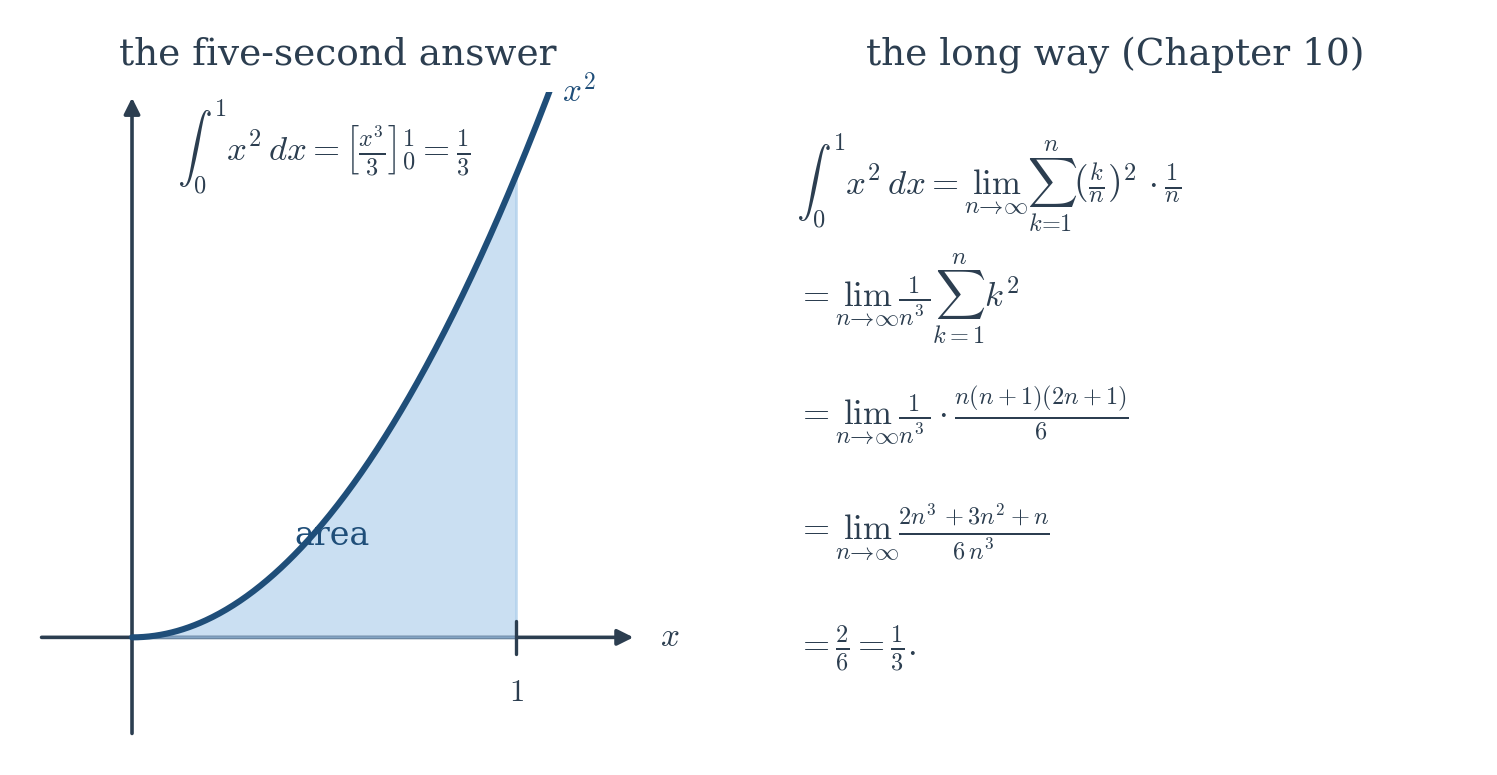
We write as . And now watch Chapter 10’s hardest computation evaporate. There, finding took a page of Riemann sums and the sum-of-squares formula. Here:
Five seconds. Find an antiderivative, plug in the endpoints, subtract. Every area you can find an antiderivative for is now this easy: ; .
The miracle, stated plainly
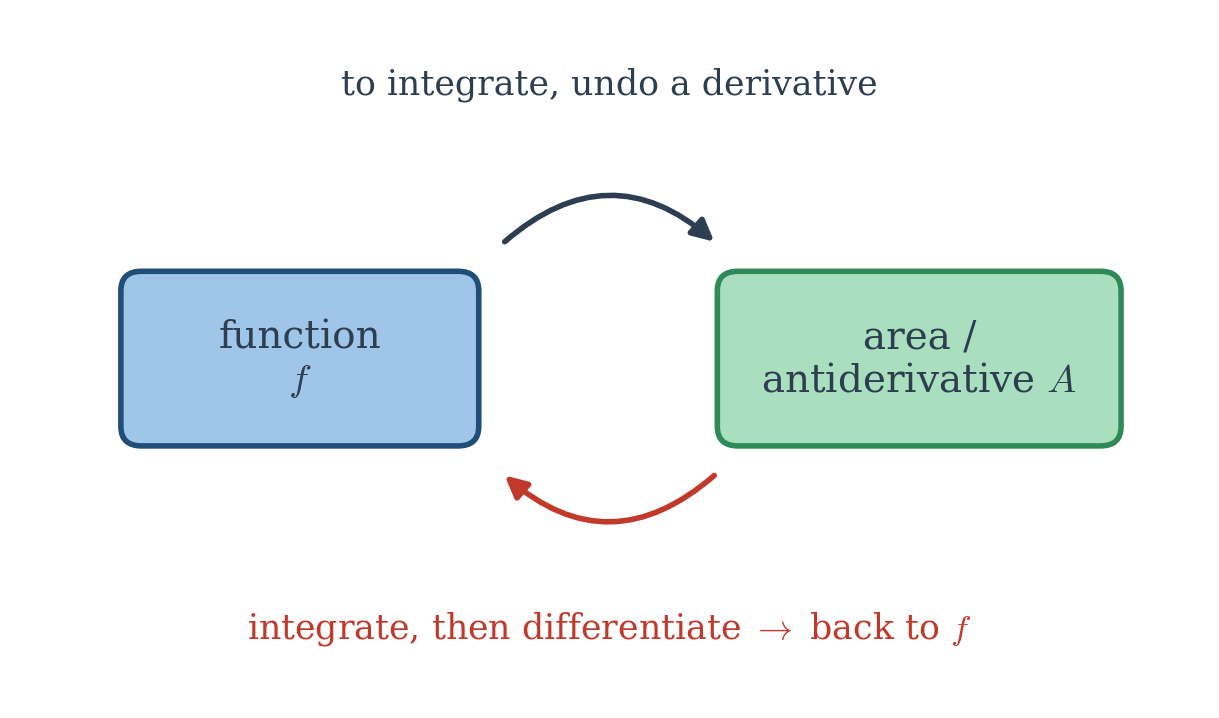
Stand back and see what just happened. Differentiation and integration are inverse operations — the two engines we built in total isolation, one measuring slopes and one measuring areas, are a single engine running in opposite directions. Part 1 says: integrate, then differentiate, and you return to where you started (). Part 2 says: to integrate, just undo a derivative. Slope and area, which have no visible relationship, turn out to be reciprocal questions. That two such different ideas are secretly the same is the reason calculus is not two subjects but one, and it is the engine under essentially all of physics, engineering, and quantitative science.