How Cars Work
From Bang to Wheels
CHAPTER FOUR
BANG. The piston flies down toward the bottom of the cylinder, riding the explosion. Through the connecting rod, it pushes the crankshaft around, the way your knee pushes a bicycle pedal.
Now we have a long, heavy metal rod, spinning fast. The wheels are over there. We need to get the spinning of the rod to the spinning of the wheels.
This sounds easy. It is not.
The problem
A car engine is fussy. It works best when its crankshaft is spinning at a particular range of speeds — usually between 1,000 and 5,000 turns per minute, which mechanics shorten to RPM. Below that range, the engine doesn’t have enough momentum to keep itself going and stalls out. Above it, it starts shaking itself apart.
The wheels of the car, on the other hand, need to spin at very different speeds depending on what the car is doing. When the car is parked, the wheels are at zero RPM. Creeping out of a parking spot, maybe 50 RPM. On the highway at 65 miles per hour, the wheels are spinning at about 800 RPM.
So we have an engine that wants to spin between 1,000 and 5,000 RPM, and wheels that need to spin between 0 and 800 RPM. These ranges don’t match. They don’t match at any speed.
What do we do?
Gears
The answer is gears. A gear is a wheel with teeth around its edge. When two gears are meshed together — their teeth interlocked — turning one of them turns the other.
The thing that makes gears interesting is what happens when the two meshed gears are different sizes.
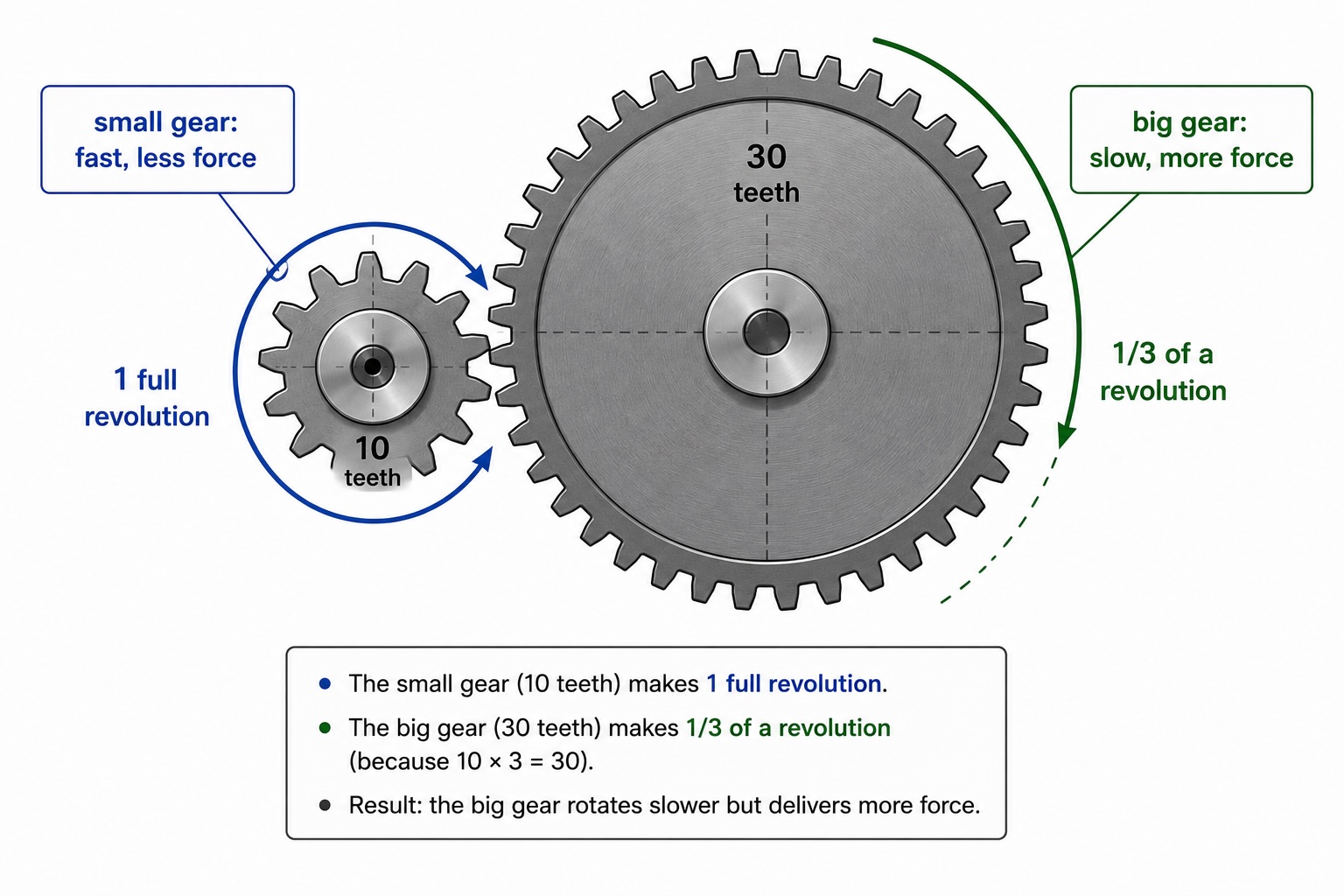
Picture a small gear with ten teeth, meshed against a big gear with thirty teeth. If you turn the small gear all the way around once, you push exactly ten teeth past the meeting point. The big gear has to turn far enough to receive those ten teeth on its own side — which, since it has thirty teeth, means it turns one-third of the way around.
So one full turn of the small gear gives one-third of a turn of the big gear. The small gear turning fast makes the big gear turn slowly. The ratio between them is three to one.
But there is a trade. When the big gear turns slowly, it turns with three times as much force as the small gear was turning with. This is the deal that gears offer everywhere they appear, in cars and bikes and clocks and wind-up toys: you can trade speed for force, or trade force for speed, but you cannot get more of both.
If you have ever ridden a bicycle with multiple gears, you have used this trade-off without thinking about it. In a low gear, one push of the pedals barely moves you forward — but it doesn’t take much effort to push, and you can get the bike moving even up a steep hill. In a high gear, each push of the pedals carries you a long way — but pushing is harder, and you can’t really start in high gear from a standstill. Same legs, same bike, different deal.