How the World Got Wired · 2012 and After
The Aftermath, in Days
The reaction was, by academic standards, immediate.
Within weeks of the AlexNet result, every major technology company in the world had suddenly become extremely interested in hiring people who worked on neural networks. Researchers who had been struggling for funding for two decades found their phones ringing. Graduate students who had taken Hinton’s quiet, unfashionable specialty as their dissertation topic found themselves, overnight, the most-recruited young people in technology.
By the late autumn of 2012, Hinton and his two students had received, separately and informally, expressions of interest from several of the world’s largest technology companies. The companies wanted to hire them. The companies wanted to license their techniques. The companies wanted them, in some form, on staff.
Hinton, Krizhevsky, and Sutskever had a small problem. They were not, strictly speaking, a company. Their work had been done at the University of Toronto, on equipment that was partly Hinton’s own and partly the university’s. The intellectual property situation was complicated. So, on the advice of a lawyer, they did something formal but unusual: they incorporated themselves into a tiny company called DNNresearch, which contained the three of them and essentially nothing else.
DNNresearch had no employees other than the founders, no product, no offices, and no revenue. What DNNresearch had was the three people who had just done the most discussed scientific work in computer science.
Then they decided to auction themselves.
Lake Tahoe
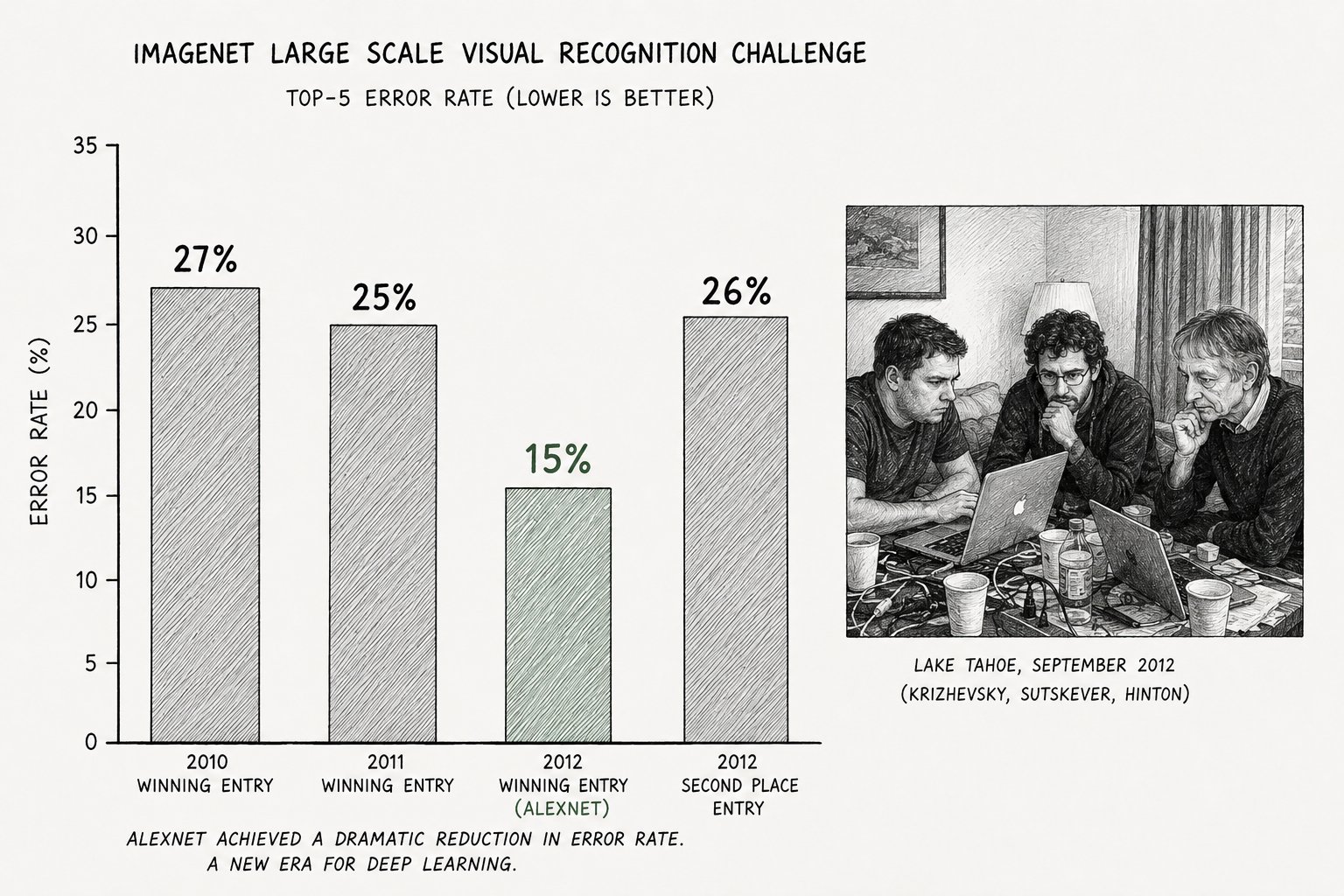
The auction took place in December of 2012, at a hotel called Harrah’s at Lake Tahoe, on the California-Nevada border, during the annual Neural Information Processing Systems conference. Most of the world’s experts in machine learning were in the same building, presenting papers, drinking coffee, networking. Hinton, Krizhevsky, and Sutskever — and a lawyer they had hired — were in a hotel room on a high floor, taking phone calls from companies competing to buy DNNresearch.
There were four bidders.
Two of them were giant American companies: Google and Microsoft. Both wanted to acquire DNNresearch outright and make Hinton and his students part of their internal research teams.
One was a young British company called DeepMind, founded in London in 2010, which had been trying to build artificial intelligence using neural networks and was, at that time, still a small independent startup. DeepMind would, two years later, be acquired by Google itself.
The fourth was Baidu, the giant Chinese search company you read about in Chapter 17. Baidu wanted Hinton and his students badly. Baidu was offering, by some accounts, the highest amount of money.
The bidding lasted several days. The numbers kept going up. The lawyer in the hotel room kept fielding calls. According to interviews Hinton has given since, the final bids reached well over $30 million for a company that, again, consisted of three people, two laptops, and an idea.
Hinton has said, in interviews, that at a certain point in the bidding he stopped raising the price. He decided he would prefer to work at Google. Google’s offer was lower than Baidu’s. He took Google’s offer anyway, partly because of geography (Toronto is closer to Mountain View than to Beijing), partly because of culture, and partly, he has admitted, because he was tired and just wanted the auction to end.
The final number — what Google paid to acquire DNNresearch — was $44 million.
Hinton’s share, after splitting it with his two graduate students, was approximately $14 million.
Fourteen million dollars. Enough to take care of his family, with very careful planning, for decades. Enough to make sure that his son’s care would be paid for, with savings to spare. Enough to never again worry about how he was going to afford the rest of his life.
The professor who had spent twenty-five years on small Canadian grants, who had been trying to make money from a Coursera course six months earlier, was suddenly, in late December of 2012, financially secure for the rest of his life. So were his two students. Each of them, in their late twenties, became wealthy.
The man who had left America in 1987 because he did not want corporate or military money was now, in 2013, an employee of one of the largest American corporations.
He has been remarkably honest, in interviews ever since, about why he did it. The money mattered. His family mattered. The idealistic version of his earlier choice had been possible, in part, because his family had not yet needed the kind of resources that only large amounts of money could provide. When they did, he made a different choice. He has said, plainly, that there was a kind of bargain involved — and that he made the bargain knowingly.
This is one of the most important things in this book for you to understand about how the world actually works.
People are not always either idealistic or greedy. Sometimes the same person is, at different points in their life, both. The choices we make depend on the situations we are in, and on the people we are responsible for. A young man with no dependents can afford to refuse American military funding for ethical reasons. A 65-year-old father with a son who needs care for the rest of his life is making a different kind of calculation. Neither of those people is wrong. They are both, in some sense, the same person.
All 24 chapters of How the World Got Wired · Library · All courses