How the World Got Wired
Chapter 2 — Licklider’s Dream
In the spring of 1957, a scientist at MIT did something unusual.
He took out a notebook, and for several days he wrote down every single thing he did at work.
He wrote down when he sat at his desk. He wrote down when he stood up to get a book. He wrote down when he drew a graph, when he made a phone call, when he searched for a document, when he did a calculation on paper, when he stared at the ceiling thinking. He wrote everything down.
His name was J.C.R. Licklider — everyone called him Lick — and he wasn’t tracking himself because he was bored. He was a psychologist by training, which meant he liked to study how human beings actually behaved, including himself. He had a hunch about how he spent his days. He wanted to test it.
When he added everything up, his hunch was right, and it was worse than he had expected.
About 85 percent of what he did at work was not actually thinking. It was clerical. Looking things up. Filing. Plotting numbers onto charts. Doing arithmetic. Finding the right paper in a drawer. Copying figures from one document to another. The things he was paid for — the real ideas, the actual scientific work — took up only about one hour in every six. The rest was busywork that any reasonably careful clerk could have done in his place.
Lick stared at his notebook. He thought: what a waste.
And then he thought something stranger: a computer could do most of this.
This was, in 1957, an unusual thought.
How Computers Worked Then
To understand why Lick’s thought was strange, you have to understand what computers were like in the 1950s.
There were not many of them. A single computer was the size of a large room — bigger than your bedroom, sometimes bigger than your entire apartment. It cost as much as a small office building. It used as much electricity as a city block. Universities and big companies might have one. The United States government had a few. Most people had never seen one in person.
And nobody talked to a computer.
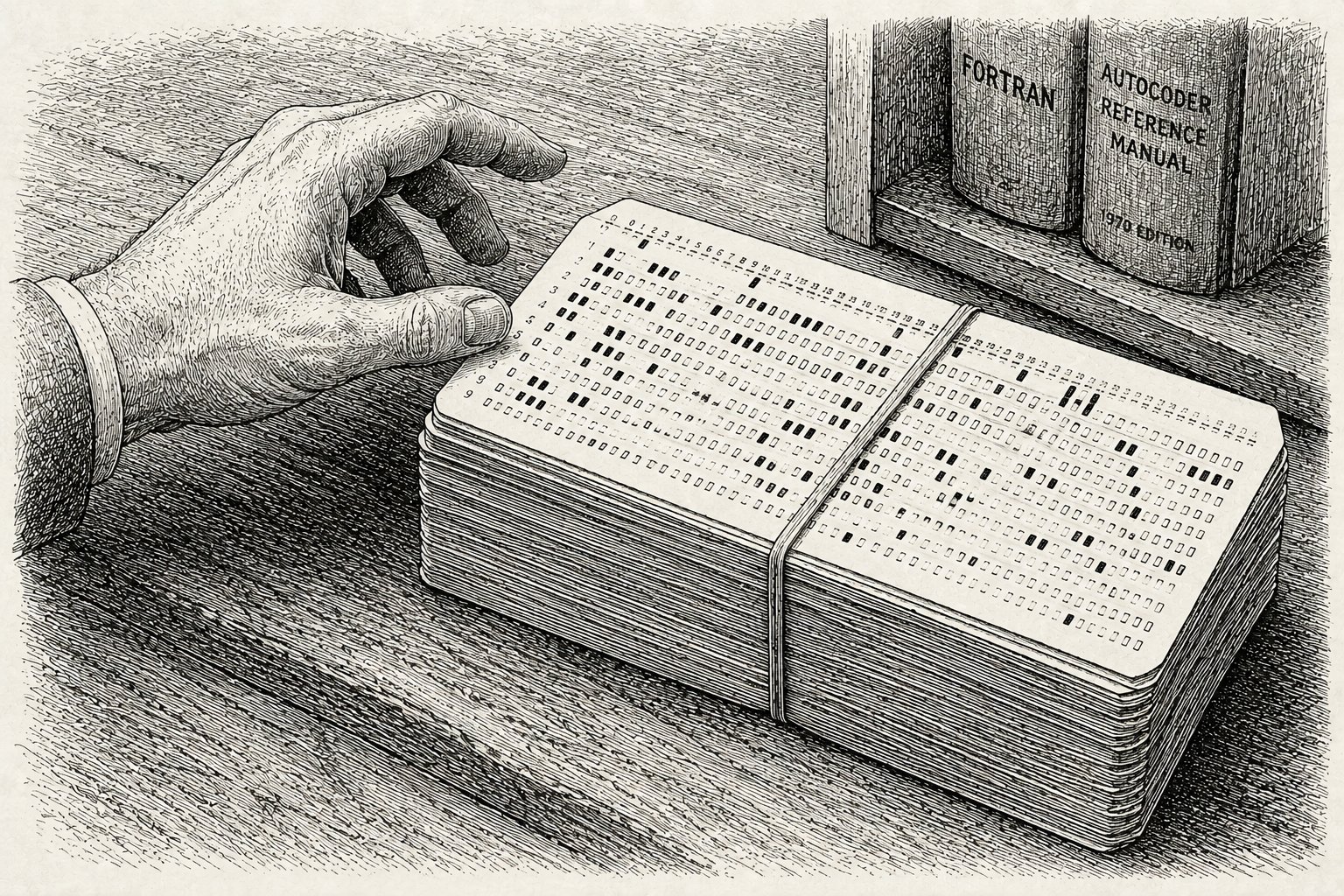
If you wanted a computer to do something for you, this is what you did. You wrote your instructions out on paper. Then you went to a special room and punched those instructions onto cardboard cards, using a machine that looked like a typewriter. Each card could hold one line of instructions. A normal program might take a few hundred cards, stacked into a deck and bound with a rubber band.
You then carried your deck of cards to the computer room and handed it to an operator — a person whose job was to feed cards into the computer. The operator would put your deck into a queue behind everyone else’s deck. You would go home.
The next morning, you would come back. The operator would hand you your cards, plus a stack of paper. The paper was the computer’s answer to your program. You would read the answer. Almost always, there was a mistake somewhere in your cards — a typo, a missing instruction, a misplaced comma. So you would fix the cards and hand them back in. You would go home again.
Twenty-four hours later, you would come back. And so on. A scientist might spend weeks on a problem that, if she could have just talked to the computer in real time, she could have solved in an afternoon.
This was called batch processing, because the computer ran one batch of cards at a time, all alone, with no humans interfering with it. The reason it was done this way was simple: computers were so expensive that you didn’t want them to ever sit idle, waiting for some slow human to type. You wanted them running at full speed, all the time. Humans were the slow part. So humans had to wait their turn.
Lick thought this was exactly backwards.
All 24 chapters of How the World Got Wired · Library · All courses