How the World Got Wired
Prologue — A Sunset in Da Nang
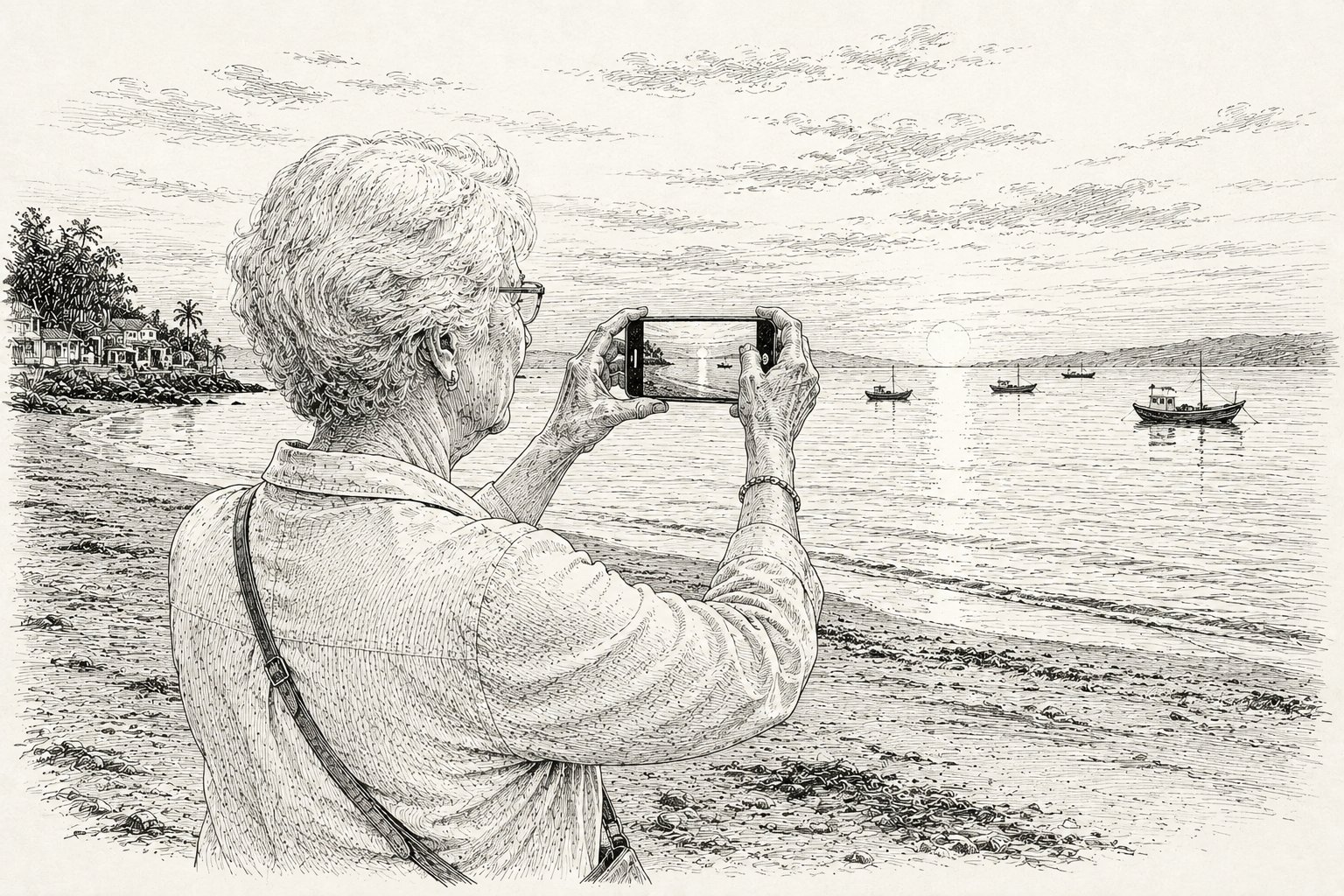
Before I tell you how the internet works, I want to tell you about something that happens every day, in a way that would have seemed impossible only thirty years ago.
It begins with your grandmother, on a beach, on the other side of the planet.
She is on vacation in a city called Da Nang, in Vietnam, on the other side of the planet from where you are right now. She’s standing on a beach at sunset. The sky is pink. There are little boats on the water. She holds up her phone and presses a button, and the phone starts filming.
She films for about ten seconds. A wave comes in. A child laughs somewhere off-camera. The pink in the sky gets a little deeper. Then she stops filming.
She taps her phone a few more times, and uploads the video to Facebook so her family back home can see it.
Now. Stop and think about what just happened.
Your grandmother is standing on a beach on the other side of the planet from you. Between her phone and your phone there is an entire ocean. There are mountains. There are deserts. There are eleven time zones. The video she just took — a real video, with light and color and sound, ten whole seconds of the world — needs to somehow cross all of that and arrive in your bedroom.
In my childhood, it could not have arrived. Not in ten seconds, not in ten days, not in ten weeks. There was no way to do it. If your grandmother had wanted to share a sunset on a beach in Vietnam with her family in another country in 1990, she would have taken a photograph with a camera that used film, waited until she got home, brought the film to a shop to be developed into pictures, picked them up a few days later, put one of them in an envelope, written an address on the envelope, taken it to a post office, paid for a stamp, and waited three weeks for it to arrive. The sunset would already be a month old by the time anyone saw it. And only one person would see it, because there was only one photograph.
You are about to watch the same sunset, in motion, with sound, less than one second after your grandmother stopped filming. So will her sister in Toronto. So will her cousin in Sydney. So will an old friend of hers in Paris. All at once. All for free.
How?
That is the question this book is going to answer.
The short version is this: your grandmother’s phone, the moment she pressed that button, did something a little strange. It took her ten-second video and chopped it up into thousands of tiny pieces. Each piece is called a packet. Each packet is numbered, like a page in a book: I am piece number 47 out of 12,330. Each packet is also stamped with an address — not a street address, but a numerical address that tells the internet where to send it. The address belongs to a giant computer that Facebook owns, sitting in a building somewhere in America.
Then her phone threw all those numbered pieces into the air.
Well, not quite the air. Her phone sent them, by radio, to a little box in her hotel room called a router. The router sent them, through a wire, to a bigger router somewhere in Da Nang. That router sent them to an even bigger one in Ho Chi Minh City. From there, the packets traveled along a fiber-optic cable — a strand of glass thinner than a hair, with laser light pulsing through it — out of Vietnam, under the South China Sea, through Singapore, and then down. Down to the bottom of the Pacific Ocean, onto a cable lying on the seafloor that stretches almost six thousand miles to California.
The packets crossed the entire Pacific Ocean in less than a tenth of a second.
They surfaced in California. They were sorted by another router. They were sent across the United States — through Nevada, through Utah, through Wyoming — and arrived at the Facebook building, which is in Oregon, or maybe Iowa, or maybe Virginia, depending on which one was least busy. The building is the size of an aircraft carrier. It has no windows. It hums.
Inside the building, a computer caught all 12,330 of the packets, checked the numbers to make sure none of them got lost on the way (a few always do — they go back and ask Vietnam to send the missing ones again), and stitched the pieces back together into a ten-second video.
Then it waited.
When you opened Facebook on your phone, your phone sent its own packets — little notes that said hello, I am here, do you have anything for me? The Facebook computer said yes, your grandmother just sent something. And then the whole journey happened again, in reverse, in a different direction. The video was chopped back into packets, sent across America, dropped into a cable on the floor of the Atlantic Ocean (or the Pacific, if you live in California), and pulled up onto land near you. Then through a router in your city. Then through a router in your neighborhood. Then through the little box in your living room. Then through the air, by radio, to your phone.
You tapped the video. It played. There was your grandmother. There was the sunset. There was the wave.
It took less than two seconds.
In those two seconds, the packets that made up your grandmother’s video traveled, in total, somewhere between fifteen and twenty thousand miles. They passed through dozens of computers owned by dozens of companies in at least four countries. They dove to the bottom of an ocean and came back up. They were checked, sorted, and reassembled by machines that have no idea what a grandmother is, or what a sunset is, or why you might want to see one.
Nobody planned your grandmother’s video specifically. Nobody at Facebook woke up that morning and said we’d better get ready, she’s about to film something. The whole enormous system was just sitting there, the way a highway sits there, ready for anyone who shows up. She showed up. The system carried her sunset across the world.
How did we build a system like that?
Who paid for the cables on the seafloor? Who owns them? Who decided that a video should be cut into 12,330 numbered pieces, instead of just sent in one big chunk? Who invented the idea that computers in different countries could talk to each other at all?
Most of those questions have answers. The answers involve a war, a satellite, a man named Licklider, a 22-year-old in Illinois, a milkman from Mississippi, a cable ship in the North Atlantic, a Canadian scientist who didn’t want to take the Navy’s money, and a lot of other people you’ve never heard of.
That’s where we’re going next.
Questions to talk about
No answer key. These are for arguing over, with someone who read the same chapter.
- Ten seconds of video, eleven time zones, an ocean. The author asks you to stop and think about what just happened. What part of it had you never wondered about before?
- A video is cut into 12,330 numbered pieces rather than sent as one chunk. Why would breaking something up make it more likely to arrive, not less?
- The answers involve a war, a satellite, a milkman from Mississippi and a cable ship. What does that list suggest about how big systems actually get built?
All 24 chapters of How the World Got Wired · Library · All courses