How the World Got Wired
Chapter 8 — Routers and the People Who Built Them
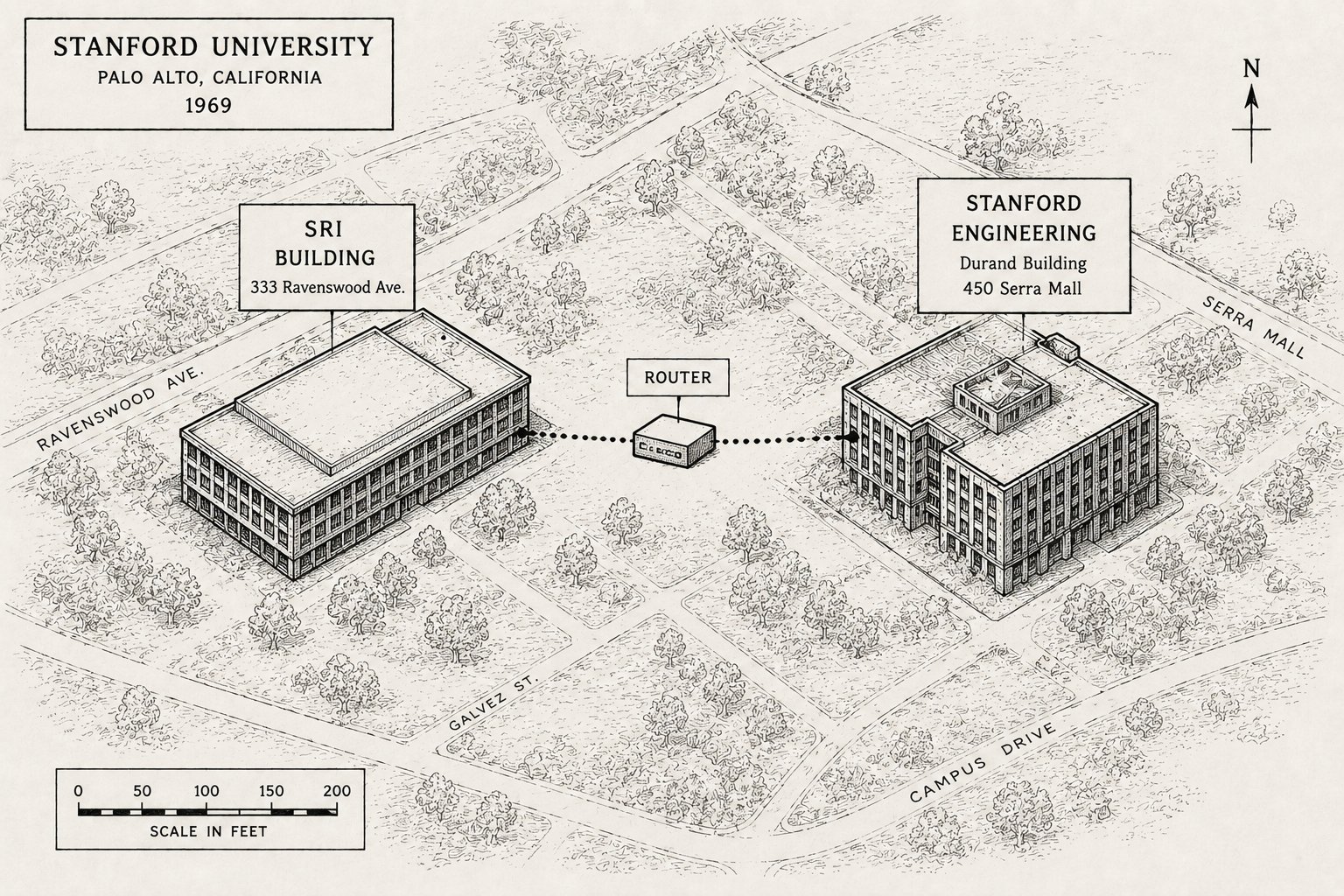
In 1980, a man and a woman who had recently fallen in love were both working at Stanford University, in California. They wanted to send each other email.
They could not.
His name was Leonard Bosack. People called him Len. He was in charge of the computers in Stanford’s Computer Science Department. Her name was Sandy Lerner. She was in charge of the computers in Stanford’s Business School. They had met as graduate students, married, and now worked in two different buildings about a quarter mile apart on the same university campus.
The two buildings each had a network of computers. But the two networks were different. The Computer Science network used one kind of equipment. The Business School network used another. The two networks did not know how to talk to each other. So Len, sitting at his desk in one building, and Sandy, sitting at hers in the other, could not send each other a single character of text.
If they wanted to communicate during the day, they had to use the phone, or get up and walk over to see each other. This was annoying, particularly when you had married the person.
So Len decided to fix it.
He worked, with a Stanford engineer named Bill Yeager, on a small piece of equipment that could sit between the two networks and translate between them. The equipment would read each packet that came in, look at where it was going, and decide which network to send it to. It would also speak more than one network’s language, so it could talk to both sides.
What they were building, although they didn’t quite call it this at first, was a multi-protocol router.
You met routers briefly in Chapter 4 — the IMPs that handled the ARPANET in 1969 were the world’s first routers. But the IMPs had been built for one specific network. What Len and Bill Yeager were building was something more general: a router that didn’t care what kind of network was on either side. It could connect any network to any other network. As long as all the packets were wrapped in the language Cerf and Kahn had given to the world — TCP/IP — the router would happily move them across.
By 1984, the router worked. Len and Sandy could email each other across campus. Other parts of Stanford asked to use the router too. Soon, the same little box was connecting many of Stanford’s networks together.
Other universities started asking for one.
That is where this chapter really begins.
All 24 chapters of How the World Got Wired · Library · All courses