How the World Got Wired
Chapter 7 — Ships and Sharks
When you talk about something that lives “in the cloud” — your photos, your messages, the apps on your phone — you might picture, if you picture anything at all, the sky. Maybe satellites. Maybe servers in some tall building somewhere.
You should picture the ocean floor.
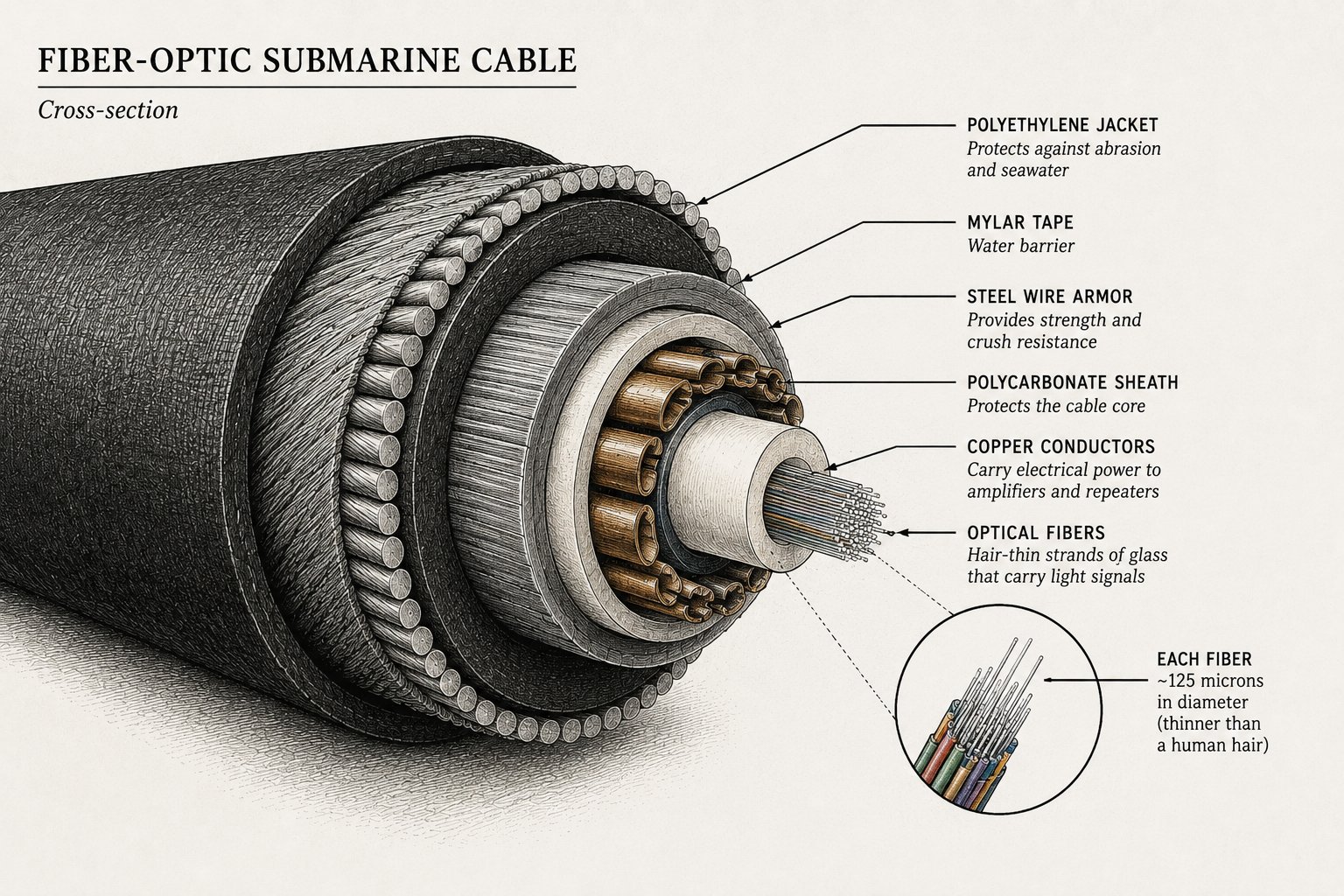
Almost everything you do online — every video your grandmother sends, every search you type, every game you play with a friend in another country — travels, at some point in its journey, through cables that lie on the bottom of the sea. Cables about the thickness of a garden hose, full of strands of glass thinner than a human hair, carrying pulses of laser light back and forth between continents.
There are more than 1.4 million kilometers of these cables on the floor of the world’s oceans. That is enough cable to wrap around the planet roughly thirty-five times. They were laid, one by one, over the past few decades, by a small fleet of specialized ships.
The cloud is not in the sky. The cloud is underwater.
This chapter is about how it got there, and about the strange and very specific group of companies and people who put it there, and about the surprisingly fragile life of a glass thread on the seafloor.
A Brief History of a Long Wire
The first time anybody tried to lay a cable across the bottom of an ocean was in 1858.
This was, you should remember, sixty years before the airplane and twelve years before the telephone. The fastest way to send a message from London to New York, at that time, was to put it on a steamship and wait two weeks. People dreamed of doing better. A few of them dreamed of doing much better.
The dreamer in chief was an American businessman named Cyrus Field. He raised an enormous amount of money to build a cable from Ireland to Newfoundland, in eastern Canada — almost 3,000 kilometers across the cold North Atlantic. Two ships, one British and one American, started in the middle of the ocean, splicing the cable together, and then sailed in opposite directions, paying out the cable behind them. After many failures — broken cables, snapped cables, storms — they finally got one cable down in August of 1858.
It worked. Queen Victoria sent a message to President James Buchanan. It took about sixteen hours to transmit a short paragraph. People in New York held a parade. Cyrus Field was hailed as a hero.
Three weeks later, the cable went dead.
The technology of 1858 wasn’t quite ready. The cables of that era were not very well insulated, and salt water seeped in, and the signals faded. It took another eight years — and the use of the largest ship in the world at the time, a Victorian iron steamship called the Great Eastern — to finally lay a cable that worked, and kept working, in 1866.
From that year on, the bottom of the ocean has never been empty.
Through the rest of the 1800s, undersea telegraph cables spread across the world. By 1902, you could send a message from London all the way around the Earth and back, entirely through cables, in a few hours. The British Empire used these cables — running between its colonies — to govern a quarter of the world’s land. People at the time called this the “All Red Line,” because British territories on maps were colored red. The cables, in a real sense, were the empire’s nervous system.
In 1956, a different kind of cable was laid across the Atlantic. This one could carry voice — actual telephone calls — instead of just the dots and dashes of Morse code. It was called TAT-1, the first transatlantic telephone cable, and on its first day it could handle thirty-six conversations at once. Thirty years later, in 1988, the first transatlantic fiber-optic cable was laid, called TAT-8. It used pulses of light through glass instead of electrical signals through copper. It could handle the equivalent of about 40,000 simultaneous phone calls.
The cables you use today, the ones carrying your grandmother’s video, can carry the equivalent of hundreds of millions of simultaneous phone calls. And there are hundreds of them.
All 24 chapters of How the World Got Wired · Library · All courses