How the World Got Wired · Three Ships and a Fire Sale
Part One: The Man Who Wanted to Wire the Oceans
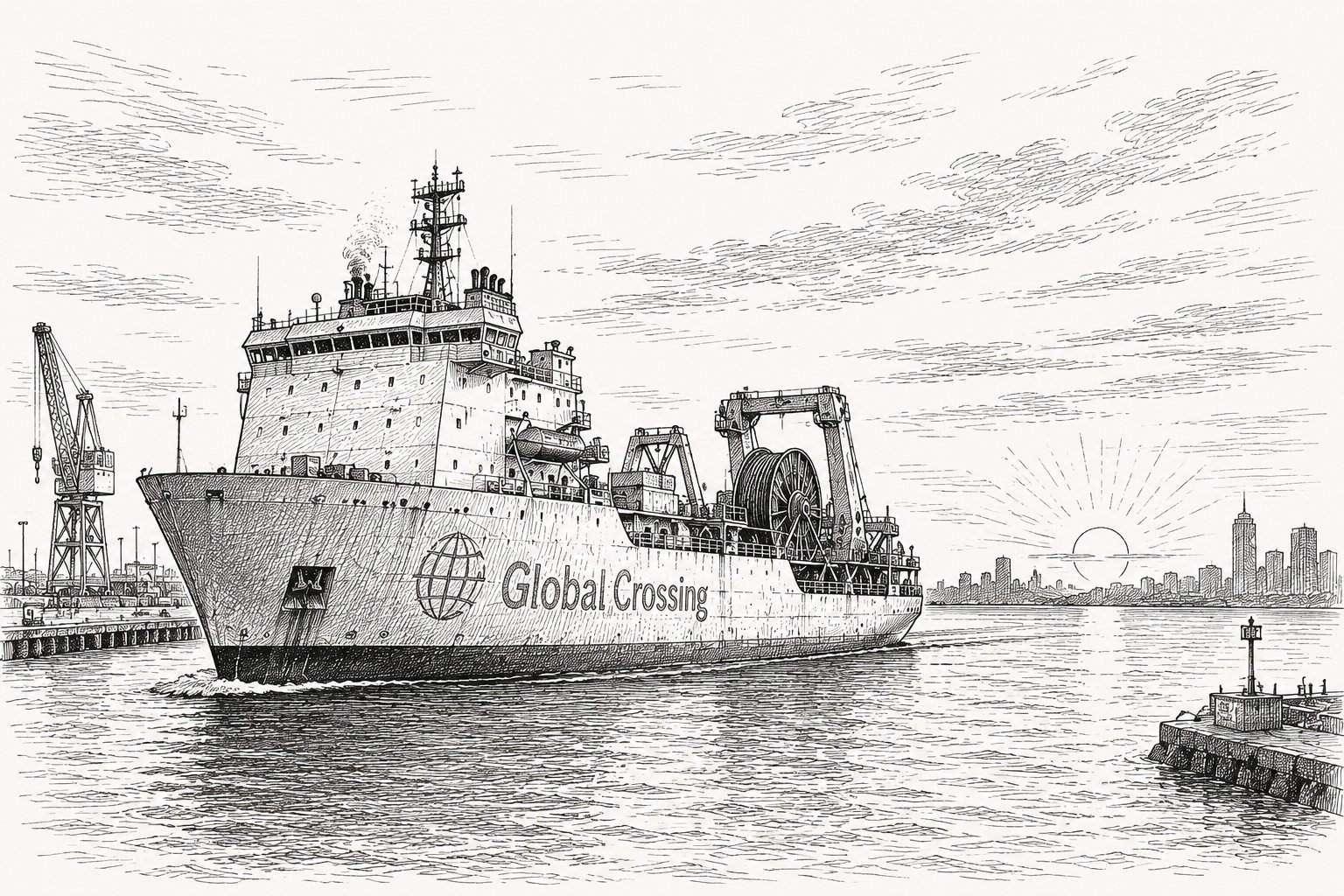
Gary Winnick was not an engineer. He had never laid a cable in his life. Before he started Global Crossing, he had been a bond salesman in New York — somebody who sold loans to big investors. He had worked, in the 1980s, for the famous financier Michael Milken.
In 1997, Winnick had an idea. The internet was growing fast. Every email, every website, every phone call between continents had to travel through cables on the ocean floor. There were not enough of them. Whoever owned those cables could charge rent for every bit of information that flowed through them — forever.
So Winnick started a company to lay cables under all the world’s oceans, as fast as possible, before anyone else could.
He raised money by borrowing it. A lot of it. Banks lent Global Crossing billions of dollars because the story sounded so good. Investors bought the company’s stock for the same reason. Within three years, Global Crossing had laid more than 100,000 miles of fiber-optic cable — enough to wrap around the earth four times. The cables connected New York to London, California to Japan, Europe to Asia.
For a brief moment in early 2000, Global Crossing was worth about $47 billion on the stock market. That was more than General Motors was worth at the time — and General Motors had been making cars for almost a hundred years. Global Crossing was three years old.
There was just one problem. Gary Winnick was not the only person with this idea.
While Global Crossing was laying cables, a dozen other companies were laying cables too. Qwest. Level 3. 360networks. Williams Communications. All of them had heard the same story: the internet is going to be huge, lay the pipes now, charge rent forever.
But here is the thing about pipes. If one company builds a pipe, that company can charge a lot to use it. If twenty companies build twenty pipes side by side, none of them can charge very much, because customers will just go to whoever charges least.
By 2001, so much fiber had been laid that almost none of it was being used. People in the industry called it dark fiber — glass strands sitting in the ocean and underground, with no light pulsing through them. Engineers estimated that about ninety-five percent of the world’s fiber was dark. It had cost hundreds of billions of dollars to lay, and it was sitting there doing nothing.
The price companies could charge to send a signal across the ocean collapsed. By some measures, it fell more than ninety percent in two years. But Global Crossing still had to pay back the billions of dollars it had borrowed. The interest on the debt did not get cheaper just because the bandwidth did.
On January 28, 2002, Global Crossing filed for bankruptcy. At the time, it was one of the largest bankruptcies in the history of the United States.
Here is the part of the story that is hard to read.
In the months before the bankruptcy, while ordinary employees still believed the company was healthy, Gary Winnick sold $735 million of his own stock. The employees couldn’t sell theirs — most of it was locked inside their retirement accounts. When the company collapsed, their retirement savings collapsed with it.
Winnick was investigated. He was never charged with a crime. He kept most of his fortune. He died in 2023, still wealthy, in California.
The cables he had laid were still down there, still working. In 2003, a company from Singapore bought what was left of Global Crossing for $250 million. Remember: Winnick had spent about $15 billion building it. The new owners had paid less than two cents for every dollar of original cost.
A few years later, the cables changed hands again, sold to a company called Level 3 for about $3 billion. Level 3 was later swallowed by CenturyLink, which renamed itself Lumen. Today, when you send an email from New York to London, there is a real chance that it travels through a cable Gary Winnick paid to lay, owned now by a company most people have never heard of, which paid almost nothing for it.
All 24 chapters of How the World Got Wired · Library · All courses