Photosynthesis · Grade 10 Science
Chapter: Matter & Energy in Living SystemsPhotosynthesis
Learning goals
- I can write the reactants and products of photosynthesis and explain where each comes from.
- I can describe the two stages of photosynthesis and the role of the chloroplast.
Readings for this unit
Before this unit
Trace carbon, oxygen and energy separately.
Use three flexible study sessions: core explanation and Parts 1–2; Parts 3–4 with their reasoning checks and models; then the whole-unit application, worked examples, independent practice, and exit check. Allow about 50–60 minutes per session, including diagrams, data work, and notebook explanations. Attempt each check before opening its guidance. Schedule chapter investigations, review, and exams separately; add time where prerequisites are uncertain. Trace the explained visual parts and write a first model, then attempt the illustrated and changed independent cases. In the third session explain a correction and revise the opening account using evidence.
Start with something to explain
Why does a growing plant need water and carbon dioxide rather than only sunlight?
Illustrative evidence case. Light supplies energy to linked processes while different reactants supply atoms; a gas measurement can show only net transfer.
Notice and wonder
Record two observations using the stated quantities or relationships. Keep observations separate from possible causes. Write one question that a new measurement could help answer.
Why does a growing plant need water and carbon dioxide rather than only sunlight?
Your first model
Label light-energy arrows, water’s oxygen source and CO₂’s carbon source separately.
Build the language from the idea
- photosynthesis
- The process by which autotrophs use light energy to build sugar (glucose) from carbon dioxide and water, releasing oxygen.
- chloroplast
- The organelle in plant and algal cells where photosynthesis takes place; it is packed with the pigment chlorophyll.
- chlorophyll
- The green pigment inside chloroplasts that absorbs light energy — mostly red and blue light — to power photosynthesis.
- light-dependent reactions
- The first stage of photosynthesis, in the thylakoid membranes, where light splits water, releases oxygen, and makes ATP and NADPH.
- Calvin cycle
- The second, light-independent stage, in the stroma, where ATP and NADPH are used to build sugar from carbon dioxide.
In the last lesson we left off with a question: where does the energy to recharge all that ATP come from? For almost the entire living world, the answer begins with photosynthesis — the process autotrophs use to capture light energy and lock it away inside food. This is where energy first enters life on Earth. Scan the whole reaction in one line: 6 CO2 + 6 H2O + light energy → C6H12O6 + 6 O2. Six molecules of carbon dioxide and six of water, powered by sunlight, are rearranged into one molecule of glucose (a sugar) with six molecules of oxygen given off. Unlike most reactions, this one *stores* energy rather than releasing it — sunlight goes in, and chemical energy comes out, tucked into the bonds of sugar.
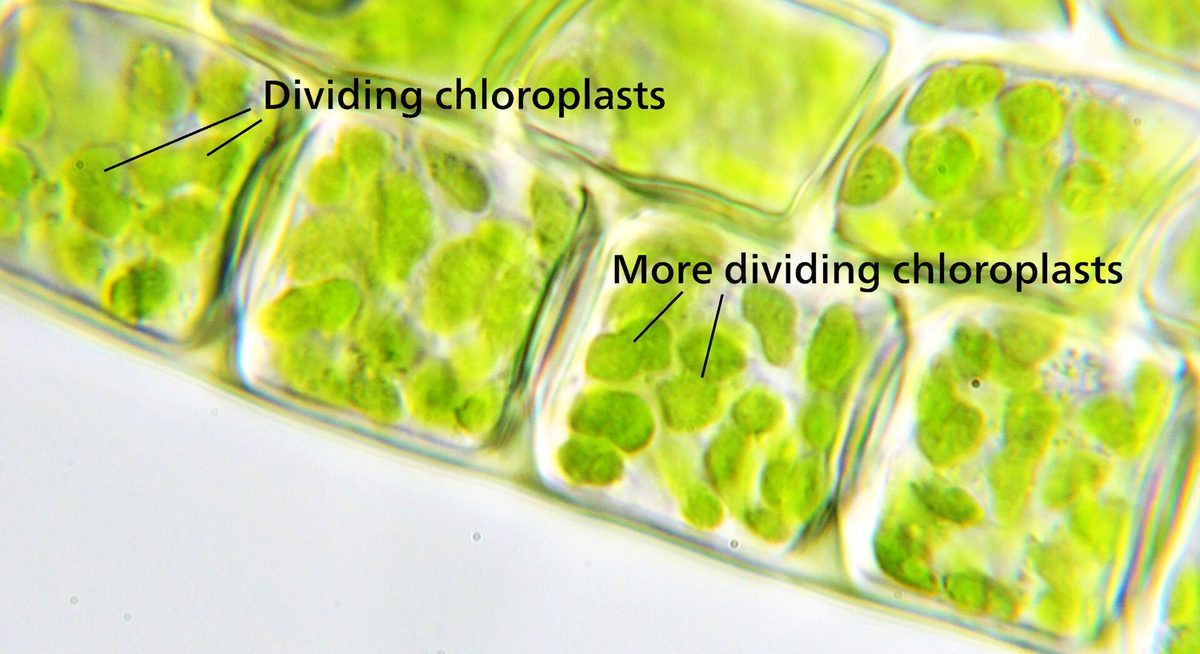
All of this happens inside the chloroplast, the green organelle you met in earlier biology as a plant cell's built-in solar panel. Its inside is not a simple bag: it is filled with flattened discs called thylakoids, stacked into neat piles, all floating in a fluid called the stroma. Studded through the thylakoid membranes is chlorophyll, the pigment that does the light-catching. Chlorophyll soaks up the red and blue wavelengths of sunlight but reflects green light back at your eyes — which is the real reason grass, leaves, and this pigment itself all look green.
Photosynthesis runs in two connected stages, in two different parts of the chloroplast. The first stage, the light-dependent reactions, takes place right in the thylakoid membranes where the chlorophyll sits. Here, light energy excites electrons and, remarkably, splits water molecules apart. That splitting is the source of the oxygen the plant releases — every O2 molecule you have ever breathed was pried out of water inside a chloroplast. The energy from the excited electrons is captured into two temporary carrier molecules, ATP and a helper called NADPH, which shuttle that energy on to the next stage.
The second stage is the Calvin cycle, and it happens in the stroma, the fluid surrounding the thylakoids. It is often called the light-*independent* stage because it does not directly use light — but do not mistake that for 'happens in the dark.' The Calvin cycle runs on the ATP and NADPH handed over from stage one, so it depends completely on the light reactions having run first. Using that energy, it grabs carbon dioxide from the air and 'fixes' the carbon atoms into a stable sugar, building glucose one carbon at a time. This is the moment loose gas from the atmosphere becomes solid food.
Put the two stages together and you can see what photosynthesis really accomplishes: it converts light energy into chemical energy stored in glucose. Now connect that back to the previous lesson. That glucose is a rechargeable-battery pack for the whole biosphere — later, any cell can break it down through cellular respiration to recharge its ATP. In a very real sense, photosynthesis is the process that charges up the energy currency of nearly every living thing, using nothing but sunlight, air, and water.
It is hard to overstate how much depends on this. Photosynthesis feeds essentially every food chain, and it is the reason our atmosphere holds breathable oxygen at all — that oxygen is the accumulated exhaust of billions of years of photosynthesis. It also clears up a famous misconception: a tree does not build its trunk out of soil. Most of a plant's solid mass is carbon pulled from carbon dioxide in the *air* during the Calvin cycle. A giant redwood is, astonishingly, built largely out of thin air and sunshine.
Photosynthesis converts light energy into chemical energy while incorporating carbon dioxide into organic molecules. Oxygen released by the process comes from water in the standard oxygenic pathway. Track each atom's source rather than assuming oxygen gas comes directly from CO₂.
Light-dependent processes generate energy-transfer molecules used in carbon fixation. The simplified overall equation combines multiple stages and does not show every intermediate. A balanced summary is useful for matter accounting but does not imply a single-step reaction.
A photosynthesis measurement depends on what is measured: net gas exchange also includes respiration. Light, temperature, carbon dioxide and water availability can limit rates. Increasing one factor will not always keep increasing the rate if another becomes limiting.
Build your understanding
Use three flexible study sessions: core explanation and Parts 1–2; Parts 3–4 with their reasoning checks and models; then the whole-unit application, worked examples, independent practice, and exit check. Allow about 50–60 minutes per session, including diagrams, data work, and notebook explanations. Attempt each check before opening its guidance. Schedule chapter investigations, review, and exams separately; add time where prerequisites are uncertain.
Part 1 · One equation, two stages
A chloroplast contains internal thylakoid membranes and a surrounding fluid stroma. Light-dependent reactions use light energy to support electron transfer and generate ATP and reducing power. Carbon fixation incorporates inorganic carbon into organic intermediates through enzyme pathways in the stroma. These are connected processes, not sunlight directly gluing complete glucose molecules together. The summary equation combines many steps and omits intermediate carriers; it should support atom accounting without pretending to show every mechanism.
Read the visual model
Identify the labeled structures and units, then trace the arrows or compare values under the caption’s stated conditions. Separate the displayed evidence from a further inference. Write your reasoning before opening the guidance.
Does “light-independent” carbon fixation mean the pathway normally ignores the light reactions entirely?
Visual reasoning — after your attempt
No. It uses products and regulated conditions linked to them; the term does not mean an isolated unlimited night-time pathway.
The overall equation — six carbon dioxide and six water yielding one glucose and six oxygen, driven by light — is a summary, not a description of a single reaction. Photosynthesis proceeds in two connected stages in different parts of the chloroplast. The light-dependent reactions occur in the thylakoid membranes: light energy absorbed by chlorophyll is used to split water, releasing oxygen as a by-product and producing ATP and the electron carrier NADPH.
The second stage, carbon fixation, occurs in the stroma surrounding the thylakoids. There carbon dioxide is incorporated into an organic molecule and built up into sugar, using the ATP and NADPH from the first stage. This stage does not require light directly, which is why it continues briefly in darkness — but only until the supply of ATP and NADPH runs out.
Pause and explain
Carbon fixation does not need light directly. Why does it nonetheless stop soon after darkness falls?
Check your reasoning after answering
It consumes the ATP and NADPH produced by the light-dependent reactions. Without light those are no longer made, and the small existing supply is used up within a short time, so carbon fixation halts.
Part 2 · Where the oxygen comes from
An atom tracer labels a source so later products reveal where atoms came from. In oxygenic photosynthesis, water supplies the oxygen released as O₂ through the light-reaction pathway. Carbon dioxide supplies carbon incorporated into organic material. The overall equation contains oxygen atoms in several reactants and products, so matching a net equation alone does not determine which source supplied a specific atom. Tracer evidence and mechanism constrain that question; isotopic labels are tracking tools rather than new kinds of life.
Read the visual model
Identify the labeled structures and units, then trace the arrows or compare values under the caption’s stated conditions. Separate the displayed evidence from a further inference. Write your reasoning before opening the guidance.
Would the presence of oxygen atoms in CO₂ prove that released O₂ came from CO₂?
Visual reasoning — after your attempt
No. Oxygenic photosynthesis releases O₂ traced to water; source assignment needs mechanism/tracer evidence beyond the summary equation.
A reliable way to test whether photosynthesis has been understood is to ask where the released oxygen originates. The equation has oxygen atoms in both carbon dioxide and water, so the formula alone does not settle it. Experiments using oxygen's heavier isotope as a label established the answer: the oxygen released comes from water, which is split in the light-dependent reactions.
The carbon dioxide's atoms take a different route — its carbon and oxygen end up in the sugar. This is a useful case of an experiment settling a question that no amount of staring at an equation could, and it is worth remembering as an example of how isotope labelling tracks atoms through a reaction.
Pause and explain
Why could the balanced equation alone not establish the source of the released oxygen?
Check your reasoning after answering
Both carbon dioxide and water contain oxygen atoms, so the equation is consistent with either source. Only an experiment that labels the atoms in one reactant and follows them, such as isotope labelling, can distinguish the possibilities.
Part 3 · Pigments and the light they use
A pigment interacts with light at particular wavelengths. An absorption spectrum shows absorption versus wavelength, while an action spectrum shows a measured biological process versus wavelength under controlled conditions. Pigments and associated structures can broaden useful light capture, but absorbed light is not all converted into organic production. Leaf thickness, other pigments, light intensity and physiological conditions influence the outcome. A leaf’s visible color reflects light reaching the observer, not proof that the other wavelengths never interact.
Read the visual model
Identify the labeled structures and units, then trace the arrows or compare values under the caption’s stated conditions. Separate the displayed evidence from a further inference. Write your reasoning before opening the guidance.
Why should an absorption curve and a photosynthesis-rate curve have different axis labels?
Visual reasoning — after your attempt
They measure different quantities; relating them requires controlled biological and optical conditions.
Chlorophyll absorbs light most strongly in the red and blue regions of the spectrum and poorly in the green, which is reflected and therefore reaches our eyes. This means not all light is equally useful: a plant under green light photosynthesizes slowly despite being well illuminated. Accessory pigments such as carotenoids absorb other wavelengths and broaden the range of light a plant can use.
That absorption pattern is what makes pigment separation informative. Chromatography of a leaf extract separates the pigments by how far they travel in a solvent, revealing several distinct pigments where the leaf looked uniformly green. The experiment demonstrates that a visible colour is a summary of what is reflected, not an inventory of what is present.
Pause and explain
Predict what happens to photosynthetic rate under pure green light of the same intensity as white light, and explain.
Check your reasoning after answering
The rate falls substantially, because chlorophyll absorbs green light poorly and reflects most of it. Intensity measured as total light energy is therefore not a good predictor of rate unless the wavelengths are ones the pigments absorb.
Part 4 · Limiting factors
A limiting factor constrains the response under the current conditions. Increasing light may initially increase photosynthesis, then produce little further change when carbon dioxide, temperature, water status or pathway capacity becomes limiting. A changed plateau can support a specific comparison, but it does not prove only one factor matters. Net production also subtracts relevant consumption/loss processes, whereas gross production refers to production before that subtraction. State whether the measurement is gas exchange, carbon incorporation or another proxy before interpreting its slope.
Read the visual model
Identify the labeled structures and units, then trace the arrows or compare values under the caption’s stated conditions. Separate the displayed evidence from a further inference. Write your reasoning before opening the guidance.
Does a plateau mean photosynthesis has stopped?
Visual reasoning — after your attempt
No. It can continue at a near-steady rate while increasing the tested input no longer raises that rate.
Photosynthetic rate is set by whichever requirement is in shortest supply. Raising light intensity increases the rate while light is limiting, then produces no further increase once carbon dioxide concentration, temperature, or the plant's own enzyme capacity becomes the constraint. A graph of rate against light intensity therefore rises and then flattens, and the flattening marks a change in which factor limits the process.
Temperature acts differently from the other two. Because the carbon-fixing reactions are enzyme-catalysed, rate rises with temperature up to an optimum and falls beyond it as enzymes denature — the same two-sided curve met in the enzyme unit. Interpreting a plateau therefore means naming a candidate limiting factor and testing it by raising that factor alone.
Pause and explain
A rate-against-light-intensity graph flattens. What does the flat region tell you, and what does it not?
Check your reasoning after answering
It tells you light is no longer the limiting factor. It does not tell you which factor has taken over — carbon dioxide, temperature, or enzyme capacity are all candidates — and distinguishing them requires raising each one separately and seeing whether the rate responds.
Apply the whole unit · Find the limiting factor
Illustrative data: oxygen bubbles per minute from a water plant at four light intensities, under two carbon dioxide levels, with three trials each reported as a mean. Low carbon dioxide (0.04 percent): 20 percent light → 9; 40 percent → 17; 60 percent → 21; 80 percent → 21. High carbon dioxide (0.15 percent): 20 percent light → 10; 40 percent → 19; 60 percent → 28; 80 percent → 35. Temperature held at 22 °C.
Your task
Describe how rate depends on light intensity at each carbon dioxide level, identify the intensity at which carbon dioxide becomes limiting in the low-carbon-dioxide series, explain how the high-carbon-dioxide series supports that identification, and state the assumption bubble counting makes. Then name the next factor you would vary.
What your response should show
- Choose the appropriate biological model or relationship and state the conditions it assumes.
- Show the counts, rates, ratios, or intermediate reasoning the question requires.
- Use the supplied evidence to justify the conclusion and separate observation from inference.
- Identify a meaningful limitation, uncertainty, or next measurement.
Response guidance — after your attempt
Low carbon dioxide: rate rises from 9 to 17 to 21 and then stays at 21, so it plateaus between 60 and 80 percent light.
High carbon dioxide: rate rises from 10 to 19 to 28 to 35, still increasing at 80 percent light, with no plateau in the range tested.
Locate the switch: in the low series light stops being limiting at about 60 percent intensity, because beyond that point extra light produces no increase.
Use the comparison: at 80 percent light, raising carbon dioxide from 0.04 to 0.15 percent raises the rate from 21 to 35, which shows carbon dioxide was the factor restricting the low series — if light had been limiting, extra carbon dioxide would not have helped.
State the assumption: bubble counting treats every bubble as the same volume of oxygen, which is only approximately true; a gas-volume measurement would be better.
Next factor: vary temperature at high carbon dioxide and high light, since the carbon-fixing enzymes should show an optimum and then a decline.
At 0.04 percent carbon dioxide the rate rises with light up to about 60 percent intensity and then holds at 21 bubbles per minute, so light ceases to be limiting at that point. At 0.15 percent carbon dioxide the rate keeps climbing to 35 at 80 percent light, with no plateau in range. The decisive comparison is at 80 percent light, where raising carbon dioxide alone lifts the rate from 21 to 35: that could not happen if light were the constraint, so carbon dioxide was limiting the first series. Bubble counting assumes uniform bubble volume, which is only approximately true, so a measured gas volume or dissolved-oxygen reading would be a stronger measure. Temperature is the factor to vary next, because the carbon-fixing reactions are enzyme-catalysed and should show a rise to an optimum followed by a decline as the enzymes denature.
Scientific references and adapted source figures
Parent / teacher teaching notes
The two-stage structure is what makes the rest of the unit explainable, so establish it before any detail: light reactions in the thylakoid membranes producing ATP, NADPH, and oxygen from water, then carbon fixation in the stroma spending them. The oxygen-from-water point is worth asking directly, since the equation does not reveal it and the isotope experiment is a good example of evidence settling a question. Limiting-factor reasoning transfers to the respiration unit and to ecology, so insist on naming which factor is in shortest supply rather than listing requirements. Ask for an explanation of each label, arrow and axis before calculation. Keep first and revised models; attempt the changed case before consulting guidance. Distinguish invented instructional records from named historical sources. Source chromosome symbols are allele-category models, not DNA sequences. These independently authored high-school supplements are not the full OpenSciEd teacher editions or an endorsement.
A diagram of photosynthesis in a leaf showing carbon dioxide and water entering, sunlight striking the chloroplast, and glucose and oxygen being produced.
The key idea
Photosynthesis captures light energy in the chloroplast and stores it as chemical energy in glucose, using carbon dioxide and water and releasing oxygen: 6 CO2 + 6 H2O + light → C6H12O6 + 6 O2.
Photosynthesis (overall equation)
6 CO2 + 6 H2O + light energy -> C6H12O6 + 6 O2
CO2 = carbon dioxide, H2O = water, C6H12O6 = glucose, O2 = oxygen; occurs in the chloroplast and stores light energy as chemical energy in glucose.
Worked examples
Example 1
- In the light-dependent reactions, water (H2O) is split apart, and that is what releases the oxygen (O2).
- In the Calvin cycle, carbon dioxide (CO2) is pulled from the air and its carbon is built into sugar.
- So the two products trace to two different reactants: O2 comes from water, and the carbon in glucose comes from carbon dioxide.
Example 2 · Worked application
- Carbon enters carbon-fixation pathways from CO₂.
- Light reactions support the energy and reducing power needed.
- The atom is incorporated into organic compounds rather than created from light.
Light supplies energy; it is not a source of carbon atoms.
Example 3
- The Calvin cycle does not use light directly; it runs on the ATP and NADPH made by the light-dependent reactions.
- When the light is switched off, the light reactions stop making fresh ATP and NADPH.
- The Calvin cycle can keep going only until the small leftover supply of ATP and NADPH is used up, then it must stop.
Example 4
- Carbon is incorporated from CO₂.
- In oxygenic photosynthesis, released O₂ comes from water.
Example 5 · Find and fix the mistake
- Test the claim against the stated conditions: Light supplies energy; it is not a source of carbon atoms.
- Carbon for photosynthetic organic matter largely comes from CO₂; roots provide water and mineral nutrients.
Light supplies energy; it is not a source of carbon atoms.
Example 6 · Reason from the visual evidence
- A pigment interacts with light at particular wavelengths. An absorption spectrum shows absorption versus wavelength, while an action spectrum shows a measured biological process versus wavelength under controlled conditions. Pigments and associated structures can broaden useful light capture, but absorbed light is not all converted into organic production. Leaf thickness, other pigments, light intensity and physiological conditions influence the outcome. A leaf’s visible color reflects light reaching the observer, not proof that the other wavelengths never interact.
- They measure different quantities; relating them requires controlled biological and optical conditions.
Original illustrative pigment-absorption pattern, not a measured spectrum of one chlorophyll type or a calibrated leaf action spectrum.
Avoid these mistakes
- Plants respire as well as photosynthesize, and net gas exchange reflects both.
Check your understanding
A plant gains organic carbon while lit. Identify a major carbon source and distinguish it from released oxygen's source.
Discuss the answer
CO₂ supplies carbon; water supplies the oxygen atoms released as O₂.
Why is net oxygen output not always equal to gross photosynthetic oxygen production?
Discuss the answer
Net gas output subtracts simultaneous consumption and other relevant transfers. A lit plant can photosynthesize and respire, so net output is not gross production.
Return to the phenomenon
Return to the initial case. Why does a growing plant need water and carbon dioxide rather than only sunlight? Revise your drawing or explanation using two named ideas and one stated limitation.
Compare explanations after your attempt
Photosynthesis transfers energy and incorporates matter through stages; pigments, limits and simultaneous respiration affect measured output.
What should we investigate next?
Which comparison would test a remaining uncertainty? State what you would change, keep comparable and measure.
Investigate, explain and revise
Complete these tasks after the teaching parts. Preserve your first model and a supported revision; use guidance after a real attempt.
Activity 1 · Return to the opening case
Use the opening question, defined terms, Parts 1–4 and your notebook. The supplied-data route needs no equipment or external account.
Your task
Return to the initial case. Why does a growing plant need water and carbon dioxide rather than only sunlight? Revise your drawing or explanation using two named ideas and one stated limitation.
Success criteria
- Use relevant stated observations.
- Explain the mechanism with a labeled model.
- Distinguish quantities and assumptions.
- Describe a revision and a useful next test.
Hint
Follow objects, materials and information separately. Check what each measured quantity means.
Response guidance — discuss after your attempt
Photosynthesis transfers energy and incorporates matter through stages; pigments, limits and simultaneous respiration affect measured output.
Activity 2 · Transfer to a changed case
Cover the worked guidance and use the unit explanations/figures to solve a changed problem.
Your task
A lit plant’s gross photosynthetic oxygen production is 14 units/h and its oxygen consumption is 5 units/h under the supplied model. Find net output and explain the oxygen-atom source in oxygenic photosynthesis.
Success criteria
- Use the stated measurements or conditions, with correct units.
- Connect the result to the biological mechanism or evidence relationship.
- Identify the assumption, model limit or further evidence requested.
Hint
Name the stated conditions, select the relevant mechanism and show intermediate reasoning.
Response guidance — discuss after your attempt
Net output is 14−5 = 9 units/h. The released photosynthetic O₂ is traced to water; plants also consume oxygen, and a net gas measurement alone is not gross production.
Words to know
- photosynthesis
- The process by which autotrophs use light energy to build sugar (glucose) from carbon dioxide and water, releasing oxygen.
- chloroplast
- The organelle in plant and algal cells where photosynthesis takes place; it is packed with the pigment chlorophyll.
- chlorophyll
- The green pigment inside chloroplasts that absorbs light energy — mostly red and blue light — to power photosynthesis.
- light-dependent reactions
- The first stage of photosynthesis, in the thylakoid membranes, where light splits water, releases oxygen, and makes ATP and NADPH.
- Calvin cycle
- The second, light-independent stage, in the stroma, where ATP and NADPH are used to build sugar from carbon dioxide.
Where does a tree's mass really come from?
In the 1600s, Jan Baptista van Helmont grew a willow in a pot for five years. The tree gained about 74 kilograms, yet the soil lost only a few grams. He concluded, incorrectly, that the mass came from water. Only much later did scientists realize the missing piece: Joseph Priestley showed in the 1770s that plants restore 'used-up' air, and eventually researchers established that a plant's solid mass comes mostly from carbon dioxide in the air, fixed into sugar during the Calvin cycle. Van Helmont's willow was built largely out of thin air and sunlight — one of biology's most counterintuitive truths.
Two stages, two addresses inside the chloroplast
Photosynthesis is really two linked factories in different rooms. The light-dependent reactions run in the thylakoid membranes, capturing light to split water and make ATP and NADPH. The Calvin cycle runs in the surrounding fluid, the stroma, using those products to build sugar. Some plants have clever variations: corn and sugarcane (C4 plants) and desert cacti (CAM plants) add extra steps that let them keep photosynthesizing efficiently in hot, dry places where ordinary plants would lose too much water. The basic chemistry is universal, but evolution has tuned it for different climates.
The pollution that remade the planet
For the first couple of billion years, Earth's air held almost no free oxygen. Then photosynthetic cyanobacteria began splitting water and releasing O2 as waste. Over hundreds of millions of years this 'pollution' accumulated in what geologists call the Great Oxygenation Event, roughly 2.4 billion years ago. It was catastrophic for the anaerobic life of the time — oxygen was toxic to them — but it paved the way for aerobic respiration and, eventually, complex life like us. The ozone layer that shields the surface from ultraviolet light is itself made from that photosynthetic oxygen.
Misconception: 'plants breathe in CO2 and out O2'
It is tempting to say plants are the mirror image of animals — that they only take in CO2 and give off O2. In reality, plants respire around the clock, taking in oxygen and releasing carbon dioxide just like you do. During the day, photosynthesis usually runs faster than respiration, so the net flow is CO2 in and O2 out. But at night, with no light, only respiration continues, and a plant is a net consumer of oxygen. Plants both photosynthesize and respire; the direction of the net exchange just depends on the light.
Engineering a better leaf
Photosynthesis is surprisingly inefficient — most crops convert only about 1% of the sunlight hitting them into stored energy. Scientists see enormous room for improvement. Research projects are re-engineering the enzymes of the Calvin cycle and even trying to install the more efficient C4 machinery into rice to boost yields for a growing world. Others are building 'artificial leaves' — devices that use sunlight to split water and make hydrogen or other fuels directly. Understanding the two stages of photosynthesis is the foundation for all of it.
In the real world
Understanding photosynthesis drives some of today's biggest projects — from engineering crops that capture sunlight more efficiently to feed a growing world, to building 'artificial leaves' that use sunlight to split water and make clean fuel.
Exit check
Where do the carbon atoms in newly made plant organic matter come from?
Check your explanation after answering
Photosynthesis incorporates carbon from carbon dioxide into organic molecules. Soil supplies other materials but is not the main carbon source of photosynthetic biomass.
Explain your reasoning without notes. If a key idea is missing, revisit the lesson and try again.