Inheritance Beyond One-Gene Models — Print · Grade 10 Science
Chapter: DNA, Inheritance & Gene ExpressionInheritance Beyond One-Gene Models
Learning goals
- I can distinguish complete dominance, incomplete dominance, and codominance.
- I can explain why many traits require several genes and environmental factors.
Readings for this unit
Before this unit
Distinguish genotype, phenotype and a model assumption.
Use three flexible study sessions: core explanation and Parts 1–2; Parts 3–4 with their reasoning checks and models; then the whole-unit application, worked examples, independent practice, and exit check. Allow about 50–60 minutes per session, including diagrams, data work, and notebook explanations. Attempt each check before opening its guidance. Schedule chapter investigations, review, and exams separately; add time where prerequisites are uncertain. Trace the explained visual parts and write a first model, then attempt the illustrated and changed independent cases. In the third session explain a correction and revise the opening account using evidence.
Start with something to explain
Why can a heterozygote look intermediate without its alleles permanently blending?
Illustrative evidence case. The phenotype mapping can be incomplete or codominant, while genotype contributions remain distinct.
Notice and wonder
Record two observations using the stated quantities or relationships. Keep observations separate from possible causes. Write one question that a new measurement could help answer.
Why can a heterozygote look intermediate without its alleles permanently blending?
Your first model
Label allele copies, measured products/traits and environmental conditions separately.
Build the language from the idea
- incomplete dominance
- A heterozygous phenotype is intermediate in the stated model.
- codominance
- Both allelic products are detectably expressed in a heterozygote.
- polygenic trait
- A trait influenced by variation at multiple genes.
A one-gene, two-allele Punnett square describes a limited model. Under complete dominance, a heterozygote has the modeled dominant phenotype. In incomplete dominance it can have an intermediate phenotype; in codominance both allelic products can be expressed. Dominant does not mean common, stronger, or beneficial.
Some traits involve many genes, environmental effects, or both. Human eye color is influenced by several genes affecting pigment; it is not accurately represented by a single brown-versus-blue pair. Continuous measurements such as height often show distributions rather than a few discrete categories. A simple model can still be useful if its limits are explicit.
Inheritance probabilities describe expected patterns across many outcomes. Four Punnett-square boxes do not guarantee four offspring, one of each outcome. Small samples can differ from expected ratios. Use genotype data, sample sizes, and a specified inheritance model before drawing conclusions from appearances.
Traits can involve incomplete dominance, codominance, several alleles, many genes or gene interactions. Multiple alleles describe possibilities in a population; a diploid individual still normally carries two alleles at one autosomal locus. Name the specific model before predicting outcomes.
Polygenic traits can show a range of values and environmental effects. A broad distribution is not evidence that inheritance is absent. It means a one-gene dominant/recessive square may be inadequate for that trait.
Linkage changes expectations because genes on one chromosome need not assort independently. Sex-linked inheritance also depends on chromosome and parental information. State the provided conditions and avoid inferring real human family outcomes from an oversimplified trait example.
Build your understanding
Use three flexible study sessions: core explanation and Parts 1–2; Parts 3–4 with their reasoning checks and models; then the whole-unit application, worked examples, independent practice, and exit check. Allow about 50–60 minutes per session, including diagrams, data work, and notebook explanations. Attempt each check before opening its guidance. Schedule chapter investigations, review, and exams separately; add time where prerequisites are uncertain.
Part 1 · Dominance is not always complete
Incomplete dominance means a heterozygous phenotype differs from both homozygotes for the defined trait. Codominance means both specified allele-associated products are detected in the heterozygote. Neither description implies that alleles merge into a permanent new allele. A model can predict 1:2:1 phenotype categories rather than the complete-dominance 3:1 pattern. State what is measured—color, product presence or another feature—before comparing models, and avoid treating every intermediate phenotype as proof of one gene.
Read the visual model
Identify the labeled structures and units, then trace the arrows or compare values under the caption’s stated conditions. Separate the displayed evidence from a further inference. Write your reasoning before opening the guidance.
Does an intermediate Rr phenotype mean future gametes contain only a new blended allele?
Visual reasoning — after your attempt
No. The genotype retains R and r in the model, which segregate as distinct contributions.
Simple dominance is one pattern among several. In incomplete dominance, the heterozygote's phenotype lies between the two homozygotes — a red and a white parent giving pink offspring — because neither allele's product fully determines the outcome. In codominance, both alleles are expressed fully and separately, so the heterozygote shows both characteristics at once rather than a blend, as in certain coat patterns with distinct patches of each colour.
The distinction is observable rather than definitional. A blend points to incomplete dominance; both features appearing separately points to codominance. In both cases the heterozygote is identifiable by sight, which means the genotype can be read from the phenotype — the opposite of the situation under full dominance.
Pause and explain
Under incomplete dominance, why is a test cross unnecessary to identify a heterozygote?
Check your reasoning after answering
The heterozygote has its own distinct intermediate phenotype, so it can be recognized directly. A test cross is needed only when two genotypes share one phenotype, as they do under full dominance.
Part 2 · More than two alleles, and more than one gene
Multiple alleles means more than two allele versions exist at a locus in a population; a typical diploid individual still carries two copies there. Polygenic traits involve contributions from several loci, often interacting with conditions. A broad distribution can also involve environmental and measurement variation, so a bell-like shape is not a unique proof of a particular gene count. A one-gene square cannot fully represent a trait with many interacting inputs without additional modeling assumptions.
Read the visual model
Identify the labeled structures and units, then trace the arrows or compare values under the caption’s stated conditions. Separate the displayed evidence from a further inference. Write your reasoning before opening the guidance.
Does three known allele versions in a population mean every diploid individual has three copies at that locus?
Visual reasoning — after your attempt
No. Population variation and an individual’s copy number are different quantities.
A gene may have more than two alleles in a population, even though a diploid individual carries only two. Human ABO blood type is the standard case: three alleles, with A and B codominant to each other and both dominant to O, producing four phenotypes from six genotypes. A single individual's two alleles are drawn from the three available in the population.
Traits may also depend on several genes. When many genes each contribute a small effect, the result is continuous variation — height, skin colour, and many measures of size and yield behave this way. Instead of a few discrete classes, the population shows a graded distribution, usually with most individuals near the middle and fewer at the extremes.
Pause and explain
Why does ABO blood type have four phenotypes but six genotypes?
Check your reasoning after answering
Three alleles give six possible pairs. Because the O allele is recessive to both A and B, the pairs AA and AO both give type A and BB and BO both give type B, so six genotypes collapse into four phenotypes: A, B, AB, and O.
Part 3 · Sex linkage
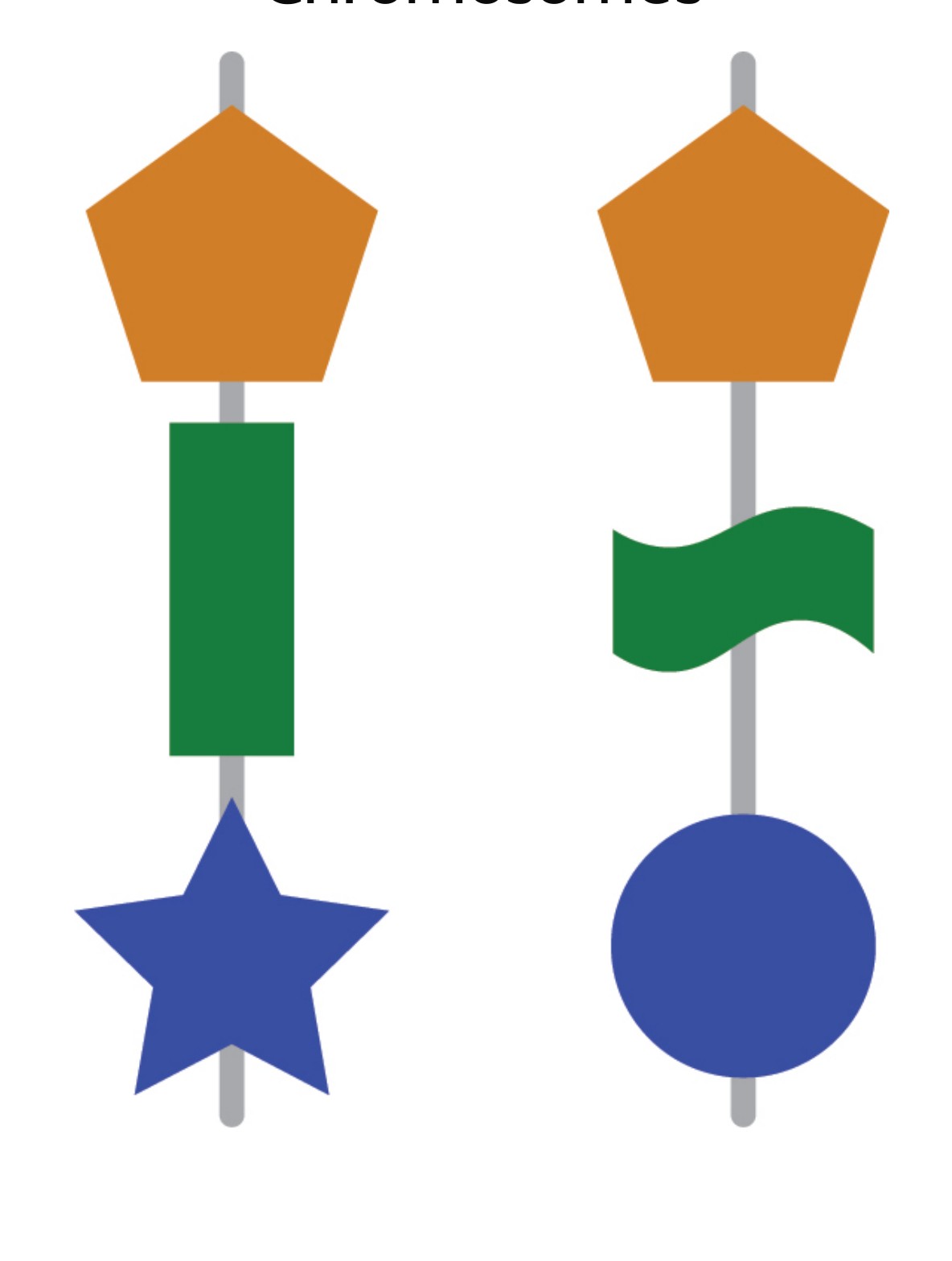
A sex-linked locus lies on a sex chromosome. In a selected X-linked model with no corresponding allele on Y, a single X-linked copy can have a different expression pattern from a two-copy genotype. The square follows the stated gamete contributions and trait relationship. It does not imply all traits are X-linked, every organism uses the same chromosome system, or sex/gender characteristics reduce to one allele. Linkage and copy count must be stated rather than borrowed from an autosomal complete-dominance example.
Read the visual model
Identify the labeled structures and units, then trace the arrows or compare values under the caption’s stated conditions. Separate the displayed evidence from a further inference. Write your reasoning before opening the guidance.
Why is an autosomal AA/Aa/aa model not automatically applicable to the single-X condition here?
Visual reasoning — after your attempt
The relevant allele-copy arrangement differs; the locus and chromosome-system assumptions determine the genotype possibilities.
Genes on the sex chromosomes are inherited differently from those on other chromosomes. In humans, individuals with two X chromosomes carry two copies of X-linked genes, while those with one X and one Y carry a single copy of most of them. A recessive allele on the X therefore produces its phenotype whenever it is the only copy present, which makes X-linked recessive conditions more frequently expressed in individuals with one X.
That asymmetry produces recognizable patterns in family records: the trait often appears in males whose mothers show no sign of it, and an affected father cannot pass an X-linked allele to his sons, since he contributes a Y. These patterns are what make a pedigree informative about where a gene sits, not merely about who is affected.
Pause and explain
A father expresses an X-linked recessive trait. Can his sons inherit the allele from him?
Check your reasoning after answering
No. He passes a Y chromosome to his sons, so they cannot receive his X-linked allele from him. All his daughters receive his X and will carry the allele.
Part 4 · Environment enters the phenotype
A genotype–environment relationship describes how a trait’s outcome depends on both inherited and environmental factors. A reaction norm compares a genotype’s outcomes across defined conditions. Different genotypes can respond by different amounts, so their effects need not simply add. Nutrition, light or temperature can change physiology and expression without rewriting every DNA sequence. Avoid using differences in an uncontrolled population to assign a percentage of one individual’s trait to genes versus environment; such an inference needs a carefully defined statistical model.
Read the visual model
Identify the labeled structures and units, then trace the arrows or compare values under the caption’s stated conditions. Separate the displayed evidence from a further inference. Write your reasoning before opening the guidance.
If genotype A changes between conditions, must a new mutation have caused the change?
Visual reasoning — after your attempt
No. Physiological and regulatory responses to conditions can change phenotype without a new sequence change.
Genotype does not fix phenotype on its own. Nutrition influences height, temperature influences coat colour in some mammals and fur patterning in others, sunlight influences skin pigmentation, and in some reptiles incubation temperature determines sex outright. A phenotype is the outcome of a genotype developing under particular conditions.
This has a direct consequence for interpreting data. A difference in a measured trait between two groups can arise from genetic differences, environmental differences, or both, so attributing it to inheritance requires evidence that the environments were comparable. Claims that a complex trait is determined by a specific gene typically go well beyond what the data support.
Pause and explain
Two groups of genetically similar plants differ in mean height. What must be established before attributing the difference to inheritance?
Check your reasoning after answering
That the growing conditions were comparable — light, water, nutrients, temperature, and spacing. Without that, the difference may be environmental, and the genetic explanation is not supported.
Apply the whole unit · Resolve four inheritance puzzles
Illustrative records. (i) Red × white flowers of one species give all pink offspring; pink × pink gives 24 red, 51 pink, 25 white. (ii) A mother is blood type O, a father type AB; their four children are types A and B only. (iii) In 40 families, an X-linked recessive condition appears in 11 sons and 0 daughters. (iv) Two genetically identical plant cuttings grown at 15 °C and 25 °C reach mean heights of 22 cm and 41 cm.
Your task
Identify the inheritance pattern or explanation in each case and give the decisive evidence, calculate the observed ratio in case (i) and the proportion of affected sons in case (iii), and state which case shows that phenotype is not determined by genotype alone. Then explain why case (ii) rules out one allele combination entirely.
What your response should show
- Choose the appropriate biological model or relationship and state the conditions it assumes.
- Show the counts, rates, ratios, or intermediate reasoning the question requires.
- Use the supplied evidence to justify the conclusion and separate observation from inference.
- Identify a meaningful limitation, uncertainty, or next measurement.
Response guidance — after your attempt
Case (i): an intermediate phenotype in the heterozygote indicates incomplete dominance; the pink × pink counts of 24:51:25 approximate 1:2:1, matching the genotype ratio because each genotype has its own phenotype.
Case (ii): an O mother contributes only O alleles and an AB father contributes A or B, so children are AO or BO — types A and B, with no AB or O possible.
Case (iii): 11 of the sons affected and no daughters fits X-linked recessive inheritance, since a son with one X expresses a recessive allele carried on it; the proportion is 11 of 40 families, about 28 percent.
Case (iv): genetically identical cuttings differing by 19 cm under different temperatures show an environmental effect on phenotype.
Identify the key case: (iv) demonstrates that genotype alone does not determine phenotype, since the genotypes are identical and the phenotypes are not.
Explain the exclusion in (ii): type O requires two O alleles, and the father has none to give, so no child of this couple can be type O; AB is likewise impossible because the mother cannot contribute A or B.
Case (i) is incomplete dominance: the heterozygote is pink, and the 24:51:25 counts from pink × pink approximate the 1:2:1 genotype ratio, which here is also the phenotype ratio because each genotype looks different. Case (ii) follows from multiple alleles with codominance: the mother can give only O and the father only A or B, so every child is AO or BO — type A or B — and neither type AB nor type O is possible, since AB would need an A or B allele from the mother and O would need an O allele from the father. Case (iii) fits X-linked recessive inheritance, affecting 11 of 40 families' sons and no daughters, because a single X carrying the recessive allele is enough to express it. Case (iv) is the decisive one for the chapter's broader point: genetically identical cuttings differ by 19 cm in mean height under different temperatures, so phenotype is the outcome of a genotype developing under particular conditions rather than a direct readout of the genes.
Scientific references and adapted source figures
- OpenSciEd 8.5 — genetics foundations and case models
- OpenSciEd middle-school source license — CC BY 4.0
Parent / teacher teaching notes
The pattern worth naming aloud is that each of these cases is a departure from one specific assumption in simple Mendelian inheritance — one gene, two alleles, full dominance, and environment held constant — so ask which assumption fails in each. ABO blood type is the best worked example because the exclusions are absolute and checkable. Case (iv) is the one to return to whenever a confident claim about genes determining a complex trait comes up, including outside this course. Ask for an explanation of each label, arrow and axis before calculation. Keep first and revised models; attempt the changed case before consulting guidance. Distinguish invented instructional records from named historical sources. Source chromosome symbols are allele-category models, not DNA sequences. These independently authored high-school supplements are not the full OpenSciEd teacher editions or an endorsement.
The key idea
Choose an inheritance model that fits the trait; probabilities and model limits belong in the explanation.
Worked examples
Example 1
- Gametes from each parent can carry R or W.
- The combinations are RR, RW, RW, WW.
Example 2 · Worked application
- The observed heterozygote is neither identical to one homozygote nor a simultaneous distinct display of both.
- An intermediate phenotype is consistent with incomplete dominance for this trait.
Do not extend one trait's pattern to all traits.
Example 3
- Each parent supplies R or W.
- The combinations RR, RW, WR and WW give ¼ red, ½ pink and ¼ white.
Example 4 · Find and fix the mistake
- Test the claim against the stated conditions: Do not extend one trait's pattern to all traits.
- Many traits involve multiple genes and environmental influences; dominance is not a universal trait explanation.
Do not extend one trait's pattern to all traits.
Example 5 · Reason from the visual evidence
- A sex-linked locus lies on a sex chromosome. In a selected X-linked model with no corresponding allele on Y, a single X-linked copy can have a different expression pattern from a two-copy genotype. The square follows the stated gamete contributions and trait relationship. It does not imply all traits are X-linked, every organism uses the same chromosome system, or sex/gender characteristics reduce to one allele. Linkage and copy count must be stated rather than borrowed from an autosomal complete-dominance example.
- The relevant allele-copy arrangement differs; the locus and chromosome-system assumptions determine the genotype possibilities.
Original constrained X-linked inheritance model, not a diagnostic pedigree or a complete account of human sex development.
Avoid these mistakes
- An individual usually does not carry every allele that exists in the population.
Check your understanding
A hypothetical flower has RR red, WW white and RW pink. Cross RW with RW.
Discuss the answer
1:2:1 phenotype ratio under the stated incomplete-dominance model.
Why must the allele-to-phenotype relationship be specified before using a Punnett square?
Discuss the answer
The same genotype probabilities produce different phenotype probabilities under complete, incomplete or codominant mappings; environmental and multi-locus conditions also matter.
Return to the phenomenon
Return to the initial case. Why can a heterozygote look intermediate without its alleles permanently blending? Revise your drawing or explanation using two named ideas and one stated limitation.
Compare explanations after your attempt
Inheritance predicts outcomes only with a stated genotype–phenotype model; multiple loci, chromosome systems and environment can change it.
What should we investigate next?
Which comparison would test a remaining uncertainty? State what you would change, keep comparable and measure.
Investigate, explain and revise
Complete these tasks after the teaching parts. Preserve your first model and a supported revision; use guidance after a real attempt.
Activity 1 · Return to the opening case
Use the opening question, defined terms, Parts 1–4 and your notebook. The supplied-data route needs no equipment or external account.
Your task
Return to the initial case. Why can a heterozygote look intermediate without its alleles permanently blending? Revise your drawing or explanation using two named ideas and one stated limitation.
Success criteria
- Use relevant stated observations.
- Explain the mechanism with a labeled model.
- Distinguish quantities and assumptions.
- Describe a revision and a useful next test.
Hint
Follow objects, materials and information separately. Check what each measured quantity means.
Response guidance — discuss after your attempt
Inheritance predicts outcomes only with a stated genotype–phenotype model; multiple loci, chromosome systems and environment can change it.
Activity 2 · Transfer to a changed case
Cover the worked guidance and use the unit explanations/figures to solve a changed problem.
Your task
A heterozygote has an intermediate phenotype under an incomplete-dominance model. Predict genotype and phenotype probabilities from Rr×Rr and explain what happens to the alleles.
Success criteria
- Use the stated measurements or conditions, with correct units.
- Connect the result to the biological mechanism or evidence relationship.
- Identify the assumption, model limit or further evidence requested.
Hint
Name the stated conditions, select the relevant mechanism and show intermediate reasoning.
Response guidance — discuss after your attempt
Genotypes are 1/4 RR, 1/2 Rr, 1/4 rr, giving three phenotype categories in the same ratio under this model. The alleles remain distinct and segregate; the intermediate appearance does not erase them.
Words to know
- incomplete dominance
- A heterozygous phenotype is intermediate in the stated model.
- codominance
- Both allelic products are detectably expressed in a heterozygote.
- polygenic trait
- A trait influenced by variation at multiple genes.
In the real world
Exit check
What does a Punnett-square prediction need to be useful?
Check your explanation after answering
Known parental genotypes and an explicit inheritance model, with probabilities rather than guaranteed outcomes.
Explain your reasoning without notes. If a key idea is missing, revisit the lesson and try again.
Problem 1
Answer and explanation
50 %
Two of four equally likely combinations are RW.
Problem 2
- expressed in the heterozygote under the stated model
- always more common
- always healthier
- more genes than recessive
Answer and explanation
expressed in the heterozygote under the stated model
Dominance describes the genotype–phenotype relationship.
Problem 3
Answer and explanation
Several genes contribute to pigment and observed color; a two-allele model omits important biology.
Problem 4
Answer and explanation
1:2:1 phenotype ratio under the stated incomplete-dominance model.
Each parent supplies R or W.
The combinations RR, RW, WR and WW give ¼ red, ½ pink and ¼ white.
Response criteria
- Use the stated conditions.
- Show the evidence or calculation.
- Explain the conclusion and any stated limitation.
Problem 5
Hints
Do not extend one trait's pattern to all traits.
Answer and explanation
Codominance, rather than an intermediate blended phenotype.
Problem 6
Hints
State what the supplied observations or conditions establish, and separate that from any assumption.
Answer and explanation
Many genes and environmental factors such as nutrition influence a complex trait.
Problem 7
Answer and explanation
The relevant allele-copy arrangement differs; the locus and chromosome-system assumptions determine the genotype possibilities.
A sex-linked locus lies on a sex chromosome. In a selected X-linked model with no corresponding allele on Y, a single X-linked copy can have a different expression pattern from a two-copy genotype. The square follows the stated gamete contributions and trait relationship. It does not imply all traits are X-linked, every organism uses the same chromosome system, or sex/gender characteristics reduce to one allele. Linkage and copy count must be stated rather than borrowed from an autosomal complete-dominance example.
The relevant allele-copy arrangement differs; the locus and chromosome-system assumptions determine the genotype possibilities.
Response criteria
- Read the structures, axes, directions and units correctly.
- Connect the evidence with the biological mechanism.
- Respect stated model assumptions and distinguish an observation from a further inference.
Problem 8
Answer and explanation
Genotypes are 1/4 RR, 1/2 Rr, 1/4 rr, giving three phenotype categories in the same ratio under this model. The alleles remain distinct and segregate; the intermediate appearance does not erase them.
Genotypes are 1/4 RR, 1/2 Rr, 1/4 rr, giving three phenotype categories in the same ratio under this model. The alleles remain distinct and segregate; the intermediate appearance does not erase them.
Response criteria
- Use the stated measurements or conditions, with correct units.
- Connect the result to the biological mechanism or evidence relationship.
- Identify the assumption, model limit or further evidence requested.