Kinetic Molecular Theory & Phase Changes — Practice · Grade 11 Science
Chapter: States of Matter & GasesWhat this practice covers
By the end of Kinetic Molecular Theory & Phase Changes you should be able to:
- I can state the assumptions of the kinetic molecular theory and use them to explain how gases behave.
- I can describe the particle arrangement in solids, liquids, and gases, and interpret heating curves and phase diagrams for all six phase changes.
11 questions, multiple choice, numeric and written answer, each with a worked explanation.
Vocabulary used: kinetic molecular theory (KMT), kinetic energy, phase change, heating curve, heat of fusion, heat of vaporization, phase diagram, sublimation.
Problem 1
- number of particles
- Kelvin temperature
- pressure of the gas
- volume of the container
Answer and explanation
Kelvin temperature
A core assumption of KMT is that average kinetic energy is directly proportional to the absolute (Kelvin) temperature.
Problem 2
- solid
- liquid
- gas
- they are identical in all states
Answer and explanation
gas
In a gas, kinetic energy dominates: particles spread far apart and move quickly with almost no attraction between them.
Problem 3
Answer and explanation
300 K
K = °C + 273 = 27 + 273 = 300 K.
Problem 4
- The substance is cooling down
- The particles have stopped moving completely
- An error was made recording the data
- A phase change is occurring; added energy breaks particle attractions instead of raising the temperature
Answer and explanation
A phase change is occurring; added energy breaks particle attractions instead of raising the temperature
During a phase change the temperature holds steady because the incoming energy goes into breaking attractions (potential energy), not speeding particles up (kinetic energy).
Problem 5
Answer and explanation
The added energy is used to overcome the attractive forces holding the particles in the solid arrangement — it raises their potential energy, not their kinetic energy. Since temperature measures average kinetic energy, it stays constant until all of the solid has melted.
Problem 6
- freezing, condensation, and deposition
- melting, boiling, and sublimation
- melting, freezing, and boiling
- sublimation, deposition, and condensation
Answer and explanation
freezing, condensation, and deposition
Freezing, condensation, and deposition all move to a more ordered, tightly held state and release energy; melting, vaporization, and sublimation absorb it.
Problem 7
Hints
Specify fixed volume and amount before applying the relation.
Answer and explanation
It is an absolute scale compatible with the kinetic-energy relation, unlike Celsius's arbitrary zero.
Problem 8
Hints
State what the supplied observations or conditions establish, and separate that from any assumption.
Answer and explanation
No. Energy can drive the phase change while temperature stays nearly constant.
Problem 9
Answer and explanation
No. Mean translational kinetic energy doubles, while a characteristic speed increases by √2, approximately 1.41.
For an ideal gas, mean translational kinetic energy per particle is proportional to absolute temperature in kelvin: 3kBT/2. The corresponding molar quantity uses R rather than kB. At a given temperature particles have a distribution of speeds; none of these statements requires every molecule to move at one speed. Doubling T doubles the mean translational energy, while a characteristic speed for the same particle mass scales as the square root of T. Celsius ratios do not express this relation.
No. Mean translational kinetic energy doubles, while a characteristic speed increases by √2, approximately 1.41.
Response criteria
- Interpret labels, structures, axes, units and directions correctly.
- Explain the chemistry relationship or mechanism.
- Respect stated assumptions and distinguish observation from inference.
Problem 10
Answer and explanation
The energy ratio is 2 and the characteristic speed ratio √2≈1.41. Kelvin is an absolute scale proportional to this mean energy; Celsius has an offset and its numeric ratios do not express the same physical relation.
The energy ratio is 2 and the characteristic speed ratio √2≈1.41. Kelvin is an absolute scale proportional to this mean energy; Celsius has an offset and its numeric ratios do not express the same physical relation.
Response criteria
- Use the stated measurements or conditions, with correct units.
- Connect the result to the chemical mechanism or evidence relationship.
- Identify the assumption, model limit or further evidence requested.
Problem 11
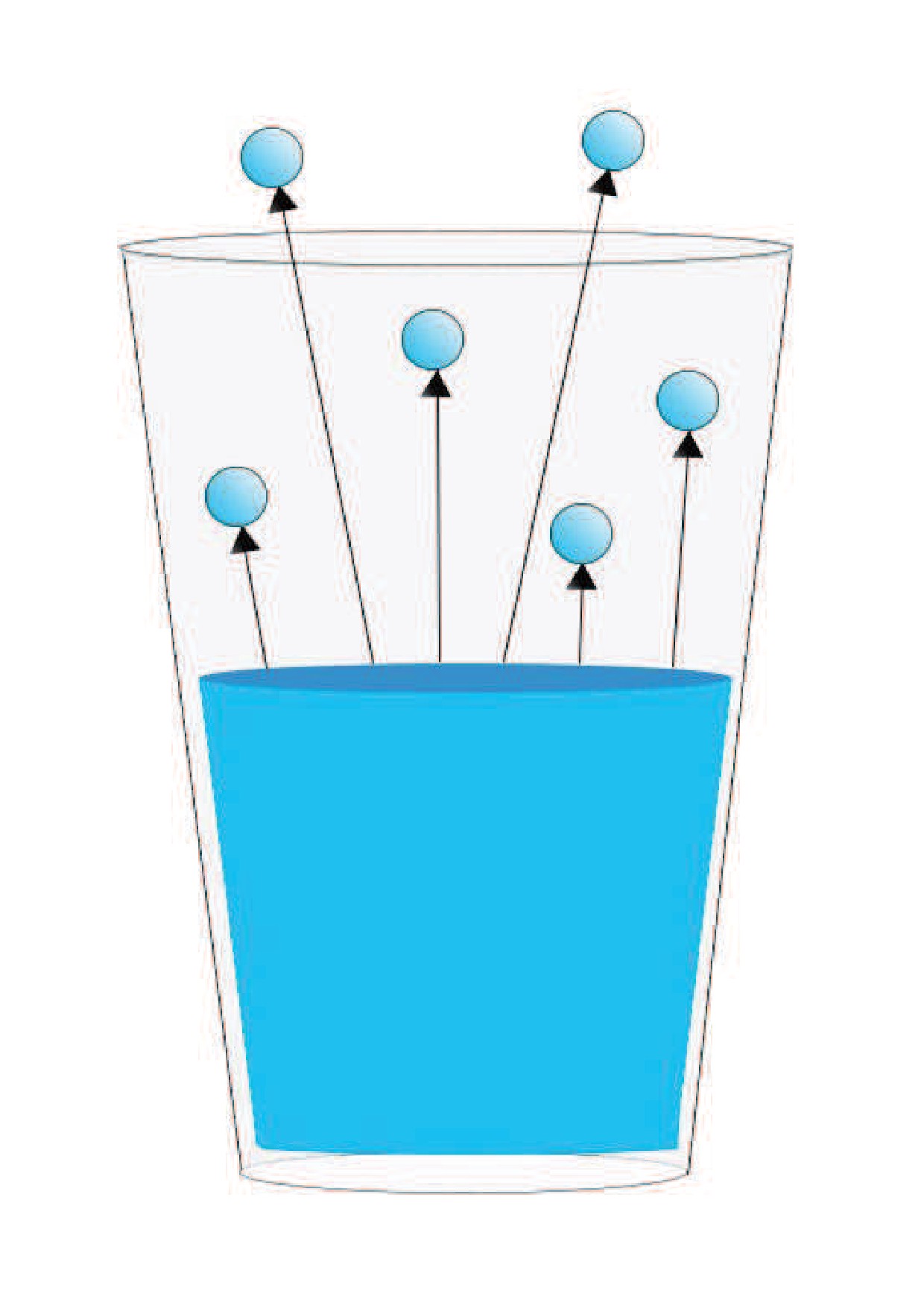
Answer and explanation
The arrows show selected molecules leaving the surface. They are not broken O–H bonds, a literal complete inventory or a claim that all molecules share one speed. Add vapor and returning condensation with equal opposing rates at the stated closed-vessel equilibrium; a constant liquid amount need not mean motion has stopped.
Identify the source’s visible labels, scales and unfinished or omitted information.
Use the local complete explanations to connect the observation with an explicit mechanism.
State assumptions and a limit before extending the model.
Response criteria
- Interpret the source symbols and boundary correctly.
- Explain the relevant mechanism using quantities/species consistently.
- State a meaningful omission, assumption or evidence limitation.