Kinetic Molecular Theory & Phase Changes — Print · Grade 11 Science
Chapter: States of Matter & GasesKinetic Molecular Theory & Phase Changes
Learning goals
- I can state the assumptions of the kinetic molecular theory and use them to explain how gases behave.
- I can describe the particle arrangement in solids, liquids, and gases, and interpret heating curves and phase diagrams for all six phase changes.
Readings for this unit
Before this unit
Temperature, energy, and phases.
Use the detailed parent plan: two core 50–60-minute sessions per focused unit, with a third assigned for selected calculation/modeling topics. First study the core explanation and Parts 1–2 with their figures/checks; next study Parts 3–4, the whole-unit application, worked cases, varied practice and exit check. Attempt reasoning before opening guidance. Extend time when actual understanding requires it; investigations and chapter assessments have separate sessions.
Start with something to explain
Does warming a gas make every molecule expand or move at the same new speed?
Illustrative evidence case. A sealed sample is warmed while the number of molecules remains fixed.
Notice and wonder
Record two observations using the stated quantities or relationships. Keep observations separate from possible causes. Write one question that a new measurement could help answer.
Does warming a gas make every molecule expand or move at the same new speed?
Your first model
Keep molecular identity, speed distribution and container response as separate parts of the model.
Build the language from the idea
- kinetic molecular theory (KMT)
- A model that explains the behavior of gases by picturing them as huge numbers of tiny particles in constant, random, straight-line motion.
- kinetic energy
- The energy of motion; the average kinetic energy of a substance's particles is directly proportional to its Kelvin temperature.
- phase change
- A physical change in which a substance moves between the solid, liquid, and gas states without becoming a new substance.
- heating curve
- A graph of temperature versus energy added (or time) as a substance is heated; it shows flat plateaus during phase changes.
- heat of fusion
- The energy absorbed to melt a given amount of a solid (and released when that amount freezes).
- heat of vaporization
- The energy absorbed to boil a given amount of a liquid (and released when that amount condenses); larger than the heat of fusion.
- phase diagram
- A pressure-versus-temperature graph showing which phase is stable under each set of conditions, including the triple point and critical point.
- sublimation
- The phase change directly from solid to gas, skipping the liquid state; deposition is the reverse.
Picture the air in the room around you. It looks like empty nothingness, yet it is actually a swarm of trillions upon trillions of molecules, each one hurtling along at hundreds of meters per second, colliding, rebounding, and racing off again. The kinetic molecular theory (KMT) is the model chemists use to make sense of that invisible chaos. Rather than tracking any single particle, KMT describes the *average* behavior of an enormous crowd of them — and from that average it successfully predicts everything a gas does, from the pressure in a tire to the lift under a hot-air balloon.
The theory rests on a few clean assumptions about an ideal gas. First, gas particles are in constant, random, straight-line motion, changing direction only when they collide. Second, the particles themselves are so tiny compared with the distances between them that their own volume is essentially zero — a gas is mostly empty space. Third, the particles neither attract nor repel one another, and their collisions are perfectly elastic, meaning no kinetic energy is lost when they bounce. Fourth, and most important, the mean translational kinetic energy per ideal-gas particle is directly proportional to the Kelvin temperature: at thermal equilibrium a greater kelvin temperature gives a greater mean translational energy, with a distribution of particle speeds.
That same idea of particle motion explains the three familiar states of matter, which really come down to a tug-of-war between the kinetic energy pulling particles apart and the attractive forces trying to hold them together. In a solid, the attractions win: particles are locked in a rigid arrangement and can only vibrate in place, so a solid keeps its shape and volume. In a liquid, the two are more evenly matched: particles stay close but can slide past one another, so a liquid keeps its volume but flows to fit its container. In a gas, motion wins completely: particles fly apart with vast empty gaps between them, so a gas expands to fill any space it is given.
Add or remove enough energy and a substance flips between states in a phase change. There are six, and they come in reverse-pairs. Adding energy drives melting (solid to liquid), vaporization (liquid to gas), and sublimation (solid straight to gas) — all endothermic, meaning they absorb energy. Removing energy drives their opposites — freezing, condensation, and deposition — all exothermic, releasing energy. The energy needed to melt a sample is its heat of fusion; the (larger) energy needed to boil it is its heat of vaporization.
A heating curve separates warming within a phase from changing phase fraction. For a selected pure substance at fixed pressure and suitable heating conditions, a melting or boiling region can remain near constant temperature while energy enters. Real curves can depart from a flat plateau through mixtures, loss, gradients or changing conditions. Segment duration depends on mass, power and energy required, and phase conversion changes intermolecular arrangements rather than ordinarily breaking internal molecular covalent bonds.
Zoom out to a phase diagram and you get the whole picture at once: pressure on the vertical axis, temperature on the horizontal, and boundary lines dividing the map into solid, liquid, and gas regions. Where all three lines meet is the triple point, the single condition where solid, liquid, and gas coexist. Follow the liquid-gas line up and it ends at the critical point, beyond which the distinction between liquid and gas disappears into a supercritical fluid. Most substances behave tidily, but water is a famous rebel — its solid-liquid boundary tilts backward (negative slope) because ice is less dense than liquid water. Carbon dioxide is another oddball: its triple point sits above normal air pressure, so at 1 atm solid CO₂ (dry ice) skips the liquid entirely and sublimes straight to gas.
Model check: Average kinetic energy is not the same as total internal energy. Energy changes particle arrangements/interactions during phase coexistence rather than mainly raising the kinetic-temperature scale.
Build your understanding
Use the detailed parent plan: two core 50–60-minute sessions per focused unit, with a third assigned for selected calculation/modeling topics. First study the core explanation and Parts 1–2 with their figures/checks; next study Parts 3–4, the whole-unit application, worked cases, varied practice and exit check. Attempt reasoning before opening guidance. Extend time when actual understanding requires it; investigations and chapter assessments have separate sessions.
Part 1 · Explain phase using motion and interactions
A phase is a region with a characteristic physical state and composition. In a simple molecular model, solid particles vibrate around constrained positions, liquid particles remain close but rearrange, and gas particles are widely separated relative to their size. The molecules themselves do not expand into larger molecules when the sample expands. Interparticle motion and interactions jointly determine phase; a regular solid-dot picture is only one structural model and does not describe every amorphous solid.
Read the visual model
Identify the labeled structures and units, then trace the arrows or compare values under the caption’s stated conditions. Separate the displayed evidence from a further inference. Write your reasoning before opening the guidance.
Which changes in the drawing distinguish liquid from gas without changing each molecule’s identity?
Visual reasoning — after your attempt
Spacing and freedom of relative movement differ. The dots keep the same species meaning; individual molecules do not become larger gas particles.
Particle motion and attractions help explain phases under stated temperature and pressure. Solid particles vibrate around positions; liquids remain close while changing neighbors; gases have much greater average separation. Particles do not expand into larger atoms when the bulk material expands.
Use the same molecule labels across water phases. A phase change rearranges and changes interactions between molecules rather than decomposing each H₂O molecule.
Pause and explain
What stays chemically unchanged when pure water boils?
Check your reasoning after answering
Water molecules retain their chemical identity. Intermolecular organization changes, rather than ordinary boiling breaking water into hydrogen and oxygen.
Part 2 · Use the ideal gas assumptions deliberately
The kinetic molecular theory ideal-gas model treats particles as small compared with their separation, with negligible intermolecular forces between collisions and elastic collisions. Pressure arises from momentum transfer to container walls, averaged over many impacts. It is not a property of one particle pushing outward continuously. Actual gases deviate when interactions or finite molecular volume matter, especially at high density or near condensation. State the model before translating a motion-arrow picture into a pressure prediction.
Read the visual model
Identify the labeled structures and units, then trace the arrows or compare values under the caption’s stated conditions. Separate the displayed evidence from a further inference. Write your reasoning before opening the guidance.
Why does a single arrow touching the wall not supply a pressure value?
Visual reasoning — after your attempt
Pressure requires the momentum transferred per time and wall area over many particles and collisions, not one selected trajectory.
The ideal kinetic model treats gas particles as negligible in volume, moving randomly with elastic collisions and negligible attractions except during collisions. Pressure comes from momentum exchange with container walls. These assumptions work best sufficiently far from condensation and at lower densities.
Compressing at constant temperature increases collision frequency per wall area in the model. Real molecules still have size and attractions, so the ideal description is an approximation.
Pause and explain
Why can ideal-gas predictions fail near liquefaction?
Check your reasoning after answering
Attractions and finite particle volumes become important, violating assumptions of negligible interactions and volume.
Part 3 · Relate Kelvin temperature to average kinetic energy
For an ideal gas, mean translational kinetic energy per particle is proportional to absolute temperature in kelvin: 3kBT/2. The corresponding molar quantity uses R rather than kB. At a given temperature particles have a distribution of speeds; none of these statements requires every molecule to move at one speed. Doubling T doubles the mean translational energy, while a characteristic speed for the same particle mass scales as the square root of T. Celsius ratios do not express this relation.
Read the visual model
Identify the labeled structures and units, then trace the arrows or compare values under the caption’s stated conditions. Separate the displayed evidence from a further inference. Write your reasoning before opening the guidance.
At 600 K versus 300 K, does a characteristic speed of the same gas double?
Visual reasoning — after your attempt
No. Mean translational kinetic energy doubles, while a characteristic speed increases by √2, approximately 1.41.
Average translational kinetic energy in the ideal model is proportional to absolute temperature. Kelvin temperature is Celsius plus 273.15. Doubling Celsius is not doubling absolute temperature. At the same temperature, different gas species share average translational kinetic energy but can have different speeds.
A lighter molecule generally moves faster on average than a heavier one at the same temperature. Equal temperature does not mean equal molecular speed.
Pause and explain
Why is 20°C to 40°C not a doubling of ideal kinetic energy?
Check your reasoning after answering
The absolute temperatures are about 293 K and 313 K, whose ratio is much less than two. The proportional relationship uses Kelvin.
Part 4 · Interpret phase changes and dynamic exchange
Evaporation transfers molecules from a liquid to vapor, while condensation returns vapor molecules to liquid. In a closed vessel at equilibrium, the opposing rates can be equal even though molecules continue crossing the interface. A stable liquid level is therefore not proof that particles stopped moving. Boiling occurs when vapor bubbles can persist under the surrounding pressure, while surface evaporation can occur below the boiling temperature. Keep chemical identity, boundary conditions and phase-transfer rates distinct.
Read the visual model
Identify the labeled structures and units, then trace the arrows or compare values under the caption’s stated conditions. Separate the displayed evidence from a further inference. Write your reasoning before opening the guidance.
What does equal evaporation and condensation rate mean for the visible amount of each phase?
Visual reasoning — after your attempt
There is no net change from that exchange under steady conditions, despite continuing molecular motion and transfer in both directions.
During evaporation, surface molecules escape and can cool the remaining liquid. In a closed container, condensation can balance evaporation dynamically. A constant macroscopic vapor amount does not require zero molecular exchange. Temperature plateaus during pure-substance phase changes need pressure and energy conditions.
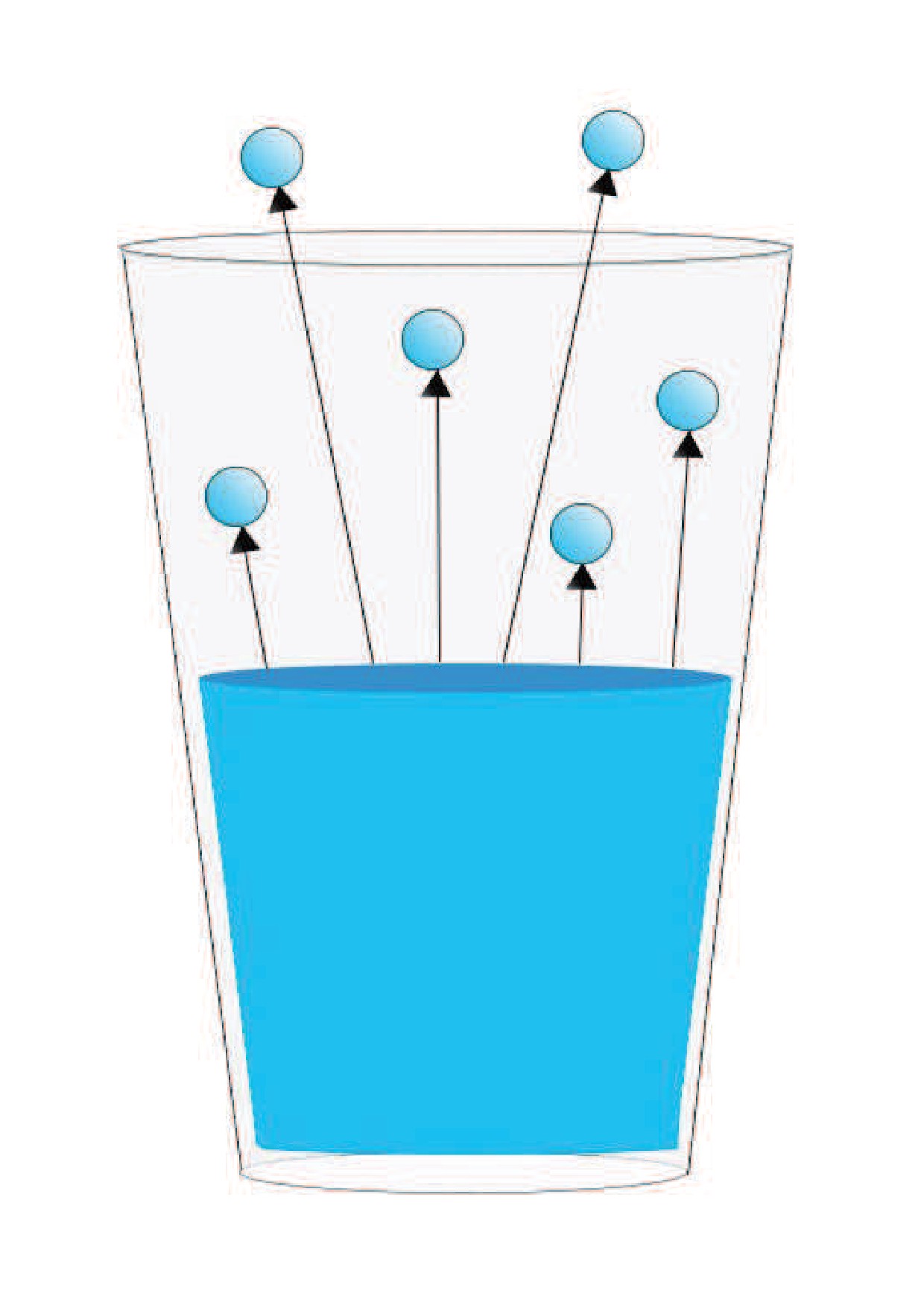
At liquid-vapor equilibrium, molecules continue crossing the interface in both directions at equal average rates.
Pause and explain
Does equilibrium stop evaporation?
Check your reasoning after answering
No. Evaporation and condensation continue, with equal average rates so the macroscopic amount remains steady.
Apply the whole unit · Compare ideal gas temperatures
Illustrative sealed rigid vessel has an ideal gas at 300 K and pressure 100 kPa. It is heated to 450 K without changing gas amount or vessel volume.
Your task
Predict pressure, explain the particle mechanism, compare the absolute-temperature ratio, and state conditions that could make a real gas depart from the prediction.
What your response should show
- Choose the appropriate chemical model or relationship and state its conditions.
- Show substitutions, units, particle or charge counts, and intermediate reasoning as relevant.
- Use supplied evidence to justify the conclusion; distinguish observation from inference.
- Identify a meaningful limitation, uncertainty, or next measurement.
Response guidance — after your attempt
At fixed n and V, ideal pressure is proportional to T.
T₂/T₁=450/300=1.50.
P₂=100×1.50=150 kPa.
The ideal prediction is 150 kPa, associated with greater average translational kinetic energy and wall momentum transfer. It is not based on a Celsius ratio or particle growth. Leaks, nonrigid volume, finite molecular size, attractions, or temperature gradients can invalidate the assumptions. This is supplied-data work, not a pressure-vessel heating experiment.
Scientific references and source-model foundations
- OpenStax — gas laws and the ideal-gas model
- OpenSciEd public middle-school source license — CC BY 4.0
Parent / teacher teaching notes
Use the assumptions alongside every particle explanation. Keep equal average kinetic energy separate from equal particle speed. Ask the learner to explain each particle symbol, axis, unit and arrow before calculating. Distinguish hypothetical models and calculated curves from measured records. Public OpenSciEd excerpts here are selected foundation prompts, not complete high-school teacher editions or an endorsement. All required advanced explanations and practice are provided locally.
An animation showing the particle arrangement and motion in the solid, liquid, and gas states of matter.
The key idea
An ideal-gas kinetic model relates mean translational energy to absolute temperature and pressure to wall momentum transfer. Phase behavior also depends on interparticle interactions and conditions, not temperature alone.
Average Kinetic Energy & Temperature
KE(avg) ∝ T (T in kelvin)
the average kinetic energy of a substance's particles is directly proportional to the absolute (Kelvin) temperature; doubling the Kelvin temperature doubles the average kinetic energy.
Kelvin Temperature Conversion
T(K) = T(°C) + 273.15
converts Celsius to the absolute (Kelvin) scale; 0 K is absolute zero. Many problems round the constant to 273.
Worked examples
Example 1
- A flat plateau on a heating curve means energy is still flowing in but the temperature is not changing — the signature of a phase change.
- The lower plateau (80°C) is the first change as the substance warms from solid: it is melting (solid to liquid) at its melting point.
- The higher plateau (218°C) is the next change up the curve: it is boiling (liquid to gas) at its boiling point.
Example 2 · Worked application
- Particle number and volume remain fixed.
- Higher Kelvin temperature means greater average kinetic energy.
- More forceful and frequent wall interactions raise pressure.
Specify fixed volume and amount before applying the relation.
Example 3
- (a) Frost forming is gas turning directly into solid — that is deposition. Going to a more ordered, tightly held state releases energy, so it is exothermic.
- (b) Melting is solid turning into liquid. Loosening the particle arrangement requires energy to be absorbed, so it is endothermic.
Example 4 · Find and fix the mistake
- Test the claim against the stated conditions: Specify fixed volume and amount before applying the relation.
- Particle separations and motion change; kinetic-molecular theory does not require individual molecules to inflate.
Specify fixed volume and amount before applying the relation.
Example 5 · Reason from the visual model
- For an ideal gas, mean translational kinetic energy per particle is proportional to absolute temperature in kelvin: 3kBT/2. The corresponding molar quantity uses R rather than kB. At a given temperature particles have a distribution of speeds; none of these statements requires every molecule to move at one speed. Doubling T doubles the mean translational energy, while a characteristic speed for the same particle mass scales as the square root of T. Celsius ratios do not express this relation.
- No. Mean translational kinetic energy doubles, while a characteristic speed increases by √2, approximately 1.41.
Original ideal-gas temperature comparison. The bars show T, not a speed distribution or total energy for samples of unspecified amount.
Avoid these mistakes
- Average kinetic energy is not the same as total internal energy.
Check your understanding
Why can melting absorb energy without warming?
Discuss the answer
Energy changes particle arrangements/interactions during phase coexistence rather than mainly raising the kinetic-temperature scale.
Return to the phenomenon
Return to the initial case. Does warming a gas make every molecule expand or move at the same new speed? Revise your drawing or explanation using two named ideas and one stated limitation.
Compare explanations after your attempt
Temperature changes mean translational energy and the distribution, not molecular identity or one universal speed. Volume or pressure response depends on the boundary conditions.
What should we investigate next?
Which comparison would test a remaining uncertainty? State what you would change, keep comparable and measure.
Investigate, calculate and revise
Keep a first model and an evidence-supported revision. Attempt each task before opening guidance; all required explanations and supplied-data routes are available locally.
Activity 1 · Return to the opening case
Use the opening phenomenon, unit definitions and explained Parts 1–4.
Your task
Return to the initial case. Does warming a gas make every molecule expand or move at the same new speed? Revise your drawing or explanation using two named ideas and one stated limitation.
Success criteria
- Use the stated observations and appropriate units.
- Connect a labeled model with the chemical mechanism.
- State assumptions and an evidence limitation.
- Explain a substantive revision or next test.
Hint
Keep species identity, material transfer and energy account distinct.
Response guidance — discuss after your attempt
Temperature changes mean translational energy and the distribution, not molecular identity or one universal speed. Volume or pressure response depends on the boundary conditions.
Activity 2 · Transfer to a changed case
Cover the worked answer and use the explained models, relationships and notebook.
Your task
Two equal-mass ideal-gas particles are compared through samples at 250 K and 500 K. Give the ratio of mean translational energy and characteristic speed, and explain why Celsius values cannot replace kelvin in these ratios.
Success criteria
- Use the stated measurements or conditions, with correct units.
- Connect the result to the chemical mechanism or evidence relationship.
- Identify the assumption, model limit or further evidence requested.
Hint
Name known quantities and conditions, show intermediate steps and check conservation.
Response guidance — discuss after your attempt
The energy ratio is 2 and the characteristic speed ratio √2≈1.41. Kelvin is an absolute scale proportional to this mean energy; Celsius has an offset and its numeric ratios do not express the same physical relation.
Words to know
- kinetic molecular theory (KMT)
- A model that explains the behavior of gases by picturing them as huge numbers of tiny particles in constant, random, straight-line motion.
- kinetic energy
- The energy of motion; the average kinetic energy of a substance's particles is directly proportional to its Kelvin temperature.
- phase change
- A physical change in which a substance moves between the solid, liquid, and gas states without becoming a new substance.
- heating curve
- A graph of temperature versus energy added (or time) as a substance is heated; it shows flat plateaus during phase changes.
- heat of fusion
- The energy absorbed to melt a given amount of a solid (and released when that amount freezes).
- heat of vaporization
- The energy absorbed to boil a given amount of a liquid (and released when that amount condenses); larger than the heat of fusion.
- phase diagram
- A pressure-versus-temperature graph showing which phase is stable under each set of conditions, including the triple point and critical point.
- sublimation
- The phase change directly from solid to gas, skipping the liquid state; deposition is the reverse.
Just how fast are the molecules around you?
The air molecules brushing past your face right now are not drifting — they are sprinting. A typical nitrogen molecule at room temperature averages about 500 meters per second, roughly 1,800 km/h, faster than the speed of sound and faster than most rifle bullets. They do not travel far before crashing, though: each molecule slams into another about five billion times every second, ricocheting after a flight of only a few dozen nanometers. What feels like still, empty air is really an unimaginably frantic pinball game.
How we know atoms really move: Brownian motion
For centuries, atoms were just a useful idea — no one had seen evidence they move. The proof came from a strange observation: in 1827 botanist Robert Brown watched tiny pollen grains in water jiggle and stagger with no cause. In 1905, Albert Einstein showed mathematically that the dance was caused by invisible water molecules bombarding the grains from all sides, and Jean Perrin's experiments soon confirmed it. That jittery motion, now called Brownian motion, was the first hard evidence that atoms and molecules are real and constantly moving — exactly what KMT assumes.
The myth that all particles move at the same speed
KMT talks about the average kinetic energy, and students often picture every molecule cruising at that one speed. In reality the speeds are spread across a wide range described by the Maxwell–Boltzmann distribution: at any instant some molecules are crawling, some are rocketing along, and most are somewhere in the middle. This spread is why liquids evaporate below their boiling point — only the fastest, highest-energy molecules at the surface escape into the air, which is also why the liquid left behind cools down.
Why water boils cooler on a mountaintop
Boiling is not fixed at 100°C — that number only holds at sea-level pressure. Boiling happens when a liquid's molecules can push out against the surrounding air pressure, so lower pressure means a lower boiling point. In Denver, a mile high, water boils around 95°C; near the summit of Everest it boils at only about 70°C, too cool to properly cook an egg or brew tea. A pressure cooker does the opposite, trapping steam to raise the internal pressure so water boils above 100°C and food cooks far faster.
Beyond the critical point: neither liquid nor gas
Follow the liquid–gas line on a phase diagram up to the critical point and something bizarre happens — heat and squeeze a substance past it and the boundary between liquid and gas simply vanishes, leaving a supercritical fluid that flows like a gas but dissolves like a liquid. Supercritical carbon dioxide is a favorite of industry: it seeps into coffee beans to strip out caffeine, leaving flavor behind, and cleans without toxic solvents. At the other extreme, the triple point of water was so reliable it was used for decades to define the exact size of the kelvin.
In the real world
Freeze-drying food and medicine relies on sublimation: frozen material is placed under low pressure so its ice turns straight to vapor, preserving structure without ever going through a soggy liquid stage.
Exit check
Why can melting absorb energy without warming?
Check your explanation after answering
Energy changes particle arrangements/interactions during phase coexistence rather than mainly raising the kinetic-temperature scale.
Explain your reasoning without notes. If a key idea is missing, revisit the lesson and try again.
Problem 1
- number of particles
- Kelvin temperature
- pressure of the gas
- volume of the container
Answer and explanation
Kelvin temperature
A core assumption of KMT is that average kinetic energy is directly proportional to the absolute (Kelvin) temperature.
Problem 2
- solid
- liquid
- gas
- they are identical in all states
Answer and explanation
gas
In a gas, kinetic energy dominates: particles spread far apart and move quickly with almost no attraction between them.
Problem 3
Answer and explanation
300 K
K = °C + 273 = 27 + 273 = 300 K.
Problem 4
- The substance is cooling down
- The particles have stopped moving completely
- An error was made recording the data
- A phase change is occurring; added energy breaks particle attractions instead of raising the temperature
Answer and explanation
A phase change is occurring; added energy breaks particle attractions instead of raising the temperature
During a phase change the temperature holds steady because the incoming energy goes into breaking attractions (potential energy), not speeding particles up (kinetic energy).
Problem 5
Answer and explanation
The added energy is used to overcome the attractive forces holding the particles in the solid arrangement — it raises their potential energy, not their kinetic energy. Since temperature measures average kinetic energy, it stays constant until all of the solid has melted.
Problem 6
- freezing, condensation, and deposition
- melting, boiling, and sublimation
- melting, freezing, and boiling
- sublimation, deposition, and condensation
Answer and explanation
freezing, condensation, and deposition
Freezing, condensation, and deposition all move to a more ordered, tightly held state and release energy; melting, vaporization, and sublimation absorb it.
Problem 7
Hints
Specify fixed volume and amount before applying the relation.
Answer and explanation
It is an absolute scale compatible with the kinetic-energy relation, unlike Celsius's arbitrary zero.
Problem 8
Hints
State what the supplied observations or conditions establish, and separate that from any assumption.
Answer and explanation
No. Energy can drive the phase change while temperature stays nearly constant.
Problem 9
Answer and explanation
No. Mean translational kinetic energy doubles, while a characteristic speed increases by √2, approximately 1.41.
For an ideal gas, mean translational kinetic energy per particle is proportional to absolute temperature in kelvin: 3kBT/2. The corresponding molar quantity uses R rather than kB. At a given temperature particles have a distribution of speeds; none of these statements requires every molecule to move at one speed. Doubling T doubles the mean translational energy, while a characteristic speed for the same particle mass scales as the square root of T. Celsius ratios do not express this relation.
No. Mean translational kinetic energy doubles, while a characteristic speed increases by √2, approximately 1.41.
Response criteria
- Interpret labels, structures, axes, units and directions correctly.
- Explain the chemistry relationship or mechanism.
- Respect stated assumptions and distinguish observation from inference.
Problem 10
Answer and explanation
The energy ratio is 2 and the characteristic speed ratio √2≈1.41. Kelvin is an absolute scale proportional to this mean energy; Celsius has an offset and its numeric ratios do not express the same physical relation.
The energy ratio is 2 and the characteristic speed ratio √2≈1.41. Kelvin is an absolute scale proportional to this mean energy; Celsius has an offset and its numeric ratios do not express the same physical relation.
Response criteria
- Use the stated measurements or conditions, with correct units.
- Connect the result to the chemical mechanism or evidence relationship.
- Identify the assumption, model limit or further evidence requested.
Problem 11
Answer and explanation
The arrows show selected molecules leaving the surface. They are not broken O–H bonds, a literal complete inventory or a claim that all molecules share one speed. Add vapor and returning condensation with equal opposing rates at the stated closed-vessel equilibrium; a constant liquid amount need not mean motion has stopped.
Identify the source’s visible labels, scales and unfinished or omitted information.
Use the local complete explanations to connect the observation with an explicit mechanism.
State assumptions and a limit before extending the model.
Response criteria
- Interpret the source symbols and boundary correctly.
- Explain the relevant mechanism using quantities/species consistently.
- State a meaningful omission, assumption or evidence limitation.