Conservation of Mass · Grade 8 Science
Chapter: ChemistryConservation of Mass
Learning goals
- I can state the law of conservation of mass.
- I can use conservation of mass to calculate an unknown mass of a reactant or product.
Readings for this unit
Before this unit
Add masses and understand a system boundary.
Use three teaching sessions of about 40–45 minutes: first observe the phenomenon, draft a model and study Parts 1–2; next explain Parts 3–4 with the figures and evidence; then work the application, examples, practice, model revision and exit check. Divide any difficult part into smaller steps and revisit after feedback. Investigations, review and quizzes have separate sessions. Study the four visual parts across the scheduled sessions, then use the illustrated worked case and independent transfer questions. Extend or revisit a session when the learner cannot explain the figure; completion time is a proposed allocation, not a mastery guarantee.
Start with something to explain
What would explain the observations in conservation of mass?
Illustrative evidence case. An illustrative complete sealed apparatus reads 120.0 g before and after a gas-producing reaction. An otherwise similar open container drops from 120.0 to 118.5 g.
Notice and wonder
How much mass must be accounted for outside the open boundary? Write two observations from the supplied record without guessing their cause. Include a quantity and its unit when given. An observation is what was recorded; an inference is what you think explains it.
Write one question about why the pattern occurs and one question about a comparison that could distinguish competing explanations. A testable question identifies what could be observed or measured.
Your first model
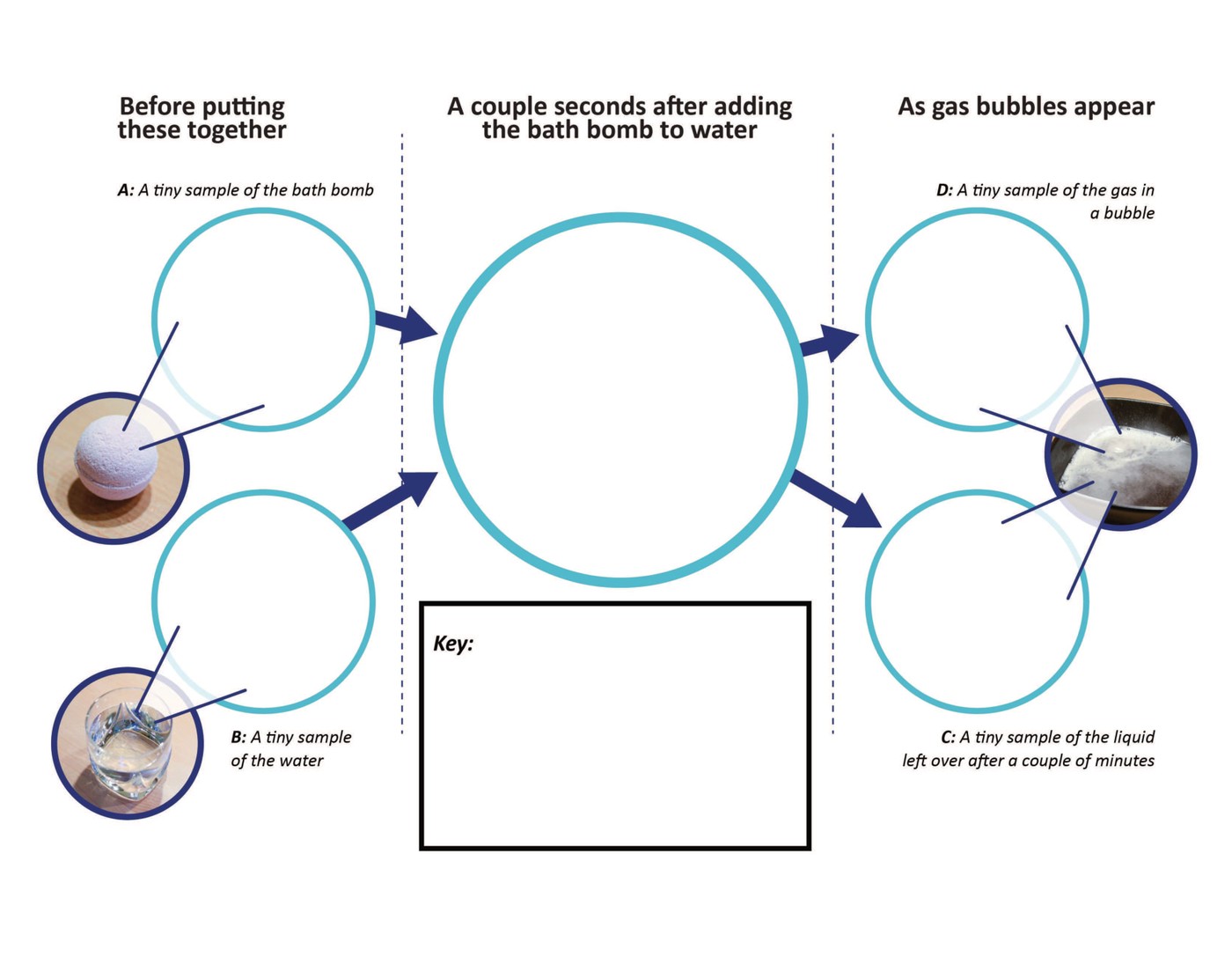
Before reading the model answer, sketch the named objects or particles and label what you think changes. Draw boundaries and account for the 1.5 g difference. Explain why an unchanged balance reading does not mean no reaction occurred. Keep this first version so you can compare it with your later explanation.
Build the language from the idea
- law of conservation of mass
- In a chemical reaction, the total mass of the reactants equals the total mass of the products.
- closed system
- A system where nothing (no gas, liquid, or solid) can enter or escape, so all mass stays inside to be measured.
- model
- A representation that explains selected features and makes predictions; it leaves other details out.
- evidence
- Relevant observations or records used to support or challenge a claim.
- system boundary
- The chosen limit separating the objects being studied from their surroundings.
- assumption
- A condition taken as true for a model or calculation and needing to be checked against the case.
In ordinary chemical reactions, atoms are rearranged rather than created or destroyed. The law of conservation of mass accounts for all relevant matter. A system is the part selected for study; a boundary separates it from its surroundings. A closed system exchanges no matter, but can exchange energy. For a complete measured apparatus with no matter loss, the before/after masses should agree within the measurement uncertainty.
In a chemical reaction, atoms are never created or destroyed — they're only rearranged into new combinations. Every atom that goes into a reaction comes out the other side, just bonded to different partners. This is the law of conservation of mass: in a closed system (one where nothing can get in or escape), the total mass of the reactants always equals the total mass of the products, exactly.
An open apparatus can appear to lose or gain mass when gases leave or enter its measured boundary. A supplied complete sealed-apparatus record helps test that account without requiring a sealed gas-producing reaction at home. Such reactions can build pressure, so use the chapter’s data and atom-counter investigation. An unchanged reading can accompany new substances; mass conservation does not mean no reaction occurred.
This is exactly why the closed system part matters so much. Most everyday reactions only look like they lose or gain mass because they're open to the air, letting gases sneak in or slip out unmeasured. Seal the same reaction inside a closed container, set it on a scale, and the reading won't budge at all — proof that the mass was there the whole time.
Conservation of mass is also a genuinely useful tool, not just an idea. If you know the total mass of the reactants and the mass of every product but one, you can find that missing mass by simple subtraction, without ever measuring it directly. It's the same dependable bookkeeping that lets engineers and chemists plan reactions precisely, confident that the atoms will always add up.
A closed reaction system includes gases as well as liquids and solids. If a gas escapes from an open cup, the cup's measured mass can fall even while the total mass of cup plus escaped gas is conserved. Draw the boundary before comparing measurements.
Atoms are rearranged during ordinary chemical reactions, not created or destroyed. Count each type of atom before and after. A balanced particle diagram helps explain conservation without assuming that the number of molecules must stay the same.
A mass comparison needs a reliable balance and the same system on both sides. Keep the lid, container and all products in the accounting. Small mismatches may come from spills, gas leaks or measurement uncertainty. Explain those possibilities before claiming a law has failed.
Build your understanding
Where this fits
This unit helps answer the chapter question: How can we tell when substances react, and what is conserved? Keep a notebook table with the question, evidence, explanation and one unresolved issue. Revise a previous model only when you can name the new evidence or idea that changes it.
Use three teaching sessions of about 40–45 minutes: first observe the phenomenon, draft a model and study Parts 1–2; next explain Parts 3–4 with the figures and evidence; then work the application, examples, practice, model revision and exit check. Divide any difficult part into smaller steps and revisit after feedback. Investigations, review and quizzes have separate sessions.
Part 1 · Choose the boundary before counting mass
A system is the matter selected for study. A closed system exchanges no matter with its surroundings, although it can exchange energy. An open system allows matter to enter or leave. Conservation of mass in ordinary reactions concerns all relevant matter, not only the solid or liquid still visible in a container.
Read the visual model
Can an open container lose measured mass without destroying atoms?
Visual reasoning — after your attempt
Yes. Gas or other matter can leave the chosen system. A lower measured mass can indicate transfer across the boundary rather than destruction.
Draw a boundary around a vessel and its gas space. If gas escapes across the boundary, the remaining vessel contents may lose mass while the combined matter in vessel and surroundings remains accounted for. State exactly what the balance measures.
Pause and explain
Can an open container lose measured mass without destroying atoms?
Check your reasoning after answering
Yes. Gas or other matter can leave the chosen system. A lower measured mass can indicate transfer across the boundary rather than destruction.
Part 2 · Count each kind of atom before and after
Atoms retain their identities during ordinary reactions. Compare the number of each element in reactants and products, not just the number of molecules. The total molecule count may change because atoms can be regrouped into differently sized molecules.
Read the visual model
A reactant is a starting substance and a product is a resulting substance. Different combinations can give different characteristic properties. The drawing is an explanation for an already specified reaction, not proof that every visible bubble is a new substance.
What evidence in the diagram supports a chemical change without supporting creation of new atoms?
Visual reasoning — after your attempt
The product molecules have a different composition/combination from the reactant molecules, while each element’s atom count stays four H and two O.
Two hydrogen molecules and one oxygen molecule can form two water molecules. The molecule count changes from three to two, but there are four hydrogen atoms and two oxygen atoms on both sides. Use separate colors or labels to track each kind.
Pause and explain
Why is equal molecule count not the conservation rule?
Check your reasoning after answering
A reaction can regroup the same atoms into a different number of molecules. Each element count, and total mass for the closed ordinary-reaction system, remains conserved.
Part 3 · Account for invisible incoming matter
An observed object can gain mass by combining with matter from its surroundings. Oxygen in air has mass even when it cannot be seen. A comparison that measures only the original solid ignores this incoming material and can create the false impression that reaction creates mass.
Read the visual model
An open-system mass can increase as well as decrease. Track matter crossing the boundary in either direction before interpreting a balance result. The chemical composition is supplied here; a mass increase alone would not identify the product.
Why does the solid’s increase to 8.0 g not contradict conservation? Name the missing source in an iron-only boundary.
Visual reasoning — after your attempt
The added 2.4 g came from oxygen in the surroundings. A complete boundary includes both iron and incoming oxygen, giving equal total mass before and after.
A metal sample can gain mass when it forms an oxide with oxygen. If 10 g of metal combines completely with 3 g of oxygen in the stated example, the product mass is 13 g. The oxygen must appear in the mass account.
Pause and explain
Why can rusting increase the mass of an iron-containing sample?
Check your reasoning after answering
Oxygen-containing matter from the surroundings joins the sample. The increased sample mass is transferred matter, not newly created atoms.
Part 4 · Interpret disagreement with the model
A measured mismatch calls for investigating missing matter, measurement limits, or an incomplete description. It does not immediately overturn conservation. Include container mass consistently, check balance resolution, and identify spilled or escaped material. Repeated readings help distinguish a systematic difference from random variation.
Read the visual model
Resolution is the smallest change an instrument can report. A model prediction and a measured reading can differ within the method’s limits. Preserve all readings instead of erasing a result that needs investigation.
What should be checked before using a 0.1 g discrepancy to reject the conservation model?
Visual reasoning — after your attempt
Check balance resolution/calibration, consistent apparatus boundaries, leaks, spills and repeated readings. Decide whether the discrepancy exceeds the credible measurement uncertainty.
A before reading that includes a lid cannot be compared fairly with an after reading without that lid. A small change comparable to instrument uncertainty may not be significant. Record the complete procedure before explaining the difference.
Pause and explain
What should be checked before claiming mass was not conserved?
Check your reasoning after answering
Check the system boundary, gas escape or entry, spills, consistent container parts, and measurement uncertainty. These can explain a mismatch in the observed portion.
Apply the whole unit · Complete the matter account
Illustrative records: an open vessel contains 25 g of reacting material initially and 22 g afterward; supplied measurements show 3 g of gas escaped. In another case, 10 g of metal combines with 3 g of oxygen.
Your task
Write a complete mass account for each case. Draw boundary-crossing arrows, explain why the open-vessel contents lose mass while the metal gains mass, and propose a measurement that would improve the account.
What your response should show
- Use the supplied observations and measurements accurately; include units where needed.
- Explain the science behind your answer, rather than giving only a number or label.
- Show a labeled model, calculation, or evidence comparison as requested.
- State an assumption or limitation and suggest a useful next measurement.
Response guidance — after your attempt
For the open vessel, 25 g=22 g remaining+3 g escaped. For the metal, 10 g+3 g=13 g product if conversion is complete and no other matter enters or leaves. The arrows show outgoing gas in the first case and incoming oxygen in the second. Weigh consistently and independently account for transferred material using a supplied or professionally controlled setup.
Scientific references and adapted teaching resources
- OpenSciEd 7.1 Chemical Reactions & Matter — public unit overview
- OpenSciEd 7.2 Chemical Reactions & Energy — public unit overview
- OpenSciEd instructional model — storyline routines
- Creative Commons Attribution 4.0 — middle-school material license
Parent / teacher teaching notes
Use labeled tokens before arithmetic. Ask which matter the measurement includes. Do not suggest sealing a gas-producing reaction in a rigid vessel; the application is a supplied-data investigation. Adaptation credit: OpenSciEd middle-school teaching routines and public task structures by OpenSciEd, CC BY 4.0. This independent version adds original explanatory text, data and figures, terminology support and a home-study schedule. It does not reproduce the complete teacher editions or their classroom validation.
The key idea
Mass is never created or destroyed in a chemical reaction — the total mass of the reactants always equals the total mass of the products.
Law of Conservation of Mass
mass of reactants = mass of products
true for any chemical reaction in a closed system — atoms are only rearranged, never created or destroyed.
Worked examples
Example 1
- By conservation of mass, mass of reactants = mass of products.
- Total reactant mass = 8 g + 64 g = 72 g.
- So the water produced must have a mass of 72 g.
Example 2 · Worked application
- Include container, liquid, solid and gas inside the boundary.
- The gas remains inside the sealed system.
- Atoms rearrange; material moving between forms does not remove its mass.
Count all products, including invisible gas.
Example 3
- Total mass of products = 14 g + 6 g = 20 g.
- By conservation of mass, mass of reactants (candle + oxygen) must also equal 20 g.
- Oxygen used = 20 g − 10 g (candle) = 10 g.
Example 4
- Use initial mass=remaining mass+escaped mass.
- Subtract 80−77=3 g.
Example 5 · Find and fix the mistake
- Test the claim against the stated conditions: Count all products, including invisible gas.
- Gas has mass. An open system can lose measured mass when gas escapes; a sealed complete system retains it.
Count all products, including invisible gas.
Example 6 · Interpret the visual model
- Identify the represented objects, axes, labeled quantities and stated conditions before choosing a rule.
- A reactant is a starting substance and a product is a resulting substance. Different combinations can give different characteristic properties. The drawing is an explanation for an already specified reaction, not proof that every visible bubble is a new substance.
- The product molecules have a different composition/combination from the reactant molecules, while each element’s atom count stays four H and two O.
Keep the model’s stated limits explicit: This supplied water-forming reaction contains four hydrogen atoms and two oxygen atoms on each side. Their combinations change from H₂ and O₂ to H₂O. Colored circles distinguish atom types rather than literal colors, and the bonds are counting aids. It is a different example from a bath-bomb reaction; the figure does not claim that a bath bomb contains hydrogen gas or oxygen gas.
Avoid these mistakes
- Conservation applies to the complete system, not just what remains in an open container.
Check your understanding
An open reaction starts with 80 g and leaves 77 g of material. If the only loss is gas, what mass escaped?
Discuss the answer
3 g of gas; remaining material plus gas still totals 80 g.
Why can the number of molecules change while the total mass remains the same?
Discuss the answer
A closed reaction system includes gases as well as liquids and solids. If a gas escapes from an open cup, the cup's measured mass can fall even while the total mass of cup plus escaped gas is conserved. Draw the boundary before comparing measurements. Atoms are rearranged during ordinary chemical reactions, not created or destroyed. Count each type of atom before and after. A balanced particle diagram helps explain conservation without assuming that the number of molecules must stay the same.
Return to the phenomenon
An illustrative complete sealed apparatus reads 120.0 g before and after a gas-producing reaction. An otherwise similar open container drops from 120.0 to 118.5 g. Draw boundaries and account for the 1.5 g difference. Explain why an unchanged balance reading does not mean no reaction occurred. Revise your first explanation using a named idea from the lesson. Mark the changed part and the evidence that supports it.
Compare explanations after your attempt
The sealed apparatus retains the matter inside its measured boundary. In the open comparison, gas can leave the measured system, accounting for the 1.5 g decrease if the conditions and measurements support that explanation. Atom rearrangement can create different substances without a changed total mass. Include escaped matter before claiming that mass was destroyed.
What should we investigate next?
Which condition could be changed to test a remaining uncertainty in this explanation? State the predicted observation and what result would challenge your model.
Investigate, explain and revise
Use these tasks after the three teaching sessions as needed. Discuss an attempted explanation before opening response guidance; a matching sentence is less important than a supported mechanism.
Activity 1 · Explain the new evidence case
Use the visible scenario above, Parts 1–4 and your first notebook model. No outside reading or equipment is required.
Your task
An illustrative complete sealed apparatus reads 120.0 g before and after a gas-producing reaction. An otherwise similar open container drops from 120.0 to 118.5 g. Draw boundaries and account for the 1.5 g difference. Explain why an unchanged balance reading does not mean no reaction occurred. Write 100–150 words or give a labeled drawing with an equivalent oral explanation.
Success criteria
- Use two relevant stated records or conditions.
- Explain the mechanism rather than only repeat a definition.
- Label observation and inference.
- Name a changed model feature or a remaining uncertainty.
Hint
Read the stated boundary and conditions before selecting a relationship. The unit’s worked examples show intermediate steps.
Response guidance — discuss after your attempt
The sealed apparatus retains the matter inside its measured boundary. In the open comparison, gas can leave the measured system, accounting for the 1.5 g decrease if the conditions and measurements support that explanation. Atom rearrangement can create different substances without a changed total mass. Include escaped matter before claiming that mass was destroyed.
Activity 2 · Read and extend the figure
Study the new labeled figure and its caption, then compare it with the associated teaching part.
Your task
How much mass must be accounted for outside the open boundary? Explain what each important label represents. Add one missing feature that would be needed for a different question, and explain why the original figure leaves it out.
Success criteria
- Answer the figure question with its stated labels.
- Connect the visual representation to the scientific idea.
- Identify a specific limitation from the caption.
- Propose a useful change without misrepresenting supplied evidence.
Hint
The balance account must include the chosen apparatus boundary. An open reading can fall as matter escapes, while a complete sealed apparatus retains its mass through atom rearrangement. Closed to matter does not mean closed to energy, and a reaction can occur with no net mass change.
Response guidance — discuss after your attempt
1.5 g, if escaping gas is the supported explanation and measurements are comparable. The balance account must include the chosen apparatus boundary. An open reading can fall as matter escapes, while a complete sealed apparatus retains its mass through atom rearrangement. Closed to matter does not mean closed to energy, and a reaction can occur with no net mass change.
Words to know
- law of conservation of mass
- In a chemical reaction, the total mass of the reactants equals the total mass of the products.
- closed system
- A system where nothing (no gas, liquid, or solid) can enter or escape, so all mass stays inside to be measured.
- model
- A representation that explains selected features and makes predictions; it leaves other details out.
- evidence
- Relevant observations or records used to support or challenge a claim.
- system boundary
- The chosen limit separating the objects being studied from their surroundings.
- assumption
- A condition taken as true for a model or calculation and needing to be checked against the case.
Antoine Lavoisier's sealed-flask experiment that rewrote chemistry
In the 1770s, most chemists believed burning released a mysterious substance called 'phlogiston,' and that mass could simply disappear during a reaction. French chemist Antoine Lavoisier tested this by burning substances inside sealed glass flasks and weighing everything — flask, contents, and all — before and after. The total mass never changed. His careful, quantitative experiments helped found modern chemistry and led directly to the law of conservation of mass. Lavoisier is often called the 'father of modern chemistry' for insisting that chemists weigh things instead of just describing them.
Hunting the 'missing' mass: it's just invisible gas
When 223 g of iron rusts completely, it combines with 96 g of oxygen pulled from the surrounding air to form 319 g of iron oxide (rust) — and 223 + 96 does equal 319. Notice the rust actually weighs more than the iron alone, because it silently absorbed oxygen gas that you can't see or weigh unless you think to look for it. Conservation of mass isn't just a rule to memorize — it's a promise that if your numbers don't add up, some reactant or product (usually a gas) escaped your notice, not the law.
The one place mass isn't perfectly conserved: nuclear reactions
Conservation of mass is essentially perfect for ordinary chemical reactions, because breaking and forming chemical bonds involves only tiny amounts of energy compared to the massive energy 'locked inside' every atom's nucleus. But inside the Sun, nuclear fusion reactions convert a measurable sliver of mass directly into energy, following Einstein's famous equation E = mc². Every second, the Sun converts roughly 4 million tonnes of its own mass into the light and heat that reaches Earth. So conservation of mass isn't violated — it's really conservation of mass-and-energy together, and chemical reactions are just too gentle to noticeably dip into that reserve.
Using the law as a mass detective
Because reactant mass always equals product mass in a closed system, scientists can find an unknown quantity by subtraction instead of by direct measurement — useful when a product is an invisible gas that's hard to capture and weigh. Pharmaceutical companies use exactly this kind of mass bookkeeping to confirm a manufacturing reaction produced the expected yield of medicine, and rocket engineers use it to calculate precisely how much oxidizer and fuel must be loaded so that none is wasted and none runs out mid-flight.
In the real world
Rocket engineers rely on conservation of mass to calculate exactly how much fuel and oxygen a rocket needs to carry for a mission.
Exit check
How much mass must be accounted for outside the open boundary? Explain the relevant mechanism and one model limitation.
Check your explanation after answering
1.5 g, if escaping gas is the supported explanation and measurements are comparable. The balance account must include the chosen apparatus boundary. An open reading can fall as matter escapes, while a complete sealed apparatus retains its mass through atom rearrangement. Closed to matter does not mean closed to energy, and a reaction can occur with no net mass change.
Explain your reasoning without notes. If a key idea is missing, revisit the lesson and try again.