Chemistry — Print · Physical Science: Matter, Forces & Energy, Grade 8
Use evidence and models to explain chemical change, conserve atoms, and track energy transfer.
Printable chapter lessons and review.
Signs of a Chemical Reaction
Learning goals
- I can list observable signs that suggest a chemical reaction has occurred.
- I can use evidence to decide whether a change is chemical rather than physical.
- I can explain daily chemical interactions with identity, historical context and conditional risk reasoning.
Readings for this unit
Before this unit
Distinguish a physical change from production of a new substance.
Use three teaching sessions of about 40–45 minutes: first observe the phenomenon, draft a model and study Parts 1–2; next explain Parts 3–4 with the figures and evidence; then work the application, examples, practice, model revision and exit check. Divide any difficult part into smaller steps and revisit after feedback. Investigations, review and quizzes have separate sessions. Study the four visual parts across the scheduled sessions, then use the illustrated worked case and independent transfer questions. Extend or revisit a session when the learner cannot explain the figure; completion time is a proposed allocation, not a mastery guarantee.
Start with something to explain
What would explain the observations in signs of a chemical reaction?
Illustrative evidence case. Supplied records show bubbles when boiling pure water and bubbles when two specified reactants form a different gas. Only the second record has composition evidence for a new substance.
Notice and wonder
Which box is an observation and which is an inference? Write two observations from the supplied record without guessing their cause. Include a quantity and its unit when given. An observation is what was recorded; an inference is what you think explains it.
Write one question about why the pattern occurs and one question about a comparison that could distinguish competing explanations. A testable question identifies what could be observed or measured.
Your first model
Before reading the model answer, sketch the named objects or particles and label what you think changes. Evaluate the claim “bubbles always prove a chemical reaction.” State what evidence distinguishes the two cases and what remains uncertain from sight alone. Keep this first version so you can compare it with your later explanation.
Build the language from the idea
- chemical reaction
- A process where reactants interact and rearrange into one or more new products.
- reactant
- A starting substance that goes into a chemical reaction.
- product
- A new substance that comes out of a chemical reaction.
- precipitate
- A solid that forms and settles out when two solutions react with each other.
- model
- A representation that explains selected features and makes predictions; it leaves other details out.
- evidence
- Relevant observations or records used to support or challenge a claim.
- system boundary
- The chosen limit separating the objects being studied from their surroundings.
- assumption
- A condition taken as true for a model or calculation and needing to be checked against the case.
A chemical reaction happens when substances called reactants interact and rearrange their atoms into new substances called products — and those products have genuinely different properties from what you started with. The trouble is that atoms are far too small to watch rearranging with your eyes. So instead of seeing the reaction directly, chemists become detectives, hunting for outward clues that a change has taken place.
Several observable signs hint that a reaction is underway. You might see bubbles of gas forming, a precipitate (a solid that appears and settles out when two liquids are mixed), or a color change. You might feel a temperature change as the mixture warms up or cools down on its own. You might even notice a new smell, or light being given off. Any one of these is a strong signal that something new is being made.
Each of these clues points back to atoms rearranging into fresh combinations. Bubbles usually mean a brand-new gas is being created and escaping. A precipitate means atoms have joined into a new solid compound that won't stay dissolved. A color change means the new products absorb and reflect light differently than the reactants did. And a temperature change means energy stored in chemical bonds is being released or soaked up as those bonds break and reform.
Here's the important catch, though: no single sign is absolute proof on its own. Bubbles might just be air you stirred in, or a liquid quietly boiling. A temperature change can come from a purely physical process, like sugar dissolving. Even a color change can sometimes be simple mixing rather than reacting. That's why a careful scientist treats these signs as evidence to weigh, not final verdicts.
The one thing that truly confirms a chemical reaction is the presence of a genuinely new substance — one with properties different from every reactant you began with. Learning to read these clues carefully is a real-world skill: it's how you'd recognize that rust has begun eating a bike frame, that milk has spoiled, or that an antacid tablet is actually going to work once it hits your stomach.
Gas bubbles, a precipitate, a lasting color change or a temperature change can be evidence for a reaction. Each has other possible causes: boiling makes bubbles without a new substance, and mixing dyes changes color physically. Use several observations and a particle explanation together.
Write an observation as something measured or seen, then write an inference separately. A cloud of solid appearing when clear solutions mix is evidence for a new solid, but identifying it requires further information. Record reactants, conditions and any comparison test so another learner can evaluate the claim.
Chemical reactions do not require visible flames. Rusting and many reactions inside cells occur gradually. Use safely supplied data to compare a possible reaction with a physical change; never taste unknown materials or mix cleaning products to look for dramatic evidence.
Build your understanding
Where this fits
This unit helps answer the chapter question: How can we tell when substances react, and what is conserved? Keep a notebook table with the question, evidence, explanation and one unresolved issue. Revise a previous model only when you can name the new evidence or idea that changes it.
Use three teaching sessions of about 40–45 minutes: first observe the phenomenon, draft a model and study Parts 1–2; next explain Parts 3–4 with the figures and evidence; then work the application, examples, practice, model revision and exit check. Divide any difficult part into smaller steps and revisit after feedback. Investigations, review and quizzes have separate sessions.
Part 1 · Record observations before naming a reaction
A reaction produces new substances. Observations such as gas formation, a temperature change, or a new solid can support that claim. Each sign also needs context because a similar visible event can result from a physical process. Write what happened separately from the explanation you propose.
Read the visual model
Do bubbles always prove a chemical reaction?
Visual reasoning — after your attempt
No. Bubbles can be vapor during boiling or gas already dissolved in a liquid. Evidence about new substance formation is needed.
Boiling gives bubbles without creating a new chemical substance. Mixing two solutions may produce a precipitate, an insoluble solid. Describe the new solid and compare it with the starting materials rather than calling every cloudy liquid a proven reaction.
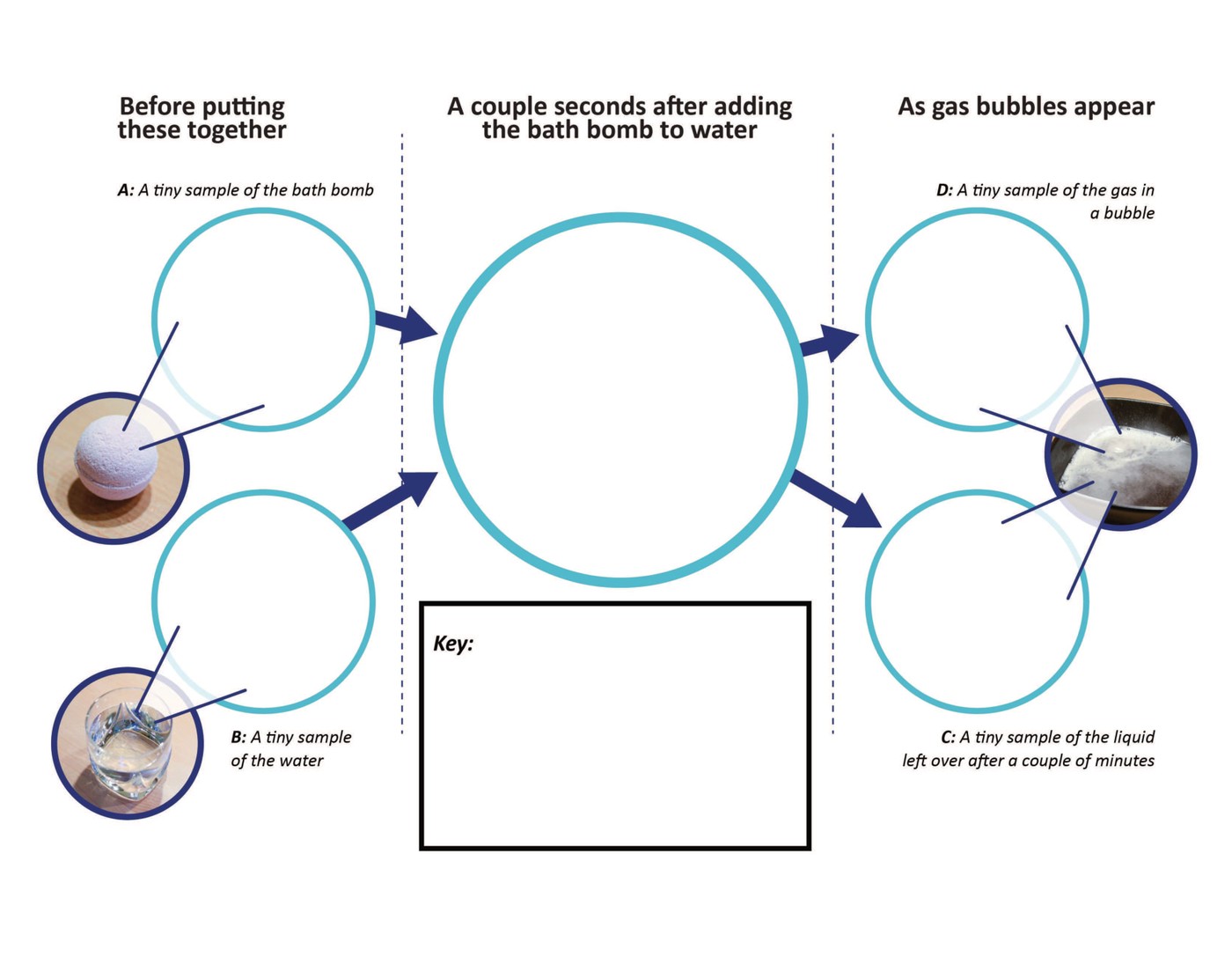
Pause and explain
Do bubbles always prove a chemical reaction?
Check your reasoning after answering
No. Bubbles can be vapor during boiling or gas already dissolved in a liquid. Evidence about new substance formation is needed.
Part 2 · Recognize a pattern of evidence
Combine observations and controls to reduce alternative explanations. A reaction may occur without an obvious color change or smell, and a single dramatic sign may be ambiguous. Safe supplied records can provide evidence of starting and final composition as well as visible changes.
Read the visual model
Why can several independent observations strengthen a claim?
Visual reasoning — after your attempt
They can rule out alternative explanations. Composition evidence together with controlled changes is stronger than relying on one ambiguous sign.
If mixing known materials produces gas at room temperature and the gas has a property unlike the starting liquids, this is stronger evidence than bubbles alone. Use an approved detection method or supplied result; never identify unknown substances by tasting or directly sniffing them.
Pause and explain
Why can several independent observations strengthen a claim?
Check your reasoning after answering
They can rule out alternative explanations. Composition evidence together with controlled changes is stronger than relying on one ambiguous sign.
Part 3 · Use particles to explain new substances
In an ordinary reaction, atoms rearrange into new groupings. Their element identities are retained, but the products can have different properties from the reactants. A particle model should distinguish atoms from molecules and identify what new arrangement appears.
Read the visual model
A reactant is a starting substance and a product is a resulting substance. Different combinations can give different characteristic properties. The drawing is an explanation for an already specified reaction, not proof that every visible bubble is a new substance.
What evidence in the diagram supports a chemical change without supporting creation of new atoms?
Visual reasoning — after your attempt
The product molecules have a different composition/combination from the reactant molecules, while each element’s atom count stays four H and two O.
Represent hydrogen and oxygen with two labeled bead types. Water molecules contain both types in a fixed ratio, unlike the separate starting molecules. A new arrangement explains new substance formation without inventing atoms or changing element labels.
Pause and explain
What must a reaction model keep unchanged about each atom?
Check your reasoning after answering
Its element identity must remain unchanged in an ordinary chemical reaction. The atom can become part of a different grouping, but its proton-defined element stays the same.
Part 4 · Design a comparison without introducing hazards
Choose one question and keep testing conditions comparable. Record quantities, time, temperature, and what was observed. Include a comparison when it helps separate mixing from reacting. A result supports the tested case, not a claim that all materials with a similar appearance react the same way.
Read the visual model
A control is a comparison chosen to test an explanation. Keep measurement conditions comparable and name what evidence is actually supplied. Confidence comes from several relevant records, rather than one dramatic visual clue.
A learner sees bubbles but has no gas-identity record. What can they report, and what claim is still unproven?
Visual reasoning — after your attempt
They can report bubbles under the stated conditions. A new substance or a particular gas identity remains unproven until suitable evidence rules out alternatives such as boiling or released trapped air.
Compare a supplied room-temperature reaction record with a supplied boiling record. Both show bubbles, but only one may show chemically new gas. At home, do not mix cleaning products or seal a gas-producing reaction in a rigid closed vessel.
Pause and explain
Which record would help distinguish boiling from gas production by reaction?
Check your reasoning after answering
Starting temperature, heating conditions, and reliable gas-identity evidence can distinguish water vapor from a chemically produced gas under comparable observations.
Chemical interactions in daily life and history
Cooking, metal corrosion, material manufacture and some batteries involve changes that matter beyond a laboratory worksheet.
A chemical is a substance with a particular composition; the word does not mean artificial, toxic or something confined to a factory. Water, oxygen and many food components are chemicals. A physical interaction can rearrange position or state while retaining identity; a chemical reaction rearranges atoms into different substance combinations. Daily processes can include both, so melting fat while cooking and reactions in browning need separate explanations.
Chemical interactions have shaped materials and technologies over time. Metal corrosion changes exposed materials into new substances, while processing can produce useful alloys or new compounds; an alloy is a mixture containing metallic elements, not automatically one fixed compound. Reactions and physical processing contribute to medicines, fertilizers, plastics, batteries and water treatment. Benefits and possible harms depend on substance, amount, exposure, method and use, not the label chemical alone.
The universe contains existing elements that combine into many substances under different conditions. Ordinary chemical reactions explain combinations such as water or mineral compounds without changing the proton-defined identities of the atoms. The formation of elements through nuclear processes is a different scale of explanation; do not attribute every past change to the same mechanism. Construct a cause-and-effect explanation with enough background, an appropriate boundary and evidence, rather than a list of impressive terms.
Explain and apply
Compare supplied descriptions of cutting iron, forming rust and mixing an alloy. Give an appropriate mechanism and explain why “all chemicals are dangerous” and “every mixture is a new compound” fail.
- Distinguish composition from appearance.
- Explain a daily/historical consequence with a mechanism.
- Evaluate blanket chemical/mixture claims with conditions.
Reasoning and marking guidance — after your attempt
Cutting can retain iron identity while rust formation produces different substances. An alloy can be a mixture rather than one fixed-ratio compound. Chemical risk cannot be decided from the word alone; identity, amount, exposure and use need evidence. Relate the chosen process to a practical effect while keeping ordinary atom rearrangement distinct from nuclear element formation.
Apply the whole unit · Weigh three possible explanations
Illustrative records: A bubbles only while water is heated to boiling; B releases gas when two approved solutions mix at room temperature and supplied analysis identifies a new gas; C changes color when a colored solution is diluted with water.
Your task
Compare the strength of reaction evidence in A, B, and C. Describe observations separately from conclusions, draw a simple model for a chemically new product, and identify a follow-up observation for the ambiguous case.
What your response should show
- Use the supplied observations and measurements accurately; include units where needed.
- Explain the science behind your answer, rather than giving only a number or label.
- Show a labeled model, calculation, or evidence comparison as requested.
- State an assumption or limitation and suggest a useful next measurement.
Response guidance — after your attempt
A is consistent with physical boiling. B has stronger chemical evidence because analysis identifies a new substance. C may simply reflect dilution and is not sufficient by itself to prove reaction. Preserve atom types in the reaction model while changing groupings. Reliable composition evidence or a controlled comparison would help evaluate C.
Scientific references and adapted teaching resources
- OpenSciEd 7.1 Chemical Reactions & Matter — public unit overview
- OpenSciEd 7.2 Chemical Reactions & Energy — public unit overview
- OpenSciEd instructional model — storyline routines
- Creative Commons Attribution 4.0 — middle-school material license
Parent / teacher teaching notes
Ask the learner to avoid proves language when evidence is ambiguous. Use the supplied records; the task does not require conducting chemical tests. Reward a well-explained uncertainty rather than an unsupported confident classification. Adaptation credit: OpenSciEd middle-school teaching routines and public task structures by OpenSciEd, CC BY 4.0. This independent version adds original explanatory text, data and figures, terminology support and a home-study schedule. It does not reproduce the complete teacher editions or their classroom validation. The illustrated study “Chemical interactions in daily life and history” is required curriculum content. Teach it before the associated application or distribute it over the assigned unit sessions; it is not an optional enrichment. Its practice/review/quiz response provides evidence of understanding. Model/data work must not be recorded as an actual physical experiment.
The key idea
Bubbles, color change, a new solid (precipitate), or a temperature change are all clues — but a truly new substance is the real proof of a chemical reaction.
Worked examples
Example 1
- Fizzing bubbles are a classic sign of gas being produced.
- A gas escaping means a new substance (carbon dioxide gas) has formed that wasn't in either the baking soda or the vinegar alone.
- This is strong evidence a chemical reaction occurred, producing carbon dioxide gas, water, and sodium acetate.
Example 2 · Worked application
- A newly formed solid may be a precipitate, evidence consistent with a reaction.
- Bubbles are only one possible sign; many reactions produce none.
- Check that the solid is a new substance rather than undissolved starting material.
Use more than one observation and distinguish a precipitate from material present initially.
Example 3
- One possibility is boiling or dissolved gas leaving the liquid.
- Another possibility is a reaction producing gas; checking whether new substances formed helps distinguish them.
Example 4 · Find and fix the mistake
- Test the claim against the stated conditions: Use more than one observation and distinguish a precipitate from material present initially.
- Reactions can occur without either; rusting and precipitation are examples of other observable changes.
Use more than one observation and distinguish a precipitate from material present initially.
Example 5 · Interpret the visual model
- Identify the represented objects, axes, labeled quantities and stated conditions before choosing a rule.
- A reactant is a starting substance and a product is a resulting substance. Different combinations can give different characteristic properties. The drawing is an explanation for an already specified reaction, not proof that every visible bubble is a new substance.
- The product molecules have a different composition/combination from the reactant molecules, while each element’s atom count stays four H and two O.
Keep the model’s stated limits explicit: This supplied water-forming reaction contains four hydrogen atoms and two oxygen atoms on each side. Their combinations change from H₂ and O₂ to H₂O. Colored circles distinguish atom types rather than literal colors, and the bonds are counting aids. It is a different example from a bath-bomb reaction; the figure does not claim that a bath bomb contains hydrogen gas or oxygen gas.
Avoid these mistakes
- Bubbles alone do not prove that a chemical reaction occurred.
Check your understanding
A clear liquid forms bubbles when warmed. Give two possible explanations and one useful follow-up observation.
Discuss the answer
Both physical gas release and chemical gas production are possible; bubbles alone are insufficient evidence.
Why is a measured observation stronger than saying a mixture looked chemical?
Discuss the answer
Gas bubbles, a precipitate, a lasting color change or a temperature change can be evidence for a reaction. Each has other possible causes: boiling makes bubbles without a new substance, and mixing dyes changes color physically. Use several observations and a particle explanation together. Write an observation as something measured or seen, then write an inference separately. A cloud of solid appearing when clear solutions mix is evidence for a new solid, but identifying it requires further information. Record reactants, conditions and any comparison test so another learner can evaluate the claim.
Return to the phenomenon
Supplied records show bubbles when boiling pure water and bubbles when two specified reactants form a different gas. Only the second record has composition evidence for a new substance. Evaluate the claim “bubbles always prove a chemical reaction.” State what evidence distinguishes the two cases and what remains uncertain from sight alone. Revise your first explanation using a named idea from the lesson. Mark the changed part and the evidence that supports it.
Compare explanations after your attempt
The claim is too strong: boiling transfers water into its gas phase without changing identity. The second case is a reaction because the stated composition evidence supports a different product. Bubbles are an observation prompting further questions; gas identity, characteristic properties and atom-accounting evidence strengthen the chemical interpretation.
What should we investigate next?
Which condition could be changed to test a remaining uncertainty in this explanation? State the predicted observation and what result would challenge your model.
Investigate, explain and revise
Use these tasks after the three teaching sessions as needed. Discuss an attempted explanation before opening response guidance; a matching sentence is less important than a supported mechanism.
Activity 1 · Explain the new evidence case
Use the visible scenario above, Parts 1–4 and your first notebook model. No outside reading or equipment is required.
Your task
Supplied records show bubbles when boiling pure water and bubbles when two specified reactants form a different gas. Only the second record has composition evidence for a new substance. Evaluate the claim “bubbles always prove a chemical reaction.” State what evidence distinguishes the two cases and what remains uncertain from sight alone. Write 100–150 words or give a labeled drawing with an equivalent oral explanation.
Success criteria
- Use two relevant stated records or conditions.
- Explain the mechanism rather than only repeat a definition.
- Label observation and inference.
- Name a changed model feature or a remaining uncertainty.
Hint
Read the stated boundary and conditions before selecting a relationship. The unit’s worked examples show intermediate steps.
Response guidance — discuss after your attempt
The claim is too strong: boiling transfers water into its gas phase without changing identity. The second case is a reaction because the stated composition evidence supports a different product. Bubbles are an observation prompting further questions; gas identity, characteristic properties and atom-accounting evidence strengthen the chemical interpretation.
Activity 2 · Read and extend the figure
Study the new labeled figure and its caption, then compare it with the associated teaching part.
Your task
Which box is an observation and which is an inference? Explain what each important label represents. Add one missing feature that would be needed for a different question, and explain why the original figure leaves it out.
Success criteria
- Answer the figure question with its stated labels.
- Connect the visual representation to the scientific idea.
- Identify a specific limitation from the caption.
- Propose a useful change without misrepresenting supplied evidence.
Hint
Bubbles alone are consistent with more than one process. The diagram distinguishes recorded appearance from possible explanations and a next evidence question. It does not supply actual gas tests or license unsafe mixing; composition must be established by suitable approved evidence.
Response guidance — discuss after your attempt
Bubbles appearing is the observation; the proposed origin is an inference until supported by identity and other evidence. Bubbles alone are consistent with more than one process. The diagram distinguishes recorded appearance from possible explanations and a next evidence question. It does not supply actual gas tests or license unsafe mixing; composition must be established by suitable approved evidence.
Words to know
- chemical reaction
- A process where reactants interact and rearrange into one or more new products.
- reactant
- A starting substance that goes into a chemical reaction.
- product
- A new substance that comes out of a chemical reaction.
- precipitate
- A solid that forms and settles out when two solutions react with each other.
- model
- A representation that explains selected features and makes predictions; it leaves other details out.
- evidence
- Relevant observations or records used to support or challenge a claim.
- system boundary
- The chosen limit separating the objects being studied from their surroundings.
- assumption
- A condition taken as true for a model or calculation and needing to be checked against the case.
Physical or chemical? The atomic-level difference
A physical change just rearranges how atoms are packed or shaped — ice melting into water is still H₂O molecules, just moving faster and looser. A chemical reaction is different: existing bonds between atoms break, and the atoms reconnect in new patterns to form molecules that never existed before. That's why a physical change can usually be undone (freeze the water back into ice), while a true chemical reaction usually can't be reversed just by changing temperature or pressure — you'd need another reaction to rebuild the original bonds.
The imposters: changes that fool the eye
Not every dramatic-looking change is a reaction. Stir sugar into water and it seems to vanish — but it's still sugar, just spread out as individual molecules (a physical change called dissolving). Dissolving certain salts, like potassium nitrate, even pulls in enough energy to make the water noticeably colder, mimicking the temperature-change clue of a reaction without any new substance forming. Mixing yellow and blue paint gives you green — a real color change — but it's just tiny colored particles blending, not new molecules. The lesson: always ask whether a genuinely new substance appeared, not just whether something looked different.
Forensics glows blue: luminol and chemiluminescence
Crime scene investigators spray a chemical called luminol to search for traces of blood invisible to the naked eye. Luminol reacts with iron in hemoglobin (the protein that carries oxygen in blood), and that reaction releases energy as light instead of heat — a glowing blue light show that shows up even years after a stain was wiped away. This eerie glow is a textbook example of a chemical reaction's signs taken to an extreme: instead of a subtle temperature change, the released energy shows up as visible chemiluminescence.
Why 'disappearing' iron actually gains weight
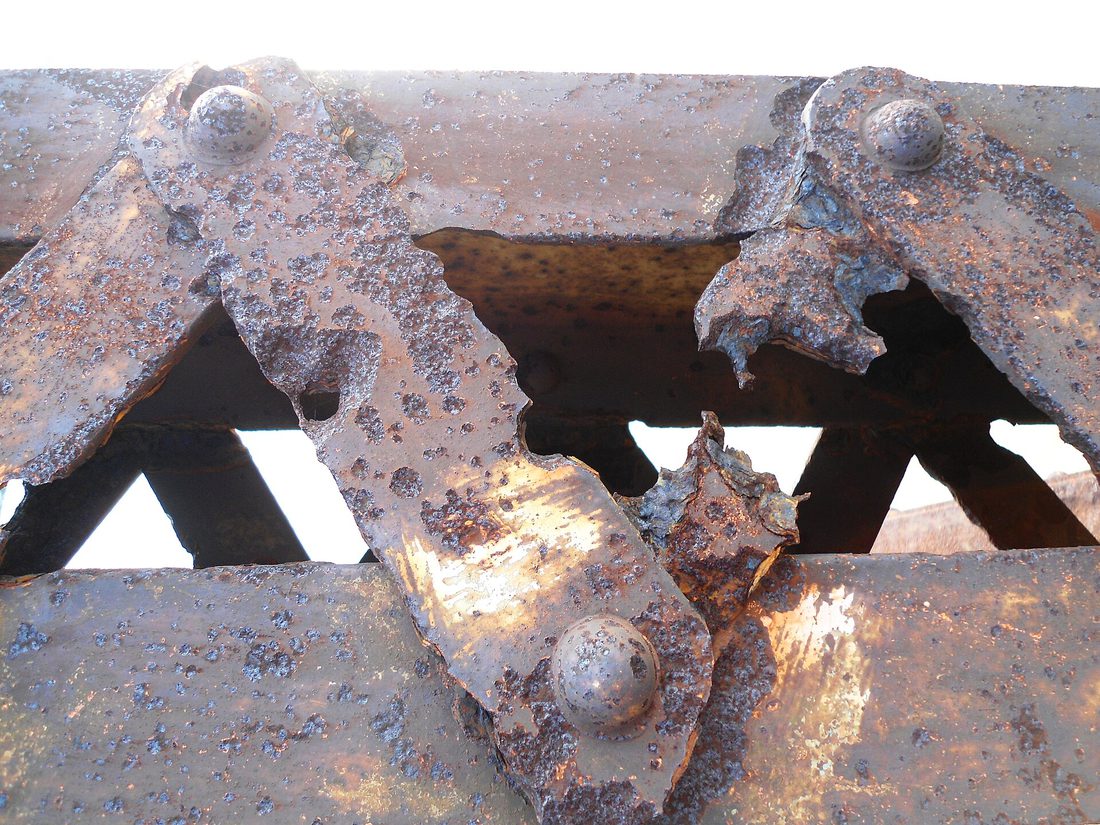
Here's a surprise: when iron rusts, it doesn't get lighter — it gets heavier. Rusting is iron reacting with oxygen from the air to form iron oxide, and those oxygen atoms attach to the iron and stay there, adding to the total mass. A fully rusted iron nail can weigh noticeably more than the shiny nail you started with, even though it looks smaller and flakier. This strange fact — that a 'falling apart' reaction can add mass instead of losing it — is the perfect setup for the next big idea: mass is never created or destroyed in a chemical reaction, only rearranged.
In the real world
Doctors and patients watch for the fizzing reaction of an antacid tablet to know it's actively neutralizing stomach acid.
Exit check
Which box is an observation and which is an inference? Explain the relevant mechanism and one model limitation.
Check your explanation after answering
Bubbles appearing is the observation; the proposed origin is an inference until supported by identity and other evidence. Bubbles alone are consistent with more than one process. The diagram distinguishes recorded appearance from possible explanations and a next evidence question. It does not supply actual gas tests or license unsafe mixing; composition must be established by suitable approved evidence.
Explain your reasoning without notes. If a key idea is missing, revisit the lesson and try again.
Conservation of Mass
Learning goals
- I can state the law of conservation of mass.
- I can use conservation of mass to calculate an unknown mass of a reactant or product.
Readings for this unit
Before this unit
Add masses and understand a system boundary.
Use three teaching sessions of about 40–45 minutes: first observe the phenomenon, draft a model and study Parts 1–2; next explain Parts 3–4 with the figures and evidence; then work the application, examples, practice, model revision and exit check. Divide any difficult part into smaller steps and revisit after feedback. Investigations, review and quizzes have separate sessions. Study the four visual parts across the scheduled sessions, then use the illustrated worked case and independent transfer questions. Extend or revisit a session when the learner cannot explain the figure; completion time is a proposed allocation, not a mastery guarantee.
Start with something to explain
What would explain the observations in conservation of mass?
Illustrative evidence case. An illustrative complete sealed apparatus reads 120.0 g before and after a gas-producing reaction. An otherwise similar open container drops from 120.0 to 118.5 g.
Notice and wonder
How much mass must be accounted for outside the open boundary? Write two observations from the supplied record without guessing their cause. Include a quantity and its unit when given. An observation is what was recorded; an inference is what you think explains it.
Write one question about why the pattern occurs and one question about a comparison that could distinguish competing explanations. A testable question identifies what could be observed or measured.
Your first model
Before reading the model answer, sketch the named objects or particles and label what you think changes. Draw boundaries and account for the 1.5 g difference. Explain why an unchanged balance reading does not mean no reaction occurred. Keep this first version so you can compare it with your later explanation.
Build the language from the idea
- law of conservation of mass
- In a chemical reaction, the total mass of the reactants equals the total mass of the products.
- closed system
- A system where nothing (no gas, liquid, or solid) can enter or escape, so all mass stays inside to be measured.
- model
- A representation that explains selected features and makes predictions; it leaves other details out.
- evidence
- Relevant observations or records used to support or challenge a claim.
- system boundary
- The chosen limit separating the objects being studied from their surroundings.
- assumption
- A condition taken as true for a model or calculation and needing to be checked against the case.
In ordinary chemical reactions, atoms are rearranged rather than created or destroyed. The law of conservation of mass accounts for all relevant matter. A system is the part selected for study; a boundary separates it from its surroundings. A closed system exchanges no matter, but can exchange energy. For a complete measured apparatus with no matter loss, the before/after masses should agree within the measurement uncertainty.
In a chemical reaction, atoms are never created or destroyed — they're only rearranged into new combinations. Every atom that goes into a reaction comes out the other side, just bonded to different partners. This is the law of conservation of mass: in a closed system (one where nothing can get in or escape), the total mass of the reactants always equals the total mass of the products, exactly.
An open apparatus can appear to lose or gain mass when gases leave or enter its measured boundary. A supplied complete sealed-apparatus record helps test that account without requiring a sealed gas-producing reaction at home. Such reactions can build pressure, so use the chapter’s data and atom-counter investigation. An unchanged reading can accompany new substances; mass conservation does not mean no reaction occurred.
This is exactly why the closed system part matters so much. Most everyday reactions only look like they lose or gain mass because they're open to the air, letting gases sneak in or slip out unmeasured. Seal the same reaction inside a closed container, set it on a scale, and the reading won't budge at all — proof that the mass was there the whole time.
Conservation of mass is also a genuinely useful tool, not just an idea. If you know the total mass of the reactants and the mass of every product but one, you can find that missing mass by simple subtraction, without ever measuring it directly. It's the same dependable bookkeeping that lets engineers and chemists plan reactions precisely, confident that the atoms will always add up.
A closed reaction system includes gases as well as liquids and solids. If a gas escapes from an open cup, the cup's measured mass can fall even while the total mass of cup plus escaped gas is conserved. Draw the boundary before comparing measurements.
Atoms are rearranged during ordinary chemical reactions, not created or destroyed. Count each type of atom before and after. A balanced particle diagram helps explain conservation without assuming that the number of molecules must stay the same.
A mass comparison needs a reliable balance and the same system on both sides. Keep the lid, container and all products in the accounting. Small mismatches may come from spills, gas leaks or measurement uncertainty. Explain those possibilities before claiming a law has failed.
Build your understanding
Where this fits
This unit helps answer the chapter question: How can we tell when substances react, and what is conserved? Keep a notebook table with the question, evidence, explanation and one unresolved issue. Revise a previous model only when you can name the new evidence or idea that changes it.
Use three teaching sessions of about 40–45 minutes: first observe the phenomenon, draft a model and study Parts 1–2; next explain Parts 3–4 with the figures and evidence; then work the application, examples, practice, model revision and exit check. Divide any difficult part into smaller steps and revisit after feedback. Investigations, review and quizzes have separate sessions.
Part 1 · Choose the boundary before counting mass
A system is the matter selected for study. A closed system exchanges no matter with its surroundings, although it can exchange energy. An open system allows matter to enter or leave. Conservation of mass in ordinary reactions concerns all relevant matter, not only the solid or liquid still visible in a container.
Read the visual model
Can an open container lose measured mass without destroying atoms?
Visual reasoning — after your attempt
Yes. Gas or other matter can leave the chosen system. A lower measured mass can indicate transfer across the boundary rather than destruction.
Draw a boundary around a vessel and its gas space. If gas escapes across the boundary, the remaining vessel contents may lose mass while the combined matter in vessel and surroundings remains accounted for. State exactly what the balance measures.
Pause and explain
Can an open container lose measured mass without destroying atoms?
Check your reasoning after answering
Yes. Gas or other matter can leave the chosen system. A lower measured mass can indicate transfer across the boundary rather than destruction.
Part 2 · Count each kind of atom before and after
Atoms retain their identities during ordinary reactions. Compare the number of each element in reactants and products, not just the number of molecules. The total molecule count may change because atoms can be regrouped into differently sized molecules.
Read the visual model
A reactant is a starting substance and a product is a resulting substance. Different combinations can give different characteristic properties. The drawing is an explanation for an already specified reaction, not proof that every visible bubble is a new substance.
What evidence in the diagram supports a chemical change without supporting creation of new atoms?
Visual reasoning — after your attempt
The product molecules have a different composition/combination from the reactant molecules, while each element’s atom count stays four H and two O.
Two hydrogen molecules and one oxygen molecule can form two water molecules. The molecule count changes from three to two, but there are four hydrogen atoms and two oxygen atoms on both sides. Use separate colors or labels to track each kind.
Pause and explain
Why is equal molecule count not the conservation rule?
Check your reasoning after answering
A reaction can regroup the same atoms into a different number of molecules. Each element count, and total mass for the closed ordinary-reaction system, remains conserved.
Part 3 · Account for invisible incoming matter
An observed object can gain mass by combining with matter from its surroundings. Oxygen in air has mass even when it cannot be seen. A comparison that measures only the original solid ignores this incoming material and can create the false impression that reaction creates mass.
Read the visual model
An open-system mass can increase as well as decrease. Track matter crossing the boundary in either direction before interpreting a balance result. The chemical composition is supplied here; a mass increase alone would not identify the product.
Why does the solid’s increase to 8.0 g not contradict conservation? Name the missing source in an iron-only boundary.
Visual reasoning — after your attempt
The added 2.4 g came from oxygen in the surroundings. A complete boundary includes both iron and incoming oxygen, giving equal total mass before and after.
A metal sample can gain mass when it forms an oxide with oxygen. If 10 g of metal combines completely with 3 g of oxygen in the stated example, the product mass is 13 g. The oxygen must appear in the mass account.
Pause and explain
Why can rusting increase the mass of an iron-containing sample?
Check your reasoning after answering
Oxygen-containing matter from the surroundings joins the sample. The increased sample mass is transferred matter, not newly created atoms.
Part 4 · Interpret disagreement with the model
A measured mismatch calls for investigating missing matter, measurement limits, or an incomplete description. It does not immediately overturn conservation. Include container mass consistently, check balance resolution, and identify spilled or escaped material. Repeated readings help distinguish a systematic difference from random variation.
Read the visual model
Resolution is the smallest change an instrument can report. A model prediction and a measured reading can differ within the method’s limits. Preserve all readings instead of erasing a result that needs investigation.
What should be checked before using a 0.1 g discrepancy to reject the conservation model?
Visual reasoning — after your attempt
Check balance resolution/calibration, consistent apparatus boundaries, leaks, spills and repeated readings. Decide whether the discrepancy exceeds the credible measurement uncertainty.
A before reading that includes a lid cannot be compared fairly with an after reading without that lid. A small change comparable to instrument uncertainty may not be significant. Record the complete procedure before explaining the difference.
Pause and explain
What should be checked before claiming mass was not conserved?
Check your reasoning after answering
Check the system boundary, gas escape or entry, spills, consistent container parts, and measurement uncertainty. These can explain a mismatch in the observed portion.
Apply the whole unit · Complete the matter account
Illustrative records: an open vessel contains 25 g of reacting material initially and 22 g afterward; supplied measurements show 3 g of gas escaped. In another case, 10 g of metal combines with 3 g of oxygen.
Your task
Write a complete mass account for each case. Draw boundary-crossing arrows, explain why the open-vessel contents lose mass while the metal gains mass, and propose a measurement that would improve the account.
What your response should show
- Use the supplied observations and measurements accurately; include units where needed.
- Explain the science behind your answer, rather than giving only a number or label.
- Show a labeled model, calculation, or evidence comparison as requested.
- State an assumption or limitation and suggest a useful next measurement.
Response guidance — after your attempt
For the open vessel, 25 g=22 g remaining+3 g escaped. For the metal, 10 g+3 g=13 g product if conversion is complete and no other matter enters or leaves. The arrows show outgoing gas in the first case and incoming oxygen in the second. Weigh consistently and independently account for transferred material using a supplied or professionally controlled setup.
Scientific references and adapted teaching resources
- OpenSciEd 7.1 Chemical Reactions & Matter — public unit overview
- OpenSciEd 7.2 Chemical Reactions & Energy — public unit overview
- OpenSciEd instructional model — storyline routines
- Creative Commons Attribution 4.0 — middle-school material license
Parent / teacher teaching notes
Use labeled tokens before arithmetic. Ask which matter the measurement includes. Do not suggest sealing a gas-producing reaction in a rigid vessel; the application is a supplied-data investigation. Adaptation credit: OpenSciEd middle-school teaching routines and public task structures by OpenSciEd, CC BY 4.0. This independent version adds original explanatory text, data and figures, terminology support and a home-study schedule. It does not reproduce the complete teacher editions or their classroom validation.
The key idea
Mass is never created or destroyed in a chemical reaction — the total mass of the reactants always equals the total mass of the products.
Law of Conservation of Mass
mass of reactants = mass of products
true for any chemical reaction in a closed system — atoms are only rearranged, never created or destroyed.
Worked examples
Example 1
- By conservation of mass, mass of reactants = mass of products.
- Total reactant mass = 8 g + 64 g = 72 g.
- So the water produced must have a mass of 72 g.
Example 2 · Worked application
- Include container, liquid, solid and gas inside the boundary.
- The gas remains inside the sealed system.
- Atoms rearrange; material moving between forms does not remove its mass.
Count all products, including invisible gas.
Example 3
- Total mass of products = 14 g + 6 g = 20 g.
- By conservation of mass, mass of reactants (candle + oxygen) must also equal 20 g.
- Oxygen used = 20 g − 10 g (candle) = 10 g.
Example 4
- Use initial mass=remaining mass+escaped mass.
- Subtract 80−77=3 g.
Example 5 · Find and fix the mistake
- Test the claim against the stated conditions: Count all products, including invisible gas.
- Gas has mass. An open system can lose measured mass when gas escapes; a sealed complete system retains it.
Count all products, including invisible gas.
Example 6 · Interpret the visual model
- Identify the represented objects, axes, labeled quantities and stated conditions before choosing a rule.
- A reactant is a starting substance and a product is a resulting substance. Different combinations can give different characteristic properties. The drawing is an explanation for an already specified reaction, not proof that every visible bubble is a new substance.
- The product molecules have a different composition/combination from the reactant molecules, while each element’s atom count stays four H and two O.
Keep the model’s stated limits explicit: This supplied water-forming reaction contains four hydrogen atoms and two oxygen atoms on each side. Their combinations change from H₂ and O₂ to H₂O. Colored circles distinguish atom types rather than literal colors, and the bonds are counting aids. It is a different example from a bath-bomb reaction; the figure does not claim that a bath bomb contains hydrogen gas or oxygen gas.
Avoid these mistakes
- Conservation applies to the complete system, not just what remains in an open container.
Check your understanding
An open reaction starts with 80 g and leaves 77 g of material. If the only loss is gas, what mass escaped?
Discuss the answer
3 g of gas; remaining material plus gas still totals 80 g.
Why can the number of molecules change while the total mass remains the same?
Discuss the answer
A closed reaction system includes gases as well as liquids and solids. If a gas escapes from an open cup, the cup's measured mass can fall even while the total mass of cup plus escaped gas is conserved. Draw the boundary before comparing measurements. Atoms are rearranged during ordinary chemical reactions, not created or destroyed. Count each type of atom before and after. A balanced particle diagram helps explain conservation without assuming that the number of molecules must stay the same.
Return to the phenomenon
An illustrative complete sealed apparatus reads 120.0 g before and after a gas-producing reaction. An otherwise similar open container drops from 120.0 to 118.5 g. Draw boundaries and account for the 1.5 g difference. Explain why an unchanged balance reading does not mean no reaction occurred. Revise your first explanation using a named idea from the lesson. Mark the changed part and the evidence that supports it.
Compare explanations after your attempt
The sealed apparatus retains the matter inside its measured boundary. In the open comparison, gas can leave the measured system, accounting for the 1.5 g decrease if the conditions and measurements support that explanation. Atom rearrangement can create different substances without a changed total mass. Include escaped matter before claiming that mass was destroyed.
What should we investigate next?
Which condition could be changed to test a remaining uncertainty in this explanation? State the predicted observation and what result would challenge your model.
Investigate, explain and revise
Use these tasks after the three teaching sessions as needed. Discuss an attempted explanation before opening response guidance; a matching sentence is less important than a supported mechanism.
Activity 1 · Explain the new evidence case
Use the visible scenario above, Parts 1–4 and your first notebook model. No outside reading or equipment is required.
Your task
An illustrative complete sealed apparatus reads 120.0 g before and after a gas-producing reaction. An otherwise similar open container drops from 120.0 to 118.5 g. Draw boundaries and account for the 1.5 g difference. Explain why an unchanged balance reading does not mean no reaction occurred. Write 100–150 words or give a labeled drawing with an equivalent oral explanation.
Success criteria
- Use two relevant stated records or conditions.
- Explain the mechanism rather than only repeat a definition.
- Label observation and inference.
- Name a changed model feature or a remaining uncertainty.
Hint
Read the stated boundary and conditions before selecting a relationship. The unit’s worked examples show intermediate steps.
Response guidance — discuss after your attempt
The sealed apparatus retains the matter inside its measured boundary. In the open comparison, gas can leave the measured system, accounting for the 1.5 g decrease if the conditions and measurements support that explanation. Atom rearrangement can create different substances without a changed total mass. Include escaped matter before claiming that mass was destroyed.
Activity 2 · Read and extend the figure
Study the new labeled figure and its caption, then compare it with the associated teaching part.
Your task
How much mass must be accounted for outside the open boundary? Explain what each important label represents. Add one missing feature that would be needed for a different question, and explain why the original figure leaves it out.
Success criteria
- Answer the figure question with its stated labels.
- Connect the visual representation to the scientific idea.
- Identify a specific limitation from the caption.
- Propose a useful change without misrepresenting supplied evidence.
Hint
The balance account must include the chosen apparatus boundary. An open reading can fall as matter escapes, while a complete sealed apparatus retains its mass through atom rearrangement. Closed to matter does not mean closed to energy, and a reaction can occur with no net mass change.
Response guidance — discuss after your attempt
1.5 g, if escaping gas is the supported explanation and measurements are comparable. The balance account must include the chosen apparatus boundary. An open reading can fall as matter escapes, while a complete sealed apparatus retains its mass through atom rearrangement. Closed to matter does not mean closed to energy, and a reaction can occur with no net mass change.
Words to know
- law of conservation of mass
- In a chemical reaction, the total mass of the reactants equals the total mass of the products.
- closed system
- A system where nothing (no gas, liquid, or solid) can enter or escape, so all mass stays inside to be measured.
- model
- A representation that explains selected features and makes predictions; it leaves other details out.
- evidence
- Relevant observations or records used to support or challenge a claim.
- system boundary
- The chosen limit separating the objects being studied from their surroundings.
- assumption
- A condition taken as true for a model or calculation and needing to be checked against the case.
Antoine Lavoisier's sealed-flask experiment that rewrote chemistry
In the 1770s, most chemists believed burning released a mysterious substance called 'phlogiston,' and that mass could simply disappear during a reaction. French chemist Antoine Lavoisier tested this by burning substances inside sealed glass flasks and weighing everything — flask, contents, and all — before and after. The total mass never changed. His careful, quantitative experiments helped found modern chemistry and led directly to the law of conservation of mass. Lavoisier is often called the 'father of modern chemistry' for insisting that chemists weigh things instead of just describing them.
Hunting the 'missing' mass: it's just invisible gas
When 223 g of iron rusts completely, it combines with 96 g of oxygen pulled from the surrounding air to form 319 g of iron oxide (rust) — and 223 + 96 does equal 319. Notice the rust actually weighs more than the iron alone, because it silently absorbed oxygen gas that you can't see or weigh unless you think to look for it. Conservation of mass isn't just a rule to memorize — it's a promise that if your numbers don't add up, some reactant or product (usually a gas) escaped your notice, not the law.
The one place mass isn't perfectly conserved: nuclear reactions
Conservation of mass is essentially perfect for ordinary chemical reactions, because breaking and forming chemical bonds involves only tiny amounts of energy compared to the massive energy 'locked inside' every atom's nucleus. But inside the Sun, nuclear fusion reactions convert a measurable sliver of mass directly into energy, following Einstein's famous equation E = mc². Every second, the Sun converts roughly 4 million tonnes of its own mass into the light and heat that reaches Earth. So conservation of mass isn't violated — it's really conservation of mass-and-energy together, and chemical reactions are just too gentle to noticeably dip into that reserve.
Using the law as a mass detective
Because reactant mass always equals product mass in a closed system, scientists can find an unknown quantity by subtraction instead of by direct measurement — useful when a product is an invisible gas that's hard to capture and weigh. Pharmaceutical companies use exactly this kind of mass bookkeeping to confirm a manufacturing reaction produced the expected yield of medicine, and rocket engineers use it to calculate precisely how much oxidizer and fuel must be loaded so that none is wasted and none runs out mid-flight.
In the real world
Rocket engineers rely on conservation of mass to calculate exactly how much fuel and oxygen a rocket needs to carry for a mission.
Exit check
How much mass must be accounted for outside the open boundary? Explain the relevant mechanism and one model limitation.
Check your explanation after answering
1.5 g, if escaping gas is the supported explanation and measurements are comparable. The balance account must include the chosen apparatus boundary. An open reading can fall as matter escapes, while a complete sealed apparatus retains its mass through atom rearrangement. Closed to matter does not mean closed to energy, and a reaction can occur with no net mass change.
Explain your reasoning without notes. If a key idea is missing, revisit the lesson and try again.
Balancing Chemical Equations
Learning goals
- I can explain why chemical equations must be balanced.
- I can balance a simple chemical equation by adjusting coefficients.
Readings for this unit
Before this unit
Count subscripts and multiply whole-number coefficients.
Use three teaching sessions of about 40–45 minutes: first observe the phenomenon, draft a model and study Parts 1–2; next explain Parts 3–4 with the figures and evidence; then work the application, examples, practice, model revision and exit check. Divide any difficult part into smaller steps and revisit after feedback. Investigations, review and quizzes have separate sessions. Study the four visual parts across the scheduled sessions, then use the illustrated worked case and independent transfer questions. Extend or revisit a session when the learner cannot explain the figure; completion time is a proposed allocation, not a mastery guarantee.
Start with something to explain
What would explain the observations in balancing chemical equations?
Illustrative evidence case. A supplied model uses H₂ and O₂ to form H₂O. A student changes the product formula to H₂O₂ in an attempt to match atom counts.
Notice and wonder
Why is H₂O₂ not a balancing correction? Write two observations from the supplied record without guessing their cause. Include a quantity and its unit when given. An observation is what was recorded; an inference is what you think explains it.
Write one question about why the pattern occurs and one question about a comparison that could distinguish competing explanations. A testable question identifies what could be observed or measured.
Your first model
Before reading the model answer, sketch the named objects or particles and label what you think changes. Balance the intended reaction and distinguish coefficients from subscripts. Explain why the student’s edit changes the chemistry. Keep this first version so you can compare it with your later explanation.
Build the language from the idea
- chemical equation
- A shorthand way of writing a reaction: reactants on the left, an arrow, then products on the right.
- coefficient
- The number written in front of a chemical formula, showing how many molecules or units of it are used.
- subscript
- The small number written after an element's symbol, showing how many atoms of it are in one molecule.
- balanced equation
- A chemical equation where the number of each type of atom is the same on both sides.
- model
- A representation that explains selected features and makes predictions; it leaves other details out.
- evidence
- Relevant observations or records used to support or challenge a claim.
- system boundary
- The chosen limit separating the objects being studied from their surroundings.
- assumption
- A condition taken as true for a model or calculation and needing to be checked against the case.
A chemical equation is a kind of shorthand sentence that describes a reaction: the reactants are written on the left, an arrow stands for 'reacts to form,' and the products are written on the right. For example, 2H₂ + O₂ → 2H₂O reads as 'two hydrogen molecules plus one oxygen molecule react to form two water molecules.' The arrow always points from what you start with toward what you end up with.
Because of the law of conservation of mass, atoms can't simply appear or vanish in a reaction — every atom on the left has to show up somewhere on the right. So a correct equation must have exactly the same number of each type of atom on both sides. When it does, we call it a balanced equation. An unbalanced equation is a bit like a receipt that doesn't add up: something has gone missing, and it can't be describing a real reaction.
To balance an equation, you adjust the coefficients — the big numbers written in front of each formula — and you never change the subscripts, the small numbers tucked inside a formula. This distinction is everything. A subscript tells you how many atoms are inside one molecule, so changing it changes the substance itself: H₂O is water, but H₂O₂ is hydrogen peroxide, a completely different chemical you'd never want in your drinking glass. A coefficient, on the other hand, just says how many of that same molecule you have — like writing a '3' in front of a recipe to make three identical batches.
Balancing is a bit like solving a puzzle, and there's a rhythm to it. Count how many of each atom sit on each side, spot an element that doesn't match, and place a coefficient to even it out. Then recount — because fixing one element often knocks another one out of balance. You keep cycling through until, all at once, every element matches on both sides.
That patient back-and-forth is worth it, because a balanced equation is more than just tidy — it's quantitative. The coefficients tell chemists the exact ratio in which substances combine, so a factory knows precisely how much of each ingredient to mix with nothing wasted. Get the balance right, and the equation becomes a reliable recipe you can scale up from a single test tube to an entire industrial plant.
A subscript is part of a substance's formula. H₂O and H₂O₂ are different substances, so changing a subscript changes the reaction being described. A coefficient changes how many particles or formula units participate and is the proper tool for balancing.
Build an element-count table for the left and right sides. Adjust coefficients, recount all elements and reduce to the smallest whole-number ratio. A balanced equation specifies proportions; it does not say how fast the reaction happens or whether reactants were supplied in those proportions.
Check a balanced equation with drawings or counters representing atoms. The coefficients need not add to the same total on both sides, because atoms can combine into different numbers of molecules. What must match is each element's total atom count.
Build your understanding
Where this fits
This unit helps answer the chapter question: How can we tell when substances react, and what is conserved? Keep a notebook table with the question, evidence, explanation and one unresolved issue. Revise a previous model only when you can name the new evidence or idea that changes it.
Use three teaching sessions of about 40–45 minutes: first observe the phenomenon, draft a model and study Parts 1–2; next explain Parts 3–4 with the figures and evidence; then work the application, examples, practice, model revision and exit check. Divide any difficult part into smaller steps and revisit after feedback. Investigations, review and quizzes have separate sessions.
Part 1 · Read formulas before changing coefficients
A formula specifies the atom ratio within a substance. A subscript belongs to that formula: H₂O contains two hydrogen atoms for every oxygen atom. A coefficient before the formula multiplies the number of represented molecules or formula units. It does not alter the identity of the substance.
Read the visual model
How do 2H₂O and H₂O₂ differ?
Visual reasoning — after your attempt
2H₂O represents two water molecules, totaling four H and two O atoms. H₂O₂ represents hydrogen peroxide with two H and two O per molecule.
Two H₂O molecules contain four hydrogen atoms and two oxygen atoms. H₂O₂ is a different substance from H₂O. Changing a subscript to make counts match changes the chemistry instead of balancing the stated reaction.
Pause and explain
How do 2H₂O and H₂O₂ differ?
Check your reasoning after answering
2H₂O represents two water molecules, totaling four H and two O atoms. H₂O₂ represents hydrogen peroxide with two H and two O per molecule.
Part 2 · Build an element-count table
List every element present and count atoms on each side. Multiply all subscripts in a formula by its coefficient. Begin with an element occurring in fewer formulas when helpful, then recount after every coefficient change. An organized table prevents a correction to one element from hiding a new mismatch elsewhere.
Read the visual model
Why must you recount all elements after a coefficient changes?
Visual reasoning — after your attempt
A coefficient multiplies every atom in that formula. Fixing one element can change another element count and require an additional adjustment.
For H₂+O₂→H₂O, hydrogen counts are initially two and two; oxygen counts are two and one. Placing 2 before water fixes oxygen but produces four hydrogens on the right, so hydrogen must be recounted.
Pause and explain
Why must you recount all elements after a coefficient changes?
Check your reasoning after answering
A coefficient multiplies every atom in that formula. Fixing one element can change another element count and require an additional adjustment.
Part 3 · Balance without losing the reaction meaning
Choose whole-number coefficients so each element count matches. For the water example, 2H₂+O₂→2H₂O gives four hydrogens and two oxygens on each side. Reduce a common factor when reporting the simplest whole-number ratio, but preserve the chemical formulas throughout.
Read the visual model
A coefficient multiplies every atom in a formula. Recount all elements after each change, including an element that was previously balanced. This prevents solving the oxygen mismatch by accidentally creating a hydrogen mismatch.
Why must adding 2 before H₂O also be followed by changing the H₂ coefficient?
Visual reasoning — after your attempt
Two H₂O molecules contain four H atoms, so two H₂ reactant molecules are needed to match them. The O₂ molecule already supplies the two O atoms.
The coefficients 2:1:2 express a relative particle ratio, not a gram ratio. Hydrogen and oxygen particles have different masses. Middle-school balancing uses counting; predicting actual reaction masses requires further information beyond equal atom numbers.
Pause and explain
Does 2:1:2 mean 2 g hydrogen reacts with 1 g oxygen to make 2 g water?
Check your reasoning after answering
No. Coefficients give particle or amount ratios. They are not directly mass ratios because the particles have different masses.
Part 4 · Check the completed model independently
Verify the equation using a new count table or labeled drawing after balancing. Every reactant and product formula should still be the supplied substance. A balanced equation is a conservation model; it does not by itself establish reaction conditions, speed, completeness, or whether a proposed reaction occurs.
Read the visual model
Use three checks: do the formulas still name the intended substances, are all element counts equal, and are the coefficients in their simplest whole-number ratio? Passing one check does not automatically pass the others.
Does the 4:2:4 equation violate conservation? What should be revised if simplest coefficients are requested?
Visual reasoning — after your attempt
It does not violate conservation: H totals 8 and O totals 4 on each side. Divide every coefficient by two to obtain 2:1:2.
If a supplied reaction is N₂+H₂→NH₃, balancing gives N₂+3H₂→2NH₃. A bead model shows two nitrogen atoms and six hydrogen atoms before and after. This bookkeeping does not mean the reaction happens simply by mixing the gases at home.
Pause and explain
What does a balanced equation establish, and what does it not establish?
Check your reasoning after answering
It establishes matching element counts for the stated reaction model. It does not establish that the reaction occurs under any chosen conditions or runs to completion.
Apply the whole unit · Check a proposed ammonia model
Illustrative proposed equation: N₂+H₂→NH₃. Nitrogen molecules contain two nitrogen atoms; hydrogen molecules contain two hydrogen atoms; each ammonia molecule contains one nitrogen and three hydrogen atoms.
Your task
Balance using coefficients, show a before-and-after element-count table, and draw the particles. Explain why changing NH₃ to NH₂ would not be an acceptable repair and why the coefficients are not masses.
What your response should show
- Use the supplied observations and measurements accurately; include units where needed.
- Explain the science behind your answer, rather than giving only a number or label.
- Show a labeled model, calculation, or evidence comparison as requested.
- State an assumption or limitation and suggest a useful next measurement.
Response guidance — after your attempt
N₂+3H₂→2NH₃ gives N:2 on both sides and H:6 on both sides. Keep the supplied formulas. Changing the ammonia subscript changes the substance and the stated reaction. Coefficients count represented particles in a ratio, not grams. The model is bookkeeping, not instructions to attempt ammonia production.
Scientific references and adapted teaching resources
- OpenSciEd 7.1 Chemical Reactions & Matter — public unit overview
- OpenSciEd 7.2 Chemical Reactions & Energy — public unit overview
- OpenSciEd instructional model — storyline routines
- Creative Commons Attribution 4.0 — middle-school material license
Parent / teacher teaching notes
Start with counters, then transfer the drawing into symbols. Permit a systematic trial-and-check method. Require a final independent count and distinguish subscripts from coefficients before moving to harder equations. Adaptation credit: OpenSciEd middle-school teaching routines and public task structures by OpenSciEd, CC BY 4.0. This independent version adds original explanatory text, data and figures, terminology support and a home-study schedule. It does not reproduce the complete teacher editions or their classroom validation.
The key idea
Balance an equation by changing coefficients (never subscripts) until every element has the same number of atoms on both sides.
Worked examples
Example 1
- Count atoms: left side has 2 H and 2 O; right side has 2 H and 1 O.
- Oxygen doesn't match — place a coefficient of 2 in front of H₂O: H₂ + O₂ → 2H₂O. Now the right side has 4 H and 2 O.
- Hydrogen no longer matches (2 vs 4) — place a coefficient of 2 in front of H₂: 2H₂ + O₂ → 2H₂O.
- Recount: left side now has 4 H and 2 O; right side has 4 H and 2 O. Balanced!
Example 2 · Worked application
- N₂ supplies 2 N atoms, so put 2 before NH₃.
- Two NH₃ molecules contain 6 H atoms, requiring 3H₂.
- Recount: N=2 and H=6 on each side.
Totals of molecules differ, but each element's atom count matches.
Example 3
- Count atoms: left side has 2 N and 2 H; right side has 1 N and 3 H.
- Nitrogen doesn't match — place a coefficient of 2 in front of NH₃: N₂ + H₂ → 2NH₃. Now the right side has 2 N and 6 H.
- Hydrogen no longer matches (2 vs 6) — place a coefficient of 3 in front of H₂: N₂ + 3H₂ → 2NH₃.
- Recount: left side now has 2 N and 6 H; right side has 2 N and 6 H. Balanced!
Example 4
- Put 2 before H₂O to give two oxygen atoms on the right.
- Put 2 before H₂ so both sides contain four hydrogen atoms.
Example 5 · Find and fix the mistake
- Test the claim against the stated conditions: Totals of molecules differ, but each element's atom count matches.
- Changing a subscript changes the substance. Only coefficients may change while balancing the given reaction.
Totals of molecules differ, but each element's atom count matches.
Example 6 · Interpret the visual model
- Identify the represented objects, axes, labeled quantities and stated conditions before choosing a rule.
- A coefficient multiplies every atom in a formula. Recount all elements after each change, including an element that was previously balanced. This prevents solving the oxygen mismatch by accidentally creating a hydrogen mismatch.
- Two H₂O molecules contain four H atoms, so two H₂ reactant molecules are needed to match them. The O₂ molecule already supplies the two O atoms.
Keep the model’s stated limits explicit: The first specified water equation has unequal oxygen counts. The balanced form uses coefficients 2, 1 and 2 to preserve four H atoms and two O atoms. Subscripts remain unchanged because they describe each substance. An equation arrow describes the chemical account; it is not a physical force or motion arrow.
Avoid these mistakes
- Never change subscripts to make an equation balance.
Check your understanding
Balance H₂ + O₂ → H₂O and verify each element.
Discuss the answer
2H₂ + O₂ → 2H₂O; H=4 and O=2 on each side.
Why need the total number of molecules on each side not match?
Discuss the answer
A subscript is part of a substance's formula. H₂O and H₂O₂ are different substances, so changing a subscript changes the reaction being described. A coefficient changes how many particles or formula units participate and is the proper tool for balancing. Build an element-count table for the left and right sides. Adjust coefficients, recount all elements and reduce to the smallest whole-number ratio. A balanced equation specifies proportions; it does not say how fast the reaction happens or whether reactants were supplied in those proportions.
Return to the phenomenon
A supplied model uses H₂ and O₂ to form H₂O. A student changes the product formula to H₂O₂ in an attempt to match atom counts. Balance the intended reaction and distinguish coefficients from subscripts. Explain why the student’s edit changes the chemistry. Revise your first explanation using a named idea from the lesson. Mark the changed part and the evidence that supports it.
Compare explanations after your attempt
The intended balance is 2H₂ + O₂ → 2H₂O, giving four H atoms and two O atoms on each side. Coefficients multiply whole particles; subscripts define the composition of each. H₂O₂ is hydrogen peroxide, a different substance, so changing that subscript does not balance the intended water-forming reaction.
What should we investigate next?
Which condition could be changed to test a remaining uncertainty in this explanation? State the predicted observation and what result would challenge your model.
Investigate, explain and revise
Use these tasks after the three teaching sessions as needed. Discuss an attempted explanation before opening response guidance; a matching sentence is less important than a supported mechanism.
Activity 1 · Explain the new evidence case
Use the visible scenario above, Parts 1–4 and your first notebook model. No outside reading or equipment is required.
Your task
A supplied model uses H₂ and O₂ to form H₂O. A student changes the product formula to H₂O₂ in an attempt to match atom counts. Balance the intended reaction and distinguish coefficients from subscripts. Explain why the student’s edit changes the chemistry. Write 100–150 words or give a labeled drawing with an equivalent oral explanation.
Success criteria
- Use two relevant stated records or conditions.
- Explain the mechanism rather than only repeat a definition.
- Label observation and inference.
- Name a changed model feature or a remaining uncertainty.
Hint
Read the stated boundary and conditions before selecting a relationship. The unit’s worked examples show intermediate steps.
Response guidance — discuss after your attempt
The intended balance is 2H₂ + O₂ → 2H₂O, giving four H atoms and two O atoms on each side. Coefficients multiply whole particles; subscripts define the composition of each. H₂O₂ is hydrogen peroxide, a different substance, so changing that subscript does not balance the intended water-forming reaction.
Activity 2 · Read and extend the figure
Study the new labeled figure and its caption, then compare it with the associated teaching part.
Your task
Why is H₂O₂ not a balancing correction? Explain what each important label represents. Add one missing feature that would be needed for a different question, and explain why the original figure leaves it out.
Success criteria
- Answer the figure question with its stated labels.
- Connect the visual representation to the scientific idea.
- Identify a specific limitation from the caption.
- Propose a useful change without misrepresenting supplied evidence.
Hint
The counts represent the balanced water-forming model. A coefficient multiplies the entire formula, whereas a subscript specifies the composition of that substance. The scheme omits bond detail and reaction conditions, and no household demonstration of hydrogen ignition is intended.
Response guidance — discuss after your attempt
It names a different substance with different composition. Use whole-particle coefficients to balance the intended water reaction. The counts represent the balanced water-forming model. A coefficient multiplies the entire formula, whereas a subscript specifies the composition of that substance. The scheme omits bond detail and reaction conditions, and no household demonstration of hydrogen ignition is intended.
Words to know
- chemical equation
- A shorthand way of writing a reaction: reactants on the left, an arrow, then products on the right.
- coefficient
- The number written in front of a chemical formula, showing how many molecules or units of it are used.
- subscript
- The small number written after an element's symbol, showing how many atoms of it are in one molecule.
- balanced equation
- A chemical equation where the number of each type of atom is the same on both sides.
- model
- A representation that explains selected features and makes predictions; it leaves other details out.
- evidence
- Relevant observations or records used to support or challenge a claim.
- system boundary
- The chosen limit separating the objects being studied from their surroundings.
- assumption
- A condition taken as true for a model or calculation and needing to be checked against the case.
A systematic trick: save oxygen (and hydrogen) for last
Simple equations can often be balanced by trial and error, but for tougher ones, chemists follow an order: balance any metals first, then nonmetals, then hydrogen, and save oxygen for last, since it tends to show up in the most molecules. Try the combustion of propane: C₃H₈ + O₂ → CO₂ + H₂O. Balancing carbon gives 3CO₂; balancing hydrogen (8 H atoms) gives 4H₂O; that leaves 6 + 4 = 10 oxygen atoms needed on the product side, so a coefficient of 5 in front of O₂ finishes the job: C₃H₈ + 5O₂ → 3CO₂ + 4H₂O. Recount every atom at the end to be sure.
John Dalton and why atoms combine in neat whole-number ratios
In the early 1800s, John Dalton proposed that matter is made of indivisible atoms, and that compounds form when atoms combine in small, fixed whole-number ratios — never fractions of an atom. This is exactly why a balanced equation always uses whole-number coefficients like 2 or 3, never 2.5: you can't have half an atom taking part in a reaction. Dalton's atomic theory, built partly from patterns chemists noticed in reactions like these, laid the foundation for everything you're learning in this unit.
Feeding the world with a balanced equation: the Haber process
The equation N₂ + 3H₂ → 2NH₃ looks like ordinary homework, but it may be one of the most consequential balanced equations in human history. In 1909, German chemist Fritz Haber figured out how to force nitrogen from the air to react with hydrogen to make ammonia, the key ingredient in synthetic fertilizer. Before this, farms were limited by naturally available nitrogen; the Haber process is credited with allowing the world's food supply — and population — to grow far beyond what would otherwise have been possible. It's a sobering footnote that Haber's chemistry was also turned toward chemical weapons in World War I, a reminder that the same balanced equation can be used for very different purposes.
When atoms travel in groups: balancing polyatomic ions
Some formulas contain a polyatomic ion — a tightly bonded cluster of atoms, like sulfate (SO₄²⁻), that usually stays stuck together through a reaction. When balancing an equation containing one, it's often faster to treat the whole group as a single unit rather than counting sulfur and oxygen separately, as long as that exact group appears unchanged on both sides. For especially complicated equations, chemists sometimes skip trial-and-error entirely and use an algebraic method — assigning a variable (a, b, c…) to each coefficient and solving a system of equations, the same kind of algebra used for systems of linear equations in math class.
In the real world
Balancing equations lets chemists calculate exactly how much of each ingredient to combine, such as when manufacturing medicines or fertilizers.
Exit check
Why is H₂O₂ not a balancing correction? Explain the relevant mechanism and one model limitation.
Check your explanation after answering
It names a different substance with different composition. Use whole-particle coefficients to balance the intended water reaction. The counts represent the balanced water-forming model. A coefficient multiplies the entire formula, whereas a subscript specifies the composition of that substance. The scheme omits bond detail and reaction conditions, and no household demonstration of hydrogen ignition is intended.
Explain your reasoning without notes. If a key idea is missing, revisit the lesson and try again.
Endothermic & Exothermic Reactions
Learning goals
- I can distinguish endothermic from exothermic reactions using energy flow and temperature change.
- I can identify real-world examples of each type of reaction.
- I can construct a labeled device model and evaluate a reaction-energy design and revision.
Readings for this unit
Before this unit
Distinguish the reacting system from its surroundings.
Use three teaching sessions of about 40–45 minutes: first observe the phenomenon, draft a model and study Parts 1–2; next explain Parts 3–4 with the figures and evidence; then work the application, examples, practice, model revision and exit check. Divide any difficult part into smaller steps and revisit after feedback. Investigations, review and quizzes have separate sessions. Study the four visual parts across the scheduled sessions, then use the illustrated worked case and independent transfer questions. Extend or revisit a session when the learner cannot explain the figure; completion time is a proposed allocation, not a mastery guarantee.
Start with something to explain
What would explain the observations in endothermic & exothermic reactions?
Illustrative evidence case. Illustrative matched surroundings start at 22 °C. Reaction A’s surrounding water reaches 28 °C; B’s reaches 17 °C. No direct bond-energy measurements are supplied.
Notice and wonder
How would a 100-unit breaking requirement with 70 released change the conclusion? Write two observations from the supplied record without guessing their cause. Include a quantity and its unit when given. An observation is what was recorded; an inference is what you think explains it.
Write one question about why the pattern occurs and one question about a comparison that could distinguish competing explanations. A testable question identifies what could be observed or measured.
Your first model
Before reading the model answer, sketch the named objects or particles and label what you think changes. Identify the likely energy-transfer directions and correct “breaking bonds always releases energy.” State a measurement condition needed for the comparison. Keep this first version so you can compare it with your later explanation.
Build the language from the idea
- exothermic reaction
- A reaction that releases energy to its surroundings, usually warming them up.
- endothermic reaction
- A reaction that absorbs energy from its surroundings, usually cooling them down.
- activation energy
- The extra energy needed to get a reaction started, even one that will end up releasing energy overall.
- model
- A representation that explains selected features and makes predictions; it leaves other details out.
- evidence
- Relevant observations or records used to support or challenge a claim.
- system boundary
- The chosen limit separating the objects being studied from their surroundings.
- assumption
- A condition taken as true for a model or calculation and needing to be checked against the case.
Every chemical reaction is also an energy story. Breaking the bonds in the reactants takes energy — you have to pull atoms apart — while forming the new bonds in the products releases energy. Whether a reaction ends up warming its surroundings or cooling them depends entirely on which of those two totals is bigger. That simple tug-of-war between energy in and energy out is what separates the two great families of reactions.
In an exothermic reaction, forming the new bonds releases more energy than breaking the old ones used up, so the leftover energy flows OUT into the surroundings — usually as heat, making everything nearby feel warmer. Burning fuel, iron rusting, and the respiration happening in your own cells right now are all exothermic. It's why a campfire heats your hands and why a running engine gets hot.
An endothermic chemical reaction absorbs energy as heat from surroundings overall under the stated conditions. Its energy account includes both bond breaking and bond formation. Some energy-absorbing processes, such as dissolving in certain cold packs, are physical processes rather than chemical reactions. Photosynthesis requires light energy; its light-driven energy storage should not be confused with a thermometer demonstration of heat absorption. Always identify the process, its boundary, and the kind of energy transfer being discussed.
Activation energy describes an energy barrier to reaction. A spark can help start fuel burning, but the subsequent rate also depends on reactants, temperature, mixing, and other conditions. An overall exothermic reaction is not guaranteed to sustain itself: it may stop if energy disperses too quickly or a reactant runs out. Net reaction energy and the barrier to starting are different ideas. An endothermic process needs a source for its energy uptake, which may be surrounding matter rather than a visible heater.
Because these reactions move real energy in predictable directions, people put them to work by design. Exothermic reactions are harnessed whenever we need heat — burning fuels to warm homes, or chemical warmers to thaw cold fingers — while endothermic reactions are useful for cooling and for storing energy, the way plants lock sunlight away inside sugar. Learning to spot which way the energy is flowing lets you predict, and even engineer, whether a chemical process will heat its surroundings up or cool them down.
An exothermic reaction transfers energy from the reacting system to surroundings; an endothermic reaction takes in energy. A thermometer in the surroundings can show warming or cooling. Always state which part of the setup is being measured.
Breaking a chemical bond requires energy, while forming a bond releases energy. The net energy change depends on both processes. Saying that energy simply comes from breaking bonds gives an incomplete and incorrect account of the overall change.
When testing a thermal change, compare equal amounts and similar containers, and record starting and ending temperatures. A heat loss to the room can reduce the measured rise. A temperature change may also arise from a physical process, so identify the process before calling it a chemical reaction.
Build your understanding
Where this fits
This unit helps answer the chapter question: How can we tell when substances react, and what is conserved? Keep a notebook table with the question, evidence, explanation and one unresolved issue. Revise a previous model only when you can name the new evidence or idea that changes it.
Use three teaching sessions of about 40–45 minutes: first observe the phenomenon, draft a model and study Parts 1–2; next explain Parts 3–4 with the figures and evidence; then work the application, examples, practice, model revision and exit check. Divide any difficult part into smaller steps and revisit after feedback. Investigations, review and quizzes have separate sessions.
Part 1 · Name the system and surroundings
To describe reaction energy, choose the reacting chemicals as the system and nearby water, container, and air as surroundings. An exothermic reaction transfers energy from the reacting system to surroundings overall. An endothermic reaction takes energy from surroundings overall. A temperature observation needs this boundary to have a clear meaning.
Read the visual model
A system is the chosen objects or process being studied. Surroundings are the interacting objects outside that boundary. Exothermic and endothermic name net transfer directions, so identify the boundary and interval first.
For the endothermic alternative, which side supplies net energy and why could the monitored surroundings cool?
Visual reasoning — after your attempt
Energy comes from the surroundings into the defined system overall. The surroundings can cool as they transfer energy, depending on the actual mass and other transfer paths.
If surrounding water warms during a reaction, energy has entered that water. Under controlled conditions this supports an exothermic interpretation for the reaction, but a heater could also warm it. Record any external energy sources.
Pause and explain
Whose temperature is usually recorded in a simple reaction demonstration?
Check your reasoning after answering
The thermometer commonly records the mixture or surrounding solution. Interpret that measurement with a stated system boundary and controlled external heating.
Part 2 · Balance bond changes rather than using one shortcut
Breaking chemical bonds requires energy; forming bonds releases energy. A reaction involves both. Its overall energy transfer depends on the difference between these contributions. It is incorrect to say that breaking bonds alone releases the energy of fuel. The complete rearrangement must be considered.
Read the visual model
How can a reaction release energy if some steps require energy?
Visual reasoning — after your attempt
Energy released during formation of new bonds can exceed the energy required to break starting bonds. The difference is the overall release.
Use an energy account: 40 model units are required for separation and 65 are released as new bonds form. The net release is 25 model units. These are supplied teaching quantities, not values measured for a named real chemical.
Pause and explain
How can a reaction release energy if some steps require energy?
Check your reasoning after answering
Energy released during formation of new bonds can exceed the energy required to break starting bonds. The difference is the overall release.
Part 3 · Read a controlled temperature comparison
Compare starting and final temperatures over the same interval with comparable quantities and containers. A control can show how much temperature changes without the reaction. Heat loss, thermometer delay, and different starting temperatures can distort comparisons. Temperature change alone is not the amount of energy unless more information is provided.
Read the visual model
A temperature graph tracks the measured sample, not an energy total. Separate reaction energy transfer from later exchange with the room. Compare like masses and methods when judging the effect of a changed recipe.
What is the maximum measured temperature change? Why does the later fall not automatically mean the reaction became endothermic?
Visual reasoning — after your attempt
Maximum rise is 29−20 = 9 °C. Later cooling can follow energy loss to cooler surroundings; it does not by itself show a reversal of the reaction’s net energy classification.
One cup rises from 21°C to 27°C while a comparison cup stays near 21°C. This supports a warming effect associated with the tested process, but the exact energy transfer requires masses, heat capacities, and loss estimates.
Pause and explain
Does a larger temperature change always mean a larger total energy release?
Check your reasoning after answering
No. Different masses, materials, and heat losses can produce different temperature changes for the same transferred energy. Compare conditions before drawing that conclusion.
Part 4 · Distinguish reaction from phase-change energy
An endothermic physical process need not be a chemical reaction. Melting absorbs energy while water remains water; a chemical reaction forms different substances. Conversely, an exothermic process can include condensation without chemical change. Use two questions: what happened to chemical identity, and which way did energy transfer?
Read the visual model
Endothermic names a net energy-transfer direction for a process. Chemical change names a change of substance identity. Ask both questions instead of using a temperature drop as a substitute for composition evidence.
If surrounding water cools, can you conclude the other process was a chemical reaction? Explain the extra evidence needed.
Visual reasoning — after your attempt
No. A phase change can also absorb energy. Evidence about substance identity or composition is needed to distinguish chemical reaction from physical change.
Label ice melting as physical and energy-absorbing under the stated conditions. Label a supplied fuel reaction as chemical and energy-releasing overall. The energy word and the change-type word describe different features.
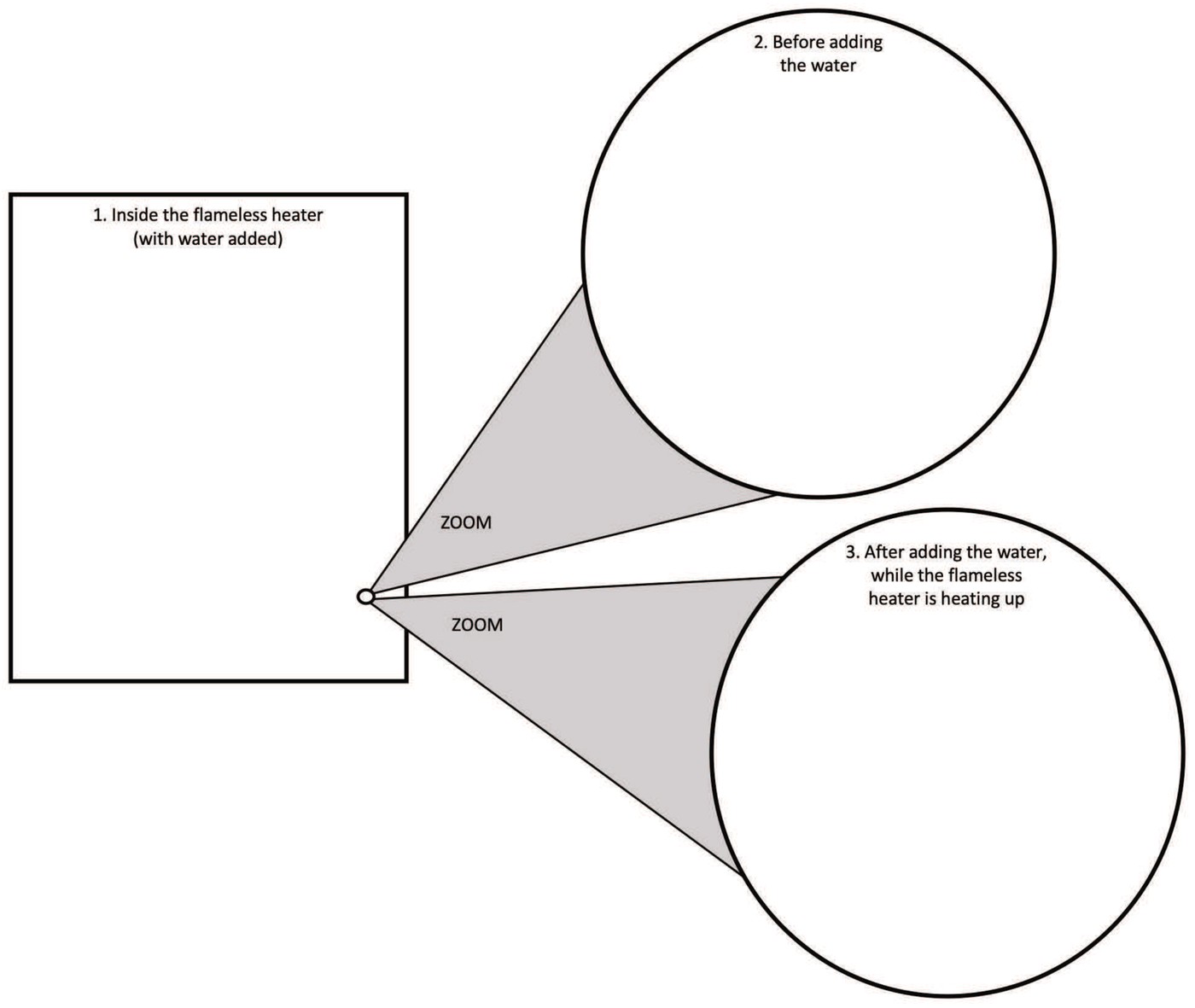
Pause and explain
Does endothermic automatically mean a chemical reaction occurred?
Check your reasoning after answering
No. Both physical processes and chemical reactions can absorb energy. New substance formation is a separate question from energy-transfer direction.
Design a chemical thermal device
A chemical device can warm or cool a target through a controlled reaction, but its design must meet both performance and safety limits.
An exothermic process transfers net energy outward; an endothermic process takes net energy from its surroundings. A thermal device directs that exchange toward a target. A target is the object intended to warm or cool, and a containment layer keeps the reacting substances from touching it. A temperature rise alone does not distinguish every physical process from a chemical reaction, so the supplied device case explicitly assumes verified reaction identity.
Define success before choosing a design. Criteria could include a target temperature range and useful duration; constraints might limit reagent amount, peak temperature, leakage and cost. A reagent is a substance used in the process. More reagent can increase total energy available but also overshoot a temperature limit. Insulation and contact geometry change where and how rapidly energy transfers. Bond breaking requires energy, formation releases it, and the net difference determines the reaction’s overall direction.
Construct a labeled paper/card model of containment, target and transfer paths, then compare the supplied warmer-design records and revise a feature. A prototype is a first testable version, not a promise of success. A supervised small-scale cooler investigation is described below as a separate actual route: baking soda is sodium bicarbonate, and household vinegar is a dilute aqueous solution containing acetic acid. Their reaction produces carbon dioxide gas and can cool the mixture. Keep the gas path open. A simple nested-cup design transfers energy from a water target toward the cooler reaction mixture through a wall; it must be built, measured and revised rather than assumed effective.
For an actual cooler comparison, define success as a repeatable decrease in target-water temperature without leakage, and keep the same small reagent amounts, water amount, starting temperature and observation intervals. Change only a feature such as contact geometry between the reaction compartment and target cup. In this open design, containment limits liquid mixing but does not trap gas. A result too small to resolve with the thermometer is useful feedback: report the resolution, check contact and environmental transfers, and revise. A no-change result is not permission to increase quantities or seal the reaction. Compare all planned trials; the supplied warmer table and cooler procedure are different devices with different criteria.
Evidence to interpret
| Illustrative design | Reagent amount (model units) | Peak target (°C) | Time in target range (min) |
|---|---|---|---|
| A | 4 | 32 | 8 |
| B | 8 | 45 | 15 |
| Revised C | 4 | 35 | 12 |
Use this method safely
Actual route requires an adult, properly fitting splash goggles, clean known household vinegar/baking soda, stable plastic cups, a tray and a suitable non-mercury thermometer. Use only the stated small amounts; keep every reaction cup uncovered and vented. No sealed bag, cap, balloon, unknown cleaner, heating, hand-warmer disassembly, ingestion or short-cut mixing. Clean spills and wash hands. Use the clearly labeled supplied-data route if equipment or safe supervision is unavailable; it is not personally collected experimental evidence.
Investigate or evaluate the supplied records
- Plan the supplied warmer comparison first: target 30–40 °C, maximum 4 reagent model units. Build a paper prototype and interpret all A/B/C records.
- For a separate supervised cooler investigation, gather two open plastic cups, a tray, a small measuring spoon/vessel, splash goggles and a thermometer. Record actual quantities and thermometer divisions.
- Establish the reaction baseline in an open cup: about 10 mL household vinegar and about half a teaspoon baking soda. Record initial vinegar temperature, add the powder and observe the changing mixture temperature until its trend is clear. Keep the thermometer sensor adequately immersed. Do not expect an exact temperature decrease.
- Plan and construct a stable nested-cup cooler with a separate small inner open cup holding 10 mL room-temperature target water. An adult helps keep it supported; the outer reaction compartment stays open and its liquid contacts the outside target-cup wall. Use a tray and do not seal either reaction compartment.
- For design A, use the same small vinegar/baking-soda amounts in the outer compartment and record target-water temperature at 0, 1, 2 and 3 minutes. Add a matching no-reaction target comparison if available. Record any liquid crossing between compartments.
- Repeat with fresh matched materials and restored starting conditions; preserve all planned readings. Do not call mixture temperature the target temperature or invent readings under the instrument’s precision.
- Revise one contact-geometry or material feature without changing reagent quantities or blocking ventilation. Test design B with matched amounts, times and initial temperatures, ideally in three trials per design.
- Graph target temperature against time, compare changes and variation, and judge the no-leak and cooling criteria. Explain reaction-to-target energy transfer and environmental exchanges. A failed prototype still needs a supported explanation and revision.
- If using supplied data instead, label the records illustrative and complete the same design/analysis. Keep actual-construction evidence separate from paper-prototype or data work.
Explain and apply
Using the source table, choose a qualifying design, draw the containment/transfer model and justify one revision. Explain what a new test must measure and why selecting only the hottest design can fail. Complete either the supervised small-scale cooler construction/retest or the supplied-data design route. State which route you used and submit its matching evidence; do not claim actual construction from a paper model.
- Apply criteria and hard constraints.
- Explain reaction energy, separate target/mixture readings and open containment.
- Compare original/revised trial evidence and its limits.
Reasoning and marking guidance — after your attempt
A qualifies at 32 °C under the stated 40 °C maximum, while B’s 45 °C violates it despite longer duration. A revision could improve insulation or transfer geometry within the reagent limit, then retest target temperature over time and check containment. Supplied C records at 35 °C for 12 minutes support that simulated comparison; they do not substitute for actual construction evidence. Account for reaction, target and surrounding energy pathways. For a real cooler route, vinegar/bicarbonate interaction can lower the reaction-mixture temperature; target water can then transfer energy through the inner-cup wall. Record the target separately and compare repeated A/B curves with a no-reaction reference. Geometry and environmental exchange can obscure a small effect, so no precise decrease is promised. A model or example result is not a substitute for actual target readings.
Apply the whole unit · Compare two energy accounts
Illustrative reaction models: A requires 40 energy units to separate starting bonds and releases 65 when product bonds form; B requires 70 and releases 50. The quantities use the same model energy unit.
Your task
Calculate the net transfer for each reaction, classify each as endothermic or exothermic, and draw labeled energy arrows between system and surroundings. Explain why a bond-breaking-only explanation fails.
What your response should show
- Use the supplied observations and measurements accurately; include units where needed.
- Explain the science behind your answer, rather than giving only a number or label.
- Show a labeled model, calculation, or evidence comparison as requested.
- State an assumption or limitation and suggest a useful next measurement.
Response guidance — after your attempt
A releases 65−40=25 units overall, so it is exothermic with a net arrow out of the reaction system. B absorbs 70−50=20 units overall, so it is endothermic with a net arrow into the system. Bond breaking requires energy in both cases; the total compares all bond changes. Actual temperature predictions require more information.
Scientific references and adapted teaching resources
- OpenSciEd 7.1 Chemical Reactions & Matter — public unit overview
- OpenSciEd 7.2 Chemical Reactions & Energy — public unit overview
- OpenSciEd instructional model — storyline routines
- Creative Commons Attribution 4.0 — middle-school material license
- ACS Middle School Chemistry 6.7 — reference for the small-scale vinegar/bicarbonate temperature investigation
Parent / teacher teaching notes
Rehearse system and surroundings before using signs. Use energy counters or arrows instead of advanced bond-energy calculations. These are supplied models, not home reaction recipes. Adaptation credit: OpenSciEd middle-school teaching routines and public task structures by OpenSciEd, CC BY 4.0. This independent version adds original explanatory text, data and figures, terminology support and a home-study schedule. It does not reproduce the complete teacher editions or their classroom validation. The illustrated study “Design a chemical thermal device” is required curriculum content. Teach it before the associated application or distribute it over the assigned unit sessions; it is not an optional enrichment. Its practice/review/quiz response provides evidence of understanding. Model/data work must not be recorded as an actual physical experiment.
The key idea
Exothermic reactions release energy to the surroundings (things get warmer); endothermic reactions absorb energy from the surroundings (things get cooler).
Temperature Change
ΔT = T final − T initial
a positive ΔT (temperature rises) suggests an exothermic reaction; a negative ΔT (temperature falls) suggests an endothermic reaction.
Worked examples
Example 1
- Ask: does energy flow into or out of the reaction?
- The packet releases heat into your hands, meaning energy is flowing OUT to the surroundings.
- Releasing energy to the surroundings is the definition of exothermic.
Example 2 · Worked application
- The water gained thermal energy as it warmed.
- That energy came from the process under the stated assumption.
- A process that transfers energy to surroundings is exothermic.
State the system boundary before naming the direction.
Example 3
- Ask: does energy flow into or out of the reaction?
- The pack absorbs heat FROM your skin and surroundings, which is why it feels cold.
- Absorbing energy from the surroundings is the definition of endothermic.
Example 4
- The surroundings lost thermal energy as they cooled.
- The pack's process absorbed energy from those surroundings.
Example 5 · Find and fix the mistake
- Test the claim against the stated conditions: State the system boundary before naming the direction.
- Breaking bonds requires input; forming bonds releases energy. Net release depends on the balance of both contributions.
State the system boundary before naming the direction.
Example 6 · Interpret the visual model
- Identify the represented objects, axes, labeled quantities and stated conditions before choosing a rule.
- A system is the chosen objects or process being studied. Surroundings are the interacting objects outside that boundary. Exothermic and endothermic name net transfer directions, so identify the boundary and interval first.
- Energy comes from the surroundings into the defined system overall. The surroundings can cool as they transfer energy, depending on the actual mass and other transfer paths.
Keep the model’s stated limits explicit: The box marks a chosen reaction-system boundary. Two alternative supplied cases show net energy transfer outward for an exothermic process and inward for an endothermic process. These opposite alternatives do not mean the same reaction has both net classifications at once. Naming the surroundings makes the account explicit before discussing measured temperature or bond changes.
Avoid these mistakes
- A colder reaction mixture can still involve conservation of energy.
Check your understanding
A cold-pack process cools its surrounding water from 22°C to 15°C. Describe the direction of energy transfer.
Discuss the answer
Energy entered the pack process; the process is endothermic under these conditions.
Why does bond breaking require an input of energy?
Discuss the answer
An exothermic reaction transfers energy from the reacting system to surroundings; an endothermic reaction takes in energy. A thermometer in the surroundings can show warming or cooling. Always state which part of the setup is being measured. Breaking a chemical bond requires energy, while forming a bond releases energy. The net energy change depends on both processes. Saying that energy simply comes from breaking bonds gives an incomplete and incorrect account of the overall change.
Return to the phenomenon
Illustrative matched surroundings start at 22 °C. Reaction A’s surrounding water reaches 28 °C; B’s reaches 17 °C. No direct bond-energy measurements are supplied. Identify the likely energy-transfer directions and correct “breaking bonds always releases energy.” State a measurement condition needed for the comparison. Revise your first explanation using a named idea from the lesson. Mark the changed part and the evidence that supports it.
Compare explanations after your attempt
A transfers net energy outward to warm the surroundings and is exothermic under the supplied model; B takes net energy from them and is endothermic. Breaking bonds requires energy; forming bonds releases energy, and the overall balance determines the net transfer. Match amounts, timing, insulation and external inputs before attributing a temperature difference to reaction alone.
What should we investigate next?
Which condition could be changed to test a remaining uncertainty in this explanation? State the predicted observation and what result would challenge your model.
Investigate, explain and revise
Use these tasks after the three teaching sessions as needed. Discuss an attempted explanation before opening response guidance; a matching sentence is less important than a supported mechanism.
Activity 1 · Explain the new evidence case
Use the visible scenario above, Parts 1–4 and your first notebook model. No outside reading or equipment is required.
Your task
Illustrative matched surroundings start at 22 °C. Reaction A’s surrounding water reaches 28 °C; B’s reaches 17 °C. No direct bond-energy measurements are supplied. Identify the likely energy-transfer directions and correct “breaking bonds always releases energy.” State a measurement condition needed for the comparison. Write 100–150 words or give a labeled drawing with an equivalent oral explanation.
Success criteria
- Use two relevant stated records or conditions.
- Explain the mechanism rather than only repeat a definition.
- Label observation and inference.
- Name a changed model feature or a remaining uncertainty.
Hint
Read the stated boundary and conditions before selecting a relationship. The unit’s worked examples show intermediate steps.
Response guidance — discuss after your attempt
A transfers net energy outward to warm the surroundings and is exothermic under the supplied model; B takes net energy from them and is endothermic. Breaking bonds requires energy; forming bonds releases energy, and the overall balance determines the net transfer. Match amounts, timing, insulation and external inputs before attributing a temperature difference to reaction alone.
Activity 2 · Read and extend the figure
Study the new labeled figure and its caption, then compare it with the associated teaching part.
Your task
How would a 100-unit breaking requirement with 70 released change the conclusion? Explain what each important label represents. Add one missing feature that would be needed for a different question, and explain why the original figure leaves it out.
Success criteria
- Answer the figure question with its stated labels.
- Connect the visual representation to the scientific idea.
- Identify a specific limitation from the caption.
- Propose a useful change without misrepresenting supplied evidence.
Hint
In this illustrative exothermic accounting, breaking bonds requires 60 units while formation releases 90, leaving 30 units transferred outward. These are model values, not measured values for a named chemical. The bar lengths compare amounts and distinguish bond breaking from the overall net result.
Response guidance — discuss after your attempt
The reaction would require a net 30 units from surroundings under that model, making the net process endothermic. In this illustrative exothermic accounting, breaking bonds requires 60 units while formation releases 90, leaving 30 units transferred outward. These are model values, not measured values for a named chemical. The bar lengths compare amounts and distinguish bond breaking from the overall net result.
Words to know
- exothermic reaction
- A reaction that releases energy to its surroundings, usually warming them up.
- endothermic reaction
- A reaction that absorbs energy from its surroundings, usually cooling them down.
- activation energy
- The extra energy needed to get a reaction started, even one that will end up releasing energy overall.
- model
- A representation that explains selected features and makes predictions; it leaves other details out.
- evidence
- Relevant observations or records used to support or challenge a claim.
- system boundary
- The chosen limit separating the objects being studied from their surroundings.
- assumption
- A condition taken as true for a model or calculation and needing to be checked against the case.
The energy hill: why even 'downhill' reactions need a push
Picture a reaction's energy as a hill: reactants start at one height, products end at another, and exothermic reactions end lower (net energy released) while endothermic ones end higher (net energy absorbed). But almost every reaction, even a strongly exothermic one, has to climb a small hump first — the activation energy — before it can roll downhill. That hump exists because old bonds must partially break before new ones can form, and breaking bonds always costs energy up front. A catalyst doesn't change how far downhill or uphill a reaction goes; it just makes the hump smaller, so the reaction can get started more easily, without being used up itself.
The chemistry hiding inside hot packs and cold packs
Break the inner pouch of an instant cold pack and it draws heat from your skin because it triggers ammonium nitrate dissolving into water — and dissolving that particular salt happens to be endothermic (it's technically a physical process, not a new chemical reaction, but it absorbs energy exactly the same way). Instant hot packs work almost opposite: they hold a supersaturated solution of sodium acetate that's unstable, and clicking the metal disc inside creates a nucleation site that lets the dissolved sodium acetate rapidly crystallize back into a solid — releasing a burst of stored energy as heat. Same basic idea (energy in vs. energy out), two very different mechanisms.
Putting a number on it: enthalpy and ΔH
Chemists measure a reaction's total energy change with a quantity called enthalpy, symbol ΔH, given in kilojoules per mole (kJ/mol). By convention, exothermic reactions get a negative ΔH (energy left the system), and endothermic reactions get a positive ΔH (energy entered the system). Burning methane, the natural gas many stoves use, releases about 890 kJ for every mole burned (ΔH ≈ −890 kJ/mol) — enough energy to boil several liters of water. The sign is really just a bookkeeping direction: negative means 'money left your account,' positive means 'money came in.'
James Prescott Joule and the discovery that heat is energy, not a fluid
For centuries, scientists believed heat was an invisible, weightless fluid called 'caloric' that flowed from hot objects to cold ones. In the 1840s, English physicist James Prescott Joule carefully measured how mechanical work (like a falling weight turning a paddle wheel in water) could raise water's temperature by a precise, repeatable amount — proving heat is really a form of energy transfer, not a substance. His careful experiments helped establish the law of conservation of energy (Unit 4), and the SI unit of energy, the joule, is named in his honor.
In the real world
Athletes use exothermic hand warmers to stay warm and endothermic instant cold packs to treat injuries on the sidelines.
Exit check
How would a 100-unit breaking requirement with 70 released change the conclusion? Explain the relevant mechanism and one model limitation.
Check your explanation after answering
The reaction would require a net 30 units from surroundings under that model, making the net process endothermic. In this illustrative exothermic accounting, breaking bonds requires 60 units while formation releases 90, leaving 30 units transferred outward. These are model values, not measured values for a named chemical. The bar lengths compare amounts and distinguish bond breaking from the overall net result.
Explain your reasoning without notes. If a key idea is missing, revisit the lesson and try again.
Acids, Bases & pH
Learning goals
- I can describe properties of acids and bases.
- I can use the pH scale to classify a substance as acidic, neutral, or basic.
Readings for this unit
Before this unit
Locate numbers on a scale and compare factors of ten.
Use three teaching sessions of about 40–45 minutes: first observe the phenomenon, draft a model and study Parts 1–2; next explain Parts 3–4 with the figures and evidence; then work the application, examples, practice, model revision and exit check. Divide any difficult part into smaller steps and revisit after feedback. Investigations, review and quizzes have separate sessions. Study the four visual parts across the scheduled sessions, then use the illustrated worked case and independent transfer questions. Extend or revisit a session when the learner cannot explain the figure; completion time is a proposed allocation, not a mastery guarantee.
Start with something to explain
What would explain the observations in acids, bases & ph?
Illustrative evidence case. Supplied room-temperature dilute aqueous solutions have pH values 3, 7 and 11. A student proposes identifying them by taste.
Notice and wonder
Does pH 7 alone make unknown water safe to drink? Write two observations from the supplied record without guessing their cause. Include a quantity and its unit when given. An observation is what was recorded; an inference is what you think explains it.
Write one question about why the pattern occurs and one question about a comparison that could distinguish competing explanations. A testable question identifies what could be observed or measured.
Your first model
Before reading the model answer, sketch the named objects or particles and label what you think changes. Classify the solutions under the stated conditions and explain a safe evidence method. Clarify whether pH alone identifies a substance or concentration. Keep this first version so you can compare it with your later explanation.
Build the language from the idea
- acid
- A substance that increases hydrogen-ion activity in water; common dilute acidic solutions have pH below 7 near room temperature. Never identify experimental samples by taste.
- base
- A substance that decreases hydrogen-ion activity in water; common dilute basic solutions have pH above 7 near room temperature. Never identify unknown samples by touch or taste.
- pH scale
- A logarithmic measure related to hydrogen-ion activity in water. Common dilute solutions near room temperature lie roughly within 0–14 with neutral near 7; this is not a universal range.
- indicator
- A chemical, like litmus paper, that changes color depending on the pH of a solution.
- neutralization
- A reaction between an acid and a base that produces a more neutral solution (plus a salt and water).
- model
- A representation that explains selected features and makes predictions; it leaves other details out.
- evidence
- Relevant observations or records used to support or challenge a claim.
- system boundary
- The chosen limit separating the objects being studied from their surroundings.
- assumption
- A condition taken as true for a model or calculation and needing to be checked against the case.
Acids in aqueous solution show characteristic behavior, including changing suitable indicators and reacting with certain other substances. Vinegar contains acetic acid and lemon juice contains citric acid. Familiar food examples help connect vocabulary to experience, but taste is not a chemical test. Use supplied records, labeled safe samples, and an appropriate indicator to study a solution rather than trying to identify an unknown substance by taste or smell.
Basic aqueous solutions change suitable indicators in a different range from acids. Some soap solutions and baking-soda solutions are basic under ordinary conditions, but concentration and ingredients matter. Slippery feel or bitter taste are not suitable tests: learners should not touch or taste chemicals to classify them. The pH value alone also does not establish that a substance is safe for a particular use.
The familiar classroom pH chart commonly spans 0–14 for dilute aqueous solutions near room temperature. Under those conditions, values below 7 are acidic, near 7 neutral, and above 7 basic. The range is not an absolute limit for every solution, and neutral pH depends on temperature. A one-unit decrease corresponds to a tenfold increase in hydrogen-ion activity; the introductory dilute-solution model uses concentration approximately. This is more precise than treating pH as a linear amount of acid.
An indicator changes color across a pH range. Compare the result with the supplied chart, use consistent lighting, and report an interval if the color is ambiguous. A calibrated pH meter can provide a more precise result when used correctly. Neither an indicator nor a meter identifies every chemical in a sample or guarantees that it is safe. Strongly colored solutions may interfere with a simple color comparison.
Neutralization involves an acid-base reaction, often producing water and dissolved salts in introductory examples. The final pH depends on chemical identities and reacting amounts, so equal liquid volumes do not necessarily give pH 7. Such reactions are useful in controlled chemical and industrial processes. This unit uses supplied evidence rather than advice for treating injuries or mixing household cleaners, and it does not imply that reaction products are automatically harmless.
For ordinary dilute aqueous solutions, a pH below 7 indicates acidic conditions and above 7 indicates basic conditions near room temperature. Each pH step corresponds to a factor of ten in hydrogen-ion activity. A two-step difference therefore corresponds to a factor of one hundred.
Acid strength describes how extensively an acid transfers protons to water; concentration describes how much acid is present in a volume. A very dilute strong acid can have a higher pH than a more concentrated weak acid. Use measurements and conditions instead of ranking safety from pH alone.
An indicator provides an approximate range, while a calibrated pH meter provides a more precise reading. Neutralization often makes water and a salt, but the final pH depends on amounts and chemical identities. Use only specified safe materials and never use taste to classify a substance.
Build your understanding
Where this fits
This unit helps answer the chapter question: How can we tell when substances react, and what is conserved? Keep a notebook table with the question, evidence, explanation and one unresolved issue. Revise a previous model only when you can name the new evidence or idea that changes it.
Use three teaching sessions of about 40–45 minutes: first observe the phenomenon, draft a model and study Parts 1–2; next explain Parts 3–4 with the figures and evidence; then work the application, examples, practice, model revision and exit check. Divide any difficult part into smaller steps and revisit after feedback. Investigations, review and quizzes have separate sessions.
Part 1 · Use pH as a property of a solution
For ordinary dilute aqueous solutions near room temperature, pH below 7 indicates acidic conditions, pH near 7 neutral conditions, and pH above 7 basic conditions. The familiar classroom range is often 0–14, but it is not an absolute boundary for all solutions. Neutrality depends on temperature.
Read the visual model
Does a pH value identify a unique chemical?
Visual reasoning — after your attempt
No. Many different solutions can have the same pH. A pH measurement describes acidity or basicity under conditions, not complete chemical identity.
Use the provided pH chart for the stated classroom conditions. A solution at pH 3 is acidic and one at pH 10 basic. These labels do not identify every dissolved substance or determine whether a mixture is safe to handle.
Pause and explain
Does a pH value identify a unique chemical?
Check your reasoning after answering
No. Many different solutions can have the same pH. A pH measurement describes acidity or basicity under conditions, not complete chemical identity.
Part 2 · Read a scale that does not increase evenly
A one-unit decrease in pH corresponds to a tenfold increase in hydrogen-ion activity; introductory dilute-solution models use concentration as an approximation. A change of two pH units therefore corresponds to a factor of 100, not two. This explains why subtracting pH values is not a direct comparison of amounts.
Read the visual model
How does pH 4 compare with pH 6 in the introductory concentration model?
Visual reasoning — after your attempt
pH 4 corresponds to about 100 times the hydrogen-ion concentration of pH 6. The two-unit difference represents two factors of ten.
In the introductory model, a pH 3 solution has about ten times the hydrogen-ion concentration of pH 4, and about one hundred times that of pH 5. These comparisons do not measure all possible harmful effects or total acid present.
Pause and explain
How does pH 4 compare with pH 6 in the introductory concentration model?
Check your reasoning after answering
pH 4 corresponds to about 100 times the hydrogen-ion concentration of pH 6. The two-unit difference represents two factors of ten.
Part 3 · Treat indicators as measurements with limits
An indicator changes appearance over a pH range. Compare its color with the supplied chart using similar lighting, and record an interval when colors are ambiguous. A colored sample can interfere with interpretation. A more precise instrument still needs calibration and suitable procedures.
Read the visual model
A range expresses what the method can resolve. Repeat a consistent approved measurement and compare the actual key. Record the uncertain match instead of forcing every reading into a precise number.
What pH claim is supported, and why would reporting 5.34 be unjustified?
Visual reasoning — after your attempt
A range around pH 5–6 is supported by the two clear matches, with the ambiguous result noted. The color method does not supply precision to two decimal places.
If a color chart supports pH between 5 and 6, record that range rather than inventing 5.37. Repeating the measurement and using an independent method can improve confidence. Never taste a sample to decide whether it is acidic.
Pause and explain
Why is an indicator result often a range rather than an exact number?
Check your reasoning after answering
Color changes span intervals and can be affected by lighting, sample color, and interpretation. The method does not justify unlimited decimal precision.
Part 4 · Explain neutralization without assuming equal volumes
An acid and a base can react, often forming water and dissolved salts in introductory examples. Final pH depends on the substances and amounts, not simply equal liquid volumes. Neutralization does not guarantee a harmless product or a final pH of 7 under every condition.
Read the visual model
Concentration describes how much of a substance is present per solution volume. The reaction ratio tells which amounts match. A pH number cannot be added or subtracted as though it were a simple count of acid units.
What remains after six base units react with ten matching acid units? Does this alone determine an exact final pH?
Visual reasoning — after your attempt
Four acid amount-units remain in excess. It does not specify an exact final pH without substance, concentration and condition information.
Equal cups of differently concentrated solutions do not supply equal reacting amounts. Use a professionally supplied result or known safe instructional material; never mix household cleaners to test neutralization. Predict only as far as the provided information allows.
Pause and explain
Will mixing equal volumes of any acid and base guarantee pH 7?
Check your reasoning after answering
No. Concentrations, reacting amounts, and acid/base chemistry matter. Equal volumes alone cannot establish the final pH or product safety.
Apply the whole unit · Interpret three indicator records
Illustrative dilute aqueous samples at room temperature: A has estimated pH 4–5; B is near pH 7; C is near pH 10. No identities or concentrations beyond these records are supplied.
Your task
Classify the samples for the stated conditions, compare pH 4 with pH 5 in the introductory model, and explain two claims these data cannot establish. Propose a way to reduce measurement uncertainty.
What your response should show
- Use the supplied observations and measurements accurately; include units where needed.
- Explain the science behind your answer, rather than giving only a number or label.
- Show a labeled model, calculation, or evidence comparison as requested.
- State an assumption or limitation and suggest a useful next measurement.
Response guidance — after your attempt
A is acidic, B approximately neutral, and C basic. pH 4 corresponds to about ten times the hydrogen-ion concentration of pH 5 in the introductory model. The records cannot identify each chemical, establish handling safety, or predict a neutralizing volume. Repeated calibrated measurements or a second suitable method could narrow the estimates.
Scientific references and adapted teaching resources
- OpenSciEd 7.1 Chemical Reactions & Matter — public unit overview
- OpenSciEd 7.2 Chemical Reactions & Energy — public unit overview
- OpenSciEd instructional model — storyline routines
- Creative Commons Attribution 4.0 — middle-school material license
Parent / teacher teaching notes
Keep the emphasis on interpreting supplied records, scale factors, and measurement limits. Chemical tasting, direct smelling, and household-cleaner mixing are not part of this unit. Adaptation credit: OpenSciEd middle-school teaching routines and public task structures by OpenSciEd, CC BY 4.0. This independent version adds original explanatory text, data and figures, terminology support and a home-study schedule. It does not reproduce the complete teacher editions or their classroom validation.
The key idea
The pH scale runs 0 (most acidic) to 14 (most basic), with 7 as neutral; mixing an acid and a base neutralizes both, moving pH toward 7.
Worked examples
Example 1
- Compare 3 to the neutral point of 7 on the pH scale.
- 3 is well below 7, so the solution is acidic.
- Lemon juice and vinegar both have a pH of around 2–3, similar to this solution.
Example 2 · Worked application
- Subtract pH values: 7−4=3.
- Each pH unit corresponds to a factor of 10.
- 10³=1000, with greater hydrogen-ion activity at the lower pH.
A lower pH must correspond to greater, not smaller, hydrogen-ion activity.
Example 3
- New pH = original pH + rise = 4 + 3 = 7.
- A pH of exactly 7 is neutral.
Example 4
- The pH difference is 5−3=2.
- Each step is a factor of 10, so the factor is 10×10=100.
Example 5 · Find and fix the mistake
- Test the claim against the stated conditions: A lower pH must correspond to greater, not smaller, hydrogen-ion activity.
- The pH scale is logarithmic. Three units represent a factor of 1000 in hydrogen-ion activity under this comparison.
A lower pH must correspond to greater, not smaller, hydrogen-ion activity.
Example 6 · Interpret the visual model
- Identify the represented objects, axes, labeled quantities and stated conditions before choosing a rule.
- A range expresses what the method can resolve. Repeat a consistent approved measurement and compare the actual key. Record the uncertain match instead of forcing every reading into a precise number.
- A range around pH 5–6 is supported by the two clear matches, with the ambiguous result noted. The color method does not supply precision to two decimal places.
Keep the model’s stated limits explicit: Two illustrative test colors match the supplied pH 5–6 key while a third reading is ambiguous. These colors are a specific provided key, not a universal rule for every indicator. An indicator’s transition range, lighting, amount and sample color can limit the estimate. No taste, skin test or mixing of unknown chemicals is intended.
Avoid these mistakes
- A two-unit pH difference represents a hundredfold change, not a twofold change.
Check your understanding
Compare the hydrogen-ion activity in solutions of pH 3 and pH 5.
Discuss the answer
The pH 3 solution has about 100 times the hydrogen-ion activity of pH 5 under comparable conditions.
Why cannot pH alone establish whether a substance is safe to handle?
Discuss the answer
For ordinary dilute aqueous solutions, a pH below 7 indicates acidic conditions and above 7 indicates basic conditions near room temperature. Each pH step corresponds to a factor of ten in hydrogen-ion activity. A two-step difference therefore corresponds to a factor of one hundred. Acid strength describes how extensively an acid transfers protons to water; concentration describes how much acid is present in a volume. A very dilute strong acid can have a higher pH than a more concentrated weak acid. Use measurements and conditions instead of ranking safety from pH alone.
Return to the phenomenon
Supplied room-temperature dilute aqueous solutions have pH values 3, 7 and 11. A student proposes identifying them by taste. Classify the solutions under the stated conditions and explain a safe evidence method. Clarify whether pH alone identifies a substance or concentration. Revise your first explanation using a named idea from the lesson. Mark the changed part and the evidence that supports it.
Compare explanations after your attempt
Under this simplified room-temperature model, pH 3 is acidic, 7 neutral and 11 basic. Use suitable supplied records or indicators with approved samples, never taste or touch-test unknowns. pH concerns hydrogen-ion activity; it does not uniquely identify composition, safety or total concentration. Values outside 0–14 and temperature-dependent neutrality are possible in broader chemistry.
What should we investigate next?
Which condition could be changed to test a remaining uncertainty in this explanation? State the predicted observation and what result would challenge your model.
Investigate, explain and revise
Use these tasks after the three teaching sessions as needed. Discuss an attempted explanation before opening response guidance; a matching sentence is less important than a supported mechanism.
Activity 1 · Explain the new evidence case
Use the visible scenario above, Parts 1–4 and your first notebook model. No outside reading or equipment is required.
Your task
Supplied room-temperature dilute aqueous solutions have pH values 3, 7 and 11. A student proposes identifying them by taste. Classify the solutions under the stated conditions and explain a safe evidence method. Clarify whether pH alone identifies a substance or concentration. Write 100–150 words or give a labeled drawing with an equivalent oral explanation.
Success criteria
- Use two relevant stated records or conditions.
- Explain the mechanism rather than only repeat a definition.
- Label observation and inference.
- Name a changed model feature or a remaining uncertainty.
Hint
Read the stated boundary and conditions before selecting a relationship. The unit’s worked examples show intermediate steps.
Response guidance — discuss after your attempt
Under this simplified room-temperature model, pH 3 is acidic, 7 neutral and 11 basic. Use suitable supplied records or indicators with approved samples, never taste or touch-test unknowns. pH concerns hydrogen-ion activity; it does not uniquely identify composition, safety or total concentration. Values outside 0–14 and temperature-dependent neutrality are possible in broader chemistry.
Activity 2 · Read and extend the figure
Study the new labeled figure and its caption, then compare it with the associated teaching part.
Your task
Does pH 7 alone make unknown water safe to drink? Explain what each important label represents. Add one missing feature that would be needed for a different question, and explain why the original figure leaves it out.
Success criteria
- Answer the figure question with its stated labels.
- Connect the visual representation to the scientific idea.
- Identify a specific limitation from the caption.
- Propose a useful change without misrepresenting supplied evidence.
Hint
This common classroom scale uses dilute aqueous solutions near room temperature, with neutral near pH 7. The spacing represents pH units rather than equal hydrogen-ion activity increments. Values outside this pictured range can occur, and pH does not uniquely identify a substance or its safety.
Response guidance — discuss after your attempt
No. Neutrality does not rule out harmful dissolved substances or microorganisms. Safety requires separate evidence. This common classroom scale uses dilute aqueous solutions near room temperature, with neutral near pH 7. The spacing represents pH units rather than equal hydrogen-ion activity increments. Values outside this pictured range can occur, and pH does not uniquely identify a substance or its safety.
Words to know
- acid
- A substance that increases hydrogen-ion activity in water; common dilute acidic solutions have pH below 7 near room temperature. Never identify experimental samples by taste.
- base
- A substance that decreases hydrogen-ion activity in water; common dilute basic solutions have pH above 7 near room temperature. Never identify unknown samples by touch or taste.
- pH scale
- A logarithmic measure related to hydrogen-ion activity in water. Common dilute solutions near room temperature lie roughly within 0–14 with neutral near 7; this is not a universal range.
- indicator
- A chemical, like litmus paper, that changes color depending on the pH of a solution.
- neutralization
- A reaction between an acid and a base that produces a more neutral solution (plus a salt and water).
- model
- A representation that explains selected features and makes predictions; it leaves other details out.
- evidence
- Relevant observations or records used to support or challenge a claim.
- system boundary
- The chosen limit separating the objects being studied from their surroundings.
- assumption
- A condition taken as true for a model or calculation and needing to be checked against the case.
What the numbers really mean: pH is a logarithmic scale
The pH scale isn't a simple ruler where 4 is just 'a bit more acidic' than 7 — it's logarithmic, meaning each single step represents a ×10 change in hydrogen ion concentration. A solution with pH 3 doesn't have a little more acid than one with pH 7 — it has 10,000 times more hydrogen ions (10⁴, since the pH values differ by 4). That's why even a small-looking shift in pH, like from 8.2 to 8.1, can represent a surprisingly large change in actual chemistry — a pattern you'll see again with the decibel scale for sound.
Søren Sørensen and the birth of 'pH' at a brewery
The pH scale was invented in 1909 by Danish chemist Søren Sørensen, who wasn't studying stomachs or labs at all — he worked at the Carlsberg Laboratory, researching how acidity affected the enzymes used in brewing beer. He needed a precise, convenient way to describe hydrogen ion concentration without writing out long decimals, so he defined pH (roughly, 'power of hydrogen') as a compact scale. More than a century later, his brewery shortcut is standard vocabulary in chemistry, medicine, agriculture, and environmental science.
Your blood is a chemistry experiment happening right now
Human blood is tightly controlled to stay between pH 7.35 and 7.45 — just barely on the basic side of neutral. Special dissolved chemicals called buffers constantly neutralize small amounts of acid or base your body produces, keeping blood pH inside that narrow window. Even a drop to pH 7.0 or a rise to pH 7.8 can be medically dangerous (conditions called acidosis and alkalosis), which is why doctors watch blood pH so closely — it's a real-time chemistry reading on your body's health.
Ocean acidification: acids and bases at planetary scale
The ocean's surface has drifted from an average pH of about 8.2 before the Industrial Revolution to about 8.1 today, as seawater absorbs extra carbon dioxide from the atmosphere and forms carbonic acid. That 0.1 drop sounds tiny, but remember — pH is logarithmic, so it actually represents roughly a 30% increase in hydrogen ion concentration in just over a century. This matters enormously for shelled ocean life like corals and oysters, which struggle to build their calcium carbonate shells in more acidic water — a striking example of chemistry, the carbon cycle, and biology all connected through one number.
In the real world
Farmers test soil pH to know which crops will thrive, and may add lime (a base) to reduce soil acidity.
Exit check
Does pH 7 alone make unknown water safe to drink? Explain the relevant mechanism and one model limitation.
Check your explanation after answering
No. Neutrality does not rule out harmful dissolved substances or microorganisms. Safety requires separate evidence. This common classroom scale uses dilute aqueous solutions near room temperature, with neutral near pH 7. The spacing represents pH units rather than equal hydrogen-ion activity increments. Values outside this pictured range can occur, and pH does not uniquely identify a substance or its safety.
Explain your reasoning without notes. If a key idea is missing, revisit the lesson and try again.
Problem 1
Answer and explanation
They can rule out alternative explanations. Composition evidence together with controlled changes is stronger than relying on one ambiguous sign.
They can rule out alternative explanations. Composition evidence together with controlled changes is stronger than relying on one ambiguous sign.
Response criteria
- Use the supplied conditions and relevant evidence.
- Explain the scientific mechanism or calculation.
- State a meaningful limitation or testable next step.
Problem 2
Answer and explanation
Bubbles appearing is the observation; the proposed origin is an inference until supported by identity and other evidence.
Bubbles appearing is the observation; the proposed origin is an inference until supported by identity and other evidence.
Response criteria
- Use the supplied conditions and relevant evidence.
- Explain the scientific mechanism or calculation.
- State a meaningful limitation or testable next step.
Problem 3
Hints
Use the illustrated study titled Chemical interactions in daily life and history. Keep the observations, model and conditions separate.
Answer and explanation
Cutting can retain iron identity while rust formation produces different substances. An alloy can be a mixture rather than one fixed-ratio compound. Chemical risk cannot be decided from the word alone; identity, amount, exposure and use need evidence. Relate the chosen process to a practical effect while keeping ordinary atom rearrangement distinct from nuclear element formation.
Cutting can retain iron identity while rust formation produces different substances. An alloy can be a mixture rather than one fixed-ratio compound. Chemical risk cannot be decided from the word alone; identity, amount, exposure and use need evidence. Relate the chosen process to a practical effect while keeping ordinary atom rearrangement distinct from nuclear element formation.
Response criteria
- Distinguish composition from appearance.
- Explain a daily/historical consequence with a mechanism.
- Evaluate blanket chemical/mixture claims with conditions.
Problem 4
Answer and explanation
Bubbles are observed; a new chemical substance is not yet established. Obtain appropriate supplied gas-identity or characteristic-property evidence and compare the control/conditions.
Record appearance without assigning an unsupported identity.
Use a discriminating comparison rather than one visual sign.
Bubbles are observed; a new chemical substance is not yet established. Obtain appropriate supplied gas-identity or characteristic-property evidence and compare the control/conditions.
Response criteria
- Use the named labels, directions or supplied quantities accurately.
- Connect the visual evidence to the scientific mechanism or calculation.
- State the relevant model conditions or limitation.
Problem 5
Answer and explanation
A reaction can regroup the same atoms into a different number of molecules. Each element count, and total mass for the closed ordinary-reaction system, remains conserved.
A reaction can regroup the same atoms into a different number of molecules. Each element count, and total mass for the closed ordinary-reaction system, remains conserved.
Response criteria
- Use the supplied conditions and relevant evidence.
- Explain the scientific mechanism or calculation.
- State a meaningful limitation or testable next step.
Problem 6
Answer and explanation
1.5 g, if escaping gas is the supported explanation and measurements are comparable.
1.5 g, if escaping gas is the supported explanation and measurements are comparable.
Response criteria
- Use the supplied conditions and relevant evidence.
- Explain the scientific mechanism or calculation.
- State a meaningful limitation or testable next step.
Problem 7
Answer and explanation
5 g of incoming gas, so 9+5 = 14 g. The increase concerns matter crossing the measured boundary rather than matter being created.
Subtract the initial solid mass from product mass.
Identify the initially omitted matter source.
5 g of incoming gas, so 9+5 = 14 g. The increase concerns matter crossing the measured boundary rather than matter being created.
Response criteria
- Use the named labels, directions or supplied quantities accurately.
- Connect the visual evidence to the scientific mechanism or calculation.
- State the relevant model conditions or limitation.
Problem 8
Answer and explanation
A coefficient multiplies every atom in that formula. Fixing one element can change another element count and require an additional adjustment.
A coefficient multiplies every atom in that formula. Fixing one element can change another element count and require an additional adjustment.
Response criteria
- Use the supplied conditions and relevant evidence.
- Explain the scientific mechanism or calculation.
- State a meaningful limitation or testable next step.
Problem 9
Answer and explanation
It names a different substance with different composition. Use whole-particle coefficients to balance the intended water reaction.
It names a different substance with different composition. Use whole-particle coefficients to balance the intended water reaction.
Response criteria
- Use the supplied conditions and relevant evidence.
- Explain the scientific mechanism or calculation.
- State a meaningful limitation or testable next step.
Problem 10
Answer and explanation
N₂ + 3H₂ → 2NH₃. Both sides contain 2 N atoms and 6 H atoms.
Match two nitrogen atoms using 2NH₃.
That product count needs six H atoms, supplied by 3H₂.
N₂ + 3H₂ → 2NH₃. Both sides contain 2 N atoms and 6 H atoms.
Response criteria
- Use the named labels, directions or supplied quantities accurately.
- Connect the visual evidence to the scientific mechanism or calculation.
- State the relevant model conditions or limitation.
Problem 11
Answer and explanation
Energy released during formation of new bonds can exceed the energy required to break starting bonds. The difference is the overall release.
Energy released during formation of new bonds can exceed the energy required to break starting bonds. The difference is the overall release.
Response criteria
- Use the supplied conditions and relevant evidence.
- Explain the scientific mechanism or calculation.
- State a meaningful limitation or testable next step.
Problem 12
Answer and explanation
The reaction would require a net 30 units from surroundings under that model, making the net process endothermic.
The reaction would require a net 30 units from surroundings under that model, making the net process endothermic.
Response criteria
- Use the supplied conditions and relevant evidence.
- Explain the scientific mechanism or calculation.
- State a meaningful limitation or testable next step.
Problem 13
Hints
Use the illustrated study titled Design a chemical thermal device. Keep the observations, model and conditions separate.
Answer and explanation
A qualifies at 32 °C under the stated 40 °C maximum, while B’s 45 °C violates it despite longer duration. A revision could improve insulation or transfer geometry within the reagent limit, then retest target temperature over time and check containment. Supplied C records at 35 °C for 12 minutes support that simulated comparison; they do not substitute for actual construction evidence. Account for reaction, target and surrounding energy pathways. For a real cooler route, vinegar/bicarbonate interaction can lower the reaction-mixture temperature; target water can then transfer energy through the inner-cup wall. Record the target separately and compare repeated A/B curves with a no-reaction reference. Geometry and environmental exchange can obscure a small effect, so no precise decrease is promised. A model or example result is not a substitute for actual target readings.
A qualifies at 32 °C under the stated 40 °C maximum, while B’s 45 °C violates it despite longer duration. A revision could improve insulation or transfer geometry within the reagent limit, then retest target temperature over time and check containment. Supplied C records at 35 °C for 12 minutes support that simulated comparison; they do not substitute for actual construction evidence. Account for reaction, target and surrounding energy pathways. For a real cooler route, vinegar/bicarbonate interaction can lower the reaction-mixture temperature; target water can then transfer energy through the inner-cup wall. Record the target separately and compare repeated A/B curves with a no-reaction reference. Geometry and environmental exchange can obscure a small effect, so no precise decrease is promised. A model or example result is not a substitute for actual target readings.
Response criteria
- Apply criteria and hard constraints.
- Explain reaction energy, separate target/mixture readings and open containment.
- Compare original/revised trial evidence and its limits.
Problem 14
Answer and explanation
Net 25 units enter from surroundings under this model, so the overall reaction is endothermic. Forming bonds releases 55; breaking them requires 80.
Compare the two contributions with directions stated.
Classify the net result, not an isolated bond step.
Net 25 units enter from surroundings under this model, so the overall reaction is endothermic. Forming bonds releases 55; breaking them requires 80.
Response criteria
- Use the named labels, directions or supplied quantities accurately.
- Connect the visual evidence to the scientific mechanism or calculation.
- State the relevant model conditions or limitation.
Problem 15
Answer and explanation
pH 4 corresponds to about 100 times the hydrogen-ion concentration of pH 6. The two-unit difference represents two factors of ten.
pH 4 corresponds to about 100 times the hydrogen-ion concentration of pH 6. The two-unit difference represents two factors of ten.
Response criteria
- Use the supplied conditions and relevant evidence.
- Explain the scientific mechanism or calculation.
- State a meaningful limitation or testable next step.
Problem 16
Answer and explanation
No. Neutrality does not rule out harmful dissolved substances or microorganisms. Safety requires separate evidence.
No. Neutrality does not rule out harmful dissolved substances or microorganisms. Safety requires separate evidence.
Response criteria
- Use the supplied conditions and relevant evidence.
- Explain the scientific mechanism or calculation.
- State a meaningful limitation or testable next step.
Problem 17
Answer and explanation
The 8–9 sample is basic and the pH 6 sample acidic under the stated common room-temperature aqueous convention. Indicator color supplies a range, not that exact decimal.
Use the supplied key and conditions.
Respect measurement resolution and the logarithmic scale.
The 8–9 sample is basic and the pH 6 sample acidic under the stated common room-temperature aqueous convention. Indicator color supplies a range, not that exact decimal.
Response criteria
- Use the named labels, directions or supplied quantities accurately.
- Connect the visual evidence to the scientific mechanism or calculation.
- State the relevant model conditions or limitation.