Waves, Information & a Speaker System · Grade 8 Science
Chapter: Waves, Sound & LightWaves, Information & a Speaker System
Learning goals
- I can trace the linked electrical, magnetic, mechanical and sound mechanisms in a speaker.
- I can decode a supplied threshold signal and explain noise limits and different vacuum-transfer cases.
Readings for this unit
Before this unit
Review the earlier circuits, magnetic forces and sound-wave units. The visible language notes explain this unit’s quantities; then connect them to its concrete records and figure.
Use three teaching sessions of about 40–45 minutes: first observe the phenomenon, draft a model and study Parts 1–2; next explain Parts 3–4 with the figures and evidence; then work the application, examples, practice, model revision and exit check. Divide any difficult part into smaller steps and revisit after feedback. Investigations, review and quizzes have separate sessions. Study the four visual parts across the scheduled sessions, then use the illustrated worked case and independent transfer questions. Extend or revisit a session when the learner cannot explain the figure; completion time is a proposed allocation, not a mastery guarantee.
Start with something to explain
What would explain the observations in waves, information & a speaker system?
Illustrative evidence case. Illustrative received values are 0.15, 0.85, 0.48 and 0.88 with threshold 0.5. A drawing shows electrical input jumping directly to an ear with no speaker or air.
Notice and wonder
What fails if the ordinary sound path becomes a vacuum gap? Write two observations from the supplied record without guessing their cause. Include a quantity and its unit when given. An observation is what was recorded; an inference is what you think explains it.
Write one question about why the pattern occurs and one question about a comparison that could distinguish competing explanations. A testable question identifies what could be observed or measured.
Your first model
Before reading the model answer, sketch the named objects or particles and label what you think changes. Decode the values, identify the less robust reading and revise the drawing with intermediate interactions. Keep this first version so you can compare it with your later explanation.
Build the language from the idea
- signal
- Changing physical pattern used to carry information.
- membrane
- Thin surface capable of moving or vibrating.
- analog
- Continuously varying representation.
- digital
- Representation using discrete permitted symbols.
- threshold
- Decision boundary for assigning a measurement to a category or symbol.
- model
- A representation that explains selected features and makes predictions; it leaves other details out.
- evidence
- Relevant observations or records used to support or challenge a claim.
- system boundary
- The chosen limit separating the objects being studied from their surroundings.
- assumption
- A condition taken as true for a model or calculation and needing to be checked against the case.
A signal is a changing physical pattern used to carry information. A message is its interpreted meaning.
In a speaker system, changing electrical current helps produce a changing magnetic interaction, which makes a membrane vibrate. A membrane is a thin movable surface.
Its motion disturbs nearby air, and sound travels to a receiver. The pieces connect earlier ideas about circuits, magnetic forces, motion and waves.
No speaker disassembly, loud sound or wall-powered experiment is required: use the supplied system model and data. The model explains a common moving-coil speaker; not every device has exactly this construction.
An observation is what a person or instrument records. An inference is a proposed interpretation of those records. Keep the two separate: a graph can show a pattern while more than one mechanism might explain it. State the chosen system, or part of the world being studied, and its boundary before accounting for material or energy transfers.
Use each figure as a reasoning tool. Read its caption and labels, describe the pattern, then explain a cause. If the picture is schematic, use the stated numbers rather than measuring its printed size. Check whether its simplified conditions match the problem before applying a formula.
Build your understanding
Where this fits
This unit helps answer the chapter question: How do waves and circuits transfer energy and information? Keep a notebook table with the question, evidence, explanation and one unresolved issue. Revise a previous model only when you can name the new evidence or idea that changes it.
Use three teaching sessions of about 40–45 minutes: first observe the phenomenon, draft a model and study Parts 1–2; next explain Parts 3–4 with the figures and evidence; then work the application, examples, practice, model revision and exit check. Divide any difficult part into smaller steps and revisit after feedback. Investigations, review and quizzes have separate sessions.
Part 1 · Trace a speaker’s linked interactions
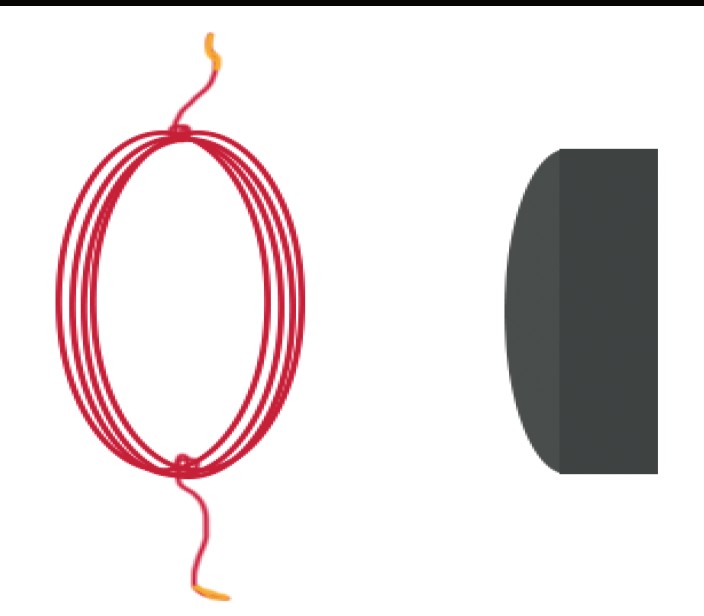
A current is the rate at which charge passes a point. In a coil of wire it produces a magnetic influence that interacts with a permanent magnet. Changing the current can change the direction or size of force on the coil. A coil attached to a membrane can move it back and forth.
Read the visual model
Why does a fixed magnet alone not explain a complete changing sound?
Visual reasoning — after your attempt
The time-varying input and resulting changing force are also needed to produce the membrane’s varying motion and air disturbance.
Draw electrical input → coil–magnet interaction → membrane vibration → air disturbance → receiver. Use a separate arrow key for energy transfer and information pattern. A static magnet alone does not reproduce a changing music signal.
Pause and explain
Why does a fixed magnet alone not explain a complete changing sound?
Check your reasoning after answering
The time-varying input and resulting changing force are also needed to produce the membrane’s varying motion and air disturbance.
Part 2 · Separate a carrier from its information
A wave can carry a patterned change that a receiver interprets. A carrier is the physical process transmitting the pattern. Light can carry information across a vacuum; ordinary sound requires matter. Faster wave travel is not the same as clearer meaning or a larger data capacity.
Read the visual model
A signal is an observable changing pattern used to convey information. A code links a pattern to meaning. Explain both the physical mechanism carrying it and the rule used to interpret it.
Would a receiver that has never learned the three-pulse code automatically know the message? What information is missing?
Visual reasoning — after your attempt
No. It can detect a pattern but needs the agreed code/context to interpret ready. Physical detection and message interpretation are different steps.
A flashlight can encode a short message using agreed short and long flashes. The light transfers energy; the sequence represents information only because the sender and receiver share a code. A flash alone has no universal sentence meaning.
Pause and explain
What must two people agree on before flashes form a reliable message?
Check your reasoning after answering
The encoding rules, timing and how to distinguish message boundaries and symbols; the physical carrier alone does not define the meaning.
Part 3 · Compare analog and digital representations
An analog representation varies continuously, such as a plotted microphone voltage. A digital representation uses discrete symbols such as 0 and 1. Discrete means separated allowed values. A threshold is the rule that assigns a measured value to a symbol; real noise can push a reading across that rule.
Read the visual model
Analog represents a continuously varying quantity. A digital representation uses discrete encoded values. Explain which aspects are stored, what is omitted and what a receiver needs to reconstruct an approximation.
Name one way this sampled record differs from the continuous pattern. Would using more samples alone remove the coarse level rounding?
Visual reasoning — after your attempt
It omits values between sample times and rounds levels. More samples improve time coverage but do not by themselves add more allowed amplitude levels.
An illustrative receiver uses readings below 0.5 as 0 and at least 0.5 as 1. Measurements 0.1, 0.8, 0.2, 0.9 decode as 0101. Measurement 0.49 is close to the threshold and can be less reliable than 0.1.
Pause and explain
Does digital transmission prevent all error?
Check your reasoning after answering
No. Noise can cause incorrect symbol decisions, especially near a threshold. Reliability depends on the system and code, not merely the digital label.
Part 4 · Revise a complete system model
A system explanation includes components, interactions, transfer paths and limitations. Breaks at different points have different consequences: an open circuit can remove the input current, a loose membrane connection can prevent its intended motion, and a vacuum removes the ordinary air sound path.
Read the visual model
A complete system explanation predicts how a change at one part influences the next. Use observations from more than one stage to localize a problem. Revising the model requires testing the proposed cause, not simply renaming a box.
If current varies and the coil moves but the cone stays still, which connection should the revised model investigate first?
Visual reasoning — after your attempt
Investigate how the cone is mechanically attached to the moving coil, while checking that the reported motion records are reliable. The failure is not automatically in air propagation.
In a supplied vacuum comparison, magnets can still interact while no ordinary airborne sound crosses an empty gap. The magnetic force and sound transmission need different models. Use evidence about the actual gap rather than claim that all effects require air.
Pause and explain
What distinguishes the sound pathway from the magnetic pathway?
Check your reasoning after answering
Sound requires material interactions in a medium. Magnetic interactions can occur across a vacuum; the two effects do not share the same air requirement.
Apply the whole unit · Decode and critique a speaker model
Illustrative case for analysis, not measurements collected by the learner. Illustrative received values are 0.15, 0.85, 0.48 and 0.88 with threshold 0.5. A drawing shows electrical input jumping directly to an ear with no speaker or air.
Your task
Decode the values, identify the less robust reading and revise the drawing with intermediate interactions. Use the supplied conditions, show intermediate reasoning and distinguish the supported conclusion from a broader claim.
What your response should show
- Use the specified quantities and units.
- Explain an intermediate step or comparison.
- Connect the pattern to the physical mechanism.
- State an assumption or limitation.
Response guidance — after your attempt
Apply the threshold separately: 0.15→0, 0.85→1, 0.48→0, 0.88→1, giving 0101.
Compare proximity to 0.5: 0.48 is only 0.02 away and most sensitive to a small noise change.
Add electrical input, coil–magnet interaction, membrane vibration, successive air interactions and receiver.
Distinguish information and energy pathways from a claim that charge or one air parcel travels the whole route.
The decoded sequence is 0101. The 0.48 value is closest to the threshold, so small noise could change its symbol. Add the coil–magnet interaction, attached membrane vibration, successive air interactions and receiver. The drawing should not imply that charge or air particles travel the entire information path unchanged.
Scientific references and adapted teaching resources
- OpenSciEd 8.2 Sound Waves — public unit overview
- OpenSciEd 8.3 Forces at a Distance — public unit overview
- OpenSciEd instructional model — storyline routines
- Creative Commons Attribution 4.0 — middle-school material license
Parent / teacher teaching notes
Ask the learner to describe the phenomenon before naming a formula. Discuss each checkpoint after an attempt. Use the supplied records when equipment is unavailable and label them illustrative rather than actual measurements. The final explanation should identify a mechanism and a limit, with different defensible wording accepted. Adaptation credit: OpenSciEd middle-school teaching routines and public task structures by OpenSciEd, CC BY 4.0. This independent version adds original explanatory text, data and figures, terminology support and a home-study schedule. It does not reproduce the complete teacher editions or their classroom validation.
The key idea
Noise can cause a reading to cross the decision threshold; a code and receiver design influence error detection and reliability. The decoded sequence is 0101.
Worked examples
Example 1 · Build the first reasoning step
- Identify what the question asks and what the stated observation establishes.
- The time-varying input and resulting changing force are also needed to produce the membrane’s varying motion and air disturbance.
Example 2 · Decode and critique a speaker model
- Apply the threshold separately: 0.15→0, 0.85→1, 0.48→0, 0.88→1, giving 0101.
- Compare proximity to 0.5: 0.48 is only 0.02 away and most sensitive to a small noise change.
- Add electrical input, coil–magnet interaction, membrane vibration, successive air interactions and receiver.
- Distinguish information and energy pathways from a claim that charge or one air parcel travels the whole route.
Explain why each stated condition matters.
Example 3 · Transfer to a different condition
- Identify the changed condition.
- No. Magnetic fields can mediate an interaction through a vacuum, while ordinary sound requires a material medium. Different mechanisms predict the different observations.
Example 4 · Find and fix the mistake
- Distinguish what is observed from what is inferred.
- Noise can cause a reading to cross the decision threshold; a code and receiver design influence error detection and reliability.
Compare the claim with the stated observations and model assumptions.
Example 5 · Interpret the visual model
- Identify the represented objects, axes, labeled quantities and stated conditions before choosing a rule.
- A signal is an observable changing pattern used to convey information. A code links a pattern to meaning. Explain both the physical mechanism carrying it and the rule used to interpret it.
- No. It can detect a pattern but needs the agreed code/context to interpret ready. Physical detection and message interpretation are different steps.
Keep the model’s stated limits explicit: Three pulses form a changing physical pattern. Under the explicitly chosen classroom code they mean ready. The material disturbance is the carrier, while the meaning depends on a shared code and receiver. A different code could assign different meaning to the same pulses. Changing pulse size within a readable range need not change the encoded pulse count.
Avoid these mistakes
- Noise can cause a reading to cross the decision threshold; a code and receiver design influence error detection and reliability.
- Do not treat a schematic drawing as a scale measurement or a universal guarantee.
- Keep the stated comparison conditions and measurement boundary explicit.
- A correct numerical result needs units and an explanation of its meaning.
Check your understanding
Why does a fixed magnet alone not explain a complete changing sound?
Discuss the answer
The time-varying input and resulting changing force are also needed to produce the membrane’s varying motion and air disturbance.
What must two people agree on before flashes form a reliable message?
Discuss the answer
The encoding rules, timing and how to distinguish message boundaries and symbols; the physical carrier alone does not define the meaning.
Does digital transmission prevent all error?
Discuss the answer
No. Noise can cause incorrect symbol decisions, especially near a threshold. Reliability depends on the system and code, not merely the digital label.
What distinguishes the sound pathway from the magnetic pathway?
Discuss the answer
Sound requires material interactions in a medium. Magnetic interactions can occur across a vacuum; the two effects do not share the same air requirement.
Return to the phenomenon
Illustrative received values are 0.15, 0.85, 0.48 and 0.88 with threshold 0.5. A drawing shows electrical input jumping directly to an ear with no speaker or air. Decode the values, identify the less robust reading and revise the drawing with intermediate interactions. Revise your first explanation using a named idea from the lesson. Mark the changed part and the evidence that supports it.
Compare explanations after your attempt
The decoded sequence is 0101. The 0.48 value is closest to the threshold, so small noise could change its symbol. Add the coil–magnet interaction, attached membrane vibration, successive air interactions and receiver. The drawing should not imply that charge or air particles travel the entire information path unchanged.
What should we investigate next?
Which condition could be changed to test a remaining uncertainty in this explanation? State the predicted observation and what result would challenge your model.
Investigate, explain and revise
Use these tasks after the three teaching sessions as needed. Discuss an attempted explanation before opening response guidance; a matching sentence is less important than a supported mechanism.
Activity 1 · Explain the new evidence case
Use the visible scenario above, Parts 1–4 and your first notebook model. No outside reading or equipment is required.
Your task
Illustrative received values are 0.15, 0.85, 0.48 and 0.88 with threshold 0.5. A drawing shows electrical input jumping directly to an ear with no speaker or air. Decode the values, identify the less robust reading and revise the drawing with intermediate interactions. Write 100–150 words or give a labeled drawing with an equivalent oral explanation.
Success criteria
- Use two relevant stated records or conditions.
- Explain the mechanism rather than only repeat a definition.
- Label observation and inference.
- Name a changed model feature or a remaining uncertainty.
Hint
Read the stated boundary and conditions before selecting a relationship. The unit’s worked examples show intermediate steps.
Response guidance — discuss after your attempt
The decoded sequence is 0101. The 0.48 value is closest to the threshold, so small noise could change its symbol. Add the coil–magnet interaction, attached membrane vibration, successive air interactions and receiver. The drawing should not imply that charge or air particles travel the entire information path unchanged.
Activity 2 · Read and extend the figure
Study the new labeled figure and its caption, then compare it with the associated teaching part.
Your task
What fails if the ordinary sound path becomes a vacuum gap? Explain what each important label represents. Add one missing feature that would be needed for a different question, and explain why the original figure leaves it out.
Success criteria
- Answer the figure question with its stated labels.
- Connect the visual representation to the scientific idea.
- Identify a specific limitation from the caption.
- Propose a useful change without misrepresenting supplied evidence.
Hint
The sequence links a changing input, magnetic interaction, membrane motion and air sound transfer. The boxes name components and mechanisms rather than show a physical scale or actual circuit wiring. The same information pattern is represented through different processes; charge is not transmitted unchanged into the ear.
Response guidance — discuss after your attempt
The air-medium sound transfer fails even though magnetic interactions can still occur across a vacuum. The model needs separate mechanisms for those links. The sequence links a changing input, magnetic interaction, membrane motion and air sound transfer. The boxes name components and mechanisms rather than show a physical scale or actual circuit wiring. The same information pattern is represented through different processes; charge is not transmitted unchanged into the ear.
Words to know
- signal
- Changing physical pattern used to carry information.
- membrane
- Thin surface capable of moving or vibrating.
- analog
- Continuously varying representation.
- digital
- Representation using discrete permitted symbols.
- threshold
- Decision boundary for assigning a measurement to a category or symbol.
- model
- A representation that explains selected features and makes predictions; it leaves other details out.
- evidence
- Relevant observations or records used to support or challenge a claim.
- system boundary
- The chosen limit separating the objects being studied from their surroundings.
- assumption
- A condition taken as true for a model or calculation and needing to be checked against the case.
In the real world
Illustrative received values are 0.15, 0.85, 0.48 and 0.88 with threshold 0.5. A drawing shows electrical input jumping directly to an ear with no speaker or air.
Exit check
What fails if the ordinary sound path becomes a vacuum gap? Explain the relevant mechanism and one model limitation.
Check your explanation after answering
The air-medium sound transfer fails even though magnetic interactions can still occur across a vacuum. The model needs separate mechanisms for those links. The sequence links a changing input, magnetic interaction, membrane motion and air sound transfer. The boxes name components and mechanisms rather than show a physical scale or actual circuit wiring. The same information pattern is represented through different processes; charge is not transmitted unchanged into the ear.
Explain your reasoning without notes. If a key idea is missing, revisit the lesson and try again.