Calculus I
Adding Up Forever
Or: when does an infinite sum settle to a number — and where do Taylor’s series really live?
Companion notebook. Play with this chapter’s ideas — sliders, animations, and drills — in
notebooks/ch12_series.ipynb.
This is the last chapter, and it finishes a story that started in the first. In Chapter 1 you learned what it means for a sequence of numbers to close in on a limit. In Chapter 7 you wrote functions as infinite sums of powers — Taylor series — and used them freely, while quietly stepping over a hard question: what does it even mean to add infinitely many things, and when is the answer a finite number? This chapter answers it, and in doing so ties the whole book into a single knot.
By the end you will know what an infinite series is (the limit of its partial sums — pure Chapter 1), which famous sums converge and which famously don’t, and two principles for telling them apart: comparison (trap your sum between sums you understand) and the integral test (weigh your sum against an area — the rectangle-and-curve picture that has run through this entire book). And you will finally pin down the thing Chapter 7 left vague: the precise interval where each Taylor series is actually allowed to equal its function — its radius of convergence.
A word on spirit before we start. A typical course buries this topic under a dozen named tests to be memorized and matched to problems like keys to locks. We will not do that. There are really just two ideas here — compare to something known, and compare to an area — and almost everything else is those two ideas wearing costumes. Learn the two, and you can rederive the rest.
What it means to add infinitely many numbers
You cannot actually perform infinitely many additions. So, exactly as with every infinite process in this book, we don’t — we add finitely many and take a limit. Given a list , form the partial sums
These partial sums form a sequence — and we already know, from Chapter 1, what it means for a sequence to converge. So:
An infinite series converges to if its sequence of partial sums converges to . If the partial sums have no limit, the series diverges.
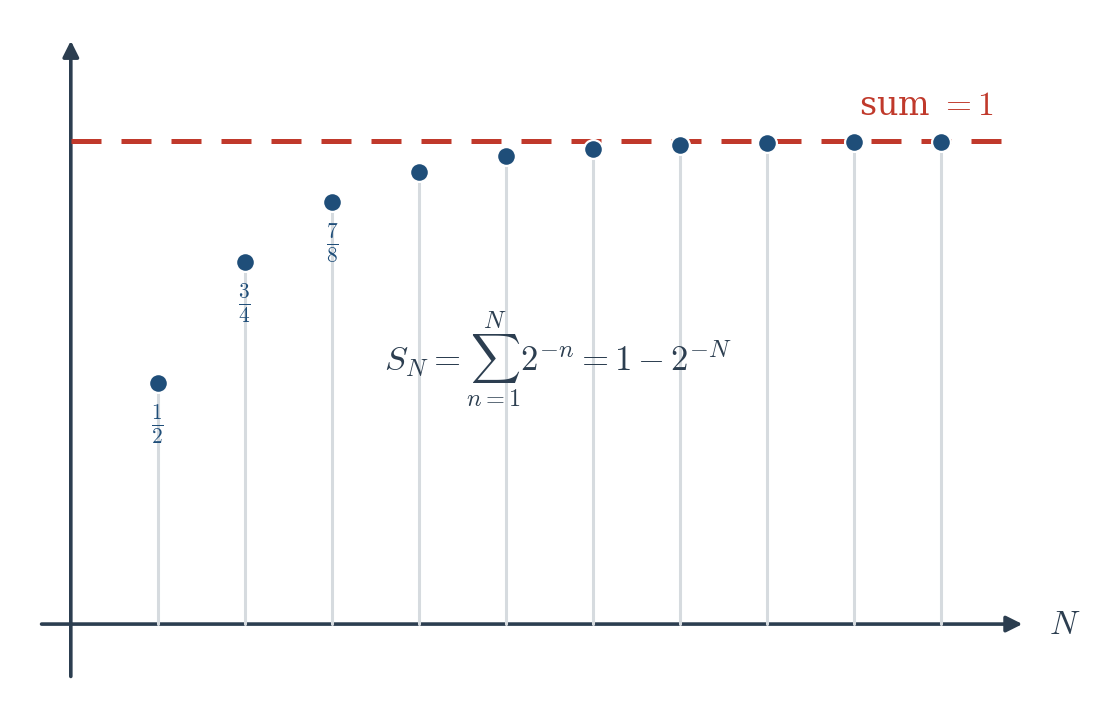
That’s the whole definition, and notice it contains nothing new: series convergence is sequence convergence of partial sums. The infinite sum converges to because its partial sums climb toward — the staircase of Chapter 1, now built from a running total. (Figure 12.1: the partial sums of plotted as a sequence of dots climbing toward the line .)