Calculus I · Adding Up Forever
The one sum you can compute exactly: the geometric series
Almost no series can be summed in closed form. One family can, and it’s the benchmark for everything else — and you’ve already met it, as the Taylor series of in Chapter 7. The geometric series adds powers of a fixed ratio :
Its partial sum has a clean form (multiply by and subtract): . Now take . If , then and the sum converges:
If , the terms don’t shrink and the partial sums run away — divergent. So ✓, while explodes. This is precisely Chapter 7’s with , and the condition is the same “wall at ” you saw the series slam into there. The geometric series is the ruler we measure other series against.
A first sanity check: the terms must die
Here is the simplest possible test, and the one principle you can always apply first.
The term test. If converges, then .
The reason is one line: , and if both partial sums converge to the same , their difference goes to . The useful form is the contrapositive: if the terms do not go to zero, the series diverges. So diverges instantly (its terms approach , not ) — no further work needed.
But beware the trap that ensnares everyone at first: the term test is necessary, not sufficient. Terms going to zero does not guarantee convergence. The most important example in the subject proves it.
The harmonic series: every term vanishes, yet the sum is infinite
Consider . The terms shrink to zero, so the term test is passed — and yet this series diverges to infinity. This is one of the genuine surprises of mathematics, and a medieval one: the argument is due to Nicole Oresme, around 1350, and it is pure cleverness.
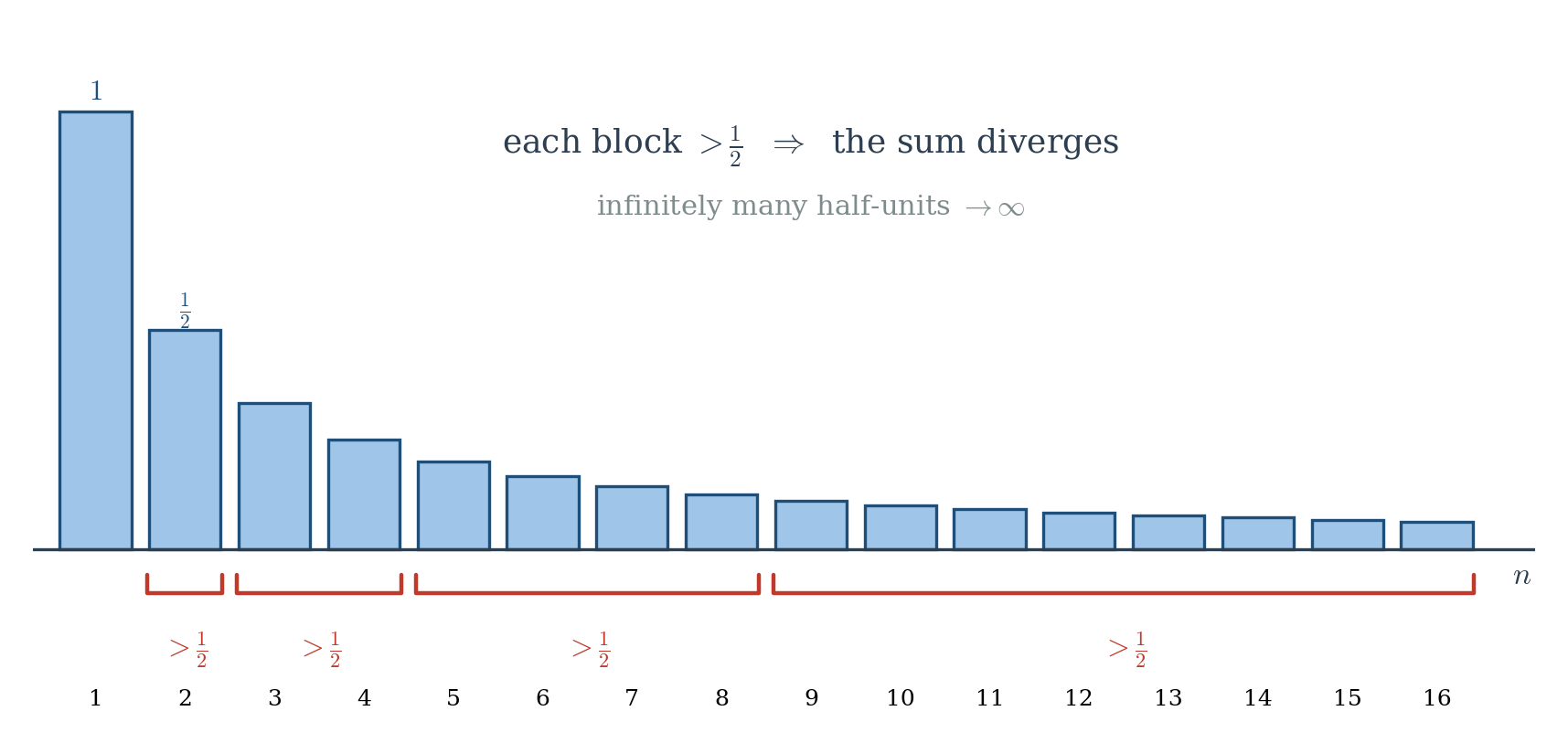
◆ Layer 2 — Oresme’s proof that the harmonic series diverges
Group the terms in blocks of doubling length and bound each block from below: Every block exceeds (each has terms no smaller than its last, and there are exactly enough of them). Since there are infinitely many blocks, each contributing more than , the partial sums climb past without bound. The sum is infinite.
Keep the harmonic series close; it is the dividing line. “The terms go to zero” feels like it should be enough — and the harmonic series is the eternal reminder that it isn’t. To decide convergence, we need real tools. Here are the two.