Calculus I · Adding Up Forever
Power series: where Taylor’s expansions actually live
Now the payoff Chapter 7 has been owed. A power series is a Taylor series viewed as a sum that may or may not converge depending on . The fundamental fact is clean:
Radius of convergence. A power series converges for all and diverges for all , for some number (possibly or ) called the radius of convergence.
So every Taylor series comes with an interval — centered at its center — inside which it genuinely equals its function, and outside which it is meaningless. This is the rigor Chapter 7 promised and postponed. And the practical tool for finding is the ratio test: form the ratio of consecutive terms and see what it approaches. (We introduce it here, where it actually matters — for power series — rather than as one more entry in a catalog.) If , then , because the series behaves geometrically with ratio , which converges precisely when .
Turn it on Chapter 7’s flagship series:
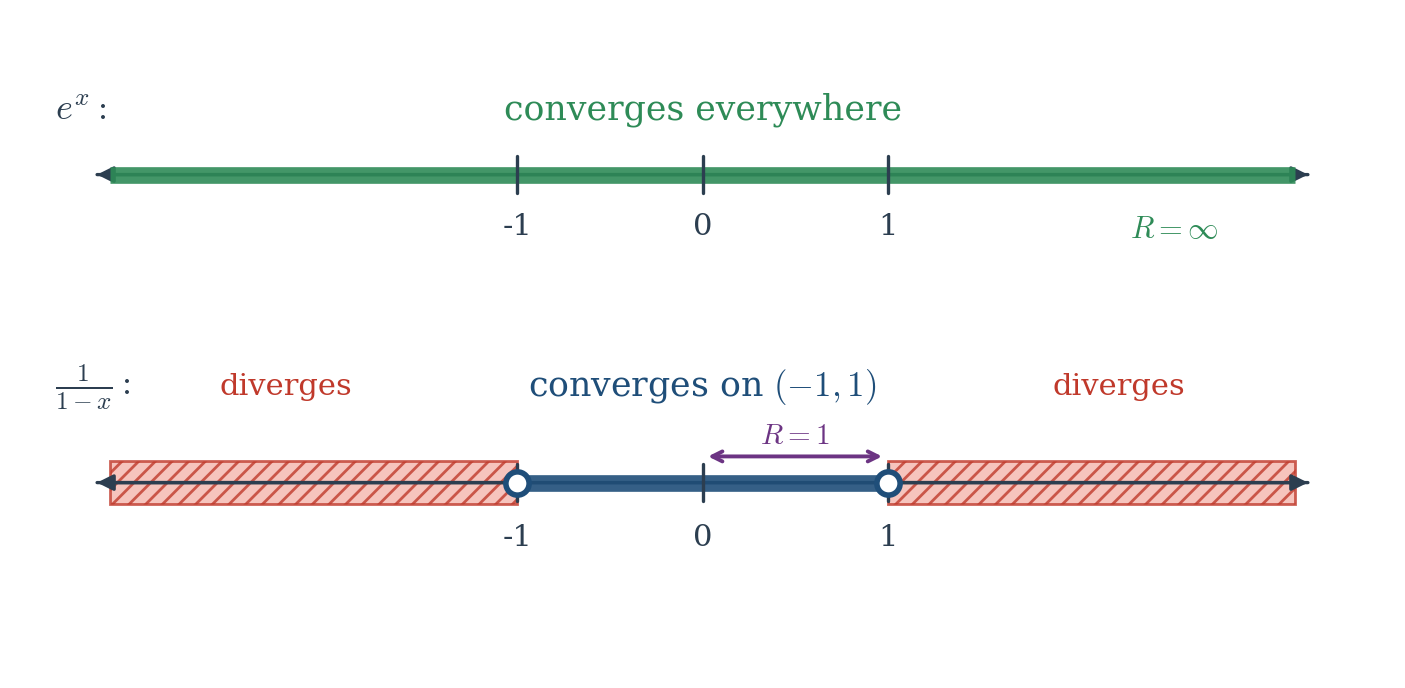
- : the ratio of coefficients is , so and . The series converges for every — confirming, rigorously, the claim you proved by remainder in Chapter 7.
- : the coefficients are all , so and . Converges for , diverges beyond — that is the wall at in Chapter 7’s convergence figure, now derived rather than drawn.
- and : both have , so each is valid only on — which is why setting in the arctangent series to reach was living dangerously, right at the boundary (it works, but only barely, and for a subtler reason).
So Chapter 7’s series were never just formal manipulations: each carries a precise domain of validity, and you can now compute it. (Figure 12.4: a power series’ interval of convergence drawn on the -axis — solid inside , hatched outside — for (the whole line) and (a segment ending at ).)
A last word: when alternating signs rescue a sum
One pattern deserves a closing mention, because Chapter 7’s sine, cosine, and arctangent series all have it: the terms alternate in sign. Alternation helps enormously, because consecutive terms partly cancel. The principle: if the terms alternate in sign and shrink steadily to zero, the series converges — even when the same terms with all-positive signs would diverge. The cleanest example is the alternating harmonic series , which converges (to , as the Chapter 7 series for at suggests) — although, strip the signs and it becomes the harmonic series, which diverges. Cancellation is a real force. We won’t drill it into a formal apparatus; the idea — alternation tames a sum — is what to carry forward.