Calculus I · Adding Up the Infinite
Substitution: the chain rule, run backward
Most antiderivatives aren’t in the table — but many can be transformed into ones that are, by the single most useful integration technique, and it is precisely the chain rule reversed. Recall the chain rule: . Read that equation from right to left and it becomes an antiderivative rule:
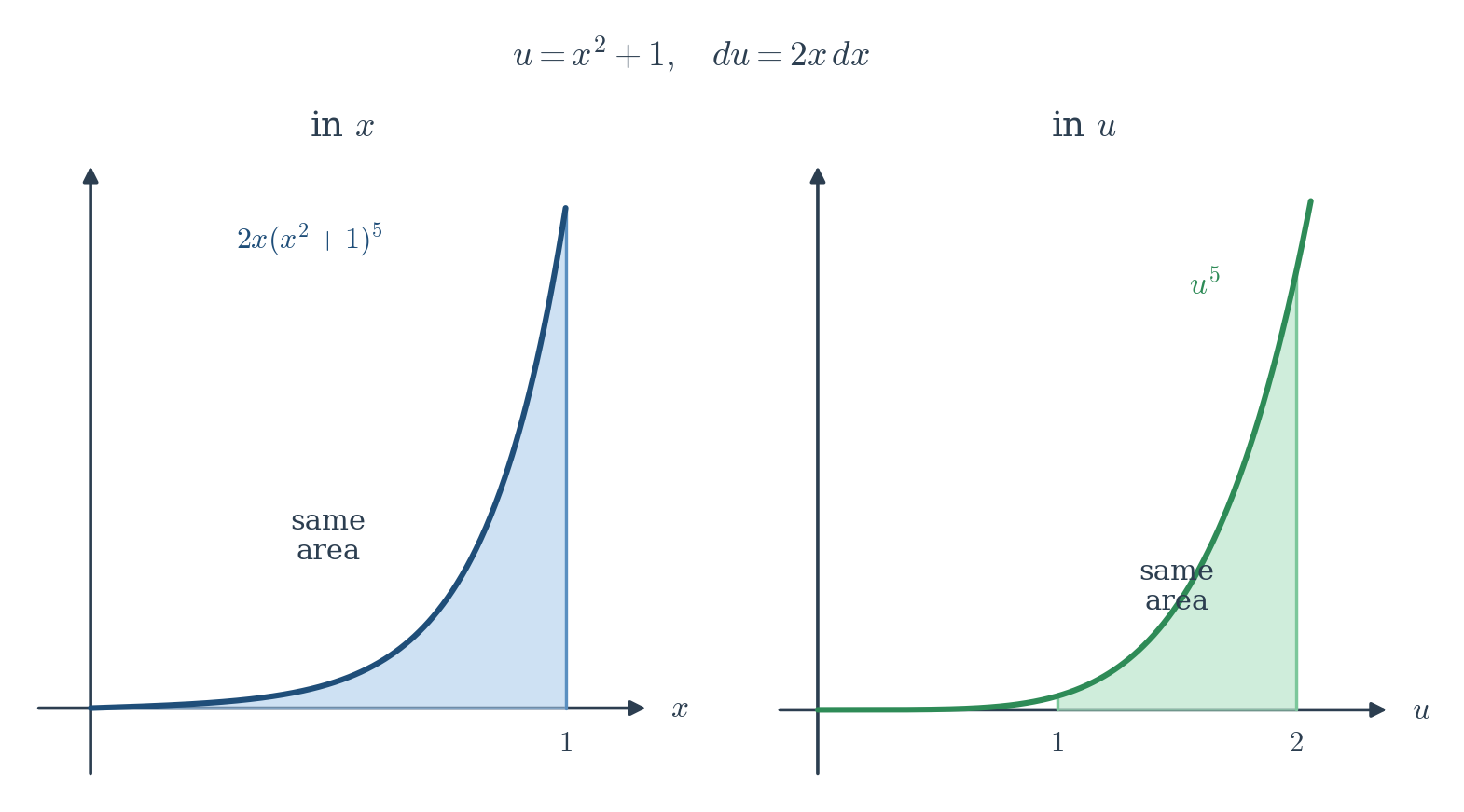
In practice you spot an “inside function” whose derivative is also sitting in the integrand (up to a constant factor), and you rename: let , so that . The integral collapses into one in that you can do from the table.
Example. . The inside is , and its derivative is right there. Let , : Differentiate the answer (chain rule!) and you get back — substitution and the chain rule are genuinely inverse moves.
Example. . Inside is , derivative — present up to the factor of . Let , , so :
Example — the logarithm pattern. . The inside is , and its derivative is sitting on top (up to the minus sign). Let , : Whenever the top of a fraction is the derivative of the bottom, substitution turns the whole thing into a logarithm — a pattern worth knowing on sight: .
This is the mirror image of Chapter 4. There, the product rule and chain rule were tools for taking derivatives; here, reversed, they become tools for finding antiderivatives. (The product rule’s reverse — integration by parts — is the other great technique, and it arrives in Chapter 11 as a payoff of the Fundamental Theorem.) For now, substitution applies cleanly to indefinite integrals; using it on definite integrals, where the limits themselves transform, is a Chapter 11 refinement.
Toolkit: Substitution
- Find an inside function whose derivative appears in the integrand (up to a constant).
- Compute and rewrite the entire integral in terms of — no may remain.
- Integrate in using the table, then substitute back.
- Always check by differentiating your answer. Substitution is the chain rule reversed, so the chain rule is your proofreader.