Calculus I · Adding Up the Infinite
When there is no antiderivative — and a whisper about frequencies
Two honest remarks before the climax.
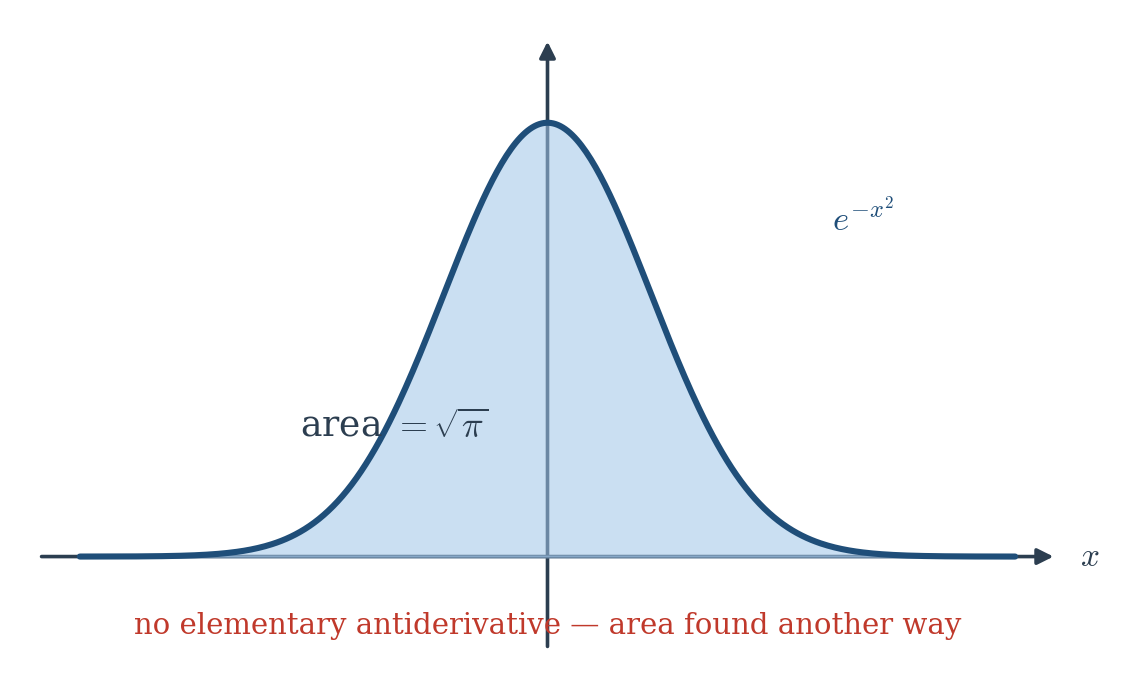
Some functions have no antiderivative you can write down. This is genuinely surprising. The function — the bell curve, whose Taylor series you found in Chapter 7 — is perfectly smooth and perfectly well-behaved, yet no combination of powers, roots, exponentials, logarithms, and trig functions has it as a derivative. Its antiderivative exists (it’s a real, smooth function), but it simply isn’t expressible in our elementary vocabulary; the same is true of and many others. When this happens, the antiderivative method of the next chapter cannot even begin, and we fall back on what never fails — Riemann sums, computed numerically. The area is always there to be measured; we just sometimes can’t name the antiderivative. And the most important such area, the total under the bell curve, is one of the loveliest numbers in mathematics — central to all of probability (Book 4), and found by an ingenious trick rather than by any antiderivative.
Integrals can measure more than area — they can measure resonance. Here is a thread to pick up much later. If you integrate a signal against a pure wave, say over one period, the resulting number tells you how much of that frequency contains — how strongly the signal “rings” at that pitch. Those numbers are the Fourier coefficients glimpsed back in Chapter 7, and they are how a sound is decomposed into tones, an image into patterns, a data stream into its essential frequencies. The integral, in this guise, is a frequency detector. The machinery belongs to Book 3; file it away beside the word Fourier.
Where this is heading: the two faces meet
Step back and look at what this chapter built. We now have two things, both called integration, that appear to have nothing to do with each other:
- the definite integral — a number, the signed area under a curve, defined as a limit of sums and (as our showed) genuinely laborious to compute;
- the antiderivative — a function, the reverse of differentiation, found quickly by running the Chapter 4 rules backward.
One is about adding up infinitely many rectangles. The other is about undoing a derivative. There is no obvious reason they should be related at all — and yet they share a symbol, which I promised was a hint.
The hint is true. The Fundamental Theorem of Calculus, the summit of this entire book, says these two faces are one: to find the area under a curve, you do not add up rectangles — you find an antiderivative and subtract its values at the endpoints. The hard limit of sums and the easy reverse-derivative compute the same number. The area under from to , which cost us a page of algebra, will become a five-second calculation. Differentiation and integration, the two engines we built separately, are about to be revealed as the same engine running in opposite directions.
Turn the page.