Will you live to 120? · Folding and Falling Apart
When the crews fall behind
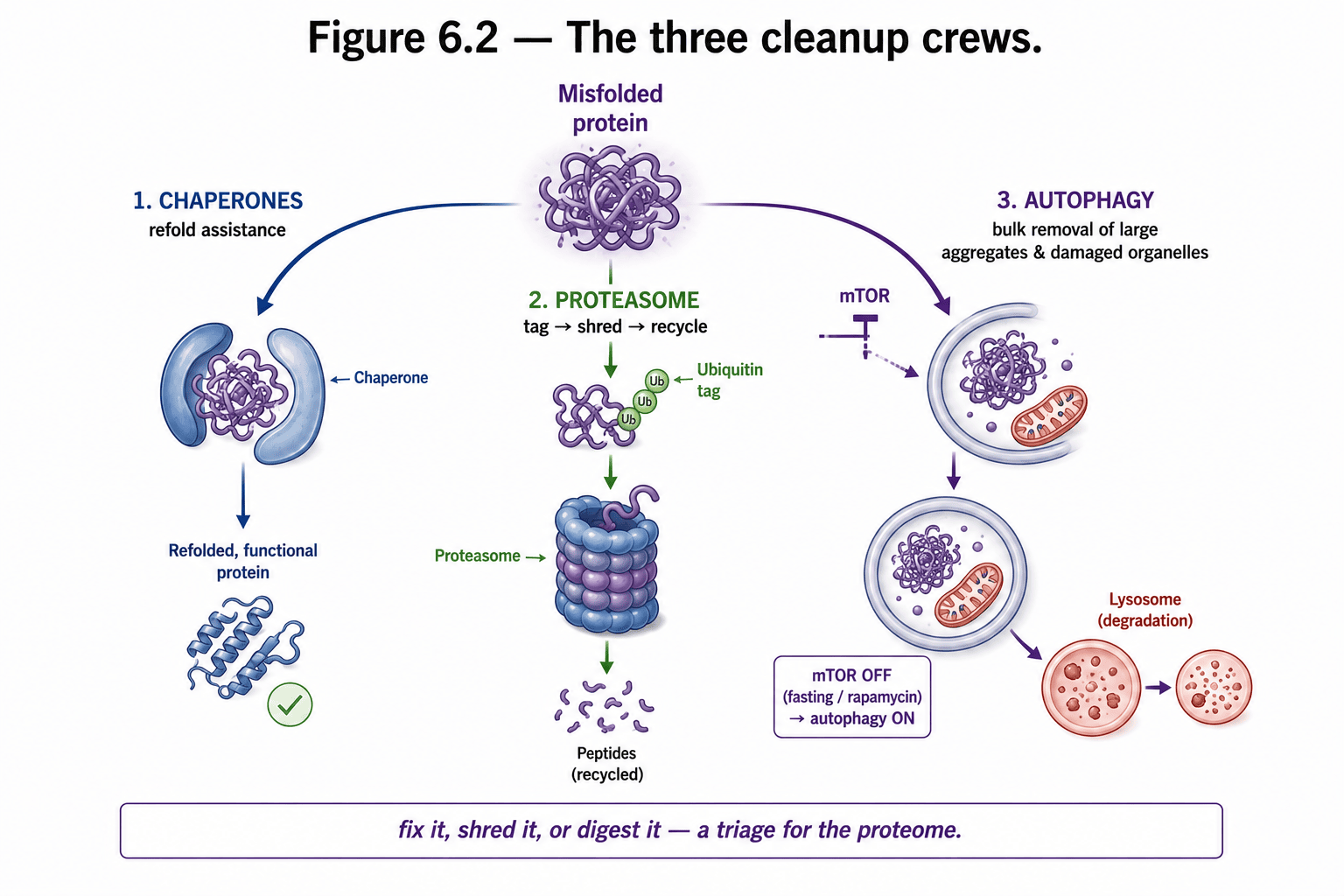
The cell does not leave folding to chance and luck. It maintains an elaborate, layered system whose entire job is keeping the proteome correctly folded, functional, and clear of junk — a system called proteostasis, for protein homeostasis. Three crews do the work, and they form a triage.
The first crew are the chaperones — proteins whose job is to help other proteins fold. Many of them are called heat-shock proteins, because the cell makes more of them under stress, when folding is most at risk. It’s important to be precise about what a chaperone does, because the obvious metaphor is wrong: a chaperone is not an instructor that teaches the protein its shape. The shape, remember, is in the sequence. A chaperone is more like a private folding room — it binds a newly made or wobbling chain, shields its sticky patches from the crowd, prevents it from clumping with its neighbors, and gives it the space and the time to find its own way down the funnel. Some chaperones can grab a misfolded protein and give it another chance to refold. They are the cell’s first response: try to fix it.
When a protein can’t be fixed, the second crew destroys it — selectively. The cell tags doomed proteins with a chain of a small marker protein called ubiquitin, a molecular label that means “destroy this.” The tagged protein is then fed into the proteasome, a barrel-shaped machine that grabs the labeled protein, pulls it apart, and chops the chain into small pieces for recycling. The ubiquitin-proteasome system is precise and fast, and it is the workhorse for disposing of individual, soluble, tagged proteins — one bad apple at a time.
But some things are too big for the proteasome to swallow: large aggregates, clumps that have already formed, and whole worn-out organelles like damaged mitochondria. For those, the cell uses the third crew, and it is the one that gives this chapter its second hallmark. Autophagy — from the Greek for “self-eating” — is the cell’s bulk recycling system. The cell wraps a portion of itself, clumps and broken organelles and all, inside a newly made membrane sac, then delivers that sac to the lysosome, an acid-filled compartment full of digestive enzymes that breaks the cargo down into raw materials to be reused. Autophagy is how the cell takes out its large trash — and, as we saw at the end of the last chapter, mitophagy, the clearing of damaged mitochondria, is just autophagy aimed at a specific target. The machinery of autophagy was worked out, painstakingly, in yeast by Yoshinori Ohsumi, who spent years watching the process under the microscope when almost no one thought it important; it turned out to sit at the center of aging, cancer, immunity, and neurodegeneration, and earned a Nobel Prize.
Together — fix it (chaperones), shred the tagged individuals (proteasome), digest the big stuff (autophagy) — these three crews wage a continuous war to keep the proteome in order. As long as they keep up with the rate at which proteins misfold, the cell stays healthy. The trouble, predictably by now, is that they don’t keep up forever.
When the crews fall behind
Here is the now-familiar shape of aging, in its sixth costume. The misfolding of proteins is a roughly constant hazard — proteins are always at some risk of folding wrong, and stress and damage add to it over time. The cleanup crews hold the line by clearing the misfolded proteins as fast as they appear. Aging is what happens when the clearing falls behind the misfolding. And it falls behind because, with age, all three crews weaken: the cell makes fewer chaperones and mounts a feebler stress response, the proteasome grows sluggish, and — most consequentially — autophagy declines. The maintenance side of the balance erodes, exactly as it did with senescent-cell clearance in Chapter 3 and mitochondrial quality control in Chapter 5. The same story keeps recurring because it is, at bottom, the story: aging is largely the slow defeat of maintenance by damage, and what differs from chapter to chapter is only which maintenance system we’re watching lose.
Once clearance falls behind, misfolded proteins accumulate, find each other’s sticky patches, and aggregate — and now we have a vicious feature of the problem. Aggregates are not just inert garbage; they actively clog the very crews meant to remove them, jamming the proteasome and overwhelming autophagy, which lets still more aggregates form. The collapse, once it begins, accelerates.
And this is where one of the most satisfying connections in the whole book closes, linking this chapter directly back to Chapter 4. Recall the master growth switch, mTOR — active when food is plentiful, telling the cell to grow. One of the specific things mTOR does when it’s active is shut autophagy off. Growth mode and cleanup mode are mutually exclusive: when the cell thinks food is abundant, it builds rather than recycles. Which means that the interventions that tip the nutrient-sensing dial toward scarcity — caloric restriction, fasting, and rapamycin — do something very concrete and very relevant here: by switching mTOR off, they switch autophagy on. They turn on the cleanup crew. A substantial part of why fasting and rapamycin are geroprotective, it turns out, is that they command the cell to stop growing and start taking out its accumulated trash. The hunger switch of Chapter 4 and the cleanup crews of Chapter 6 are the same circuit seen from two ends — which is also why the most evidence-backed longevity interventions and the proteostasis story are not two topics but one.
All 10 chapters of Will you live to 120? · Foundations · All courses