Signs of a Chemical Reaction — Print · Grade 8 Science
Chapter: ChemistrySigns of a Chemical Reaction
Learning goals
- I can list observable signs that suggest a chemical reaction has occurred.
- I can use evidence to decide whether a change is chemical rather than physical.
- I can explain daily chemical interactions with identity, historical context and conditional risk reasoning.
Readings for this unit
Before this unit
Distinguish a physical change from production of a new substance.
Use three teaching sessions of about 40–45 minutes: first observe the phenomenon, draft a model and study Parts 1–2; next explain Parts 3–4 with the figures and evidence; then work the application, examples, practice, model revision and exit check. Divide any difficult part into smaller steps and revisit after feedback. Investigations, review and quizzes have separate sessions. Study the four visual parts across the scheduled sessions, then use the illustrated worked case and independent transfer questions. Extend or revisit a session when the learner cannot explain the figure; completion time is a proposed allocation, not a mastery guarantee.
Start with something to explain
What would explain the observations in signs of a chemical reaction?
Illustrative evidence case. Supplied records show bubbles when boiling pure water and bubbles when two specified reactants form a different gas. Only the second record has composition evidence for a new substance.
Notice and wonder
Which box is an observation and which is an inference? Write two observations from the supplied record without guessing their cause. Include a quantity and its unit when given. An observation is what was recorded; an inference is what you think explains it.
Write one question about why the pattern occurs and one question about a comparison that could distinguish competing explanations. A testable question identifies what could be observed or measured.
Your first model
Before reading the model answer, sketch the named objects or particles and label what you think changes. Evaluate the claim “bubbles always prove a chemical reaction.” State what evidence distinguishes the two cases and what remains uncertain from sight alone. Keep this first version so you can compare it with your later explanation.
Build the language from the idea
- chemical reaction
- A process where reactants interact and rearrange into one or more new products.
- reactant
- A starting substance that goes into a chemical reaction.
- product
- A new substance that comes out of a chemical reaction.
- precipitate
- A solid that forms and settles out when two solutions react with each other.
- model
- A representation that explains selected features and makes predictions; it leaves other details out.
- evidence
- Relevant observations or records used to support or challenge a claim.
- system boundary
- The chosen limit separating the objects being studied from their surroundings.
- assumption
- A condition taken as true for a model or calculation and needing to be checked against the case.
A chemical reaction happens when substances called reactants interact and rearrange their atoms into new substances called products — and those products have genuinely different properties from what you started with. The trouble is that atoms are far too small to watch rearranging with your eyes. So instead of seeing the reaction directly, chemists become detectives, hunting for outward clues that a change has taken place.
Several observable signs hint that a reaction is underway. You might see bubbles of gas forming, a precipitate (a solid that appears and settles out when two liquids are mixed), or a color change. You might feel a temperature change as the mixture warms up or cools down on its own. You might even notice a new smell, or light being given off. Any one of these is a strong signal that something new is being made.
Each of these clues points back to atoms rearranging into fresh combinations. Bubbles usually mean a brand-new gas is being created and escaping. A precipitate means atoms have joined into a new solid compound that won't stay dissolved. A color change means the new products absorb and reflect light differently than the reactants did. And a temperature change means energy stored in chemical bonds is being released or soaked up as those bonds break and reform.
Here's the important catch, though: no single sign is absolute proof on its own. Bubbles might just be air you stirred in, or a liquid quietly boiling. A temperature change can come from a purely physical process, like sugar dissolving. Even a color change can sometimes be simple mixing rather than reacting. That's why a careful scientist treats these signs as evidence to weigh, not final verdicts.
The one thing that truly confirms a chemical reaction is the presence of a genuinely new substance — one with properties different from every reactant you began with. Learning to read these clues carefully is a real-world skill: it's how you'd recognize that rust has begun eating a bike frame, that milk has spoiled, or that an antacid tablet is actually going to work once it hits your stomach.
Gas bubbles, a precipitate, a lasting color change or a temperature change can be evidence for a reaction. Each has other possible causes: boiling makes bubbles without a new substance, and mixing dyes changes color physically. Use several observations and a particle explanation together.
Write an observation as something measured or seen, then write an inference separately. A cloud of solid appearing when clear solutions mix is evidence for a new solid, but identifying it requires further information. Record reactants, conditions and any comparison test so another learner can evaluate the claim.
Chemical reactions do not require visible flames. Rusting and many reactions inside cells occur gradually. Use safely supplied data to compare a possible reaction with a physical change; never taste unknown materials or mix cleaning products to look for dramatic evidence.
Build your understanding
Where this fits
This unit helps answer the chapter question: How can we tell when substances react, and what is conserved? Keep a notebook table with the question, evidence, explanation and one unresolved issue. Revise a previous model only when you can name the new evidence or idea that changes it.
Use three teaching sessions of about 40–45 minutes: first observe the phenomenon, draft a model and study Parts 1–2; next explain Parts 3–4 with the figures and evidence; then work the application, examples, practice, model revision and exit check. Divide any difficult part into smaller steps and revisit after feedback. Investigations, review and quizzes have separate sessions.
Part 1 · Record observations before naming a reaction
A reaction produces new substances. Observations such as gas formation, a temperature change, or a new solid can support that claim. Each sign also needs context because a similar visible event can result from a physical process. Write what happened separately from the explanation you propose.
Read the visual model
Do bubbles always prove a chemical reaction?
Visual reasoning — after your attempt
No. Bubbles can be vapor during boiling or gas already dissolved in a liquid. Evidence about new substance formation is needed.
Boiling gives bubbles without creating a new chemical substance. Mixing two solutions may produce a precipitate, an insoluble solid. Describe the new solid and compare it with the starting materials rather than calling every cloudy liquid a proven reaction.
Pause and explain
Do bubbles always prove a chemical reaction?
Check your reasoning after answering
No. Bubbles can be vapor during boiling or gas already dissolved in a liquid. Evidence about new substance formation is needed.
Part 2 · Recognize a pattern of evidence
Combine observations and controls to reduce alternative explanations. A reaction may occur without an obvious color change or smell, and a single dramatic sign may be ambiguous. Safe supplied records can provide evidence of starting and final composition as well as visible changes.
Read the visual model
Why can several independent observations strengthen a claim?
Visual reasoning — after your attempt
They can rule out alternative explanations. Composition evidence together with controlled changes is stronger than relying on one ambiguous sign.
If mixing known materials produces gas at room temperature and the gas has a property unlike the starting liquids, this is stronger evidence than bubbles alone. Use an approved detection method or supplied result; never identify unknown substances by tasting or directly sniffing them.
Pause and explain
Why can several independent observations strengthen a claim?
Check your reasoning after answering
They can rule out alternative explanations. Composition evidence together with controlled changes is stronger than relying on one ambiguous sign.
Part 3 · Use particles to explain new substances
In an ordinary reaction, atoms rearrange into new groupings. Their element identities are retained, but the products can have different properties from the reactants. A particle model should distinguish atoms from molecules and identify what new arrangement appears.
Read the visual model
A reactant is a starting substance and a product is a resulting substance. Different combinations can give different characteristic properties. The drawing is an explanation for an already specified reaction, not proof that every visible bubble is a new substance.
What evidence in the diagram supports a chemical change without supporting creation of new atoms?
Visual reasoning — after your attempt
The product molecules have a different composition/combination from the reactant molecules, while each element’s atom count stays four H and two O.
Represent hydrogen and oxygen with two labeled bead types. Water molecules contain both types in a fixed ratio, unlike the separate starting molecules. A new arrangement explains new substance formation without inventing atoms or changing element labels.
Pause and explain
What must a reaction model keep unchanged about each atom?
Check your reasoning after answering
Its element identity must remain unchanged in an ordinary chemical reaction. The atom can become part of a different grouping, but its proton-defined element stays the same.
Part 4 · Design a comparison without introducing hazards
Choose one question and keep testing conditions comparable. Record quantities, time, temperature, and what was observed. Include a comparison when it helps separate mixing from reacting. A result supports the tested case, not a claim that all materials with a similar appearance react the same way.
Read the visual model
A control is a comparison chosen to test an explanation. Keep measurement conditions comparable and name what evidence is actually supplied. Confidence comes from several relevant records, rather than one dramatic visual clue.
A learner sees bubbles but has no gas-identity record. What can they report, and what claim is still unproven?
Visual reasoning — after your attempt
They can report bubbles under the stated conditions. A new substance or a particular gas identity remains unproven until suitable evidence rules out alternatives such as boiling or released trapped air.
Compare a supplied room-temperature reaction record with a supplied boiling record. Both show bubbles, but only one may show chemically new gas. At home, do not mix cleaning products or seal a gas-producing reaction in a rigid closed vessel.
Pause and explain
Which record would help distinguish boiling from gas production by reaction?
Check your reasoning after answering
Starting temperature, heating conditions, and reliable gas-identity evidence can distinguish water vapor from a chemically produced gas under comparable observations.
Chemical interactions in daily life and history
Cooking, metal corrosion, material manufacture and some batteries involve changes that matter beyond a laboratory worksheet.
A chemical is a substance with a particular composition; the word does not mean artificial, toxic or something confined to a factory. Water, oxygen and many food components are chemicals. A physical interaction can rearrange position or state while retaining identity; a chemical reaction rearranges atoms into different substance combinations. Daily processes can include both, so melting fat while cooking and reactions in browning need separate explanations.
Chemical interactions have shaped materials and technologies over time. Metal corrosion changes exposed materials into new substances, while processing can produce useful alloys or new compounds; an alloy is a mixture containing metallic elements, not automatically one fixed compound. Reactions and physical processing contribute to medicines, fertilizers, plastics, batteries and water treatment. Benefits and possible harms depend on substance, amount, exposure, method and use, not the label chemical alone.
The universe contains existing elements that combine into many substances under different conditions. Ordinary chemical reactions explain combinations such as water or mineral compounds without changing the proton-defined identities of the atoms. The formation of elements through nuclear processes is a different scale of explanation; do not attribute every past change to the same mechanism. Construct a cause-and-effect explanation with enough background, an appropriate boundary and evidence, rather than a list of impressive terms.
Explain and apply
Compare supplied descriptions of cutting iron, forming rust and mixing an alloy. Give an appropriate mechanism and explain why “all chemicals are dangerous” and “every mixture is a new compound” fail.
- Distinguish composition from appearance.
- Explain a daily/historical consequence with a mechanism.
- Evaluate blanket chemical/mixture claims with conditions.
Reasoning and marking guidance — after your attempt
Cutting can retain iron identity while rust formation produces different substances. An alloy can be a mixture rather than one fixed-ratio compound. Chemical risk cannot be decided from the word alone; identity, amount, exposure and use need evidence. Relate the chosen process to a practical effect while keeping ordinary atom rearrangement distinct from nuclear element formation.
Apply the whole unit · Weigh three possible explanations
Illustrative records: A bubbles only while water is heated to boiling; B releases gas when two approved solutions mix at room temperature and supplied analysis identifies a new gas; C changes color when a colored solution is diluted with water.
Your task
Compare the strength of reaction evidence in A, B, and C. Describe observations separately from conclusions, draw a simple model for a chemically new product, and identify a follow-up observation for the ambiguous case.
What your response should show
- Use the supplied observations and measurements accurately; include units where needed.
- Explain the science behind your answer, rather than giving only a number or label.
- Show a labeled model, calculation, or evidence comparison as requested.
- State an assumption or limitation and suggest a useful next measurement.
Response guidance — after your attempt
A is consistent with physical boiling. B has stronger chemical evidence because analysis identifies a new substance. C may simply reflect dilution and is not sufficient by itself to prove reaction. Preserve atom types in the reaction model while changing groupings. Reliable composition evidence or a controlled comparison would help evaluate C.
Scientific references and adapted teaching resources
- OpenSciEd 7.1 Chemical Reactions & Matter — public unit overview
- OpenSciEd 7.2 Chemical Reactions & Energy — public unit overview
- OpenSciEd instructional model — storyline routines
- Creative Commons Attribution 4.0 — middle-school material license
Parent / teacher teaching notes
Ask the learner to avoid proves language when evidence is ambiguous. Use the supplied records; the task does not require conducting chemical tests. Reward a well-explained uncertainty rather than an unsupported confident classification. Adaptation credit: OpenSciEd middle-school teaching routines and public task structures by OpenSciEd, CC BY 4.0. This independent version adds original explanatory text, data and figures, terminology support and a home-study schedule. It does not reproduce the complete teacher editions or their classroom validation. The illustrated study “Chemical interactions in daily life and history” is required curriculum content. Teach it before the associated application or distribute it over the assigned unit sessions; it is not an optional enrichment. Its practice/review/quiz response provides evidence of understanding. Model/data work must not be recorded as an actual physical experiment.
The key idea
Bubbles, color change, a new solid (precipitate), or a temperature change are all clues — but a truly new substance is the real proof of a chemical reaction.
Worked examples
Example 1
- Fizzing bubbles are a classic sign of gas being produced.
- A gas escaping means a new substance (carbon dioxide gas) has formed that wasn't in either the baking soda or the vinegar alone.
- This is strong evidence a chemical reaction occurred, producing carbon dioxide gas, water, and sodium acetate.
Example 2 · Worked application
- A newly formed solid may be a precipitate, evidence consistent with a reaction.
- Bubbles are only one possible sign; many reactions produce none.
- Check that the solid is a new substance rather than undissolved starting material.
Use more than one observation and distinguish a precipitate from material present initially.
Example 3
- One possibility is boiling or dissolved gas leaving the liquid.
- Another possibility is a reaction producing gas; checking whether new substances formed helps distinguish them.
Example 4 · Find and fix the mistake
- Test the claim against the stated conditions: Use more than one observation and distinguish a precipitate from material present initially.
- Reactions can occur without either; rusting and precipitation are examples of other observable changes.
Use more than one observation and distinguish a precipitate from material present initially.
Example 5 · Interpret the visual model
- Identify the represented objects, axes, labeled quantities and stated conditions before choosing a rule.
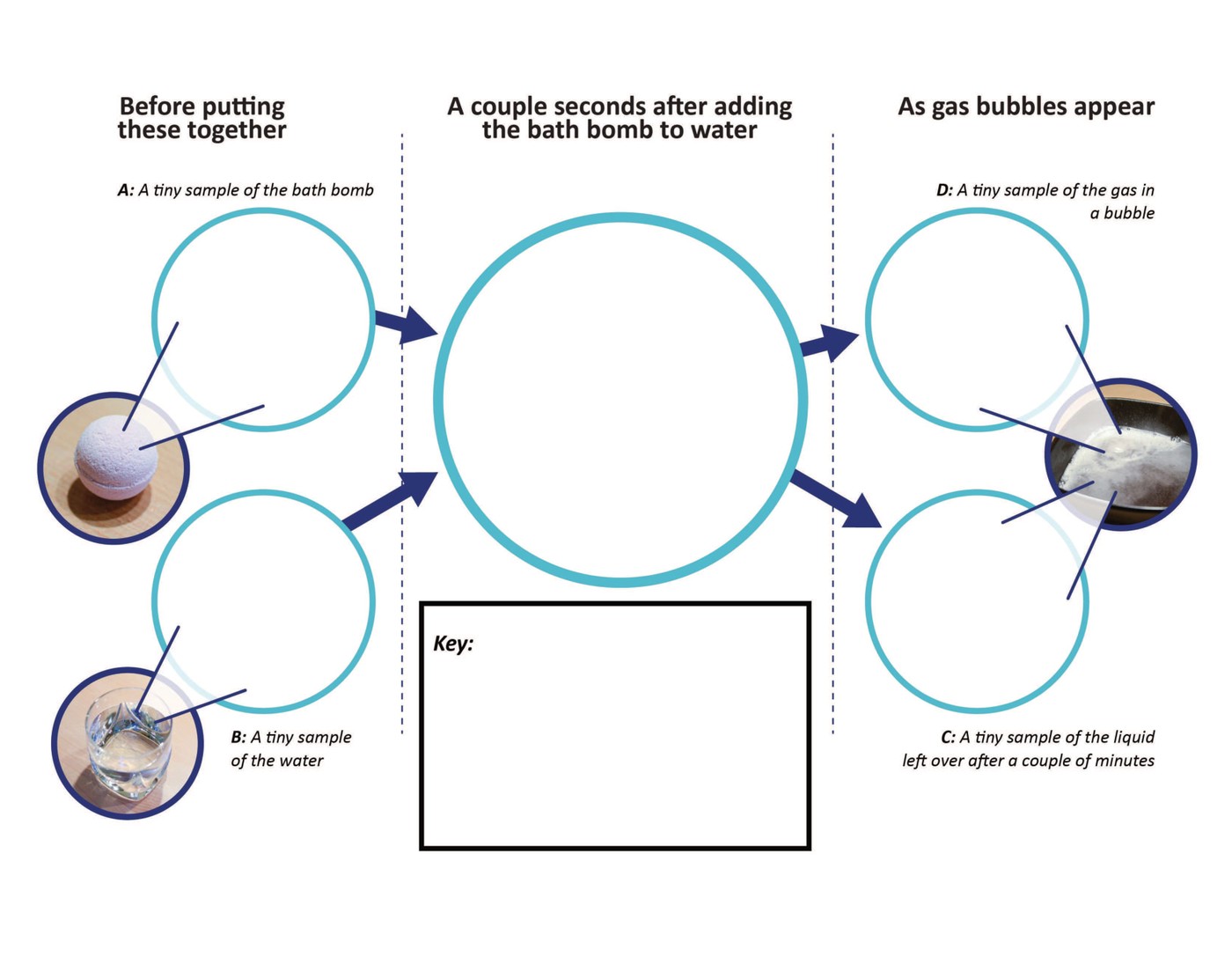
- A reactant is a starting substance and a product is a resulting substance. Different combinations can give different characteristic properties. The drawing is an explanation for an already specified reaction, not proof that every visible bubble is a new substance.
- The product molecules have a different composition/combination from the reactant molecules, while each element’s atom count stays four H and two O.
Keep the model’s stated limits explicit: This supplied water-forming reaction contains four hydrogen atoms and two oxygen atoms on each side. Their combinations change from H₂ and O₂ to H₂O. Colored circles distinguish atom types rather than literal colors, and the bonds are counting aids. It is a different example from a bath-bomb reaction; the figure does not claim that a bath bomb contains hydrogen gas or oxygen gas.
Avoid these mistakes
- Bubbles alone do not prove that a chemical reaction occurred.
Check your understanding
A clear liquid forms bubbles when warmed. Give two possible explanations and one useful follow-up observation.
Discuss the answer
Both physical gas release and chemical gas production are possible; bubbles alone are insufficient evidence.
Why is a measured observation stronger than saying a mixture looked chemical?
Discuss the answer
Gas bubbles, a precipitate, a lasting color change or a temperature change can be evidence for a reaction. Each has other possible causes: boiling makes bubbles without a new substance, and mixing dyes changes color physically. Use several observations and a particle explanation together. Write an observation as something measured or seen, then write an inference separately. A cloud of solid appearing when clear solutions mix is evidence for a new solid, but identifying it requires further information. Record reactants, conditions and any comparison test so another learner can evaluate the claim.
Return to the phenomenon
Supplied records show bubbles when boiling pure water and bubbles when two specified reactants form a different gas. Only the second record has composition evidence for a new substance. Evaluate the claim “bubbles always prove a chemical reaction.” State what evidence distinguishes the two cases and what remains uncertain from sight alone. Revise your first explanation using a named idea from the lesson. Mark the changed part and the evidence that supports it.
Compare explanations after your attempt
The claim is too strong: boiling transfers water into its gas phase without changing identity. The second case is a reaction because the stated composition evidence supports a different product. Bubbles are an observation prompting further questions; gas identity, characteristic properties and atom-accounting evidence strengthen the chemical interpretation.
What should we investigate next?
Which condition could be changed to test a remaining uncertainty in this explanation? State the predicted observation and what result would challenge your model.
Investigate, explain and revise
Use these tasks after the three teaching sessions as needed. Discuss an attempted explanation before opening response guidance; a matching sentence is less important than a supported mechanism.
Activity 1 · Explain the new evidence case
Use the visible scenario above, Parts 1–4 and your first notebook model. No outside reading or equipment is required.
Your task
Supplied records show bubbles when boiling pure water and bubbles when two specified reactants form a different gas. Only the second record has composition evidence for a new substance. Evaluate the claim “bubbles always prove a chemical reaction.” State what evidence distinguishes the two cases and what remains uncertain from sight alone. Write 100–150 words or give a labeled drawing with an equivalent oral explanation.
Success criteria
- Use two relevant stated records or conditions.
- Explain the mechanism rather than only repeat a definition.
- Label observation and inference.
- Name a changed model feature or a remaining uncertainty.
Hint
Read the stated boundary and conditions before selecting a relationship. The unit’s worked examples show intermediate steps.
Response guidance — discuss after your attempt
The claim is too strong: boiling transfers water into its gas phase without changing identity. The second case is a reaction because the stated composition evidence supports a different product. Bubbles are an observation prompting further questions; gas identity, characteristic properties and atom-accounting evidence strengthen the chemical interpretation.
Activity 2 · Read and extend the figure
Study the new labeled figure and its caption, then compare it with the associated teaching part.
Your task
Which box is an observation and which is an inference? Explain what each important label represents. Add one missing feature that would be needed for a different question, and explain why the original figure leaves it out.
Success criteria
- Answer the figure question with its stated labels.
- Connect the visual representation to the scientific idea.
- Identify a specific limitation from the caption.
- Propose a useful change without misrepresenting supplied evidence.
Hint
Bubbles alone are consistent with more than one process. The diagram distinguishes recorded appearance from possible explanations and a next evidence question. It does not supply actual gas tests or license unsafe mixing; composition must be established by suitable approved evidence.
Response guidance — discuss after your attempt
Bubbles appearing is the observation; the proposed origin is an inference until supported by identity and other evidence. Bubbles alone are consistent with more than one process. The diagram distinguishes recorded appearance from possible explanations and a next evidence question. It does not supply actual gas tests or license unsafe mixing; composition must be established by suitable approved evidence.
Words to know
- chemical reaction
- A process where reactants interact and rearrange into one or more new products.
- reactant
- A starting substance that goes into a chemical reaction.
- product
- A new substance that comes out of a chemical reaction.
- precipitate
- A solid that forms and settles out when two solutions react with each other.
- model
- A representation that explains selected features and makes predictions; it leaves other details out.
- evidence
- Relevant observations or records used to support or challenge a claim.
- system boundary
- The chosen limit separating the objects being studied from their surroundings.
- assumption
- A condition taken as true for a model or calculation and needing to be checked against the case.
Physical or chemical? The atomic-level difference
A physical change just rearranges how atoms are packed or shaped — ice melting into water is still H₂O molecules, just moving faster and looser. A chemical reaction is different: existing bonds between atoms break, and the atoms reconnect in new patterns to form molecules that never existed before. That's why a physical change can usually be undone (freeze the water back into ice), while a true chemical reaction usually can't be reversed just by changing temperature or pressure — you'd need another reaction to rebuild the original bonds.
The imposters: changes that fool the eye
Not every dramatic-looking change is a reaction. Stir sugar into water and it seems to vanish — but it's still sugar, just spread out as individual molecules (a physical change called dissolving). Dissolving certain salts, like potassium nitrate, even pulls in enough energy to make the water noticeably colder, mimicking the temperature-change clue of a reaction without any new substance forming. Mixing yellow and blue paint gives you green — a real color change — but it's just tiny colored particles blending, not new molecules. The lesson: always ask whether a genuinely new substance appeared, not just whether something looked different.
Forensics glows blue: luminol and chemiluminescence
Crime scene investigators spray a chemical called luminol to search for traces of blood invisible to the naked eye. Luminol reacts with iron in hemoglobin (the protein that carries oxygen in blood), and that reaction releases energy as light instead of heat — a glowing blue light show that shows up even years after a stain was wiped away. This eerie glow is a textbook example of a chemical reaction's signs taken to an extreme: instead of a subtle temperature change, the released energy shows up as visible chemiluminescence.
Why 'disappearing' iron actually gains weight
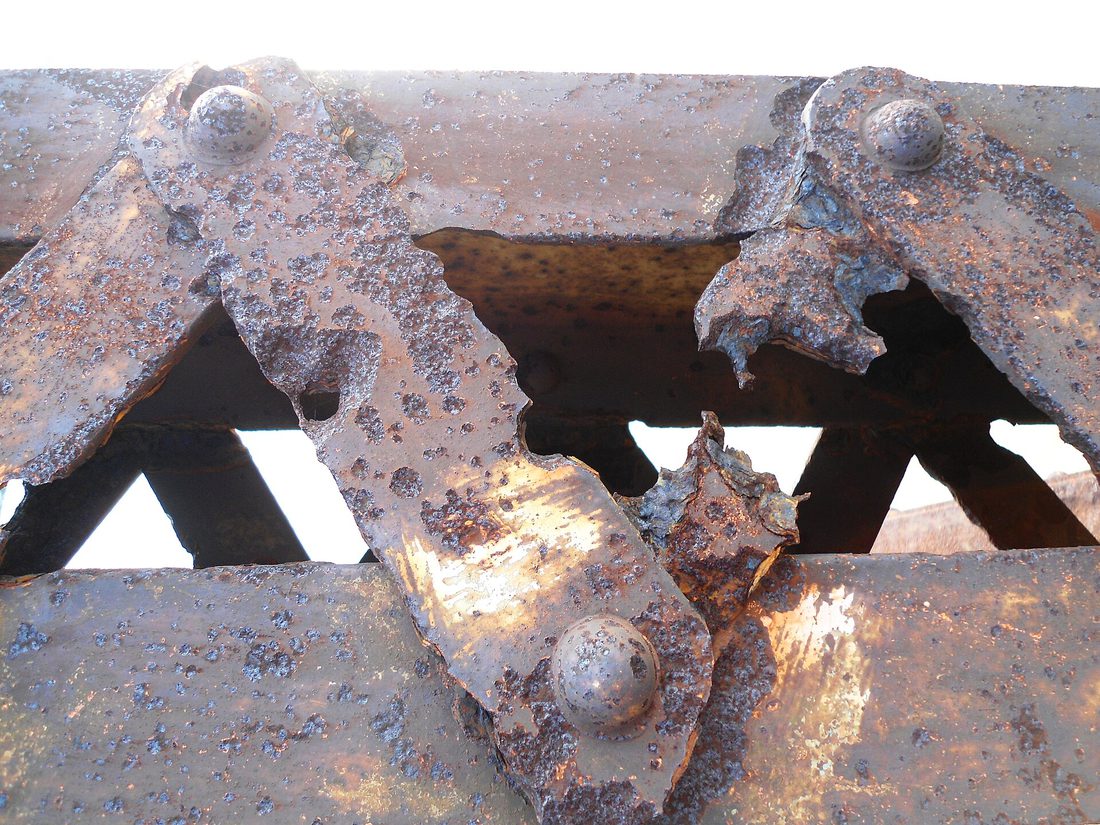
Here's a surprise: when iron rusts, it doesn't get lighter — it gets heavier. Rusting is iron reacting with oxygen from the air to form iron oxide, and those oxygen atoms attach to the iron and stay there, adding to the total mass. A fully rusted iron nail can weigh noticeably more than the shiny nail you started with, even though it looks smaller and flakier. This strange fact — that a 'falling apart' reaction can add mass instead of losing it — is the perfect setup for the next big idea: mass is never created or destroyed in a chemical reaction, only rearranged.
In the real world
Doctors and patients watch for the fizzing reaction of an antacid tablet to know it's actively neutralizing stomach acid.
Exit check
Which box is an observation and which is an inference? Explain the relevant mechanism and one model limitation.
Check your explanation after answering
Bubbles appearing is the observation; the proposed origin is an inference until supported by identity and other evidence. Bubbles alone are consistent with more than one process. The diagram distinguishes recorded appearance from possible explanations and a next evidence question. It does not supply actual gas tests or license unsafe mixing; composition must be established by suitable approved evidence.
Explain your reasoning without notes. If a key idea is missing, revisit the lesson and try again.
Problem 1
- Formation of a precipitate
- Gas bubbles forming
- A change of shape
- A color change
Answer and explanation
A change of shape
A change of shape alone (like bending or cutting) is a physical change, not evidence of a chemical reaction.
Problem 2
- reactant
- catalyst
- precipitate
- solvent
Answer and explanation
precipitate
A solid that forms and settles out of a solution during a reaction is called a precipitate.
Problem 3
Answer and explanation
15 °C
ΔT = 35 − 20 = 15°C.
Problem 4
Answer and explanation
Gas bubbles suggest a new gaseous substance is escaping that wasn't there before, and a color change suggests new compounds have formed with different light-absorbing properties than the original substances.
Problem 5
- ice melting
- iron rusting
- water boiling
- sugar dissolving in tea
Answer and explanation
iron rusting
Rusting forms a new substance, iron oxide, so it is a chemical reaction — unlike the other physical changes listed.
Problem 6
Answer and explanation
Physical processes can also change temperature — for example, dissolving some substances absorbs or releases heat even though no new substance forms — so a temperature change is only a clue, not final proof.
Problem 7
Answer and explanation
Both physical gas release and chemical gas production are possible; bubbles alone are insufficient evidence.
One possibility is boiling or dissolved gas leaving the liquid.
Another possibility is a reaction producing gas; checking whether new substances formed helps distinguish them.
Response criteria
- Use the stated conditions.
- Show the evidence or calculation.
- Explain the conclusion and any stated limitation.
Problem 8
Hints
Use more than one observation and distinguish a precipitate from material present initially.
Answer and explanation
Water vapor forms during a physical phase change. Gas bubbles can arise without producing a new chemical substance.
Problem 9
Hints
State what the supplied observations or conditions establish, and separate that from any assumption.
Answer and explanation
Record temperatures and compare with separate mixing controls, then look for evidence of new composition. Warming alone can also accompany physical mixing or dissolving.
Problem 10
Hints
Use the illustrated study titled Chemical interactions in daily life and history. Keep the observations, model and conditions separate.
Answer and explanation
Cutting can retain iron identity while rust formation produces different substances. An alloy can be a mixture rather than one fixed-ratio compound. Chemical risk cannot be decided from the word alone; identity, amount, exposure and use need evidence. Relate the chosen process to a practical effect while keeping ordinary atom rearrangement distinct from nuclear element formation.
Cutting can retain iron identity while rust formation produces different substances. An alloy can be a mixture rather than one fixed-ratio compound. Chemical risk cannot be decided from the word alone; identity, amount, exposure and use need evidence. Relate the chosen process to a practical effect while keeping ordinary atom rearrangement distinct from nuclear element formation.
Response criteria
- Distinguish composition from appearance.
- Explain a daily/historical consequence with a mechanism.
- Evaluate blanket chemical/mixture claims with conditions.
Problem 11
Answer and explanation
The product molecules have a different composition/combination from the reactant molecules, while each element’s atom count stays four H and two O.
A reactant is a starting substance and a product is a resulting substance. Different combinations can give different characteristic properties. The drawing is an explanation for an already specified reaction, not proof that every visible bubble is a new substance.
The product molecules have a different composition/combination from the reactant molecules, while each element’s atom count stays four H and two O.
Response criteria
- Use the named labels, directions or supplied quantities accurately.
- Connect the visual evidence to the scientific mechanism or calculation.
- State the relevant model conditions or limitation.
Problem 12
Answer and explanation
Bubbles are observed; a new chemical substance is not yet established. Obtain appropriate supplied gas-identity or characteristic-property evidence and compare the control/conditions.
Record appearance without assigning an unsupported identity.
Use a discriminating comparison rather than one visual sign.
Bubbles are observed; a new chemical substance is not yet established. Obtain appropriate supplied gas-identity or characteristic-property evidence and compare the control/conditions.
Response criteria
- Use the named labels, directions or supplied quantities accurately.
- Connect the visual evidence to the scientific mechanism or calculation.
- State the relevant model conditions or limitation.