Newton's Three Laws of Motion · Grade 8 Science
Chapter: MotionNewton's Three Laws of Motion
Learning goals
- I can state Newton's three laws of motion in my own words.
- I can apply Newton's second law (F = ma) to find force, mass, or acceleration.
- I can identify action-reaction force pairs.
- I can plan separate controlled force and mass comparisons.
Readings for this unit
Before this unit
Calculate net force and distinguish mass from weight.
Use three teaching sessions of about 40–45 minutes: first observe the phenomenon, draft a model and study Parts 1–2; next explain Parts 3–4 with the figures and evidence; then work the application, examples, practice, model revision and exit check. Divide any difficult part into smaller steps and revisit after feedback. Investigations, review and quizzes have separate sessions. Study the four visual parts across the scheduled sessions, then use the illustrated worked case and independent transfer questions. Extend or revisit a session when the learner cannot explain the figure; completion time is a proposed allocation, not a mastery guarantee.
Start with something to explain
What would explain the observations in newton's three laws of motion?
Illustrative evidence case. Illustrative carts of 2 kg and 4 kg each experience a 6 N horizontal net force. Other conditions are comparable.
Notice and wonder
What happens if mass and force both double? Write two observations from the supplied record without guessing their cause. Include a quantity and its unit when given. An observation is what was recorded; an inference is what you think explains it.
Write one question about why the pattern occurs and one question about a comparison that could distinguish competing explanations. A testable question identifies what could be observed or measured.
Your first model
Before reading the model answer, sketch the named objects or particles and label what you think changes. Calculate acceleration magnitudes, identify an equal-and-opposite interaction pair and explain why zero net force does not require rest. Keep this first version so you can compare it with your later explanation.
Build the language from the idea
- inertia
- The tendency of an object to resist a change in its motion.
- Newton's first law
- An object at rest stays at rest, and an object in motion stays in motion at constant velocity, unless acted on by an unbalanced force.
- Newton's second law
- Force equals mass times acceleration: F = ma.
- Newton's third law
- For every action force, there is an equal and opposite reaction force.
- newton (N)
- The unit used to measure force; 1 newton = 1 kg·m/s².
- model
- A representation that explains selected features and makes predictions; it leaves other details out.
- evidence
- Relevant observations or records used to support or challenge a claim.
- system boundary
- The chosen limit separating the objects being studied from their surroundings.
- assumption
- A condition taken as true for a model or calculation and needing to be checked against the case.
Isaac Newton tied together how forces and motion relate in just three elegant laws, and together they explain almost everything you see moving around you. Newton's first law is the law of inertia: an object at rest stays at rest, and an object already moving keeps moving at the same speed and in the same straight-line direction, unless an unbalanced force acts on it. Inertia is simply an object's built-in resistance to any change in its motion, and the more mass something has, the more inertia it has — that's why it's easy to stop a rolling tennis ball but nearly impossible to stop a rolling truck.
You feel the first law every time you ride in a car. When the car suddenly brakes, your body lurches forward — not because something pushed you, but because your body was already moving and 'wants' to keep moving until a force stops it. That force is your seatbelt, which is exactly why it can save your life. The same law explains why a stack of coins stays put when you flick the bottom one out, and why you slide sideways when a car turns sharply.
This first law also corrects one of the most common misunderstandings in all of physics: the belief that keeping something moving requires a constant push. It seems obvious from daily life — stop pedaling and your bike coasts to a halt. But the truth is the opposite: a moving object only slows down because hidden forces like friction and air resistance are pushing back on it. Remove those forces, as in the near-frictionless emptiness of deep space, and an object will glide onward forever with no engine at all.
Newton's second law puts numbers to all of this with one compact equation: F = ma, meaning force equals mass times acceleration. It says two intuitive things at once. First, the harder you push something, the more it accelerates. Second, the more mass an object has, the harder it resists that acceleration — which is why the same kick sends a soccer ball flying but barely budges a bowling ball. Force is measured in a unit called the newton (N), where 1 newton is the force needed to accelerate 1 kilogram at 1 m/s².
Newton's third law delivers the famous line: for every action force, there is an equal and opposite reaction force — and, crucially, those two forces act on different objects. When a swimmer's hands push water backward, the water pushes the swimmer forward with equal strength. When you jump, your legs push down on the Earth and the Earth pushes back up on you. The forces always come in matched pairs, pointing in opposite directions.
This third law is the secret behind how a rocket can fly through the vacuum of space, where there's nothing to push against. The rocket doesn't push on the air — it pushes a huge amount of hot gas downward out of its engines, and by Newton's third law that gas pushes the rocket upward with equal force. From walking (your feet push the ground backward so it pushes you forward) to a squid jetting through the ocean, these three laws together let you predict how any push or pull will change the way things move.
Newton's first law describes motion when net force is zero. The second law connects net force to acceleration: Fnet=ma. The third law identifies paired forces between two interacting objects. Use the law that addresses the question rather than memorizing isolated slogans.
A force diagram belongs to one object. If a hand pushes a cart, include the hand's force on the cart, not the cart's force on the hand. The latter belongs on the hand's diagram. Pair forces have equal magnitude, but different masses can have different accelerations.
For a fixed net force, a larger mass has a smaller acceleration. For a fixed mass, doubling net force doubles acceleration. These are model predictions that can be tested with repeated measurements; friction and measurement uncertainty can alter an ideal classroom result.
Build your understanding
Where this fits
This unit helps answer the chapter question: What evidence lets us describe and predict motion? Keep a notebook table with the question, evidence, explanation and one unresolved issue. Revise a previous model only when you can name the new evidence or idea that changes it.
Use three teaching sessions of about 40–45 minutes: first observe the phenomenon, draft a model and study Parts 1–2; next explain Parts 3–4 with the figures and evidence; then work the application, examples, practice, model revision and exit check. Divide any difficult part into smaller steps and revisit after feedback. Investigations, review and quizzes have separate sessions.
Part 1 · Use inertia to explain persistence of motion
Newton’s first law describes constant velocity when the net external force is zero. Inertia is resistance to changes in velocity and increases with mass. A forward force is not required merely to maintain steady motion in the ideal case; everyday objects slow because resistance supplies an unbalanced force.
Read the visual model
Why is inertia not an extra force on a force diagram?
Visual reasoning — after your attempt
Inertia describes how mass resists acceleration. It is not an interaction from another object and should not be added as a force arrow.
A released toy cart slows due to interactions such as rolling resistance, not because motion uses up a stored force. A passenger’s motion changes when a seat or restraint exerts force; connect the law to interactions rather than calling inertia a pushing force.
Read the equal-time snapshots. The rest case overlaps at one position; the constant-velocity case moves the same distance each second. Neither needs a net forward force. Inertia describes resistance to a velocity change; it is not another force acting forward. Identify real interactions such as rolling resistance before explaining why an ordinary cart slows.
Pause and explain
Why is inertia not an extra force on a force diagram?
Check your reasoning after answering
Inertia describes how mass resists acceleration. It is not an interaction from another object and should not be added as a force arrow.
Part 2 · Use the net force in the second law
For the introductory constant-mass model, net force=mass×acceleration. Acceleration points in the net-force direction. A larger applied push does not automatically give larger acceleration if opposing forces or mass also change. Find the net force on one chosen object before using the equation.
Read the visual model
Which force belongs in F=ma for this calculation?
Visual reasoning — after your attempt
Use the net external force on the chosen cart, not a single applied force when other forces also act.
A 2 kg cart pushed right with 10 N against 4 N resistance has net force 6 N right and acceleration 3 m/s² right. Dividing 10 N by mass would ignore resistance and overestimate acceleration.
Read the red arrows on the cart, subtract opposite forces and then use the resulting net force. The green arrow is their summary and must not be counted as an additional interaction. A rightward acceleration could mean a right-moving cart speeds up or a left-moving cart slows; no present velocity was supplied by the force diagram.
Pause and explain
Which force belongs in F=ma for this calculation?
Check your reasoning after answering
Use the net external force on the chosen cart, not a single applied force when other forces also act.
Part 3 · Place third-law pairs on different objects
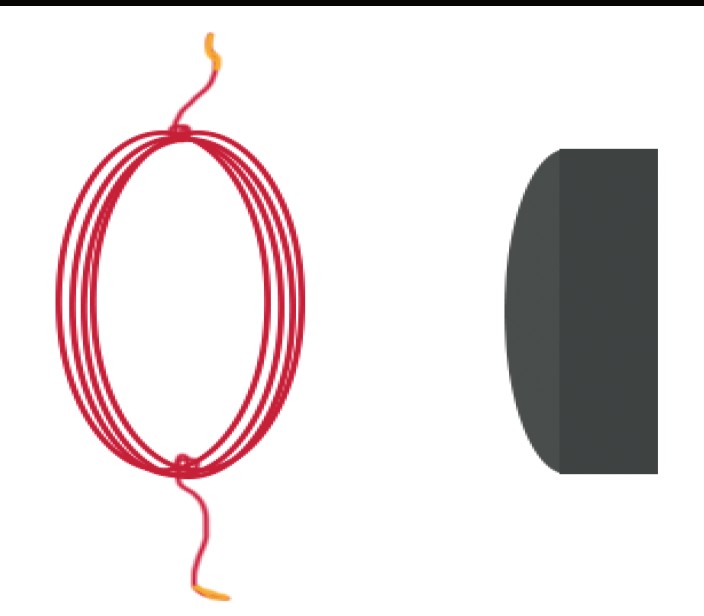
When object A exerts a force on B, B exerts an equal opposite force on A. These two forces act on different objects, so they do not cancel within one object’s force diagram. Balanced forces on a single object are a different kind of pair.
Read the visual model
Why do equal action-reaction forces not prevent the cart accelerating?
Visual reasoning — after your attempt
One force acts on the cart and the other on the hand. They are not both forces on the cart, so they cannot be canceled in its net-force calculation.
A hand pushes a cart and the cart pushes the hand equally in the opposite direction. The cart can accelerate because its own net force need not be zero. The two objects can have different accelerations because their masses and other interactions differ.
Pause and explain
Why do equal action-reaction forces not prevent the cart accelerating?
Check your reasoning after answering
One force acts on the cart and the other on the hand. They are not both forces on the cart, so they cannot be canceled in its net-force calculation.
Part 4 · Combine the laws in one explanation
A complete explanation names the object, its interacting partners, the net force, and the change in velocity. Use the first law when net force is zero, the second law for acceleration, and the third law to describe interaction partners. The laws answer related but different questions.
Read the visual model
Do equal interaction forces require equal accelerations?
Visual reasoning — after your attempt
No. Acceleration depends on each object’s mass and all forces acting on it. Equal opposite partner forces act on different objects.
For two carts with equal net force but different masses, the heavier cart has smaller acceleration. Each push still has an equal opposite partner force on the pusher. These facts are consistent because interaction-force equality is not acceleration equality.
The two graphs hold different quantities fixed. Left: mass is 2 kg, so a = Fnet/2 and acceleration increases in direct proportion to net force. Right: net force is 6 N, so a = 6/m and acceleration decreases with increasing mass along a curve. Do not change mass and force together and attribute the result to one factor. Repeated measurements can be compared with these model predictions without pretending the model curves are collected data.
Pause and explain
Do equal interaction forces require equal accelerations?
Check your reasoning after answering
No. Acceleration depends on each object’s mass and all forces acting on it. Equal opposite partner forces act on different objects.
Investigate force and mass separately
A change in a cart’s motion is not established by a force arrow alone. A planned comparison needs motion records, controls and a receiver.
Acceleration is the rate of velocity change, not the object’s current speed. To investigate its relation to net force, keep mass fixed and compare different controlled net forces. To investigate mass, keep net force fixed and compare masses. A horizontal force estimate must include opposing resistance; an applied pull during acceleration is not automatically the net force. An inertial reference is a frame where the introductory laws apply without additional apparent forces.
Define motion measurement before testing: specify the start, positive direction, time interval, and recorded positions or velocities. Equal-interval records can establish average velocities and their changes. Repeating a comparison reveals variation; it does not repair a method that changed both intended factors together. Use safe toy observations to investigate qualitative patterns only, or the supplied quantitative model data; do not invent a constant force from an unmeasured hand push.
Braking illustrates a net force opposite an existing motion direction. A right-moving cart under a leftward net force can slow before reversing. Friction, a brake pad or another interaction transfers energy into deformation and thermal changes. If force becomes balanced while the cart still moves, constant velocity can continue in the ideal model. The three laws connect persistence, net-force/mass response and separate interaction partners rather than provide three unrelated slogans.
Evidence to interpret
| Mass (kg) | Net force (N) | Acceleration (m/s²) |
|---|---|---|
| 1 | 1 | 1 |
| 1 | 2 | 2 |
| 2 | 2 | 1 |
| 4 | 2 | 0.5 |
Investigate or evaluate the supplied records
- State one intended variable and choose matching record pairs.
- Specify initial state, time measurements and a fixed positive direction.
- Use supplied values or an approved safe simulation; ordinary hand-push observations do not provide calibrated net-force values.
- Plot acceleration against the changed factor while identifying fixed conditions.
- Plan repeated trials and a result that would challenge the explanation.
Explain and apply
Plan two comparisons from the records: one isolating net force, the other mass. Specify motion measurements, repeats, controls and what outcome would challenge the predicted relation. Explain braking separately from velocity direction.
- Design two separately controlled comparisons.
- Specify recorded motion, units and repeats.
- Explain a challenge result and braking mechanism.
Reasoning and marking guidance — after your attempt
Compare the 1 kg cases at 1 and 2 N to isolate net force; compare 1, 2 and 4 kg at 2 N to isolate mass. Match path, resisting conditions, timing, measuring procedure and initial state. Keep all repeated records. The supplied model gives a=Fnet/m; unexpected motion needs a boundary/force/method review rather than automatic rejection of conservation or hidden invented values. A leftward net force can slow rightward motion.
Apply the whole unit · Compare two carts
Illustrative trials: cart A has mass 2 kg and cart B mass 4 kg. Each receives a 10 N push right and 2 N resistance left. Both begin at rest; assume constant forces over the comparison interval.
Your task
Draw a force diagram for each cart, calculate acceleration, and describe how the first, second, and third laws apply. Label the partner force exerted on the pusher without adding it to the cart diagram.
What your response should show
- Use the supplied observations and measurements accurately; include units where needed.
- Explain the science behind your answer, rather than giving only a number or label.
- Show a labeled model, calculation, or evidence comparison as requested.
- State an assumption or limitation and suggest a useful next measurement.
Response guidance — after your attempt
Each cart has net force 8 N right. A accelerates at 4 m/s²; B at 2 m/s². Their velocities change because net force is nonzero. Each cart exerts a 10 N opposite force on its pusher, acting on the pusher rather than the cart. Equal applied forces and resistance do not imply equal acceleration when masses differ.
Scientific references and adapted teaching resources
- OpenSciEd 8.1 Contact Forces — public unit overview
- OpenSciEd instructional model — storyline routines
- Creative Commons Attribution 4.0 — middle-school material license
Parent / teacher teaching notes
Check each force with the sentence source acts on object. Require net-force subtraction before division by mass. Use a zero-net-force comparison to connect all three laws without suggesting they are separate unrelated rules. Adaptation credit: OpenSciEd middle-school teaching routines and public task structures by OpenSciEd, CC BY 4.0. This independent version adds original explanatory text, data and figures, terminology support and a home-study schedule. It does not reproduce the complete teacher editions or their classroom validation. The illustrated study “Investigate force and mass separately” is required curriculum content. Teach it before the associated application or distribute it over the assigned unit sessions; it is not an optional enrichment. Its practice/review/quiz response provides evidence of understanding. Model/data work must not be recorded as an actual physical experiment.
The key idea
First law: objects resist changes in motion (inertia). Second law: F = ma. Third law: every action has an equal, opposite reaction.
Newton's Second Law
F = ma
F is net force in newtons (N); m is mass in kg; a is acceleration in m/s². Rearranges to a = F ÷ m or m = F ÷ a.
Worked examples
Example 1
- Rearrange F = ma to solve for acceleration: a = F ÷ m.
- a = 20 ÷ 5.
- = 4.
Example 2 · Worked application
- Apply a=Fnet/m: 6/2=3 m/s² right.
- The hand's push on the cart has a partner: the cart's push on the hand.
- The two partner forces act on different objects, so they do not cancel within the cart's force sum.
Use net force on one object in Newton's second law.
Example 3
- Use F = ma.
- F = 0.4 × 25.
- = 10.
Example 4
- Acceleration=Fnet/m=12/4=3 m/s².
- The reaction to the hand pushing the cart is the cart pushing the hand, on a different object.
Example 5 · Find and fix the mistake
- Test the claim against the stated conditions: Use net force on one object in Newton's second law.
- They act on different objects. Acceleration depends on the net force on each individual object.
Use net force on one object in Newton's second law.
Example 6 · Read both second-law graphs
- Left graph: a = 9/2 = 4.5 m/s².
- Right graph: a = 6/4 = 1.5 m/s².
- State what was fixed before comparing results.
The examples change different variables; neither graph predicts current velocity from force alone.
Example 7 · Interpret the visual model
- Identify the represented objects, axes, labeled quantities and stated conditions before choosing a rule.
- A released toy cart slows due to interactions such as rolling resistance, not because motion uses up a stored force. A passenger’s motion changes when a seat or restraint exerts force; connect the law to interactions rather than calling inertia a pushing force.
- Inertia describes how mass resists acceleration. It is not an interaction from another object and should not be added as a force arrow.
Keep the model’s stated limits explicit: Equal-time snapshots can show no position change or equal changes in position. Both are consistent with zero net force in an inertial reference frame. The moving cart does not need a forward net force to keep its constant velocity. On a real surface, rolling resistance can slow it unless balanced. The rest snapshots overlap intentionally; no extra force called inertia should be drawn.
Avoid these mistakes
- Third-law forces do not cancel on a single object.
Check your understanding
A net horizontal force of 12 N acts on a 4 kg cart. Calculate acceleration and identify the reaction to a hand's push.
Discuss the answer
3 m/s² in the net-force direction; the cart exerts an equal opposite force on the hand.
Why can a truck and a small car exert equal collision forces but have different accelerations?
Discuss the answer
Newton's first law describes motion when net force is zero. The second law connects net force to acceleration: Fnet=ma. The third law identifies paired forces between two interacting objects. Use the law that addresses the question rather than memorizing isolated slogans. A force diagram belongs to one object. If a hand pushes a cart, include the hand's force on the cart, not the cart's force on the hand. The latter belongs on the hand's diagram. Pair forces have equal magnitude, but different masses can have different accelerations.
Return to the phenomenon
Illustrative carts of 2 kg and 4 kg each experience a 6 N horizontal net force. Other conditions are comparable. Calculate acceleration magnitudes, identify an equal-and-opposite interaction pair and explain why zero net force does not require rest. Revise your first explanation using a named idea from the lesson. Mark the changed part and the evidence that supports it.
Compare explanations after your attempt
Accelerations are 3 and 1.5 m/s² because a=Fnet/m. Equal interaction forces act on different objects, such as hand-on-cart and cart-on-hand. A zero net force means no acceleration in the simple inertial-frame model and permits constant nonzero velocity. Mass affects response, not an extra permanent force needed just to keep moving.
What should we investigate next?
Which condition could be changed to test a remaining uncertainty in this explanation? State the predicted observation and what result would challenge your model.
Investigate, explain and revise
Use these tasks after the three teaching sessions as needed. Discuss an attempted explanation before opening response guidance; a matching sentence is less important than a supported mechanism.
Activity 1 · Explain the new evidence case
Use the visible scenario above, Parts 1–4 and your first notebook model. No outside reading or equipment is required.
Your task
Illustrative carts of 2 kg and 4 kg each experience a 6 N horizontal net force. Other conditions are comparable. Calculate acceleration magnitudes, identify an equal-and-opposite interaction pair and explain why zero net force does not require rest. Write 100–150 words or give a labeled drawing with an equivalent oral explanation.
Success criteria
- Use two relevant stated records or conditions.
- Explain the mechanism rather than only repeat a definition.
- Label observation and inference.
- Name a changed model feature or a remaining uncertainty.
Hint
Read the stated boundary and conditions before selecting a relationship. The unit’s worked examples show intermediate steps.
Response guidance — discuss after your attempt
Accelerations are 3 and 1.5 m/s² because a=Fnet/m. Equal interaction forces act on different objects, such as hand-on-cart and cart-on-hand. A zero net force means no acceleration in the simple inertial-frame model and permits constant nonzero velocity. Mass affects response, not an extra permanent force needed just to keep moving.
Activity 2 · Read and extend the figure
Study the new labeled figure and its caption, then compare it with the associated teaching part.
Your task
What happens if mass and force both double? Explain what each important label represents. Add one missing feature that would be needed for a different question, and explain why the original figure leaves it out.
Success criteria
- Answer the figure question with its stated labels.
- Connect the visual representation to the scientific idea.
- Identify a specific limitation from the caption.
- Propose a useful change without misrepresenting supplied evidence.
Hint
For the same 6 N net force, doubling mass halves acceleration from 3 to 1.5 m/s². The bars represent rates of velocity change, not current velocity or distance. Equal net force is a condition of this comparison; interaction pairs would require named separate receivers.
Response guidance — discuss after your attempt
The ratio Fnet/m, and thus acceleration, remains unchanged in this simple model. For the same 6 N net force, doubling mass halves acceleration from 3 to 1.5 m/s². The bars represent rates of velocity change, not current velocity or distance. Equal net force is a condition of this comparison; interaction pairs would require named separate receivers.
Words to know
- inertia
- The tendency of an object to resist a change in its motion.
- Newton's first law
- An object at rest stays at rest, and an object in motion stays in motion at constant velocity, unless acted on by an unbalanced force.
- Newton's second law
- Force equals mass times acceleration: F = ma.
- Newton's third law
- For every action force, there is an equal and opposite reaction force.
- newton (N)
- The unit used to measure force; 1 newton = 1 kg·m/s².
- model
- A representation that explains selected features and makes predictions; it leaves other details out.
- evidence
- Relevant observations or records used to support or challenge a claim.
- system boundary
- The chosen limit separating the objects being studied from their surroundings.
- assumption
- A condition taken as true for a model or calculation and needing to be checked against the case.
Newton stood on giants' shoulders — and corrected a 2,000-year-old mistake
The ancient Greek philosopher Aristotle taught that a constant force was needed to keep anything moving, and that objects naturally wanted to come to rest — an idea that felt intuitive and went essentially unquestioned for almost 2,000 years. Galileo's experiments with rolling balls suggested otherwise: on a perfectly frictionless surface, a moving object would just keep going forever. In 1687, Isaac Newton formalized this insight as his first law in a book called the Principia Mathematica, one of the most influential science books ever written, building directly on Galileo's and Johannes Kepler's earlier work.
Inertia depends on mass, not speed
It's tempting to think a fast-moving object has 'more inertia' than a slow one, but inertia only depends on mass — how much matter something has — not on how fast it's currently moving. A parked truck and a truck cruising at highway speed have exactly the same inertia (resistance to a change in motion), which is why it takes the same enormous force to start a heavy truck rolling as it does to bring it to a sudden stop. This is exactly why seatbelts and headrests exist: in a sudden stop, your body's inertia makes it want to keep moving forward (or your head want to stay still) even after the car has stopped.
Momentum and impulse: the hidden link between the second and third laws
Multiply an object's mass by its velocity and you get its momentum (p = mv) — a kind of 'quantity of motion.' It turns out force is really just how fast momentum changes: force × time = change in momentum. That's why airbags work: by stretching a car crash's stopping time from a fraction of a second into a slightly longer fraction of a second, the same change in momentum happens with much less force on your body. This connects directly to Newton's third law, too — the passenger pushes back on the airbag exactly as hard as the airbag pushes on the passenger.
Real rockets, real numbers: the third law at full throttle
The Saturn V rocket that carried astronauts to the Moon weighed nearly 3 million kilograms fully fueled, and its engines pushed exhaust gases downward with a combined thrust of over 34 million newtons at liftoff. By Newton's third law, that exhaust pushed back on the rocket with just as much force in the opposite direction — enough to overcome the rocket's enormous weight and accelerate it off the launch pad. No engine 'pushes against the air' the way a swimmer pushes against water; rockets work identically in the vacuum of space, since the action-reaction pair is between the rocket and its own exhaust, not the surrounding air.
In the real world
Newton's third law explains exactly how rockets launch into space — by pushing exhaust gas downward, they get pushed upward in return.
Exit check
What happens if mass and force both double? Explain the relevant mechanism and one model limitation.
Check your explanation after answering
The ratio Fnet/m, and thus acceleration, remains unchanged in this simple model. For the same 6 N net force, doubling mass halves acceleration from 3 to 1.5 m/s². The bars represent rates of velocity change, not current velocity or distance. Equal net force is a condition of this comparison; interaction pairs would require named separate receivers.
Explain your reasoning without notes. If a key idea is missing, revisit the lesson and try again.