Will you live to 120?
Chapter 5 · The Beautiful Wrong Idea
The free-radical theory of aging was elegant, intuitive, and supported by everything except the experiment — and the experiment showed that a little of the “poison” is exactly what keeps you healthy.
Companion notebook · Chapter 5. No separate notebook for this chapter — the inverted-U “Goldilocks dose” you build for Chapter 4 is the same curve at work here: a little ROS signals and protects, while too much harms: Open the Chapter 4 notebook →
We rust from the inside
Of all the theories of why we age, one stands above the rest for sheer intuitive force. Iron left in the rain rusts; cut an apple and it browns; a fire consumes its fuel and leaves ash. All of these are oxidation — oxygen reacting with matter and degrading it. And we, who breathe oxygen and burn fuel to live, are slowly oxidizing too. We rust from the inside. Aging, on this view, is simply the accumulated chemical wear of a lifetime of breathing — the unavoidable price of using oxygen to stay alive.
This is the free-radical theory of aging, proposed in 1956 by a chemist named Denham Harman, and for half a century it was the dominant theory in the field. It is easy to see why. It is mechanistically precise, it connects aging to the most basic fact of our metabolism, it matches the observation that oxidative damage really does accumulate in old tissues, and — crucially — it makes a clear, hopeful, actionable prediction: if oxidation causes aging, then antioxidants — molecules that neutralize the reactive byproducts of metabolism — should slow aging and prevent the diseases that come with it. Eat your antioxidants, mop up the rust, live longer. An entire multi-billion-dollar supplement industry was built on that single inference, and it remains, to this day, the most widely believed idea about how to slow aging.
It is also, in its simple and intuitive form, wrong — and the story of how we learned that it was wrong is the most important lesson in this book about how to tell a beautiful idea from a true one. (A small, telling detail: Harman, the father of the theory that aging is unavoidable oxidative decay, lived to 98.) This chapter is about the cell’s power plants, the reactive molecules they make, the theory that those molecules age us, and the long, expensive demonstration that the theory had it almost exactly backwards.
What a mitochondrion actually does
To understand the theory, and its undoing, you need to know where the “rust” comes from, and that means looking inside the mitochondrion — but we have to be precise, because “the cell’s power plant” is the kind of phrase that substitutes for understanding rather than building it.
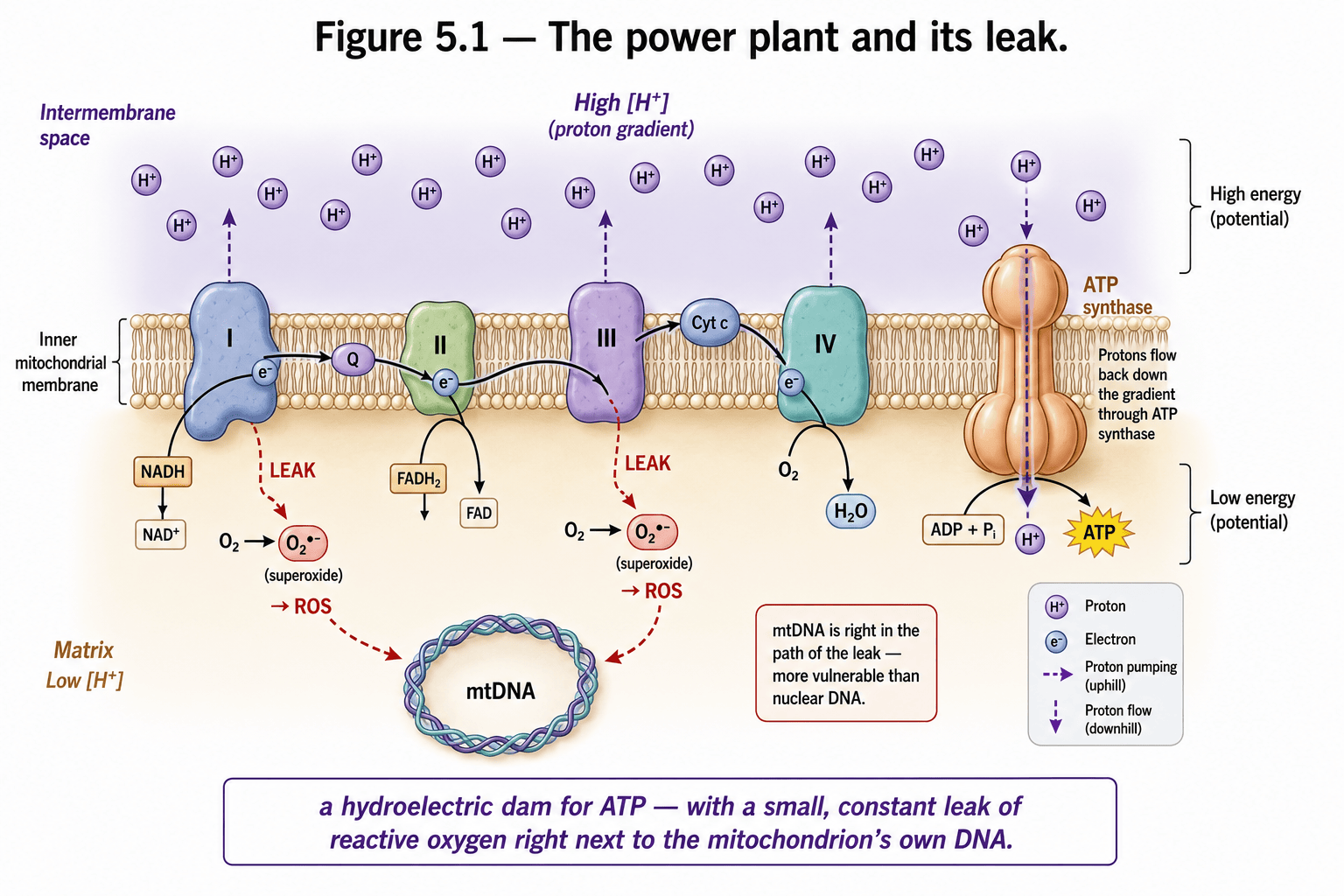
Mitochondria are small compartments inside your cells whose job is to convert the energy in food into ATP, the molecule the cell spends to do everything it does. The conversion works like a tiny hydroelectric dam, and the analogy is exact rather than poetic. Electrons stripped from food are passed down a chain of four protein complexes embedded in the mitochondrion’s inner membrane — the electron transport chain. As each electron hops down the chain, the energy released is used to pump protons (hydrogen ions) across the membrane, building up a reservoir of protons on one side, like water held behind a dam. That stored-up gradient is then released through a turbine — a remarkable rotating enzyme called ATP synthase — and the flow drives the turbine to manufacture ATP. At the very end of the chain, the spent electrons are handed off to oxygen, which combines with them (and with protons) to form water. This is why you breathe: oxygen is the final electron acceptor at the bottom of the chain, and without it the whole electron flow backs up and stops. Most of the ATP that powers your body is made exactly this way, every second.
Now the catch that launched a thousand supplement bottles. The electron chain is fast and busy and not perfectly tidy. A small fraction of the electrons moving down it — far less than a percent — escape prematurely and react directly with oxygen, producing not water but a damaged, reactive form of oxygen: superoxide, the first of a family of molecules collectively called reactive oxygen species, or ROS. Superoxide and its chemical relatives (hydrogen peroxide, and the especially vicious hydroxyl radical) are reactive precisely because they are unstable — they will grab electrons from whatever is nearby, and “whatever is nearby” includes the cell’s proteins, the fatty membranes, and DNA. ROS are, in short, a byproduct of breathing: an unavoidable trickle of chemically corrosive molecules, produced continuously as the price of making energy from oxygen. They are the rust.
The most beautiful theory of aging
Harman’s insight, refined in 1972 into what’s called the mitochondrial theory of aging, took that leak and built it into a self-reinforcing catastrophe — and the elegance of the construction is exactly why it held the field for fifty years.
The argument runs like this. Mitochondria are the main source of ROS. They also carry their own small genome — a circular loop of DNA, separate from the DNA in the cell’s nucleus, that encodes several of the essential parts of the electron transport chain. And this mitochondrial DNA sits right next to the leak, in the most ROS-drenched spot in the cell, with what was long thought to be weaker protection and repair than nuclear DNA enjoys. So picture the loop closing: ROS damage the mitochondrial DNA; damaged DNA builds a faulty, sputtering electron transport chain; a faulty chain leaks even more electrons as ROS; more ROS do more damage. A vicious cycle — each turn worse than the last — that grinds the mitochondria, and with them the cell, and with them you, slowly into decline. Aging as an error catastrophe, spiraling out from the cell’s own power supply.
All 10 chapters of Will you live to 120? · Foundations · All courses