Will you live to 120? · The Beautiful Wrong Idea
The graveyard
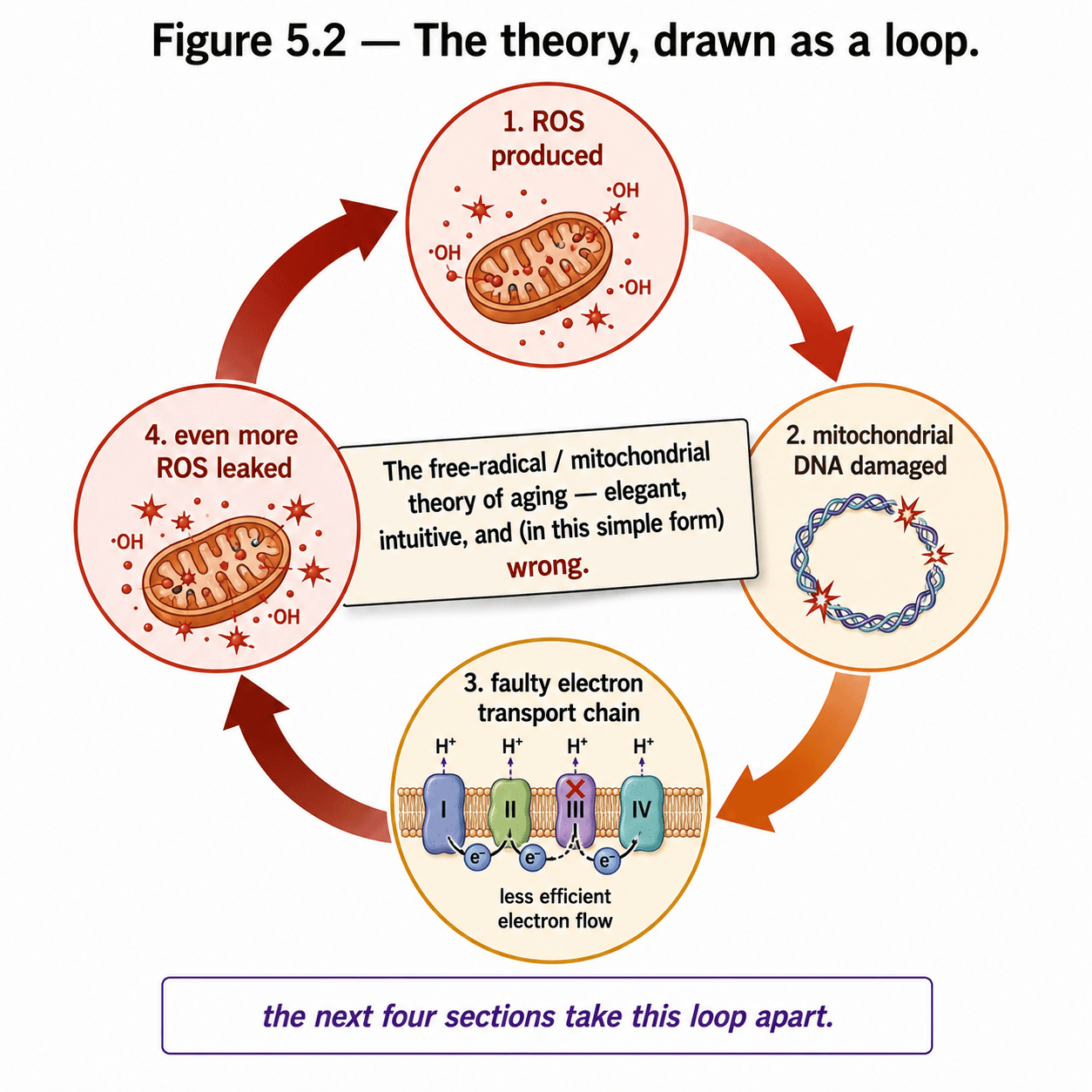
It explained things, too, which is what made it irresistible. It fit the old “rate of living” observation that animals with faster metabolisms tend to live shorter lives — more metabolism, more ROS, faster aging. It fit the rising tide of oxidative damage markers found in aged tissue. And when researchers discovered, in 1969, an enzyme called superoxide dismutase whose entire job is to find and destroy superoxide, it seemed like confirmation from the cell itself: evolution had built dedicated machinery to defend against ROS, which surely meant ROS were a serious threat worth defending against. The theory had a mechanism, observational support, evolutionary corroboration, and — above all — a clean prediction that anyone could test and anyone could act on. Take antioxidants and you will age more slowly.
The graveyard
A clear prediction is a gift, because it can be tested — and the free-radical theory’s prediction was tested, in some of the largest and most expensive clinical trials ever run. The results form one of the most instructive graveyards in all of medicine.
The case for antioxidants did not start with supplements; it started with food. People who ate diets rich in antioxidant-laden fruits and vegetables had, observably, lower rates of cancer and heart disease. That correlation was real and robust, and it pointed straight at the supplement aisle: if the antioxidants in vegetables protect you, then antioxidant pills should bottle that protection. So the hypothesis went to the randomized controlled trial — the one method that can tell a real cause from a misleading correlation — and the trials gave back an answer almost nobody expected.
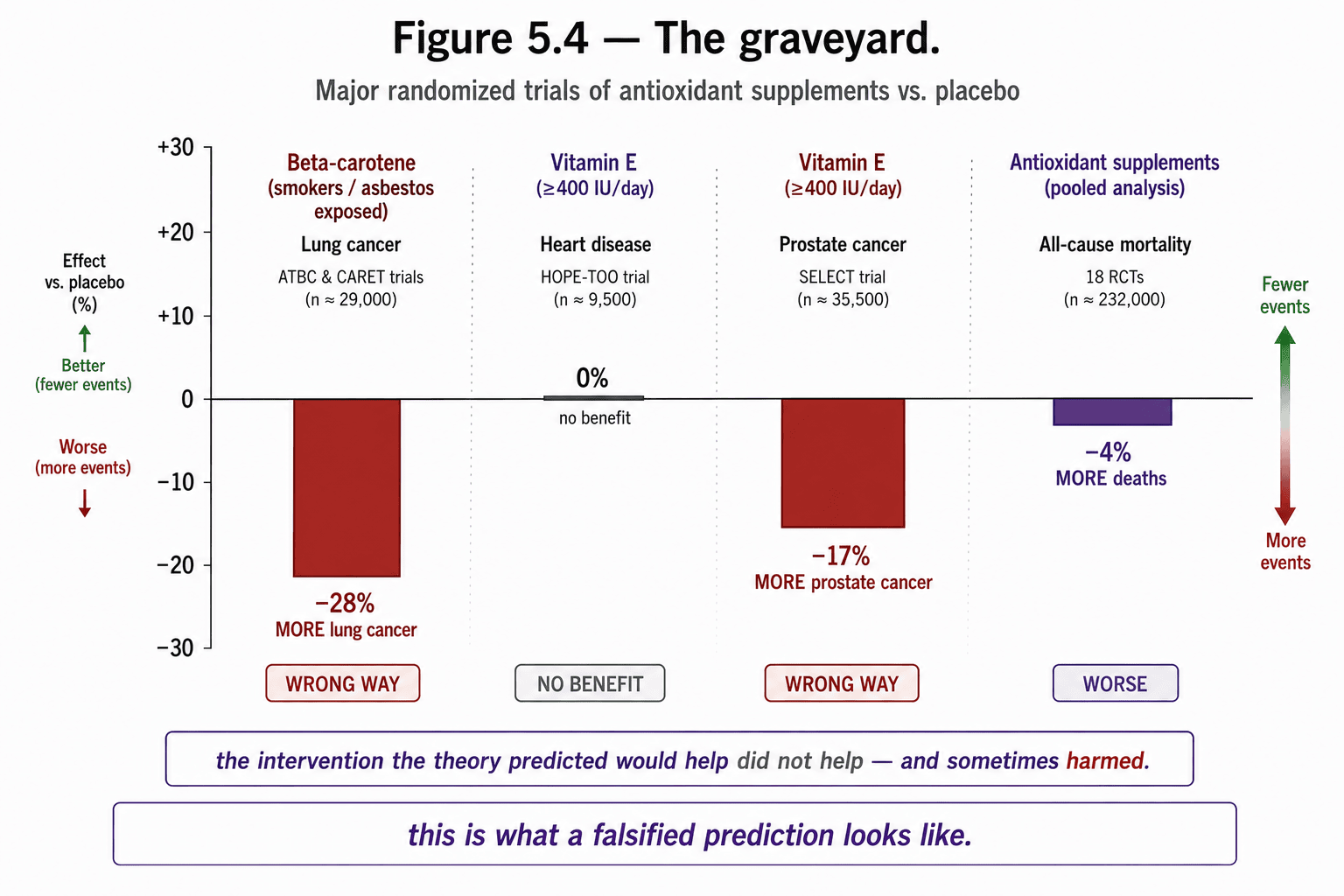
The most shocking result involved beta-carotene, the antioxidant that gives carrots their color, tested as a means of preventing lung cancer in people at high risk. Two enormous trials — one in tens of thousands of Finnish male smokers, another in thousands of American smokers and asbestos-exposed workers — gave half the participants beta-carotene and half a placebo, and waited. The antioxidant did not prevent lung cancer. It caused more of it. The smokers taking beta-carotene developed lung cancer at higher rates, and died at higher rates, than those taking the placebo. The American trial was halted ahead of schedule, because it had become unethical to keep giving people a supplement that was making them worse. Read that again, because it is the single most useful data point in this book: an antioxidant, given specifically to prevent cancer, on the strength of a beautiful and intuitive theory, increased cancer and death.
It was not a fluke. Vitamin E, the great hope for preventing heart disease, failed trial after trial to prevent it — and a major prostate-cancer-prevention trial found that vitamin E supplementation increased the risk of prostate cancer. Pooled analyses combining dozens of antioxidant-supplement trials, covering hundreds of thousands of people, reached a verdict that should be engraved over the supplement aisle: antioxidant supplements do not reduce mortality, and several of them — beta-carotene, vitamin E, high-dose vitamin A — are associated with a small but real increase in the risk of dying. The most intuitive theory of aging ever proposed made a clear prediction, the prediction was tested as rigorously as medicine knows how to test anything, and the prediction was not merely unconfirmed. It was inverted.
How could the food correlation have been so misleading? The answer is the lesson of the last chapter — compared to what? — wearing a slightly different coat. People who eat lots of vegetables are not a random sample of humanity; they tend, on average, to exercise more, smoke less, be wealthier, see doctors more, and do a hundred other healthful things. When you observe that vegetable-eaters get less cancer, you are seeing the combined effect of being the kind of person who eats vegetables, and the beta-carotene is just one strand tangled up with all the rest. The randomized trial cuts that tangle: by assigning the supplement at random, it isolates the one thing — the beta-carotene itself — from everything that usually travels with it. And once isolated, the beta-carotene’s true effect turned out to be nothing, or worse than nothing. The vegetables may well be good for you. The beta-carotene pulled out of them and packed into a pill is a different thing entirely.
Deeper Water — why observational studies fooled everyone, and why the trial is king. The antioxidant story is the clearest classroom example of confounding and why it makes observational data treacherous for causal questions. A confounder is a hidden third factor that influences both the thing you’re measuring and the outcome, manufacturing a correlation that isn’t causal. Vegetable consumption and low cancer risk are correlated, but a cluster of confounders — wealth, education, exercise, not smoking, general health-consciousness, what researchers call healthy-user bias — drives both, so the correlation survives even if the vegetables themselves do nothing. You cannot fully fix this by “adjusting” for the confounders you can think of, because there are always confounders you didn’t think of, or can’t measure well. The randomized controlled trial solves the problem at a stroke and is worth understanding why it works: by assigning the intervention with a coin flip, randomization makes the treatment and placebo groups statistically identical in every respect — the confounders you know about, the ones you don’t, the ones nobody has ever named — except the one thing you’re testing. Any difference in outcome must then be due to that one thing. This is why a single well-run RCT can overturn decades of consistent observational data, and why it is the highest standard of evidence in medicine. It is also why the trials being stopped early matters: there are formal rules (pre-specified stopping boundaries, monitored by an independent board) that halt a trial when one group is clearly being harmed, because continuing to give people a treatment you now believe is hurting them violates the ethics that make human experiments permissible at all. The beta-carotene trial was stopped not because the science failed but because the science worked — it detected harm, and the rules required acting on it.
ROS are not just poison
All 10 chapters of Will you live to 120? · Foundations · All courses