Will you live to 120? · The Beautiful Wrong Idea
A little poison, please
So the antioxidants failed, and several of them harmed. Why? If ROS are corrosive byproducts, mopping them up should at worst do nothing. How could reducing the rust make things worse? The answer is the conceptual correction at the heart of the modern view, and it overturns the theory’s founding assumption: ROS are not only poison. They are also signals.
The simple theory treated reactive oxygen as pure damage — chemical shrapnel, all cost and no use. But cells, it turns out, deliberately produce ROS — especially hydrogen peroxide — as messengers, and depend on them for a startling range of essential jobs. Controlled bursts of ROS regulate gene expression, trigger the cell’s own adaptive stress responses, help control how cells grow and specialize, and are the actual weapon the immune system uses: when a white blood cell engulfs a bacterium, it kills it by blasting it with a deliberate burst of reactive oxygen, the so-called respiratory burst. ROS sit at the center of how the cell senses its own condition and responds to it. At low and moderate levels they are not damage at all — they are information, a chemical language the cell uses to tell itself what’s happening and what to do about it.
Once you see that, the harm from antioxidants stops being a paradox and becomes almost obvious. When you flood your body with antioxidants, you are not just mopping up corrosive shrapnel. You are also garbling the cell’s signaling — muffling the very messages it uses to mount its defenses and adapt to stress. You are turning down a signal the cell needs, not just absorbing a poison it fears. An antioxidant pill cannot tell the difference between a damaging ROS and a signaling one; it suppresses both. And suppressing the signal, it turns out, can be considerably worse for you than tolerating the trickle of damage.
A little poison, please
This brings us to the resolution, and it is the same idea that ran quietly through the last chapter, now made central: hormesis — the principle that a small dose of something stressful or even toxic can be beneficial, because it provokes the body to overcompensate with a protective response, while a large dose is harmful. The dose makes the poison, and at the bottom of the dose scale, the poison is medicine.
Applied to mitochondria, this is called mitohormesis, and it works exactly as you’d now expect. A little mitochondrial ROS is good for you — not in spite of being a stressor but because it is one. A mild pulse of reactive oxygen acts as a warning shot that triggers the cell to strengthen itself: to ramp up its own internal antioxidant defenses, build more and better mitochondria, and raise its general stress resistance. The cell, briefly stressed, overcorrects, and ends up tougher than before. The relationship between ROS and health is therefore not the straight downhill line the free-radical theory assumed — less ROS, more health — but an inverted U: too little ROS and you lose the protective signal, too much and you suffer real damage, with an optimum somewhere in the middle. The theory’s fatal error was assuming a monotonic line where biology had built a curve.
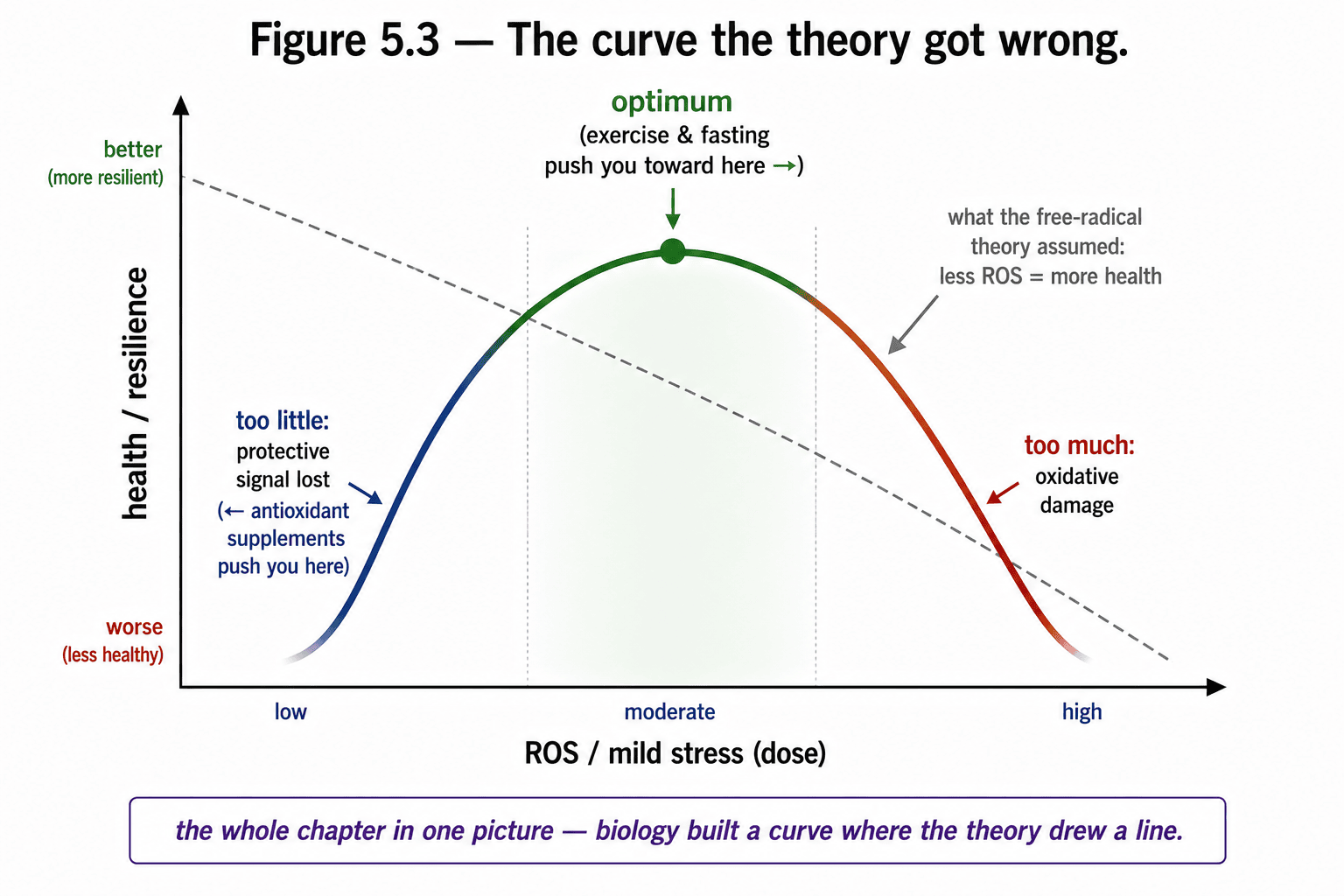
The most beautiful evidence for all of this is a single, clean human experiment that resolves a paradox you may have already noticed. Exercise increases ROS production — when you work your muscles hard, their mitochondria burn faster and leak more reactive oxygen. By the free-radical theory, exercise should therefore accelerate aging. Instead, exercise is about the most reliably health-promoting thing a human being can do. Mitohormesis explains why: the ROS burst from exercise is the signal that triggers all of exercise’s adaptive benefits — the improved insulin sensitivity, the strengthened defenses, the metabolic tune-up. And here is the experiment that proved it: researchers gave one group of people exercising regularly a daily dose of antioxidant vitamins (C and E), and another group exercising identically a placebo. The placebo group got the expected healthful adaptations to exercise. The antioxidant group largely did not — the supplements blunted the key metabolic adaptations to exercise, including the improvements in insulin sensitivity and the cell’s own antioxidant defenses. By mopping up the ROS, the antioxidants had muffled the signal, and with the signal damped, the body’s adaptation never fully took hold. You could exercise hard and, by taking your vitamins, get much of the benefit canceled out.
Sit with what that means. It is the free-radical theory’s prediction falsified at the level of mechanism, in a single elegant study: the thing the theory said was pure damage turned out to be the very signal that makes the single healthiest behavior we know actually work. (It is also, you’ll notice, the exact shape of the metformin-and-exercise finding from the last chapter — a chemical that dampens a stress signal can dampen the adaptation that signal was supposed to trigger.)
When the theory was put to the genetic test
The clinical trials buried the prediction; the laboratory then buried the mechanism, by testing the vicious cycle directly. If oxidative damage drives aging, several things should follow — and when researchers checked, they mostly didn’t.
If more antioxidant defense slows aging, then engineering mice to overproduce antioxidant enzymes should make them live longer. By and large, it didn’t — most such mice lived perfectly ordinary lifespans, with at best a modest exception or two. If oxidative damage levels set lifespan, then the longest-lived animals should be the least oxidatively damaged. But the naked mole-rat — a hairless, subterranean rodent that lives over thirty years, roughly ten times longer than a mouse of similar size, and is strikingly resistant to cancer — carries high levels of oxidative damage from a young age. By the free-radical theory it should age in fast-forward; instead it is the longest-lived rodent known. It is a living refutation of the idea that your oxidative-damage burden determines how long you live. (Birds, too, with their furnace-hot metabolisms and long lifespans, quietly defy the rate-of-living logic.)
All 10 chapters of Will you live to 120? · Foundations · All courses